Bringing Back Mom

I stopped talking about Mom the past two years. As Dad’s memory faded, he no longer seemed to mourn her. When I did bring up the topic of Mom – perhaps commented on something she would have enjoyed or her birthday – his pain was visible. So I stopped bringing her up.

But now we are preparing to bury Mom and Dad in the plot at Arlington National Cemetery that was reserved for them when they buried my sister Midge there in 1953. I’ve set an ambitious goal for myself to write some sort of a legacy book for the family, something that tells the story of Mom’s Driscoll side as well as Dad’s Harrison/Snively/Campbell clan.

I’m posting bits of memories here, augmented by some historical stuff. Since this series of posts is not about the experience of caring for or losing a parent, its primary interest for readers may be as a peek at life in the West in the early 20th century. Because Mom was Eileen long before she was Mom, I refer to her by her birth name when I get to the section about her personal history before my brothers and I came along.

* * *

Dad said it best, “Eileen is a personage.”  Eileen Driscoll Campbell did more than fill up her corner of space. She could fill a room with her personal power and presence, and she influenced the course of everything and everyone around her.

Beginning

The older I got, the more I wondered how it was that my parents were 40 and 41 when I was born, when most of my friends’ parents were younger. My brothers are 15, 10 and 3 years older than I am.

Eventually I became old enough to ask whether I was planned. Mom would demur, answering only, “Every once in a while, we just said oh what the hell.”

Two characteristics were apparent in her statement: she wasn’t hung up on being proper, though she was every inch a lady, and she had the ability to live in the moment.

Some of that character came from being an only child. Born on July 3, 1917 in Boise, her mother, Madeline (born Maude Grace Spieles on Nov. 30, 1885 in Chicago) and father, Dean (born April 24, 1883 in Tekamah, Nebraska) met and married only two years prior, in 1915.  When Eileen was born, they were 31 and 34, old for the times.

But some of Eileen’s independent streak may have derived from growing up in the West, when the West was still wild. Eileen had grown up on her grandmother Hannah’s knees, hearing stories about how “Han-Han” came “West”… when the West was Minnesota.
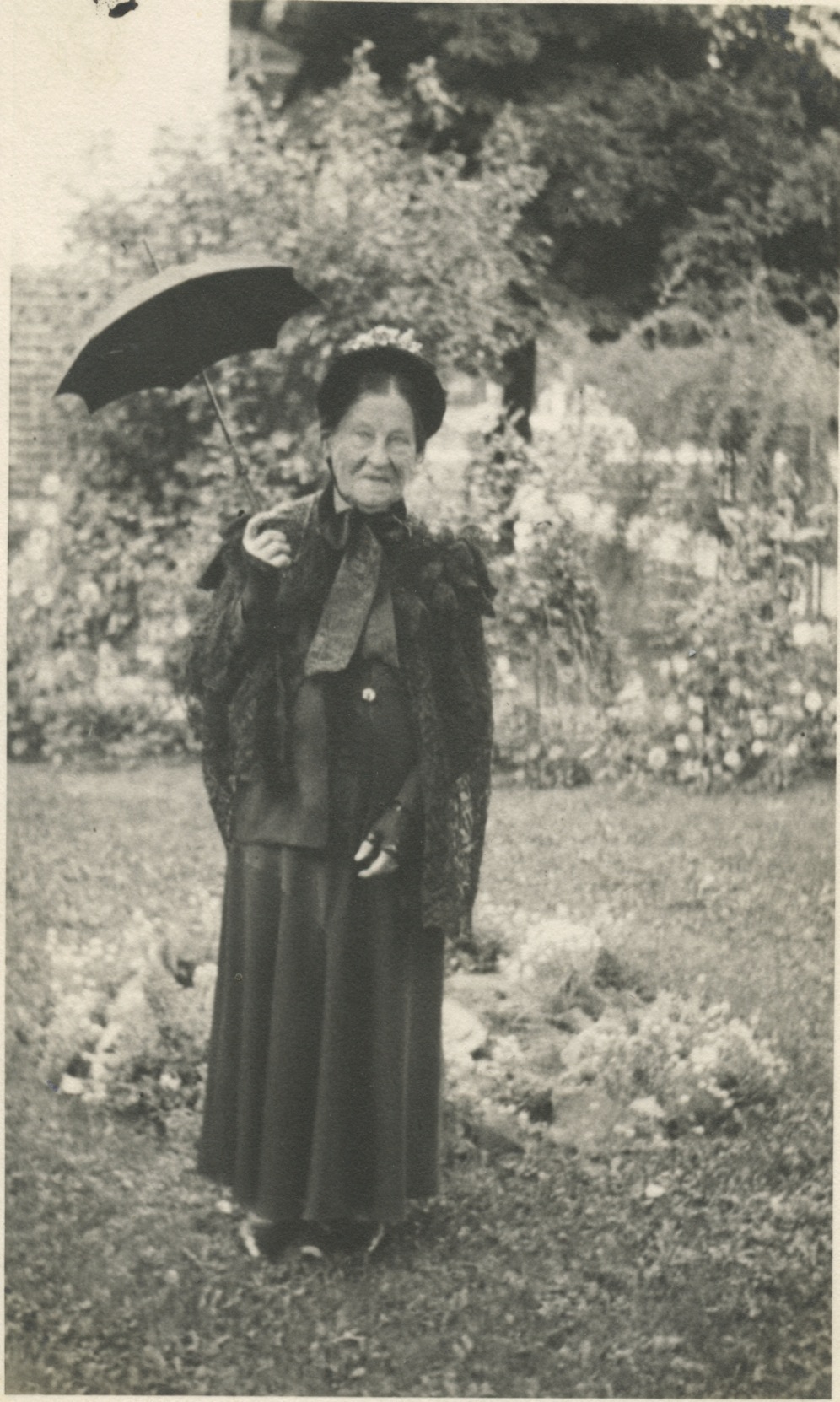
Hannah Driscoll, 1935

Hannah Driscoll, 1935

Hannah’s family left Pennsylvania to take advantage of land grants created under the Homestead Act, claimed 160 acres of land in Martin County, and erected a rudimentary sod house on the prairie. After almost 10 years, they gave up, tired of Minnesota’s terrible blizzards lasting days, the menace of prairie fires and the last straw, the grasshopper scourge of 1873. “Settling to the earth they were a crawling mass devouring every green thing except the wild greens,” Hannah wrote in her memoir.

In 1874, the family struck out for Nebraska in two horse-drawn covered wagons, where they established a farm in Tehama. Hannah married John Driscoll in 1881, who landed in town following his discharge from the 64th N.Y. voluntary infantry after the end of the Civil War. When John’s health failed, years later, they sold the bank and lumberyard John had established, and struck out for the west coast. The family had tickets to the Lewis and Clark Exposition in Portland in 1905, but never made it farther than Boise, where they permanently settled.

Mom's father, Dean Driscoll

Mom’s father, Dean Driscoll

Dean’s photo album from the early 1900s look like a movie set, with Native Americans on the streets and horse-drawn carriages. Letters from John to his Dean’s younger brother Lynn, away at college, shared news big and little of Boise (population 17,000) at the turn of the 20th century: a visit by William Jennings Bryan, foreclosures of businesses by the Sheriff, plunging land values, small pox and ptomaine poisoning outbreaks, fatal auto accidents as cars replaced horseless carriages, an arrest of an acquaintance for insulting a woman (“he said he was drunk”) and the institutionalization of another into a “mental asylum” in Seattle.

Eileen must have felt the world ripped out from under her when her father died in February 1941 of hypertension. It is perhaps because of his early death, at the age of 58, that we heard so much about Dean.

Eileen and her mother were extraordinarily proud of Dean’s reputation in the community as a respected attorney in private practice and later as a one-term Representative to the state legislature and Assistant Attorney General. (Aunt Janie, Grandmother Campbell’s sister, apparently had a real snit about the Driscoll focus on Dean, writing from Oceanside where Dad had returned home from the war, “I am so sick of Mrs. D’s everlasting hammering on the Driscolls.”) A Harvard Law School graduate, Dean was admitted to practice at the U.S. Supreme Court, though he never argued a case before it.

Short (5’6″) and energetic, he had a shock of thick brown hair and dressed immaculately, never appearing on the streets of Boise without a fresh flower in the lapel buttonhole of his fresh white Palm Beach suit in the summertime (and rarely without an Antony Y Cleopatra cigar parked in his mouth). The buttonhole flower came from his mother Hannah’s yard “starting with the snowdrops, first flowers through the snow, and as spring and summer progressed, violets, lily-of-the-valley, pansies, pinks, through the fall-flowering marigolds,” Mom wrote in a letter to historian Gwynn Barrett to assist in his research for a book on Uncle Lynn. Dean had a strong sense of duty to his parents and stopped to visit his mother on the way to the office every morning, eating buckwheat pancakes whenever they were offered.

Despite his reputation, the Driscolls weren’t wealthy. His income level may have been due to the small town nature of a law practice. In a letter in 1912 to Lynn, Dean’s father wrote, “…Dean says he has made $200 a month since he commenced business but has only collected $400 of it. He is well satisfied but I hope he will get money soon as I have been putting up for him so far….”

Dean held most of the details of his law practice close to the chest, but we know he represented immigrant communities including Basque Americans, which had (and has) the largest concentration in the U.S.; in Mom’s last years, lamb was the dinner entree for which she always had an appetite, a holdover from her memories of participating in the Basque community’s annual lambing camp. She recalled that her Dad could dance the traditional La Jota, and Christmas Eve dinners didn’t begin until her father had stopped by the Archabals, a Basque sheep ranching family. He was posthumously awarded the Order of the White Rose of Finland for service to that community as chairman of the State for the Finnish Relief Fund.

He liked vigorous sports and sparred with professional boxers when they came to town.  Mom later wrote that he like long runs – “five miles at least” – up into the foothills. At the Y, he played handball often and boxed nearly every day, in addition to playing on the “Bankers” Twilight Baseball League team.

Mom wrote:

“The first thing anyone should say about Dean Driscoll is that he had absolute integrity. I don’t think it was possible for him to compromise — or “adjust” or “compensate,” as we say these days. He had extremely high standards of ethics and performance for himself (probably a contributing factor to the high blood pressure which killed him) and for those close to him. And he simply didn’t bother with people who didn’t meet those standards.”

Mom also wrote that her Dad had a “keen wit and sense of humor and was a master at rather cutting repartee. He used words sparingly – but very much to the point – and often devastatingly.”

Pranks were big in those days, and Mom remembered this story of his youthful mischief: when a minister came to visit and put his hat near the heater, Dean slipped a piece of Limburger cheese inside the hat band, with predictable results. She wrote, “My Dad didn’t think I was very funny, tho, when I tried the same trick in the pocket of a leather jacket belonging to a friend, thereby ruining the coat. I never could figure out a way… to equal or emulate his Halloween feat back in Nebraska boyhood when he and his friends put a cow astride the church roof. Even he didn’t remember how they got it there – but it was a community effort to get it down.”

She also recalled the story of a widowed friend of her parents who coquettishly said to Dean, “Oh, Dean, no one loves me and my hands are so cold. Will you hold them?” He retorted, “God loves you and sit on your hands.”

Mom was very close to her mother, who she described as loving, caring and shy. Madeline was embarrassed by her lack of a college education, to which we were told Dean would reply, “You have an educated heart.”

We have few insights into life at their home at 1504 N. 17th Street. We know Eileen was fond of their Chinese cook, Fong Wing, who disappeared during periodic “tong wars” between the two competing societies in Boise.

Dean was hardworking, even a workaholic. Mom wrote, “It was his habit, as long as I can remember, to go back to the office after dinner, work until midnight or so – and then drive out across the desert, to ‘blow the cobwebs out of his brain’ as he put it.”

At his mother’s insistence, Dean had signed a temperance pledge so Dean and Madeline’s home was alcohol free. Every family has its “oft-told-tales” and Mom often recalled one about an especially hot evening when her father said, “You know, Madeline, I think I’d like to have a drink.” After conferring, he set about preparing a Tom Collins and brought one out to Madeline, who was sitting on the porch. She declared, “I believe this is the best Tom Collins I’ve ever tasted.” After a moment, Dean exclaimed, “Oh my god, I forgot to add the gin.”

Childhood
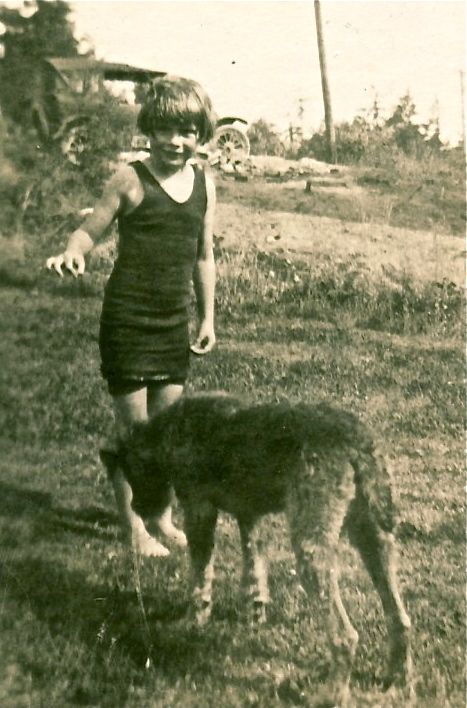
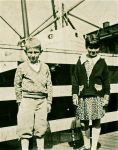
Age 7

Age 7

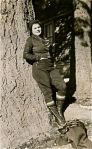
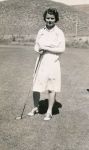
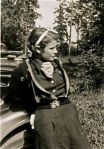
In her childhood pictures in the 20s, Eileen’s dark brown brown hair was cut in a chin-length page boy that complemented her strong chin, and high and prominent cheekbones. She had an outdoorsy look about her, with toned arms and legs, and coloring associated with the “Black Irish” (leading one family friend to inquire if there might have been a little racial mixing in generations past). Her brown eyes sparkled and her generous lips framed a bright smile. Even in the pictures of her as a teenager in the 30s, when the style was for girls to look demure, her face still conveyed a sense of individualism, determination and intelligence.

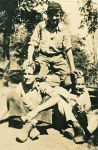
Mom rides on the shoulders of a pal

Mom rides on the shoulders of a pal

Either because of her father’s model or her own innate competitiveness, Mom was a Tomboy. It wasn’t that the boys on the street wanted to play with her; it was just that she was the only one who had footballs and other sports equipment. Because she hunted with her father nearly every weekend (until high school when she said she found dances and dates too exciting to miss), he taught her to drive when she was 11.

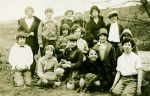
Eileen’s photo album shows her out and about in her elementary days, in her sailor-style uniform at Girl Reserve Camp, rowing a canoe, on a class bird-hunting trip, climbing a tree. Several friendships formed in childhood stayed with her for life, especially Barb Kidder Ringrose, Betty Ash Hearne and Raine (Lorraine) Moats. Many of the pictures display nicknames: Mugs for Barb (Eileen was Mug-Wug), “Prunes” for Eugene Stokes. They learned to play bridge and took ballroom dancing lessons together. Especially important to her from childhood on was her relationship with her cousins Harriet and John Driscoll. (John died in a training mission during WWII, a loss that Eileen always carried with her.)

Even in her youth, Eileen wasn’t one to back down from a fight. In 1999, Raine wrote to share this memory after their grade school, Lowell, beat Park School, which had a reputation for being tough: “One of those girls kept coming up behind me and hitting me on the back of the head. I was the timid one and so tried to ignore it. This apparently got the best of Eileen because she ran back and started hitting and fighting this girl, maybe because she was hurting and annoying her friend. She really tore into her.”

By the age of 14, Eileen’s pictures show her “cutting up” with groups of friends, a growing circle of boys and girls. The girls got together and formed their own mock sorority, Eta Beta Pie.

Eileen’s social circle expanded in high school. Based on pictures, boys began to appeal to her beyond their utility for sports and horseplay. In the picture below, she coquettishly styles herself for the camera, perhaps a precursor to her turn as a shoe model for the prestigious I. Magnin department store during college. She spoke later of a romantic interest in Stanton Stringfellow, with whom she was featured in the Flora Dora follies. Stanton set a Robert Herrick poem to music for her with the lyrics, “I dare not ask a kiss/I dare not beg a smile/Lest having that, or this/I might grow proud the while. No, no, the utmost share/Of my desire shall be/Only to kiss the air/That lately kissed thee.”

College

Leaving for college, 1935

Leaving for college, 1935

After Eileen graduated, she initially attended Mills College in California, an all-women’s college. She participated in the choir, and eventually transferred to University of Washington where she majored in music (focused on vocal performance) and was an active member of Gamma Phi Beta.

In the spring of 1939, Eileen and Hank were both enrolled in “the grand old man” Dr. Padelford’s course on Browning. Every couple has a how-they-met story, and Henry would usually tell it. He would set the stage by explaining that he did not attend class the first few days, having a free pass – thanks to a fraternity brother – to taste the wares at the Rainier Brewery. But the third day of class, he was there, albeit disheveled and worse for wear. As class began, most of the seats were filled, but one remained open next to him. “Then this vision entered the room,” he would say, “dressed to the nines.” Eileen took one look around the room, saw the chair next to Hank, and promptly took another seat in the back corner. “She came into class that first day on Brook Fink’s arm,” he would say, “but after two weeks, she left on mine.”

Their courtship wasn’t entirely smooth sailing. A houseguest at the Gamma Phi house turned out to be from Yakima, so Eileen ask her if she knew Hank. “Oh, yes,” the visitor replied, going on to note that he was the boy who had his pin on a girl back home. When Henry arrived to collect Eileen for their date, he said he knew something was wrong the minute he set eyes on her. She gave him $5 for train fare and told him not to come back unless he had his pin.

After that, they were an item. Both graduated in 1939. Eileen once expressed to her father an interest in becoming an attorney, but he rebuffed the idea, saying there would be no “female barristers” in the family. After graduating, both lived in Seattle, Eileen in an apartment where Henry spent a great deal of time. He entered law school, since the family expected him to become the family lawyer, while Eileen took clerical courses. By late 1940, Henry knew that the law was not for him, and he became increasingly convinced that the U.S. would soon be in the war that was tearing apart Europe.

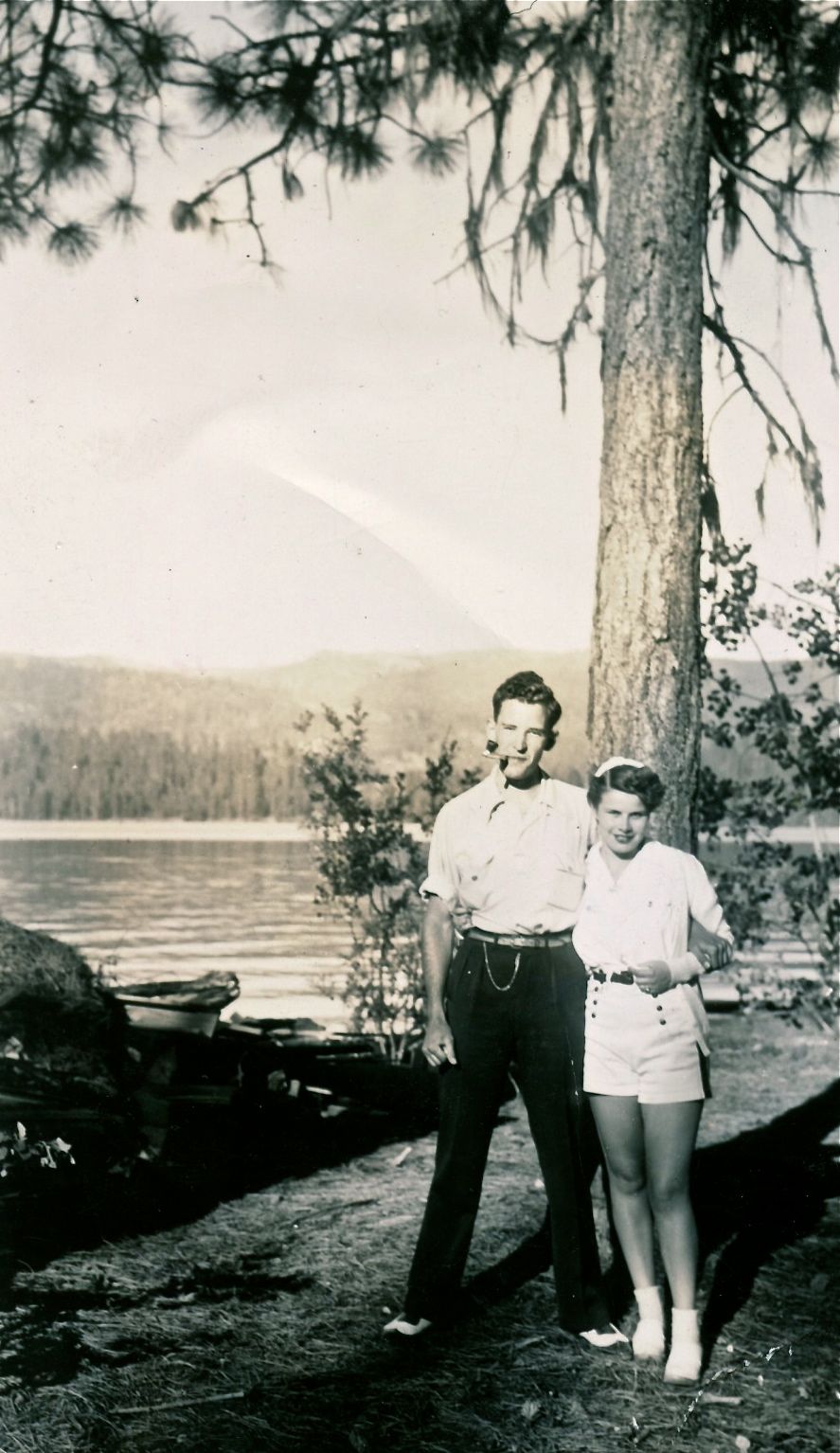
eileen1939

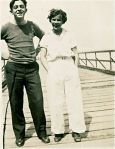
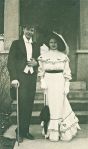
In love, 1940

In love, 1940

Henry enlisted in the 5th Reserve Officer’s Commissioning program of the Marine Corps in January 1941. From there, Eileen and Henry’s stories diverged. Eileen said that Henry wrote her in September or October of 1941 and asked her to join him; Henry held that he sent no such offer. After Pearl Harbor, however, Eileen immediately took a train east and the two married on December 26, 1941.

Next: the war years

Leave a comment

Filed under Family history, Uncategorized

Older Men’s Urinary Problems (and what I wish I’d known)

Okay this is a bit crass, but it’s the first thing that came to mind as I started this post. My Dad used to cite the three rules of being an older man: 1) never pass up an erection, 2) never trust a fart, and 3) never pass up a bathroom.

As I look back on his last year or two of life, I know we did things mostly right, but I wasn’t aware of the options for urinary incontinence, and I wish I’d known to pursue it a little harder. I’ve been surprised to find how many people found my blog posts about end-stage congestive heart failure, so I’ve decided to put one more bread crumb out there for adult children who are trying to figure out how to help their fathers with urinary urgency, benign prostatic hyperplasia or acute urinary retention.

Urinary urgency – especially that interrupts sleep — is a common complaint of older men. My Dad, like many, took Proscar (the generic is finasteride) for the presumed source of the problem: an enlarged prostate.

His concern about having to “go” urgently kept him from activities he might have enjoyed. When he had an independent living apartment, he said the reason he wouldn’t participate in group outings was the lack of a bathroom on a bus. He didn’t want to go to movies for the same reason. The first thing he did in any new location was to locate the nearest bathroom.

His urgency increased significantly over the 12 months before he died. On a trip to Seattle, he couldn’t make it from the dining room to our guest room and wet himself – twice. It was heart breaking. Those accidents increased in frequency.

The month before he died, he was in excruciating pain in the morning when he was unable to void — at all. For a long time, he had experienced a weakened stream. But looking back on it, I realize that he was also having real trouble starting to go. And that had been true for some time.

When my brother took him to the urgent care center at the nurse practitioner’s urging, they drained 1 liter of fluid from his bladder and he came home with a diagnosis of acute urinary retention. Three days later, the same thing happened. This time, he went home from the ER with a catheter, which became permanent. (To his credit, the Sutter General triage nurse listened to what we said about how much urine was drained a few days prior and he immediately admitted Dad, saying, “Wow. That must hurt.”)

It had never occurred to me that there was more he could do besides taking the Proscar. I knew he had some kind of prostate surgery years before, but apparently the prostate can enlarge again.

In conferring with the urologist, we learned that he wasn’t on a second medication that is frequently used for benign prostatic hyperplasia (BPH), Flomax (tamsulosin). He started on the drug, but later discontinued it when his condition deteriorated (and we realized that the potential of a fall due to a dizziness as a known side effect was worse than dealing with the catheter).

Unfortunately, Dad’s health went into a slide about the same time that we figured out the BPH problem, and the urologist, Dad and I agreed that he needed to get stronger before it made sense to remove the catheter and try a non-surgical treatment. (Though my brothers and I were very concerned about Dad’s dignity and comfort, the catheter turned out to be a blessing in disguise. Dad quickly lost strength, and having the catheter kept him from having to endure adult diaper changes.)

If Dad had improved, he would have been a candidate for cooled thermotherapy, a therapy that is feasible even for patients on blood thinners. This is how the urologist’s brochure described it:

Cooled ThermoTherapy™ is performed in your urologist’s office in just under 30 minutes. You will be on an exam table in a comfortable position. You will be given medication to help you relax and may receive local anesthesia. The treatment is performed with a small flexible catheter that is inserted into the urethra. This catheter contains channels to circulate cooled fluid around an antenna that produces targeted heat within the prostate. The heat reduces excess prostate tissue. The proprietary cooling technology protects the healthy urethra and maintains patient comfort during treatment.  Once the treatment is completed, you will be able to go home. You will typically wear a temporary catheter for a few days to allow the prostate to begin its healing process.

For us, it’s all water under the bridge. We did the best we could. But maybe we could have made life a little less anxiety producing if we’d known sooner that there were some options for Dad’s urinary urgency. I hope you find this helpful.

By the way, I found MayoClinic.com to have the best information about BPH symptoms, causes and treatment options.

2 Comments

Filed under CHF and Other Medical Problems, Uncategorized

Things My Mother Said

My husband and I both got a smile on our face when Talk of the Nation’s guest Mary Schmich said how much she loved the term, “lollygag,” as part of Monday’s show, ‘From Groovy to Slacks: The Words That Date You.'” Though the thrust of the show was about changes in the popularity of words — bring back “nincompoop” please! — it reminded me that my Mom, who died in 1999, had some doozy turns of phrase.

She teased Dad that she had to stay home with the children when he was assigned to Canadian Army Staff College in Kingston, Ontario, while he went “gallivanting” all over Canada.

When my room was dirty, she said I had things “spread from Hell to breakfast.” When things were in disarray, she might also say everything was “cattywompus,” as my brother Dean reminded me.

When I was making out with my high school boyfriend downstairs, she yelled down to ask if we were “making love” down there. By which she meant kissing. We jumped up like we had been branded and screamed, “No!”

When we stopped at Horseshoe Bend in the Yakima River on one of many blisteringly hot treks to visit Grandmother, we “hotted off our feet.”

When she was doing this and that around the house, she was “piddling around.”

When she became upset about something, she was having “a major snit.”

There were no “heavens to Betsy”‘s in our house (given that I was in residence) but there were a fair amount of “honest to God”‘s.

She also liked, “Ye Gods,” as in: “If you could see what Dad spends on shooting…. Ye Gods, the entry fee for today’s meet is $60.”

I don’t think my mother considered “damn” and “hell” to be swear words. Her answer as to whether I was planned — since I was born when they were 40 and 41 — was, “Every once in a while we just said “Oh what the hell.”

She didn’t mind the occasional pejorative term. When she hospitalized early in 1999, I flew back from a business trip to Washington DC and arrived at her bedside. She asked, “Did you say hi to everyone except that jackass in the White House?” (Bill Clinton’s impeachment hearings were underway.)

Her colorful language may have been imparted to her by her father, an attorney of some repute. He referred to a certain shade as “baby s*** brown.”

Mom wasn’t one to sit around and feel sorry for herself, or to say or write things that were too heavy; those sentiments she would call “maudlin.”

When popular usage failed her, Mom turned to a made-up word, “sorensified.” You won’t find it in the dictionary, but it’s what you feel after a truly satisfying meal.

What funny phrases of your parents do you remember?

Leave a comment

Filed under Uncategorized, Words

Cracking Open

By Hectonichus (Own work) [CC-BY-SA-3.0 (http://creativecommons.org/licenses/by-sa/3.0) or GFDL (http://www.gnu.org/copyleft/fdl.html)], via Wikimedia Commons

Bereavement can be strange.

It’s been more than four months since Dad died. Immediately after his death, I was bone tired, contemplative, somber without being sad. Having a day stretch ahead of me felt like a balm. I could think what I wanted, feel what I wanted, do what I wanted.

For a time after that, I ran away, though not consciously. I had a backlog of people I wanted to spend time with. It was suddenly feasible to visit them rather than ask them to visit me.

It no longer feels strange not to be caring for Dad, nor unsettling when awareness comes suddenly upon me that I am no longer his caregiver. I’ve stopped startling when I realize I can be without my phone as my constant companion; I can take a walk without carrying it, or go to the movies without it turned upside down against my knee, on silent mode, so that I will feel any urgent texts or calls. We can eat dinner when we want, and linger at the table for as long as we want. I’ve stopped listening for the click of the brakes on his walker, mentally following his path to the john during the evening and night to make sure he safely settles back into bed.

I am untethered. But now I feel directionless. And I am restless.

I’ve known restlessness in the past: intellectual restlessness, physical restlessness, even sexual restlessness. This restlessness has a different tenor.

I am pent up, ready to do something, something else, but what? I have the attention span of a squirrel. (Which, when combined with ready access to Google, can be downright dangerous. I just learned, for example, that a squirrel has an attention span on normal things of about one second and about four minutes on acorns and nuts.)

I want to hike. I want to learn to sail. I want to create a template from the strategic planning I’ve been doing for nonprofits. I want to write.

I know that I am fortunate to have this time of freedom. When my mother died after four months in hospice, my employer at the time was clearly unhappy with me; that “take all the time you need” turned into “get back in here and start generating revenue!” I was thrown back into a political maelstrom at work, settling in to a new house, and worrying about my newly widowed father.

Time to think, feel and figure things out is a luxury. Time is something I’ve never had much of. It makes me uncomfortable.

An old friend who specializes in organizational development used to say, “Break down, break through.” I have disassembled the pieces of my life and am looking at them like so many Legos, wondering what to build.

1 Comment

Filed under Uncategorized

Memorial Day: A Friend Never Forgets

Photo credit: fkehren via flickr under CC license

Photo credit: fkehren via flickr under CC license

Announcement time at church. There was a reminder about the hiking club outing, a request for sign-ups to bring a salad or cake for the parish picnic on June 9, and a woman who said she had become a great-grandmother once in January and twice in April.

An older man dressed neatly in a coat and tie took the microphone. “I want to remember friends who never came back,” he began.

The rustling of papers and quiet conversations ceased.

— I remember George Monroe who died in the invasion of Saipan. He was a lieutenant in the Marines. He had a contract to play baseball with the Boston Braves but he never returned.

— And my friend Rocky Rogers. He had been captain of the swim team at Amherst. He was shot down over the Channel.

— These are the friends I want to remember on this day of days, Memorial Day.

Because the George’s and Rocky’s who never came back are remembered by fine men like Herb, men with big hearts and long memories, we remember the meaning of Memorial Day.

1 Comment

Filed under Marines and those who serve, Uncategorized

The Anxiety of Aging Parents

hospital bill

The title of this post can be read two ways. As parents age, they become more anxious, but we adult children become more apprehensive, too. Like a migraine headache, financial security just keeps pounding away. Especially when bills like the one above arrive. Dad came out one morning unable to speak clearly, having experienced what we later learned was a TIA or mini-stroke.

My Dad was unusual for recognizing his increasing limitations as he had plenty of medical reason to expect that a period of incapacitation could precede his death. He had a will, gave one of my brothers financial power of attorney, had a checking account with two of us on it in addition to himself, turned over bill-paying to us, and purchased long term care insurance (though, regrettably, without an inflation rider making those years of premium payments a ridiculously bad investment).

That said, he constantly worried about whether his financial resources were adequate. Anytime an “Explanation of Benefits” arrived from his supplemental Medicare plan insurer, it set off a new round of questions – even if it clearly stated that he did not have to pay the amount. I took to carrying with me a handwritten ledger of his monthly income and monthly obligations.

“See? You’re fine,” I would reassure him.

The flip side of the parent-adult child financial anxiety coin is harder to solve. How do you have “the talk” with a parent who doesn’t think his or her financial situation is an appropriate topic of conversation? At a financial seminar hosted by UBS last week, I learned that the average age of a widow is 55. Older married women – still – don’t necessarily know the details of their financial accounts.

This morning’s New York Times carries a great article, “The Talk You Didn’t Have With Your Parents Could Cost You.” Among other tips, it quotes Amy Goyer, a caregiving expert at AARP, who offered these practical suggestions:

  • Know what type of information you are seeking before you start a conversation, such as: whether a will exists, a financial power of attorney, a medical power of attorney or health care directive; what their health insurance covers, including long term care insurance; whether they have life insurance; and if there is a list of every singe account they owe or collect money from.
  • Start conversations with an “I” statement such as, “I’m concerned about doing the right thing when you pass.”

Although my Dad shied away from the Internet (after a few attempts), the article also reminds adult children to secure passwords for any Internet-only accounts. And the worst place to keep legal documents and instructions, the article suggests, is a safe deposit box, because survivors often lack access to them.

I know it’s “nature’s way,” but certain aspects of aging have always struck me as cruel; high among them, our parents’ feeling of insecurity as they lose ground. Though adult children have a moral obligation to protect aging parents’ security, we can’t lose sight of the need to ease their hearts and minds. That often takes finesse, driven by caring concern.

Leave a comment

Filed under Uncategorized

Our Common Cause as Adult Children

Dad bird hunting

You won’t find this blog post until you’re ready to think about what we have in common: the sometimes-painful, sometimes-rewarding responsibility for caring for a parent during their “golden years.”

The senior years can be tremendously active and exciting – a period of freedom after a long life of work. But for our parents and most of us – yes, us, too – there comes a period when the world shrinks.

Our job, if we love our parents and choose to be involved, is to make their passage during these years as good as they can be.

Almost every day, I stumble across someone who faces their parents’ elder years with trepidation. It happened again this morning, walking with a neighbor.

These are the truths I hear over and over again:

  • Parents don’t want to be a burden; they actively wish to die in their sleep or go quickly, and don’t want the adult child to feel pain over their departure.
  • Parents often live near their lifetime’s worth of friends, while their children are sometimes states away. Adult children worry how they will provide the assistance needed when one or both parents need more help.
  • One sibling bears most or all of the responsibility for looking after their parents.
  • Often, there’s a sibling or sibling’s spouse who is not on the same page about what should happen.
  • We feel drawn and quartered. We may face pressure at work or be trying to support our young adult children or spouses through rough patches in their lives even while we are trying to pay more attention to our aging parents.
  • Having candid conversations with parents about their intentions, physical limitations and financial preparedness is very, very difficult. Few aging parents are realistic and proactive, leaving adult children to worry about whether (or when) they will have to step in and take over.

I learned some truths of my own along the way, truths that surprised me. I fully expected Dad, who had advanced heart disease for more than 50 years, to go out with a big bang. Instead, he rallied over and over again, never quite recapturing the ground he had lost, but persisting even so. He lived at least 15 years with congestive heart failure.

I also learned that quality of life didn’t depend on the things he thought it did. His perspective changed with time, and he was able to be pretty satisfied even though Mom was gone and he couldn’t hunt, fish and enjoy the outdoors as he once did. His world was small, but there were people in it who loved him.

I learned that Dad’s long decline was an important time for him in coming to terms with regrets. He regretted that his father wasn’t more interested in him. He regretted that he couldn’t save my little sister when she became ill with leukemia. He regretted that he couldn’t protect my mother from feeling afraid during her terminal illness with lung cancer. Eventually, those regrets ran their course and were replaced by peace.

I learned that I could give him my love and attention without resentment, even though it meant living my own life in the very slow lane.

I learned that I could have a far deeper relationship with Dad after my Mom’s death than we ever had before.

I learned so much from the last seven years caring for him.

But I understand the fears of those who stand at the precipice of their parents’ old age, wondering and worrying how they will handle it. All I can tell you for sure is that it won’t go quite the way you expect it to. There will be parts that are harder, but there will also be surprising gifts.

3 Comments

Filed under Uncategorized

Oohrah for Strong Women

The Major Marches

Not familiar with “ooh-rah”? It’s that explosive sound that Marines use to express enthusiastic approval. I heard it at Friday’s evening parade at Marine Barracks in Washington DC and I’ve been thinking about it ever since.

Among the precision marchers on the parade ground and ceremonial hosters were a few women in uniforms identical to their male counterparts. And they looked sharp.

I was saddened, then, when I saw the trolls out on Marine Barracks’ Facebook page commenting on the photo that appears up top:

Thank God I got out of the corps before I witnessed this political crap take place!

It seems that several of the Barracks’ Facebook followers were dismayed to learn that women had invaded the Corps, and in this case, were wearing the male uniform.

A woman Facebooker responded far more courteously than I might have (but knowing online trolls, I like to stay out of their line of fire):

Gentlemen, it’s the prescribed parade uniform for designated personnel at the Barracks. Pls keep your personal attacks/feelings against this Marine to yourselves.

The Major also received support from two men who follow the Marine Barracks page:

I look at it like this. I dont care which uniform of the Marines she is wearing. She a Major and by the looks of it, has had a pretty good career. Semper Fi Major!

I prefer that she wear this one as she carriers herself, the Ladies of the Corps and the Marine Corps well. Semper Fi

I had the honor and pleasure of meeting the Marine they were writing about. And she’s not just any Marine. Major Sarah Armstrong is the first female parade commander of a Friday Evening Parade, a tradition that started back in my Dad’s time as Executive Officer of Marine Barracks.

Those shiny medals on her jacket? They’re campaign and achievement medals. She earned ’em the hard way. At least one of those ribbons denotes her tour in Afghanistan.

My mother was a strong woman. My friends are strong women. My daughter is a strong woman.

In the place where my father served 56 years ago, at a time when only men achieved positions of leadership in the Marine Corps, I’m thrilled to see Major Armstrong doing her thing, and doing it so competently.

As one of the Facebookers concluded:

Ooorah ma’am!

Update:

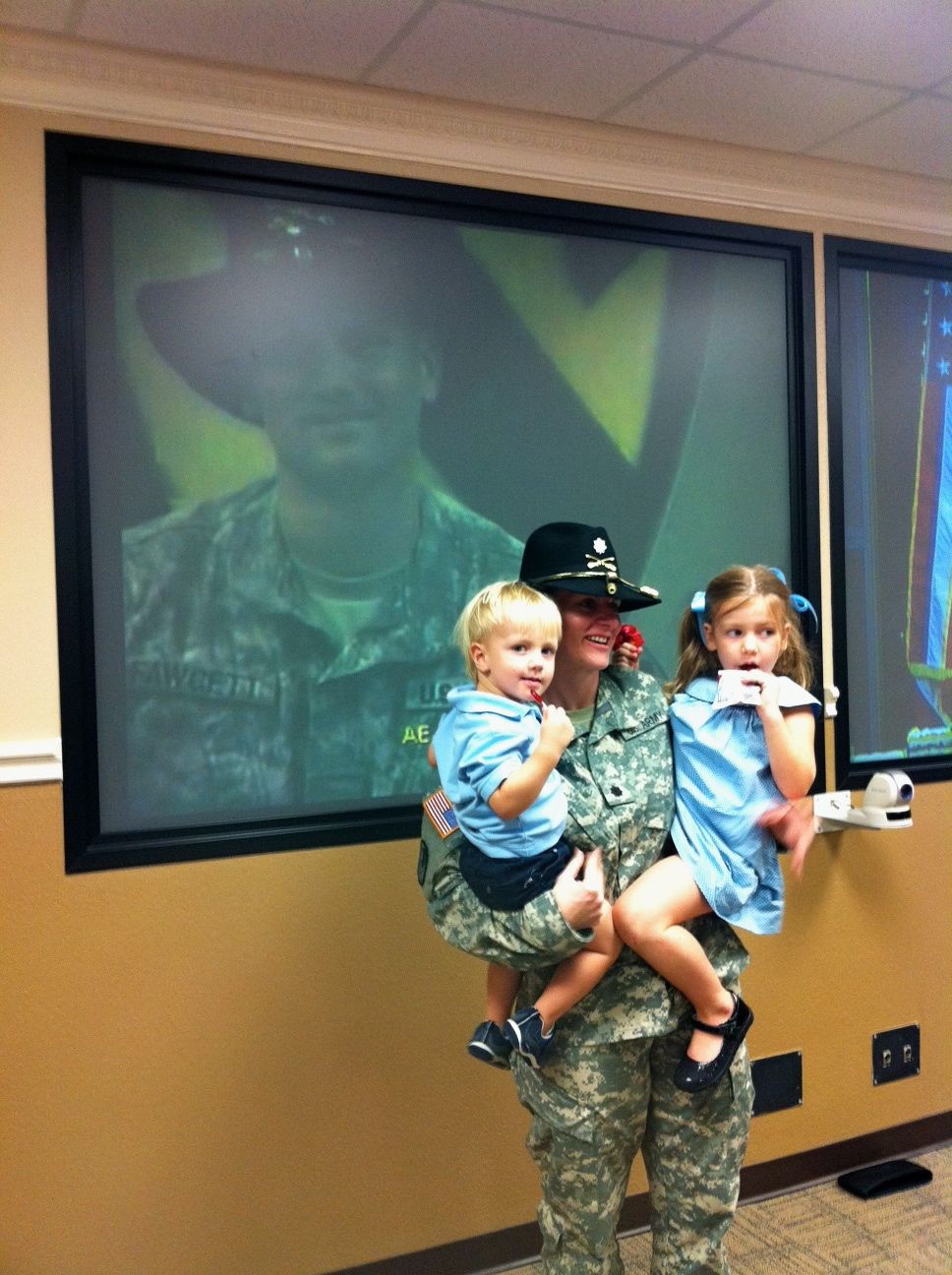
Per the comment I received from my second cousin John, turns out I’ve got a strong woman in my extended family in the form of Col. Marne Sutten, US Army. She’s married to John’s son, Col. Grant Fawcett. Between the two of them they served five tours in Iraq. They’re busy raising their two children in Tampa, FL. Photos provided by John Fawcett:

Just after Col. Megan Sutten's promotion ceremony, watched happily by her husband Grant via video

Just after Col. Megan Sutten’s promotion ceremony, watched happily by her husband Grant via video

Col. Megan Sutten and Col. Grant Fawcett

Col. Megan Sutten and Col. Grant Fawcett

Col. Grant Fawcett as the last convoys pull out of Iraq

Col. Grant Fawcett as the last convoys pull out of Iraq

6 Comments

Filed under Marines and those who serve, Uncategorized

Marine Corps Wife: My Mom’s Career

That's mom seated at bottom left, and Dad standing at upper right in 1959

That’s mom seated at bottom left, and Dad standing at upper right in 1959

Skimming through Mom and Dad’s photo albums from the late 50s, Dad is pictured at the pinnacle of his success in the Marines. While it was Dad’s obituary that carried the details of his promotions and assignments, in many ways his career was her career.

It wasn’t that she loyally followed Dad as Sarah followed Abraham. She was a woman with a mission. She kept the home front running and deployed her considerable social and organizational skills to the job of supporting Dad in the regimented social environment that surrounded officers’ wives.

Dad said he wasn’t keen on the idea of marrying in the tumultuous weeks that followed Pearl Harbor. Not that he didn’t love Mom. He did, passionately. But he was acutely aware of the potentially abbreviated life span of a Second Lieutenant in wartime, and he didn’t want to see her widowed.

When he shipped out in 1943, soon to join with the 4th Marine Division in the battle for Roi-Namur in the Marshall Islands, he left Mom at home with my brother, Scott, who had been born that November. When the war ended and he returned, he joked that he had to fight for his pants. Actually what he said was that had to fight for his pants every day of their marriage. When the war ended, he returned from the horrors of Saipain, Tinian and Iwo Jima to a home where Mom was comfortably and firmly in charge.

As Dad’s assignments took them from Quantico, to Washington DC, up to Kingston Ontario, back to Washington DC, and then across a country and an ocean to Honolulu, Mom packed and unpacked, settled kids in schools.

Each time they arrived at a new post, she paid a social visit to the Commanding Officer’s wife, calling card in hand, as expected. She joined the Officers’ Wives Club, and knowing Mom, she did an exemplary job of supporting their activities. She loved the social whirl that went with an officer’s life in those days, like the formal party in honor of the promotion of Leonard Chapman to Brigadier General.

In 1951, my Mom found herself running a busy household with a nine year old, a four year old and a one year old – oh, and Nana, her mother. Mom and Dad’s worst fears came to pass when little Midge was diagnosed with leukemia, for which there was no known cure.

As a mother, I can’t imagine how she coped, but it was in character for her to forge ahead, hoping against hope. My uncle, a hematologist-oncologist, came down from Boston to administer experimental treatments and oversee Midge’s care. To no avail. She died October 22, 1953, a few months short of her fourth birthday.

Dad’s orders to ship out for a solo tour of duty with the 3rd Marine Division in Gifu, Japan, were held during the last months of Midge’s illness. Mom had learned, as Midge lay dying, that she was pregnant for the fourth time.

On February 21, 1954, Dad wrote Mom from Okinawa while in transit:

Postcard from Japan 1954

Although it was lost in Dad’s move to California, I remember reading a lengthy letter he wrote from his tour in Japan, sharing the pain of their devastating loss, saying how he longed to be there to hold her.

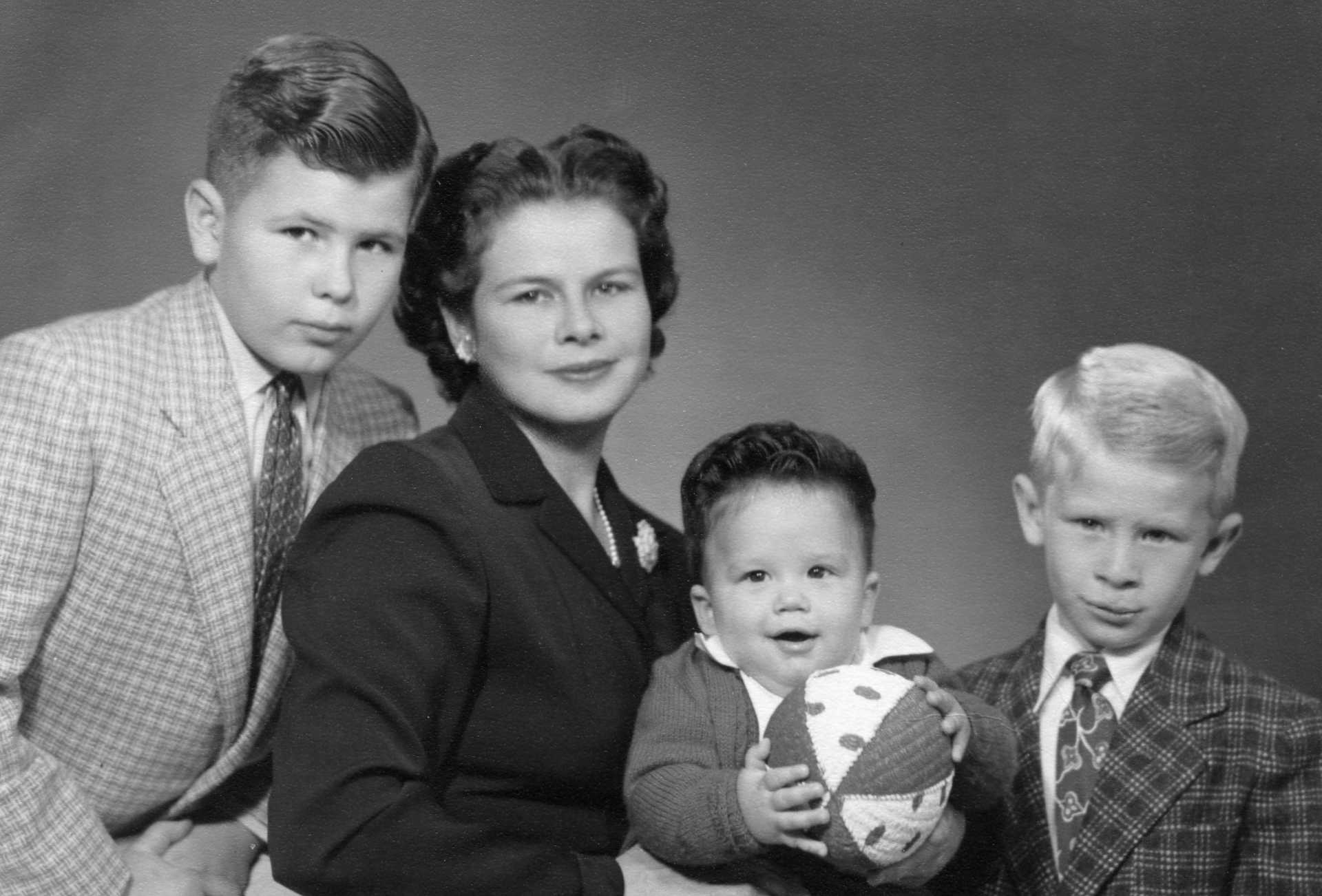
When my brother Dean was born in April 1954, Dad said, “It was if the sun came out.” That may be true, but now Mom was alone, managing a household with an 11 year old, a six year old, her mother, and a newborn. She was on her own when she had Dean christened:

Eileen Campbell with baby Dean, flanked by Bruce and Scott

In a professional portrait she had taken the next year, her expression is serene but somber.

Eileen Campbell raising three boys, 1955

This summer, we will inter both Mom and Dad with Midge at Arlington National Cemetery. While visiting Washington DC this past week to make arrangements, I wondered if it was fair to put so much emphasis on Dad’s career. After all, the burial with honors is provided because of his service, not hers.

Then I realized that it wasn’t just Dad’s efforts that deserve the recognition. Like most military spouses, she earned it, too. Knowing Dad, he would be the first to say that Mom made it possible for him to do what he did.

2 Comments

Filed under Marines and those who serve, Uncategorized

Seeing Mom Among the Flowers

A member of the Washington National Cathedral Altar Guild

Friday was my “Mother’s Day.” Mom, gone since 1999, felt so present to me all day. I came east to see my friend Sharon and the premiere of the documentary she produced about the author Elizabeth Spencer, “Landscapes of the Heart,” but also for a mission: I hoped to secure a date for my father’s and mother’s interments at Arlington National Cemetery.

Though it was Dad who I focused on during the past seven years, and Dad who died in January, the trip was about both of them.

After meeting with a representative at Arlington, I asked Sharon if she would mind visiting Washington National Cathedral. My mother always talked about it, and continued to buy the Cathedral’s annual Christmas cards long after we left Washington, D.C.

Washington National CathedralUpon entering the Gothic-inspired masterpiece, we walked up the center aisle and diverted to the right around a stage that was being prepared for a concert.

Like many European cathedrals, the nave and transept are embellished with small side chapels.

In the first of these chapels, below a round contemporary sculpture of Jesus’ face, stood a woman in a pink shirt and apron, stoop shouldered, slowly trimming the stems of lacy blossoms that she was using to complete the final touches on two symmetrical arrangements of pink lilies. Her salt-and-pepper hair was short, mostly gray, a little curly. Perhaps the last vestiges of a perm that was nearly grown out.

For just a moment, she was my mother.

The woman in pink was an Altar Guild member, one of the stalwart legions of the Episcopal Church Women who do so much behind the scenes in fulfillment of their faith and commitment to the church, in camaraderie with one another.

My mind involuntarily summoned the smell of damp linens, starch and heat, a visceral memory of one of my mother’s monthly turns ironing the altar linens. Just as readily, I remember the scent of fresh-cut stems when she trimmed a gladiola, a rose, a peony, or greens harvested from our back yard for an altar arrangement.

In the sculpture above the altar, Jesus’ eyes are closed, but his head inclines toward her. I don’t know if the image is meant to represent him in death on the cross, or is meant to express sympathy for those who pray here. Blade-like rays extend beyond his halo through which a jagged hole is blown.

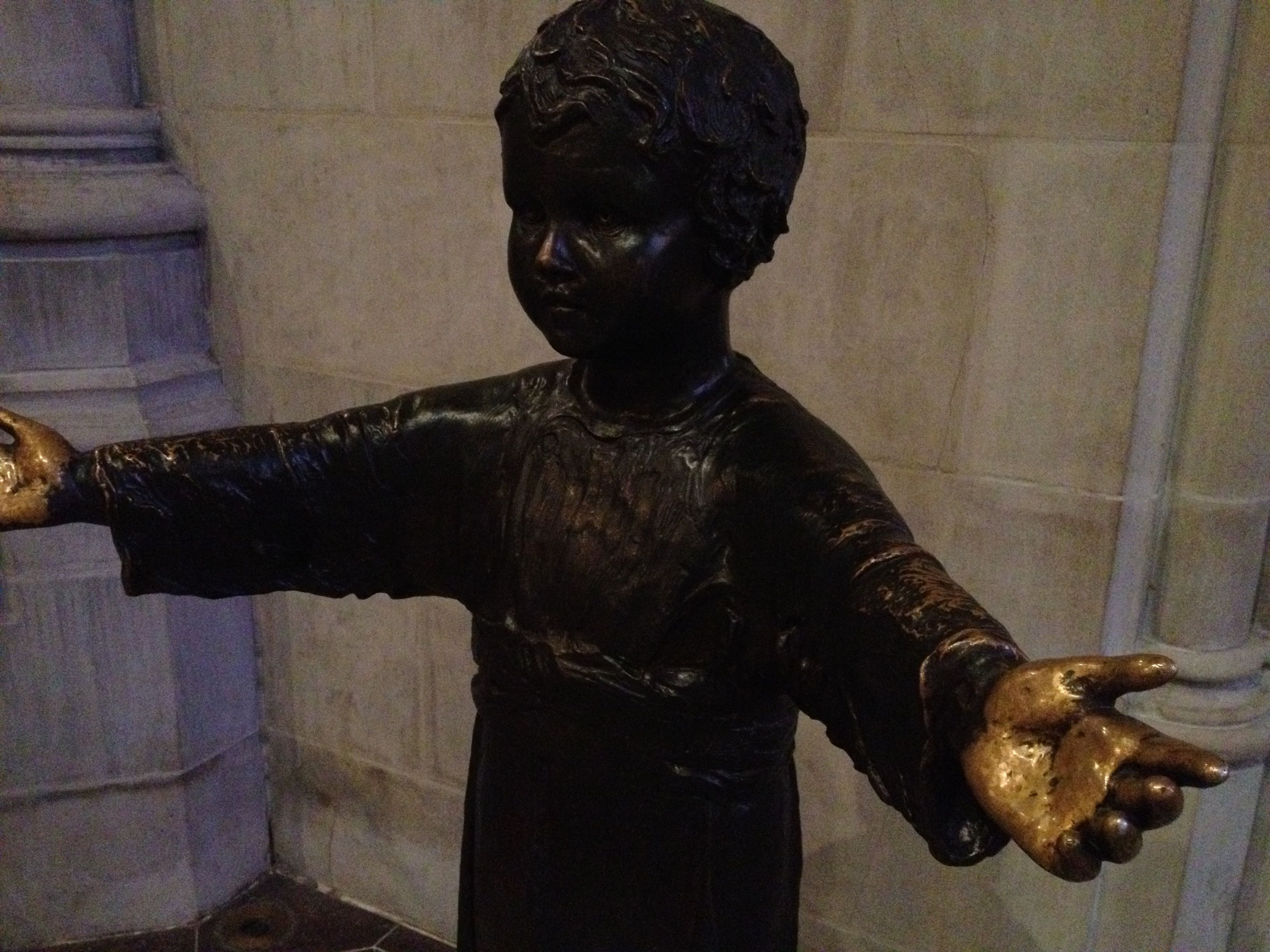
Washington National Cathedral's Christ Child statueLater I learned the chapel memorialized those who served and died in wars. Near it, a bronze statue of the Christ Child welcomes visitors to the adjacent the Children’s Chapel. The statue is the size of a six year old, its palms polished to a sheen from all of the touches to its outstretched chubby palms.

It felt meant, just as the whole week has felt perfect. Here is “Mom,” creating a striking decoration for the War Memorial, within the hour that we have confirmed a date and time for her burial along with Dad, joining Midge in her resting place. And there, next door, is the Children’s Chapel, with the child Jesus extending his arms in welcome.

My brother Scott sent this reply to a note I sent to my brothers confirming the interment date. “Has anyone thought about what day it is today? Nice that we got this confirmation on the 14th anniversary of Mom’s passing.”

1 Comment

Filed under Uncategorized