Tag Archives: seniors

What’s on your list of 5 self care things you do?

My friends and I seem to have entered a new phase. Once upon a time, our calendars overflowed with weddings. Then it was baby showers, and until recently, children’s graduations. Now our email and text exchanges are more likely to pertain to a parent’s health crisis. Usually coupled with news of challenges facing our young adult children.

We’re savvy enough to know that we need to take care of ourselves as we care for others, but busy and stressed enough that it’s really hard to actually do it.

My friend just texted me to say she was leaving town tomorrow to look in on her Mom, who’s had a setback in her recovery from surgery. True to form, she asked me how I was doing, and I replied that things are a bit better on several fronts.

She then asked, “So what are you doing for you?”

To which I replied, “What are YOU doing for you?”

I wasn’t trying to play the “gotcha” game (this isn’t politics, after all), but that’s kind of how it turned out:

Crap. I knew you would turn that one back on me! You know I’m the worst at putting myself in the top 10, or 20, on any list!!! At best, I’m trying to learn to be a bit more compassionate for my own frailties. It’s a start.

I’ve actually been thinking about this self care thing since my guardian angel, Jim, instructed me to list 5 things I would do for self care. That it’s taken me three weeks to think of five things tells you something.

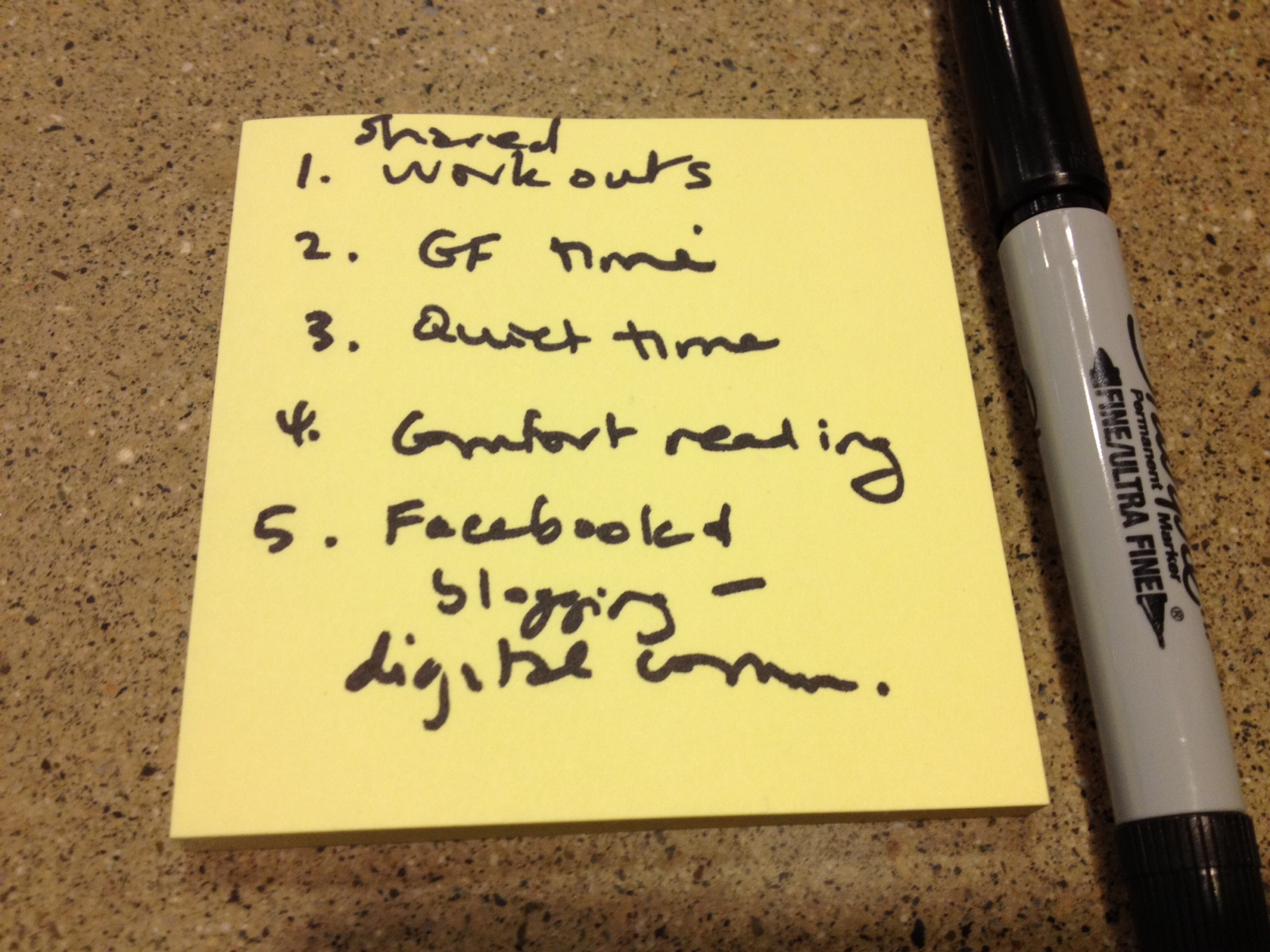
My five are below. I’d love to hear what YOU do to take care of yourself as you care for others. We can all learn from each other — and maybe encourage one another to actually follow through on these things.

1.  Work out with others.

I often say that I live with the future. When you’re around a 95-year-old you realize the importance of strength and balance. I walked but I knew that wasn’t enough. I admitted that I couldn’t motivate myself to do things like – ugh – sit-ups or pushups.  I also thought it was unlikely I’d get my butt out the door to a gym class given my caregiving responsibilities. So, my big plan was to work out 4-6 times with a trainer and then miraculously carry on alone, having formed a virtuous habit. During my first workout, I was shocked at how poor my balance was – that and the fact I couldn’t do 10 sit-ups without holding on to my thighs to heft my upper body from its prone position.

That was four years ago. After a year or so, my neighbors who walked together twice a week for years expressed interest in trying it on for size. Now my driveway is a boot camp at least twice a week. Scheduling that time, and keeping it, is absolutely at the top of the list in terms of things I do for myself.

I figured my trainer, the amazing Kylee Neff, was an absolute liar when she told me I’d have more energy from working out. For about three months, I wanted to go to sleep early on the days we trained. But she’s right. Now if I can’t work out for a week, my energy and outlook isn’t as good. It’s as important to me as – gasp! – coffee once was. (Strangely, I also feel almost no need for caffeine.)

Working out with one or more friends also makes it hard to slack. After all, they show up in my driveway. But the group banter has the extra advantage of taking my mind off the momentary pain of whatever circuit Kylee has dreamed up for that day.

2.  Comfort read.

You’ve heard of comfort eating? I comfort read. My literary diet changes completely when I’m under stress. When my mother was dying of cancer, I was soothed by re-reading The Wind and the Willows. I’m a big fan of Mr. Toad, with or without the Disney attraction. Though I still read heavier fare (for example, The Looming Towers), I am drawn to cheesy and breezy. I read things like Deborah Harkness’ Discovery of Witches series (all two of them), J.R.R. Martin’s Song of Ice and Fire series (a.k.a. Game of Thrones), and the utterly ridiculous Sookie Stackhouse series by Charlaine Harris. Apparently I find fairies, witches and vampires comforting.

3.  Spend time with girlfriends.

My friends save me, over and over. Just knowing they are there is a huge source of support. Nothing against guys, and my husband is the Rock of Gibraltar, but there’s something about deep conversation with trusted female friends. It’s better than wine and chocolate. Recently, a friend and I agreed to set up a weekly time to meet. Her husband has Alzheimer’s and both of us have to coordinate social activities around caregiving tasks. It just works better to put something standing on the calendar. And, yes, it involves wine. Duh.

4.  Stay connected with Facebook.

I actually surprised myself with this one. So much is written about Facebook as a time suck, or about how Facebook is no substitute for deeper, face-to-face connections. But caregiving is isolating, and Facebook helps me to feel there’s still a world out there.

I love the pictures of kids and the quick posts about the sweet or funny things kids say. I travel vicariously through some of my friends whose jobs or travel budgets seem to take them everywhere. I salivate over my foodie friends’ posts about the amazing seasonal recipes they’ve dreamed up. I read the links to articles that appeal to my interests and appreciate the fact they were shared. I catch up on a friend’s recovery from a brutal cycling accident. I feel for the people (and animals) in Eastern Washington when my friend in E-burg posts update on the terrible fires there. It may seem a little strange but I even love the beefcake pictures posted by my gay friends; it makes me happy to know someone’s romantic life is more exciting than mine! Pictures of weddings, funny bits from George Takei, updates from nonprofits I care about… I enjoy almost everything in my news feed. And of course, I can always block the political posts that get a bit annoying this time of year.

5.  Find quiet time.

I’m not a true extrovert, although most people would assume I am. It’s hard for me to find an hour when I can be alone in the house, or at least alone before anyone else is awake. I crave and need moments when NO ONE WANTS OR NEEDS ANYTHING FROM ME. You may have figured out that I blog during these rare quiet moments. And when I say quiet, I mean just that. I feel so over stimulated that I need moments without music or TV. Silence is a balm.

So I’ll ask it again: what do YOU do to take care of yourself? This inquiring mind wants to know.

4 Comments

Filed under Uncategorized

Too much love?

Can you imagine this image as an older parent? It’s not how we think about our role as caregivers, is it? (courtesy Teach Through Love)

Our first instinct as parents is to surround our children in a cocoon of love that cushions them against hurts both physical and emotional. But eventually, we find out that we do our children no favors if we never let them struggle.

I am learning that being a caregiver for an aging parent is not that different.

Since I moved my father to California in 2006, he’s spent the majority of the time at my house. He has his own bedroom with a cushy La-Z-Boy, television and bathroom. After giving up the family house where he lived from 1969 to 2003, I wanted him to feel this was home. At the same time, I wanted to know I could leave town and trust that he would be secure, with all of the support services he needs. So he’s had a one bedroom apartment in a nice assisted living community.

The back-and-forth worked just fine until July, when his health became unstable. Although he is now almost fully recovered, his emotional health continues to suffer.

My mother, during the final stages of lung cancer, expressed fear of dying, despite the deep faith that sustained her for so many years. My father wondered why, if there is a God, would he abandon my mother in her hour of need? Now it is my father who fears dying – and, in particular, dying alone.

Ten days ago, he asked me, “Can I come live with you?” He continued, “Living alone is no way to live. I’m afraid to die alone.”

Using my strategic planning skills, it seemed to me that we had to revisit Dad’s living situation. My objective, and that of my brothers, is to ensure that Dad lives with as little physical and emotional distress as possible. To that I had to add an objective about meeting the needs of my own family — oh, and taking care of myself, too.

It seemed to me that there were three possible solutions: 1) Dad would come to live with me full-time; 2) we continue to muddle through with more companion services at his apartment on the days that I am not available; or 3) we limit the number of nights that Dad stays at my house because of his increased distress when he has to return to his apartment.

I sought input from a social worker, a mentor, our home church pastor, his doctor, and a psychologist. Along the way I also had Dad evaluated for hospice and found out that he’s not close to qualifying for that type of end-of-life care. I had to start thinking about what would be best for a period of gradual decline that could last for several years – something I never imagined given that Dad has had three heart attacks, three strokes and three open heart bypass surgeries.

I also had to “listen” to myself. I realized I felt overwhelmed by the possibility of Dad moving in full-time. I really want that to happen, but now isn’t the right time. My Dad isn’t the only one who needs me right now.  I had to admit to myself that I felt exhausted.

The social worker shared a little tough love with me. She said, “He is distressed about the prospect of going back to his apartment because it isn’t ‘home.’ And it isn’t home because you won’t let it be home. He spends enough time at your house that the transition is difficult. He doesn’t remember exactly what happens there and it feels unsafe to him to return.” She went on, “As family members, you’re responsible for providing the caring, but not necessarily the care.”

My beloved mentor Jim offered this advice:

This is very hard to do: separate what is in his best interest and his care needs from your heart duty as a loving daughter.  Like most elders in his situation, he is becoming more child like — likes what he likes and won’t budge; wants his mommy really to take care of him although he would not recognize that is what he is doing to you.  If he does move in and a caregiver is part of the team, you will have to force him to agree to let that caregiver do his/her thing.  You almost have to write out a ‘contract’ that he has to agree to.  Obviously it is not a legal thing, but you use it to force him to focus on reality when he just wants it all to be different and for you to be there constantly.

My church home pastor suggested that I facilitate a casual visit with a priest. “Throw him a lifeline,” he suggested. “He may choose not to talk about his concerns about death, but he may be ready to talk.” And my psychologist friend suggested having Dad evaluated for anti-depressants. His doctor agrees that may be worth trying.

So what was decided? I had a conference call with my brothers last Wednesday night and we decided to try out an arrangement where Dad is limited to three nights a week at my house. I’ve visited him at his apartment every day and joined him for lunch to reinforce the message that the staff knows him and is paying attention.

He doesn’t love it, but he is responding to the message that there are some things I need to do right now to take care of my family and myself. He asks how he can help, and I say, “Just be patient, Dad, and be supportive when I can’t be here.”

Week one went well, but the big test will come this weekend when I leave town for three days… Stay tuned.


1 Comment

Filed under Uncategorized

Ghosts in the rocking chair?

The spat that I described in my last post ended with the receipt of a sincere apology from my brother after a three-day marathon of back-and-forth emails. He also asked to “start over” with not just me, but my other brothers.

After time for reflection, I learned a lot, albeit painfully, from the whole kerfuffle. In keeping with the Buddhist proverb, “When the student is ready, the teacher will appear,” I stumbled across some teaching from an unlikely source: a child advocacy and parent-teacher education resource called Teach Through Love. Teach Through Love shared an article link on its Facebook page, and highlighted this quote:

Similarly, our kids push our buttons precisely because they are our children. Psychologists call this phenomenon ‘ghosts in the nursery,’ by which they mean that our children stimulate the intense feelings of our own childhoods, and we often respond by unconsciously re-enacting the past that’s etched like forgotten hieroglyphics deep in our psyches. The fears and rage of childhood are powerful and can overwhelm us even as adults. It can be enormously challenging to lay these ghosts to rest.

My brother said that his temper flares when he feels overlooked, ignored, or otherwise “disrespected” and he attributed this sensitivity to some disappointments in his life. When we met for dinner last week, I asked him if he thought it might be related to a longing of his for respect from my father, and perhaps the respect of his siblings for him based on birth order.

He scratched his arm repeatedly as he described his experiences with Dad growing up, beginning with Dad’s return from WWII. Dad later asked him to be “the man of the house” when Dad was sent on a solo tour out to Japan just after my sister’s death from leukemia. And when Dad was disabled due to a massive heart attack in 1962, he was called upon again. He was the same age then that my son is now. Instead of focusing on college, he was trying to help the family pull through the crisis of my Dad’s near-death and the aftermath of my father’s forced retirement from the Marine Corps. (In those days, a heart attack meant automatic and full retirement because, with limited treatment options, military command didn’t believe that a soldier would recover sufficiently to fulfill his duties.)

My mother and father often said that they raised their two eldest children, but they let the two youngest raise themselves. We had the same parents, but grew up in different worlds. My younger brother and I mostly grew up in a civilian world — a world, I might add, that Dad found quite deflating. I admired my Dad, but I didn’t think he was perfect. And I told him off – royally – when I was 21. I was tired of feeling afraid of my father, who retained command presence long after leaving the Marines.

When my brother sent his angry email, he felt disrespected by my younger sibling and me. The email that triggered the original firestorm pushed a flashing red button in his brain. But that button was installed long before.


Leave a comment

Filed under Uncategorized

Sibling fight!

Why is it that food fights are fun and email fights are not?

I was quite smug last night when I told a friend that I thought my brothers and I were really communicating effectively with one another. She had just returned from 10 days of overseeing her mother’s recovery from pneumonia and surgery, during which she was repeatedly second-guessed by her out-of-state sister.

Then I got an email from one of my brothers today, who reacted to an email sent by another brother. I won’t get into the details but I’ll share the zinger with which he ended his message: “…have the two younger sib’s simply cut out the two older sib’s from having a voice?”

I thought we were past this.

But the truth is that it is very, very hard for people who act like grownups in most situations to behave that way when something triggers half-buried resentment. We are all suddenly six.

There are a lot of “perhapses” that come into my mind. Perhaps the brother who sent the original email should have called instead of sending this particular message by email. Perhaps the brother who seethed over the email should have picked up the phone and expressed his concern to the sender, or to me (since I was supposedly colluding in the decision in question). We could have done better.

When we are stressed, as we are in no small part by Dad’s deteriorating health, we are reduced to the ugliest side of our personalities and temperaments.

It’s hard to keep one’s eye on the real issues here: how to make sure that Dad feels loved and safe, and how to preserve and perhaps strengthen our sibling relationships for the time when Dad is no longer there to bind us.

Right now I’m working on that last part.

2 Comments

Filed under Uncategorized

My husband, the unsung hero

(Before you read this post, stop remembering the Andy Kaufman version of the Mighty Mouse theme song. I mean it. Stop. It. Right. Now.)

My husband and I have always had a 50-50 arrangement, if you average it over time. Statistical nerd that I am, I know that the average can mask a labile distribution of responsibility for household and familial duties. Sometimes it’s 75-25, sometimes 25-75, and occasionally even 90-10 (as in the time when we were preparing to move and my husband managed to break his knee on a guys’ trip).

Every time someone says to me that I’m an angel for taking care of my Dad, I remember that the guy holding my halo in place is my husband.

When I stop to take inventory, I realize that it’s a whole bunch of little things he does that accumulate to make a difference. When he comes home from work every evening, he asks if my Dad has his glass of wine. While I scramble to do my “magic” in the kitchen (anyone who knows me knows this is not a joyful experience), he’s contributing the comfortable routine of my Dad’s life. Dad used to have a couple of scotch and waters before dinner that over the years morphed into a glass of red wine. Dad’s almost lost his taste for wine at all, but that pre-dinner libation is a nicety in the not-so-nice world of advanced age.

Sometimes my husband “covers” for me if I have a morning meeting or am entertaining a couple of girlfriends. I’ve never detected a moment of resentment if I ask him to fix Dad’s breakfast or put his dinner on the table.

Taking care of Dad severely limits our flexibility to accept invitations from friends or go out of town for the weekend, things my extrovert husband would enjoy. But he never complains. Ever. I’ve never detected resentment, though he would be well within his rights to feel some.

And he shares his space often, as family members come to visit my Dad.

Perhaps most significantly, he doesn’t try to fix my problems when I feel down or a little worn out. Earlier in our marriage, we learned that my sharing a problem led to him trying to solve it, when sometimes all I wanted was the opportunity to vent. He sits with me and empathizes. I feel held inside even if we are not touching outside.

Next time your mental jukebox plays, “Here I am to save the day!” remember the great men who are out there standing behind the “angels” like me.

1 Comment

Filed under Uncategorized

What makes caregiving so hard?

I thought I knew what hard is. Hard was being nine months pregnant, diagnosed with pregnancy induced hypertension (ankles bloated to the exploding point), and getting ready to present the first full-scale consumer awareness study to the hospital system execs for whom I worked. Hard was working full-time, while trying to be a good mother of  a one-year-old and  studying for my M.B.A. during nap time and at night. Hard was working a full day with two hours of commute time on either end.

Being responsible for someone who needs your help and care, it seems to me, isn’t exactly training for the Olympics. But it can feel that way sometimes.

My Dad doesn’t need assistance with the basics. He dresses himself, puts his hearing aids in, eats independently, and has the toileting thing pretty much under control. My caregiving gig is a lot easier than many.

I think what’s hardest for me is the emotional burden – dodging obstacles, holding others up who worry from afar, and coping with the no-end-in-sightedness. I am constantly anticipating problems and talking steps to circumvent them, for example, clearing my Dad’s path of trip hazards and pre-emptively clearing dishes so that my he will not take it upon himself to do so, toodling from the breakfast table to the counter with dishes in both hands (and thus without either cane or walker). When a medication stops working and needs to be adjusted,  I run the gauntlet of conversations with doctors and care staff, trying to get accurate information about the situation (clarifying, clarifying, confirming) and calling and finally badgering someone into changing medical orders.

Dad is unstable enough that my brothers now worry from afar. I understand their vigilance, having felt just the same way when home in California during my mother’s four month hospice period in 1999. When I report setbacks, which have been more frequent during the last month, I get messages from my brothers asking if this is a crisis and whether they should book flights. I know their messages are code for, “Do you think he could die?” I try to reassure them. Understanding that you are going to lose someone is to begin grieving. I know they hurt. [Brothers who read this: this is not a complaint. I really appreciate your increased vigilance.]

We’re not there yet. Several times of late I’ve been asked what I will do when “this period is over” (code for “when Dad is dead”). I don’t know. I can’t plan. If I get my head in the future it will be even harder to manage the day-to-day. So I am actively avoiding long term planning.

Right now my whole world is the next two weeks, in which I hope we will stabilize Dad’s underlying congestive heart failure condition so that his weight swings and shortness of breath resolve, at least until the next unsettled period.

This shouldn’t be that hard. But some days it is. Fortunately, today is not one of them. So far.

3 Comments

Filed under Uncategorized

Worth repeating: family communication tips for caregivers

Full disclosure: that’s my hand holding Dad’s, and the blog post below was originally published on the Ray Stone Seniors website. The article was inspired in part by my recent blog post about my experience with family communication, but I thought this had some great tips worth sharing.

With more people living longer, many of us find ourselves balancing caring for our children with caring for our parents, often, while working full-time. Family communication – with parents and siblings – can either become an obstacle to ensuring that parents and caregivers get the support they need and want, or an opportunity to deepen relationships. According to “The Elder Care Study: Everyday Realities and Wishes for Change,” 60 percent of former caregivers reported that their relationships with the elderly relative they cared for changed for the better due to the experience. The same study found that working together to support an aging parent drew some families closer, while a lack of support or help had the opposite effect.

What’s working for these families who report coping well, despite the extra work of caring for an elder? Intentional family communications aimed at fulfilling the older person’s wishes can go a long way toward turning this period of greater dependence into a period that will be remembered as a loving, if difficult, time.

Research and our experiences at Ray Stone Senior Living suggest these 5 techniques can increase the likelihood that caregivers will succeed in achieving better balance, and strengthened relationships:

  1. Start by putting the opinion of the elderly parent at the center of the dialogue. AARP Foundation’s “Planning Guide for Families” cautions that families “should never make a plan or interfere in the lives of their loved one without their knowledge or consent.” Don’t expect, however, to learn what your parents do and don’t want in one fell swoop; be a good listener and look for opportunities to engage them and clarify their wishes when triggering events arise, such as a conversation about a neighbor or friend who is having health problems or making changes due to aging.
  2. Identify a primary contact person. Kathy Quan, R.N., B.S.N., P.H.N., author of “The Everything Guide to Caring for Aging Parents” suggests that identifying a point person to act as a clearinghouse of information can help avoid miscommunication and rumor mills. That central communicator will be charged with making sure that all family members get the same information at the same time. She also suggests having a conversation about ground rules for back-and-forth exchanges, such as: ensuring that everyone is heard, limiting the length of uninterrupted comments (“speeches”), avoiding finger pointing, and not reverting to old, unhelpful family communication patterns.
  3. Divide duties. The Elder Care Study found that 86% of family caregivers said they receive help from other family members, but almost half added that they didn’t get as much help as they would like. Often, women feel they carry more than their fair share of responsibility, but they may not challenge this pattern out of habitual gender roles. By making a list of activities that could be supported, family members’ different abilities and resources may be more fully utilized. Expressing empathy and appreciation for siblings’ contributions also can go a long way toward fostering positive relationships – and possibly more offers of help.
  4. Take advantage of technology-enabled ways to communicate (but pay attention to etiquette). Many families find email an efficient way to keep everyone in the loop – not just about medical problems or changes in medication or routine, but reminiscences that may be shared in the course of the day. Email is also great for attaching documents and photos, as well as passing along greetings from Mom or Dad to other family members. However, email is a poor choice for sensitive discussions or voicing a concern or criticism. Some families also use a family website or blog to stay in touch – not just about parents, but about extended family happenings.
  5. Don’t forget to keep Mom and Dad informed, too. Returning to point #1, the goal of all caregiving efforts should be to honor aging parents’ wishes while keeping them safe. As medical and physical challenges increase, it can be easy to slip into conferring with medical or other professionals as if the older parents are not in the room. Insist that others still treat your Mom and Dad as if they are central, even if it can be frustrating to slow down or repeat information. After a discussion, it can be very helpful to recap it in writing in the form of a letter or note, especially if your parent has any short-term memory loss.

Caring for one’s parents as they age can be tiring, but it can be a time to honor these loved ones by giving back some of the love and support they have shown you along the way. It may even strengthen family relationships into the next generation.

1 Comment

Filed under Uncategorized

Is there value in prolonging life after 80? 90?

The title of this post is provocative, but so is this use of the politicized phrase “death panel” by Joe Klein in his June 11 Time feature article, “How to Die”: “My parents died serenely, with dignity. When you are a death panel — when the time and manner of their passing is at least partly in your hands — that is the very best you can hope for.”

Mr. Klein’s story — which encompassed his parents’ relationship, their struggles with very old age, his Dad’s tendency to act “as if old age were a reversible condition,” and finally his experience with Geisinger’s candid communications style and evidence-based approach to medical care — was truly moving. I recognized in his account the emotional tug-of-war that goes with being the caregiver who has the day-to-day responsibility of interpreting a parent’s end-of-life wishes.

The Time feature (click to see a video with the author here) and another article in the New York Times’ “New Old Age” blog has pushed to the front of my mind this question: will I send my Dad to the E.R. again?

Klein describes how his 91-year-old mother’s trips to the emergency room were becoming more frequent. When he was traveling out of state, he got a call that she was in the hospital, had pneumonia and wasn’t eating. He was told that she would die unless they put in a feeding tube. Although he knew she specifically didn’t want a feeding tube, he authorized it so that she might have the chance to recover. He later came to believe that he made a mistake in that decision and that “there are better ways to handle the end-game.”

The New York Times blog article, “At the End, a Rush to the E.R.,” by Paula Span, comments on a study just published in Health Affairs and calls the E.R. “a conveyer belt to hospitalization.” The analysis of the medical records of 4,158 people over 65 who died over a 14 year period revealed that 75% had visited an emergency room in their final six months and 68% of those died in the hospital.

To go to the hospital or not is almost certainly a decision I will face in the near future

In January, my 95-year-old Dad had a seizure-like episode while we were out walking.  I didn’t panic, but my heart was racing and I had to decide what to do almost instantly. (I blogged about my internal crisis last month.) Fearing that he was having a stroke, I immediately called 9-1-1 and first responders arrived minutes later. Dad quickly stabilized, so much so that the paramedic asked me if I wanted him to go to the hospital in the ambulance — or not. I know that t-PA, the drug used to break up clots associated with strokes (thus preventing many of a stroke’s worst effects), has to be administered within three hours of the event, so I opted for the ambulance run to the hospital.

After a long day of waiting on an uncomfortable ER “bed”, they weren’t able to figure out what caused Dad’s symptoms. He was admitted for observation and spent two nights. They did a bunch of tests (blood, X-ray, CT, MRI, ultrasound, echocardiogram, and even a nuclear medicine stress test) and concluded that he did not have a stroke, and that his heart is actually in very good shape except for the old damage from his original heart attack.

Although he had no procedures, the tests and just being in the hospital were very uncomfortable for him. Holding still during an MRI was excruciating. He was exhausted after his discharge.

But now we have information we didn’t before. He doesn’t have major blockages in his heart or his carotid arteries. His congestive heart failure — a condition he’s had for at least 10 years — will continue to be treated with medication.

So under what circumstances would I send my Dad to the hospital in an ambulance again?

My big concern is that Dad not be in acute pain or discomfort. If he falls and hurts himself, I won’t be strong enough to help him, and he could be in a lot of pain. So I would authorize the ambulance run, but I’d lobby like hell to get him out as soon as possible. If he has significant chest pain, I will also call 9-1-1. I stopped by an estate sale earlier today and talked with the son-in-law of a neighbor who passed away in December; his Dad went to the hospital after not being able to defecate for several weeks. I’d send Dad to the hospital under the same circumstances. If he was very ill and I thought he could recover with IV antibiotics — Dad’s still got the biceps of a 40 year old — I’d probably authorize a short hospital stay. But I will say “no” to anything but the most benign diagnostic tests; we’re done with long diagnostic procedures. And I’d say no to ventilation, feeding tubes and the like. But any time I say “yes” to the hospital, I know I’m taking a risk that he could decline and die there. He doesn’t want that, and neither do I.

My dilemma – like many caregivers’ — is the unpredictability of the period ahead

Although I love “The New Old Age” blog, another recent post pissed me off. “Among the Very Ill, Confusion about Life’s End” describes how annoying geriatricians find it that older Americans are unwilling to plan for the end of life. Seems that a study of people who met hospice criteria (expected to die within six months, although many live longer) most often answered “I don’t know” to a question about what they expected the course of their final illness to be (answer choices: suddenly, within a day or two of a health crisis, after a prolonged illness or “I don’t know”).

The article noted, “Each individual had a terminal disease with a somewhat predictable trajectory, though precise prognoses are always difficult.”

That’s what pissed me off… because with a few exceptions (mostly cancer), death isn’t very predictable. I’ve seen the data at hospice conferences. And in my experience doctors really don’t like to be asked to estimate how long someone might have.

Dad ought to have been eligible for hospice care, oh, about seven years ago. The cardiovascular surgeon who performed Dad’s third open heart bypass surgery in 1999 expected Dad would have five good years before his heart finally gave out. I’d have Dad in a hospice program in a skinny minute if someone could tell me that he is likely to only have six months to live. My mother was given an estimate of 4-6 weeks after being diagnosed with terminal lung cancer in January of 1999. I fought with the hospitalist to bring her home to die, despite his telling me, “It’d be kinder for all parties concerned if she just winked out here in the hospital.” She died on May 10, at sunset, with my Dad holding her hand, thanks to great hospice care that kept her mostly comfortable to the very end.

Putting a value on the end of life

Mr. Klein noted that his mother had a heart valve operation when she was 80 for a heart murmur that was getting worse. He went on to explain how much it cost.

My father would have died without that last open heart surgery in 1999, when he was 82. I’m sure it cost a lot, too. But in the 13 years since then, some very important things have happened.

He has spent many hours with me reviewing his life and some of the things that have caused him the greatest pain – especially his father’s lack of interest and involvement, and the death of my sister due to leukemia at age four. He’s also had a chance to tell lots of stories about things he’s proud of, moments he relishes. I know him in a way that wouldn’t have been possible while my Mother was still alive. He has given so much love and acceptance to my three brothers and me in these intervening years.

Though I am all for improving care coordination and undoing the perverse incentives of Medicare fee-for-service, I hope we never discount the value of having the time and health to come to terms with the approach of death.

My Dad feels ready to go, and I am ready to say goodbye when the time is right. And in the meantime I will do everything in my power to keep him happy and comfortable, which (unfortunately) may mean at least one more run to the hospital before he can be enrolled in a hospice program.

2 Comments

Filed under Uncategorized

My Dad wonders, “What’s the alternative?”

For Father’s Day, I’m putting together a digital scrapbook of sorts. I came across some notes I scribbled after talking with Dad in 2009. We had talked a little about the fact that he doesn’t live in the past despite some agonizingly painful memories, as when my sister died of leukemia at the age of four:

The past is over. And I can’t live in the future. So I live in the present. I have these distinct periods of my life. They’re almost separate lives. I wish your sister had lived. In my last memory of her she was in an oxygen tent, holding out her arms and saying, “Daddy help me.” I couldn’t do a thing.

It struck me that, as emotional as Dad is, he has been – and is – a very practical man.  He does what has to be done.  When memories are too painful, he doesn’t dwell on them.

A few days later, we talked a little more.

“I’m getting to be an old crock,” he said.  I commented, “You do so much better than most people your age – you’re hardly an old crock.”  Then he said, “I hope it doesn’t shock you, but I look forward to being with your mother again.”

Now, Dad and I had talked about his concept of faith and God many times in the past, and he had expressed regret that he couldn’t quite believe in God, much as he might want to.  Further, he found it unfair that my Mom, a woman of so much faith in God, would express fear of death when she was in the late stages of terminal lung cancer.  So I said, “I take it you do believe in an after-life.”  He replied:  “What’s the alternative?” I’ll take that as a yes.

1 Comment

Filed under Faith journey, Uncategorized

Real emotions from a real man

Dad started singing the “Battle Hymn of the Republic” today at the kitchen table, and as always, he choked up.

“It was a terrible war,” he said. “They all are.”

Then he went on to say, “I’m a sentimental man. But it’s real. I mean it.”

I know Dad means it. I’ve known it for a long time. In a strange bit of juxtaposition, today I came across a letter I wrote to my Dad when I was 22. I was very, very angry at him for an argument we had. It ended badly, with him physically throwing me out of his room when I stood my ground. In retaliation, I took his car and drove very, very fast around the Olympic peninsula, returning to my parents’ home in the wee hours of the morning. (Like that was really intelligent.)

I wrote:

A long time ago, I wrote an essay about myself. I found myself struggling with words to describe you, and to describe my feelings about you. I kept coming up with metaphors about rocks — things that reflected both strength and immovability. And no one would question that you are both of those things.

Somehow, Dad, it is different growing up as your daughter and not as your son. For all the femininity that is within me, I am still as strong and independent as my brothers – a person quite capable of standing on her own two feet. To accept this in a son, I believe, is less difficult than to accept it in me. Perhaps it is for this reason that years of feelings welled up inside me as we spoke tonight, and I realized I needed to be accepted, in the same way my brothers are respected, once and for all….

I understand your strength. I understand your pride, and that you cannot show weakness most of all to me. I see the softness and warmth that you have as a father. But I have never seen the side of you that could say to me, ‘I am wrong,’ or ‘I am sorry.’

Tonight, however, just for once in my 22 years, I needed to hear something. I needed to hear something other than ‘dismissed.’

I believe you rejected me tonight because for the first time in my life I was terribly insubordinate to you. I said no.

I love you but I have always been afraid of you. Part of my growing up and turning twenty-two was finally fighting this love-fear feeling about my father. “They” say some things like this are never gotten over, but I’m not writing a psych book and I could care less what anyone else has to say about my need for ‘reaffirmation.’

…Do you know how much it meant to me when you said you wanted to take me fishing and just to talk to me this summer? I guess that was the first time you had ever really wanted to sit down and share those words of wisdom with me that I have always imagined you have with my brothers. I don’t think I’ve ever been as happy as the day you asked me about going fishing.

This is the grown-up me that you may not always notice, Dad. It isn’t the woman that you and Mom have often doubted would have enough love — unselfish love — to be happy in marriage. This is the me that my friends have come to know, the one that has a lot of love to give, but needs it in return, too.

I need to hear that you could say you were sorry. I need, just once, to see that side of you. And I’m sorry, but I’m not sure why. I just know it’s a fact.

You may not like me very well after you read this letter. You may be able to dismiss it, or say I’m upset, or say I’m trying to fight you. I’m not, however, doing any of those things. With every once of love in my heart, I’m showing you everything that’s there. And Dad, that more than anything else demonstrates my tremendous love and trust and admiration for you.

Please don’t take this letter as any form of criticism. Take it as what it is — just a very big step in your daughter’s final transition into adult and womanhood.”

How did the story end? My Dad said he was sorry. He showed me the love and respect I so desperately needed then. Our relationship changed forever.

2 Comments

Filed under Uncategorized