Dad’s Affair with the Military History Channel

My Dad was an avid reader. Foreign Affairs kept him current on geo-political dynamics. The Economist informed him about money and economies around the world. The New York Times and Christian Science Monitor made sure that he kept up with U.S. news. Until a couple of years ago, he consumed non-fiction books about Shakespeare (Harold Bloom), history (Jared Diamond) and military strategy (Stephen Ambrose).

As he lost his concentration for longer works, the ratio between the printed word and the boob tube reversed itself. Television went from an evening pastime that would begin with the evening news shows (a vestige of the time when they used to be actual, thoughtful shows presided over by thoughtful anchors like Huntley and Brinkley or Walter Cronkite) to the status of electronic companion.

During his last few months of life, he consumed the Military History Channel almost exclusively.

Hour after hour, day after day, he watched familiar black and white images culled from news reels. Military advances were demonstrated with ever more lethal efficiency through film clips and interviews about wars from the Revolutionary War forward. Some documented in painful detail the creeping advance of the Marines in the Pacific Theater of WWII. Dad’s war.

I worried about the effect of this steady diet of war video. Why ingest gruesome images of loss and destruction? Would it trouble his dreams?

He was, like so many veterans of his age, not one to talk about the war. Certainly he didn’t regale us with tales of his buddies, near misses, brave efforts or hijinks. War was a serious topic, rarely broached.

I sometimes felt like Dad’s own movie clips were running in a loop in his head. Without preamble, Dad would occasionally look up from a glass of wine and remember standing on the loading dock in San Diego with the sudden responsibility for loading a warship that would soon be bound for Kwajalein.

Did the images on the small screen take him back to a time and place he needed to revisit? He seemed expressionless when he watched the scenes. How could they not depress him?

I considered switching the channel, suggesting different fare, but I stopped myself. He had so little control over his life at that point. Who was I to legislate what he watched? I wondered if perhaps he needed to review this important part of his history. Or perhaps he just followed a habit formed long ago when he used to be a student of military strategy.

In those last, long weeks, I sat next to him and wondered what he thought.

1 Comment

Filed under Uncategorized

Family Values

I’m still on a high after spending the night with my oldest “bestie,” my friend into whose arms I all but fell when I met her, another new kid, in December of 7th grade. While we no longer talk deep into the night in my creaky old four-poster bed, huddled against the chill in my downstairs bedroom, we still talk about the big issues we wrestle with.

When it comes to losing parents, we’ve been on more or less the same schedule. One of her parents died in 1998, while I lost my Mom in 1999. She lost her surviving parent last fall, and I lost Dad in January.

I told her, “I’ve just had a few questions I’ve been thinking about: who am I now, what is my relationship with God, and how should I define my family from now on? That’s all.”

Until Dad died, my brothers and I were still connected through him. We were still the original family. We were sons and daughter, brothers and sister. I’m proud to say that we remained very aligned in our understanding of Dad’s wishes, and in making decisions about his care when he became more frail. Calling on my brother’s to “sub” for me when I needed to be out of town meant that we had fewer opportunities to be together, but Dad still served as the magnet that brought us together.

Now that pull is gone, and the volition to gather must come from within us. Family, at this point, becomes a choice and not a given.

Into this time of re-definition comes my friend, fresh off reading a book ostensibly about parenting, but with implications for any of us at any point in our lives. She was intrigued by the author’s suggestion that families should have a written mission statement, a code, if you will, of what the family stands for.

Though my father did bring some unusual practices into our family – using a flip chart to document family goals and objectives (which my mother then dutifully typed and submitted as minutes to be approved at the next family meeting) – we didn’t have a mission statement. But I have no doubt about how my mother or family viewed or defined family.

If you were family, you were “in.” Period. You could add to family – inviting “orphans” who didn’t have a place to go for Thanksgiving, for example – but you couldn’t delete family. Mom even included ex-wives in dinner invitations as long as the current spouse wasn’t present. When his mother was in a nursing home for several years following a broken hip, my father visited her every night after dinner. When my mother lost her father, her mother came to live with Mom and Dad. My mother, who was an only child, prized family and considered her first cousins, Harriet and John, to be siblings.

Without question, there were family members who did some lousy things to Mom and Dad along the way. But none were ever cut off. The welcome mat was always out even if contact was limited.

Not everyone is fortunate enough to have family members who are fundamentally decent human beings, and for them, “family by design” rather than “family by blood” makes sense. But I think those situations are rare.

Defining and defending family is more than something I do for myself. It is something I do as a message to my children.

1 Comment

Filed under Uncategorized

Dad’s Origins: Both A Storied and Broken Past

(Fifth in a family legacy series. As before, when I write Dad’s story I switch to third person, since he was Henry long before he was Dad. Unlike the post about Eileen’s beginnings, I had a transcript of a first-hand interview with Henry and relied on that for much of this piece.)

As my father told it, his mother was as kind as his father was tough.

Campbell origins

On his maternal side, Henry came from a family that was obsessed with family lineage; his mother and aunt traced it back to the pre-Revolutionary War period to Ninian Beall, who was given a land grant from the Crown where Georgetown (in Washington, D.C.) resides today. On his paternal side, he came from a situation so dire that his father ran away at 13.

Henry’s father, Admiral Franklin (A.F.) Campbell, never talked about his Campbell family background. Family records indicate that his father, Frank Campbell, was his mother Mary Baker’s second husband. When Mary Baker died, her obituary listed two surviving children and four stepchildren, but Henry never met his grandparents.

In an interview in 2000 with Betsy, Henry shared what he knew:

He grew up on a dirt poor, hard scrabble farm. But he was under a very severe father, which explains some of the harshness with which he treated us. He always wanted to be a loving father, but he couldn’t bring himself to all the way.

When he was 13, he ran away from home. He went to Chicago where he picked up bottles on the street and washed them and turned them over to bottlers to make enough money to eat. He was very much living on the street. Somehow he got a job on floor of the Chicago grain exchange when he was 17.  When was 18 or 19, he caught the eye one of the traders on the floor who made him his assistant. By the time he was 23, he had made $100,000. This was in the 1890s. The crash of 1898 came along and he lost most of it, but he’d saved enough to go to dental school. I think it was a two-year course in those days. After the first year, he was made an assistant to one of the professors, which paid his tuition and board the second year. He left there and came West, went to Seattle.

Early 20th century Yakima

A potlatch party at Fort Simcoe on July 4, 1894 - HJ is in the chair behind the man lying down and Lizzie is behind

A potlatch party at Fort Simcoe on July 4, 1894 – HJ is in the chair behind the man lying down and Lizzie is behind

Henry often shared this story as a way of explaining what Yakima was like at the turn of the 20th century:

It was still a little bit of the wild west. Dad was an expert card player, so he used to spend some time in the back room of the Old Pastime, which was a saloon in those days, before he was married. He would go in there after work, play cards. He was very good at it. The Pastime Saloon was between Front and First Street on Yakima Avenue, in the middle of the block. Long narrow room. The front end was given over, in my day, to a soda fountain. In the back room, they had card games, with a bead curtain in between the front and the rear, much like you saw in the old movies. There used to be a man in town named Jake Cottrell, known as Uncle Jake, with no visible means of support. He’d be around for a while, and then he’d disappear, and later come back, pretty well off again.

The story came out that he was a horse trader. He would steal the horses on the east side of the mountain, run them over to the west coast, sell them, and come back to Yakima. The local sheriff said, “Okay, you can be here if you want to, but keep your nose clean and we won’t bother you.” He loved to watch my Dad play cards. Dad would be in the back of the room, against the south wall, in a corner table. Uncle Jake used to sit behind him, up against the wall, in the corner, and watch him play. Uncle Jake was something of a dude, a striking figure. He had quite a reputation as a gentleman. It seems there had been a local bravo who came into town and breezed around saying that he was the Montana Kid. He borrowed $50 from Uncle Jake. The kid comes back into town a month or two later and spreads it around town that he owed Uncle Jake $50 but he wasn’t going to pay it, and if Uncle Jake didn’t like it, he knew what he could do. On this particular day, Uncle Jake was sitting in the back watching Dad play cards. The Montana Kid comes in and orders a whiskey. The game went on. The kid had his second drink. Dad said, “I see that’s Montana Kid at the bar.” “Ya, I seen him when he come in,” Uncle Jake said.

Dad was waiting for fireworks but nothing happened. The kid was well into his third drink when Uncle Jake said, “Gentleman, excuse me.” He walked into the front room, behind the bar. He reached around in front of the kid, took the diamond stick pin out of the Montana Kid’s cravat and threw it down on the counter. The kid started to turn around and Uncle Jake stuck a gun in his back and said, “Now, put your hands up on the bar. We’re all gentlemen here. I understand that you decided would not pay me that $50. I’ll keep your diamond stick pin and we’re all even, if that’s okay. And if that’s not okay, you and I will go out in the back alley, and I’ll give you the first shot, and I’ll bet you drinks on the house I’ll hit you five times before I go down.” The Kid turned to his friend and said, “Look in my pocket and pull out that roll of bills and give Uncle Jake $50.” And he picked up his stick pin and walked out, and was never seen in town again.

The Snivelys

Jessie Harrison Snively (along with her sister Janie and her brother Harry) was the child of Elizabeth Harrison Martin Snively (1858-1937) and H.J. Snively (1856-1930), or as Henry called him, “the Grand Old Man.” H.J. served as district attorney, legislator, and was a Democratic candidate for governor and prominent attorney. Among other cases, he defended a “negro murderer” at a time when blacks were presumed guilty of any crime involving a white victim. The Yakima Herald carried this front-page news story:

The negro’s face grew almost pale as the clerk approached the words which would determine his fate, and as they were passed and the verdict was only manslaughter instead of the harsher one that was expected, he turned toward Mr. Snively with a look of gratitude on his face. Well might he do so, for there were few men in the courtroom who believed, after hearing the sentence, that anything else but the masterly handling of the case by the local attorney had saved the black criminal…. Whitley was charged with the murder of Edward Curtis, a white man at Toppenish, and it was alleged that he shot (Edward) Curtis down in cold blood for the simple reason that the latter called him ‘shine.'”… The feeling at Toppenish ran very high at the time and Whitley would surely have been lynched if there had been any one who was capable of leading a party for such a purpose.”

Henry described his grandmother and grandfather and their home in the 2000 interview. Although Henry didn’t mention it, a 1970s Yakima newspaper column noted that H.J. brought a bear from a circus as a pet for his son, Harry; after neighborhood children teased it, it became a problem and H.J. had to get rid of it.

He was as far as I know much an influence on my family, but also very much the preeminent figure in town. He was a very successful criminal lawyer with an enormous reputation for effective defense of criminals. Criminal law was a big deal in those days, and he was very effective at it and very effective in front of a jury. Not that I ever heard him. In fact that’s one of the things I wish he had thought to do and taken the time to do, was invite me, as his grandson who was nominated by the rest of the family to be his successor in the law, to see what he did in preparation and watch him do his job in a court. It would have made a big difference to me I’m sure. He was a big figure in town, but as far as his family and his daughters were concerned, he was god.

The family homestead was on more than a city block at 16th and Yakima Avenue, the block between 16th on the east end and Uppers Ditch on the west end, halfway up the hill, opposite Park Avenue [the current site of the Central Lutheran Church].  The family home burned before I saw it and was replaced by the house I knew, which was a three-story frame structure. The bottom floor was strictly laundry room and all that stuff. The second floor was the living room, dining room and a big kitchen, with a big pantry. There was a big display cabinet – 10’ long, chest high, with all kinds of Indian artifacts. My grandfather was at that time a strong voice for the Yakima Indians. He represented them in court when need be, and was very much involved in tribal affairs, and used to spend a lot of time down on the reservation near White Swan, just south of Union Gap. As a result of gifts from those contacts, he acquired a lot of artifacts. I don’t know what ever happened to them.

Elizabeth, H.J.’s wife was quite the Virginia woman. The origin of the Martin family was Tidewater Virginia, which was a plantation area with magnificent homes. A slave area, I’m sure, to maintain those places. Eventually we visited the region where the Martins originated. Martinsville is 40 miles north of the North Carolina border and that is apparently where Grandmother’s family came from.

Jessie was particularly close to her sister, Janie, who remained in Yakima throughout her life. Harry, the brother, died many years ago; his wife, Pearl, brought several of the family antiques to Henry’s home in Tacoma – including the four poster bed that once belonged to Thomas Harrison and was used by him in the Naval Observatory where he lived and served as its clerk. “Uncle Thomas,” who began working for the federal government in 1848, when John Quincy Adams was President, had at the age of 95 racked up the longest continuous service of any federal employee in one branch of government (the Interior Department). Over the years, friends continually tried to secure a retirement pension of $100 a month; he received a pension – finally – on August 20, 1920. By then he had voluntarily demoted himself (and his pay) from senior clerk to second class clerk, feeling that age was interfering with the efficiency of his work.

Janie and Jessie were raised to be modest and refined young ladies. Though they were young women during the final efforts to grant the vote to women in Washington state (which passed in 1910), it is unlikely that the family approved of suffragettes. We have no records of their education, but most likely they attended finishing school. They engaged in the expected pastimes of the day, such as embroidery and painting of china. In a letter immediately following the war, Janie made it clear that she disapproved of “Mrs. D.” and that Eileen would do well to emulate her more demure sisters-in-law, Louise and Letty Ann.

Jessie and Janie were so proud of their heritage that they secured membership in the Colonial Dames of America. These days, the C.D.A. is a little obtuse about its aims, but its early membership materials made it clear that it was a society for “gentlewomen.” A letter written by Mrs. Joseph Rucker Lamar, the former national president of the organization in the 1960 proceedings of the Washington state chapter of the National Society read:

“We insist that the descendant shall have inherited and have exemplified in her life the qualities that made her ancestor eligible, that she shall (in other words) have kept alive the traditions of her race, that she shall not only be patriotic, but that she shall bring to her patriotism the influence and force that spring from a life devoted to noble ends; that, in short, she shall be be truly representative of the best in American life.”

Jessie and Janie collected a trove of books with pictures of historic homes and monuments in Virginia and Tidewater Maryland, marking those with family connections like these (click to enlarge):

Jessie and A.F.

Jessie and Admiral (A.F.) were not a love match. Jessie was unusually tall for the time – 5’8″ – and, while the prettier of the two sisters, probably not considered classically attractive. According to cousin Louise, Grandmother Jessie was warned that A.F. had a relationship with a woman named Erma when he began courting Jessie. (Jessie would eventually divorce A.F. after tolerating the alliance for nearly 50 years, when he was involved in a car accident with her. A.F. is buried with Erma.) He plainly thought that he would be marrying money if he could secure Jessie as his wife; however, most of the family’s wealth was expended on Harry’s failed ventures, including what is still labeled Snively Ranch on the Hanford Nuclear Site. Henry explained in 2000:

Janie and Jessie were the daughters of the big wheel in town. My speculation was that one of the reasons he married my mother was for exactly that fact. He figured that the day would come when he would come into a sum of money left by my grandfather Snively to his granddaughter. But the old man died broke, trying to keep his son in business. Uncle Harry, my mother’s brother, lost at least two fortunes in sheep ranching.

The way it came down to me was that Mom knew my Uncle Ed, who was a surgeon (and a very good one). Apparently he attempted to court Mother but Grandmother Snively would not permit it until the elder sister was married, so he wound up marrying Janie, his second choice.

I don’t know how my mother and Dad met – probably in church. He was a very handsome young man. Dad was very much the dude around town. He had a matched pair of trotting horses and a carriage. I’m talking about somewhere in the early 1900s. I saw pictures of him – he used to have these sealskin gauntlets he used in the winter time that went up to the elbows, and a big seal hat. It could be really cold in Yakima.  I remember walking to school with snow up to my knees. Zero to ten below was normal in the winter time. Really cold.

The A.F. Campbell family’s resources came from his dental franchise operation. Because A.F. was a dentist, the household was among the first in the area to get a telephone; the phone number was 547. Henry described his father as the “Painless Parker” of the west, with several “dental parlors” in Washington state including Yakima Dental Parlors and Florence Dental Parlor in Seattle. Eventually A.F. limited his practice to Yakima and focused on cosmetic dentistry; his clientele included Spring Byington, a 1920s actress of some fame. A.F. kept an exhaustive scrapbook of advertisements for his dental parlors and those of competitors. In one ad, he argued why it was ethical for dentists to advertise: “If a dental company have offices magnificently fitted up, with all the modern appliances for dental work, have competent and courteous workmen, and make reasonable charges, there is just as much reason for the public knowing these things as there is for knowing that John Wanamaker is conducting his summer furniture sale…”

Boyhood

Henry was born October 24, 1916, a middle child between his older brother William Franklin Campbell (“Big Bill”) and Edmund West Campbell, Sr., M.D. In family lore, Bill was “the handsome one,” Ed “the sweet one,” and Henry “the smart one.” In photos, however, it is Henry who looks to be “the sweet one,” throwing his arms around his big brother Bill in one photo (prior to Ed’s birth).

Henry around 1920

Henry’s earliest memory was having to wear short pants at an age that he thought deserved long “big boy” pants: I remember we got invited to a party at the Yakima Country Club. Dad didn’t belong to it but Uncle Ed  did. I was six years old and I was supposed to come to where the party was. I went out and hid in the shrubbery because I had a pantywaist on. It’s kind of like a garter around your middle and you button your pants to it. I had no hips so it kept your pants from falling down. But mostly, I was embarrassed because I had short pants on. Any boy who was any boy at all at six had long pants. Don’t think this isn’t a big deal. Your honor depends on it. I was in a pantywaist. It was so humiliating.

102 Park Avenue in 2000

102 Park Avenue in 2000

Bill and Hank with their dog, Rock, in front of Aunt Janie's house

Bill and Hank with their dog, Rock, in front of Aunt Janie’s house

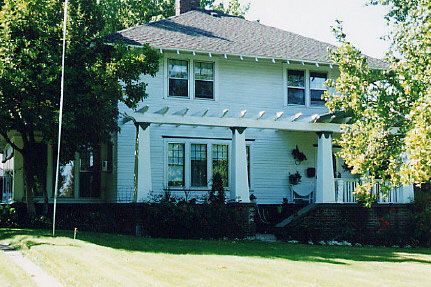
Henry and his brothers grew up in a large (4,000 square foot) home built on nearly 2 acres not long after Jessie and A.F. were married in 1911. The white wood-frame home at 102 Park Avenue had three bedrooms and a three-sided sleeping porch with huge sash windows that nested completely flush with the upper and lower window casements, designed to catch any breath of a breeze during the long, hot Yakima summer nights. Outside, it was embellished with a trellis, which Henry used to sneak out at night. The yard had a big expanse of grass which the boys would have helped to mow; they were also responsible for helping to maintain the many fruit trees:

The hardest thing I did was having to thin the pear trees or peach trees out in back, in mid summer. The fruit grew in clusters. Instead of six or eight in a cluster, you’d remove some so they would grow bigger. Hot! Sweaty! Peach fuzz all down your back! Miserable.

I also took out the clinkers in the winter. We used to shovel the coal, get up in the morning, shake the coal down. When I was about 10, Dad bought an iron fireman. What an iron fireman does is automatically feed the fine pea-coal into the furnace. Overnight the cinders would clinkerize, build up a hard, foamy detritus cinder or ash. I’d take those out every morning before I went to school.

Henry’s relationship with his older brother, Bill, and other boys, was sometimes contentious. Slight for his age, he was determined to build up strength, which he did by swimming in the open irrigation ditch that ran along Park Avenue with a current about the speed of a brisk walk:

I started swimming in the ditch, which had several benefits. One thing it did for me was it made me refine my style, using a flutter kick instead of a scissors kick, because it works better. I switched from kind of a half side stroke to a straight crawl. At first, I would swim up from the swimming hole to the bridge across the ditch at the Parson’s house, which was probably 50 yards, against a 3 or 3 ½ mile current, and then I’d drift back down. And then I started going to the Park Lane bridge, another 50 yard stretch. And then finally up to the siphon at Summit View. After a couple of years I would do that three or four times – swim out and drift back. That did a lot to build up my muscular strength in my shoulders.

Henry remembered life at home in a 2000 interview:

I remember Sarah, the black cook, a fine woman. I spent a lot of time in the kitchen. She was a very affable person. This was before the Depression, which hit us about 1930 or ‘31. There was also a woman, Hallie, of indeterminate Nordic ancestry. Big woman, somewhat plump. Dad fired her because a man stayed one night in the basement with her.

Dad would get home from the office about 5. He was a dentist. He would mix himself a mint julep with nothing but the best straight bourbon whiskey. I asked him once, ‘What do you think about Scotch whiskey?’ He said, ‘Son there’s only one thing worse than Scotch whiskey and that’s Irish whiskey.’ He would have one or at most two, and dinner would be served promptly at six. We all sat at this big table; I sat on the west side, Dad was on my right at the south end of the room. Then Bill, then Ed, then Mom. We all had dinner. Everybody talked but the kids.

Henry, who maintained a life-long love of hunting and fishing, was exposed to both by his Dad, although he wistfully wondered, late in life, why his father did not seem to want to spend time with his sons engaged in these pursuits. A.F. was often in the Yakima paper for his outdoor sports accomplishments — breaking 96% of 1,125 targets in a trap-shooting tournament, capturing the record for the largest fish taken with tackle in Lake Keechelus (a 29″ Dolly Varden trout weighing 10 lbs.), catching the largest Chinook salmon in the Tieton River (40 1/4″) — and his expertise in bridge.

I must have been 6 or 7 when my Dad bought me a BB gun. I would get up in the morning very early, 3:30 in the morning. I’d walk up our backyard through the Howard place behind us and into the Gibson’s orchard, and hunt sparrows. English Sparrows were anathema in an orchard. Then I graduated to bigger birds; if it moved, I shot it. I could injure a Robin but I couldn’t kill it because they were too big. We had a big wisteria over our back porch, gorgeous in the summer time. In the winter, of course, it was just a bare framework. Mother’s bedroom overlooked that on the second floor. So I could get up there, open the window, and get the juncos that would roost up there.

One of the most embarrassing, even shameful, occurrences when I was 13 and I went duck hunting for the first time, down in the lower valley, below Toppenish, just off the highway that goes over the hill to Goldendale. Dad belonged to a duck club there with maybe 8 or 10 members. There were two big ponds. The big one was maybe half a mile long and a third as wide. So there was room for a number of duck blinds. Dad liked to hunt on the upper, smaller pond because there was usually no one there. He never gave me instruction on how to shoot. He just gave me the gun and turned me loose. The shame of my early period was shooting some ruddy ducks. They flew in and sat down out there and my Dad told me to shoot them. “What do you mean shoot ‘em? Dad, they’re out in the water, they’re sitting.” He said, “I know that. Go ahead and shoot ‘em!” I didn’t want to do that because it wasn’t sportsmanlike, I’d read that in a magazine. You only shot birds on the wing. So finally he urged me and I did it, and I killed one. When I went to pick it up I was so shame faced I haven’t forgotten having done that to this day.

I’m guessing I was 10 years old Dad when gave me a 22. The NRA had a junior rifle club. My brother Bill and his running mate Jack Callahan went up to Cowiche Canyon. (Jack’s father had a dry goods store in town; come the crash of ’29, his father killed himself. Apparently he left enough to take care of Jack and his mother.) It’s a narrow cleft. We would get out on the ledge on the shaded side and, looking across at the sunny side, watch for the rock marmots to come out and sit in the sun. It was about 75 yards across, a long shot for a 22. The marmots used to raise hell in the farmers’ alfalfa fields, so they welcomed it. The object was to hit them in the head so they couldn’t crawl down into their burrow. If they crawled down, you lost; if they just laid there and twitched, you won. Very politically incorrect these days. We used to go to a place just south of the duck pond to hunt jack rabbits. You would take a shot at one, and if you missed one, he would run around. But they will circle. So you’d get them when they ran back around. That takes a bit of doing. I once shot a crow down out of the air with a rifle, and a pheasant. That’s instinctive shooting.

1935 was a fabulous year for birds. There was a big drought in the east. I theorized that they came west to get away from it, but I doubt that could be true. One day, early on that season, the limit of ducks was 12.  There were 12 hunters. We went out and we were all back at the clubhouse within one hour with a full limit of ducks. Except for one hen, they were all green mallards. The sky was lousy with birds. I remember shooting two doves, one with each barrel. I took one with a right barrel and one with a left barrel, swinging.

My Dad was an avid sportsman. He was a great fisherman. He would take his buckboard and drive up through the Naches, up into what is now Cliffdale, and fish the Naches River, the American River, the Bumping River, and the Tietan River. He often stopped off at Aunt Nell’s place in the Nile valley. They were pioneer types, fairly elderly. He told the story about getting up one morning and going out to the front porch. By the front door was a rattlesnake lying in the sun, so Dad killed it. Aunt Nell came out a little later, and said, “Oh, doc, what would you do that for? Poor little fella didn’t mean no harm.”

Dad occasionally took me fishing up the Yakima. I was with him when I caught the biggest trout I have ever taken out of the Yakima River. The next day, dressed (de-gutted), it weighed 3 ½ lbs. It had to be a 5 lb. trout.

High school

Henry was moved ahead two grades growing up, and lamented that he got nowhere with the girls, not even Suzanne Bartlett, the neighbor across the street, whose mother seemed to have second sight any time he came close to being able to make any kind of amorous advance. Henry described his high school experience:

I was 16 when I graduated in 1933. I entered into senior year at 15, which is much too young. I remember going to the principal’s office for tutoring. The principal used to send for Jack Hollen and I to go up to the top floor for arithmetic tests to see how we would do. We were the whizzes in class at that. If we were to do a sum in our head, Jack was quicker than me by a heartbeat or two. If it was on paper, I was quicker by a heartbeat or two.

He did have a coterie of guys with whom he enjoyed outdoor activities and other pastimes:

Kenny Colvin was a small man but very athletic in nature. One of our classmates, named Jack Hawkins, whose Dad ran a paper supply house providing paper for fruit packers, tackled him on the steps of high school – something like that – and wound up crippling Ken. That pretty well killed his athletic aspirations. 

We used to play a lot of poker with George Crum and George Sears. The Sears family owned a big hardware store in town. George Crum’s family didn’t have a dime. The mother was widowed. They were skinning by the best they could but he was a real bright kid, and a good friend of mine. I was friends with Dick Jacobs, possibly Bob Barks and one or two others on the periphery including Craig Walker. I remember when George Sears got in it for the first time – we were teaching him how to play – and we got into a betting situation. I had folded my hand by this time. Someone was holding a flush. And George, not quite know what he was doing, was betting a buck or so. George called his bet, saw the other guy’s flush, and said, “God, I’ve got nothing but a full house.”

It was with these friends who Henry ventured out after high school graduation to hike the Sand Ridge Trail, starting out from Rimrock Lake —  a 20 mile hike over challenging terrain. When he returned, Henry said that he sat down and polished off an entire loaf of bread and jar of jelly. “Nothing ever tasted so good,” he said.

College years

Henry first attended Yakima Valley Junior College before transferring to the University of Washington. Free from the strictures of home and enjoying his membership in the Alpha Delta Phi fraternity, he apparently did not cover himself in glory academically and came close to being brought home by his father.

Henry begged his father for his indulgence and a second chance to remain at the university:

2-17-37

Dear Dad:

I received your letter.  In answer to it I have no defense, no have I anything I can honestly say in my own defense, except this one thing — if you feel that in the name of whatever faith you have left in me, you will give me the remainder of this quarter, I will prove to you in fact – not words – that that faith is justified.  If I fail to do so, I shall no longer ask for support from you, except such as you, out of charity, extend to me until I can get a job.

Dad, I could write you begging for babying, and give a lot of reasons why I am “different”, “misunderstood”, but whatever seems to me to have gone from my makeup, and whatever my stupidity has merited, at least I have pride enough left – foolish as it may be – to deal honestly with you.  Were you different than you are, I probably would have done just that, but it is impossible in view of the fairness with which you have dealt with me.

Dad, I rather hesitate to write this, because I don’t know whether I can express in words what I feel or whether you will accept it in the objective and impersonal sense in which I mean it.  Nevertheless, it is simply this: that right now there is nothing I want so much in the world as the faith, love and respect of you and Mother.  If I cause you to lose that, then I frankly feel no purpose in pursuit of life, or any further exertion, because when those things go, with them goes my self-respect, and that gone, I should have nothing.  I hope you can understand what I mean, that you don’t consider it simply poor melodrama in an attempt to work on your sympathies, because in that event this were better not written.  In any case, this is the last you will hear of anything of the sort.

May I then repeat that I ask only this next month’s indulgence, and that, if I fail, I shall remove myself as quickly as possible from your responsibility as no longer worthy of your consideration.

Your loving son,

Henry

A.F. apparently wrote the Dean of Students, who wrote back saying that, as far as he could tell, Henry was a fine young man, and he should be given the benefit of the doubt. Henry stayed.

Henry’s career goals at the time were not of his own making. His family had determined that he would become an attorney. What he loved was literature. As an adolescent, he had discovered “classics” like the ribald Rabelais. (Though a 16th century writer, its humor was apparently attuned to adolescent boy humor 400 years later.) Henry continued to be amused by this passage about the gigantic baby Gargantua who underwent a process of experimentation to discover a “rumpswab”:

I affirm and maintain that the paragon arsecloth is the neck of a plump downy goose, provided you hold her head between your legs…. You will experience a most marvellously pleasant sensation in the region of your scutnozzle, as much because of the fluffy underplumage as because the bird’s warmth, tempering the bumgut and the rest of the intestines, actually reaches your heart and brain.”

Henry moved on to Shakespeare, developing a particular fondness for Macbeth.  Eventually that love of literature enabled him to cross paths with Eileen during his senior year at the University of Washington. Henry vividly remembered that spring, when co-eds shed their coats and tweeds to wander the Arboretum in their “diaphanous skirts.”

They called Henry “love in bloom.”

1 Comment

Filed under Family history, Uncategorized

My Father’s War

Henry at the 23rd Marine's base camp in Maui, 1945

Henry at the 23rd Marine’s base camp in Maui, 1945

(Third in a family legacy series. In the second, I tried to imagine what Mom’s experience must have been like on the home front, which I titled, “My Mother’s War.”)

Like many men of the Greatest Generation, Dad was always quick to deflect attention from his accomplishments during the war. The real heroes, he said, were the guys who were wounded or died. As a child, I morbidly wondered if he ever killed someone. So far removed was it from my experience that I thought of it like something from a movie. I never found out if he did, never asked him, perhaps because when the topic of the war arose, there was always a pause. For a moment he seemed far away, remembering scenes, perhaps. Or people.

Only in the last 15 years of his life did he share information about his role during the war. Even when sharing relatively lighthearted stories, he would often be moved to tears as memories welled up.

After instructing recruits at the base in Quantico for two years on rifle marksmanship, bayonet training, mortars, map reading, nomenclature, and cleaning of all the military weapons, he received orders to join the 23rd Marines, 4th Marine Division in 1943.

He was to serve as R-4, Regimental Supply Officer.

When I was young, I didn’t think being a supply officer sounded very exciting. But Dad would put it in context for me, explaining, “Your intelligence officer tells you what the enemy can do, while your supply officer tells you what you can do.” The supply officer’s job is to ensure combat readiness by having the personnel and materials in the right place at the right time to achieve the combat objective. The lack of food and supplies confounded Gen. Robert E. Lee on his northernmost advance to Gettysburg, and we know how that ended. Had the Confederate Army had adequate supplies, things might have turned out very differently.

Dad’s explained his first assignment, loading a ship in San Diego in preparation for the 4th Marines’ deployment to the battle lines in the Pacific in December 1943 or January 1944:

“I was told to take a communications group and establish an advance command post with about 15 guys.  Rhett Williamson was S4 Supply and Logistics Officer.  …He had stuff coming from five places.  The first time I know about it is a truck shows up at the gate for instructions.  We start getting these loads of stuff.  Loading should have been pre-planned.  Rhett isn’t down on the docks.  It’s chaos unless I do something about it.   This went on for 10 days.  When we got through, we were the only ones in the U.S. who knew what we had and where it was. Louis Jones, Regimental Commander, asked Rhett what was going on and kept him standing there until 4 a.m.  Then he said, “Campbell, you are now R4 (Regimental Supply Officer).

“We got it all on there.  At 2 a.m., I got a call at the gate.  ‘We have a load of explosives on there.’  The Commanding Officer said he didn’t want any explosives on the base without him knowing about it.  So I called him at 2 a.m.  I never heard from him again.

“At 6 p.m., we’re all loaded up.  We were supposed to leave at 8 a.m.  At 7 p.m., a truck shows up with ammunition.  I asked him what was in the trucks.  He said enough for a round of fire for an entire regiment.  So I told them to unload the ship, put everything on the dock, and put the ammunition in the boat.

“That’s how you load a ship. You figure out what you need in terms of beans and bullets.  You figure out what you need first and put them on last. We disembarked right on time.”

According to John Costello writing in The Pacific War 1941-1945, the 4th was to participate in Operation Flintlock, the plan to assault Japanese positions in the Marshall Islands that were being used as bases for ships, submarines and air staging. The battle plan was hotly debated because of the bloody lesson of Tarawa, which had resulted in heavy losses.

The plan called for attacking two positions in the Kwajalein atoll. Roi-Namur, the northern objective, was made up of two islands connected by a narrow causeway. In alignment with battle tactics learned the hard way based on the first two years of the war in the Pacific, the islands were blasted by battleships for three days before the amphibious landing.

Now S-4, Dad’s job was to get materials ashore. He secured a boat driver and chose to land supplies after the first wave of infantrymen but ahead of the next wave.  Company Commander Shelton Scales’ jaw was said to have dropped when he landed on the beach and found Dad there ahead of him. The attack that began on Jan. 31, 1944 was mopped up by Feb. 3.

Saipan was a challenge of a different order. The Battle of Saipan was part of “Operation Forager,” which aimed to sieze Saipan, nearby Tinian and recapture Guam in the Marianas. According to Costello, “Operation Forager’s 535 ships and the 127,571 troops assigned to the American assault in the Marianas made it not only the largest force yet assembled for any naval operation but also the instrument of a new phase of the war.”  Now American troops would attack well-defended bases of Japan’s inner defense line rather than pulverize atolls.

Bombardment began June 13, 1944, and D-Day was two days later. With over 3,000 killed and 10,000 wounded, it would become the costliest operation for American forces to date – but that cost paled in comparison to Japanese loss of life. Five thousand Imperial Army soldiers died in suicidal Banzaii attacks, and an estimated 22,000 civilians died, principally because their shelters were in harm’s way and indistinguishable to Marines who cleared suspected bunkers with explosives. Even more horrifying, an estimated 1,000 women and children jumped off a cliff to their deaths based on orders from Emperor Hirohito suggesting they would be heroes on a par with soldiers in the afterlife if they did not surrender. Taking Saipan took six weeks.

Dad received his first Bronze Star in 1944 for his efforts on Saipan. The citation read: “By his initiative, perseverance and outstanding ability, he not only provided by proper planning for the supply of his organization but during the early phases of the Saipan operation while beaches were congested, under heavy hostile gunfire, and threatened by Japanese counterattack, he through several sleepless days and nights not only insured the combat supply of his own unit, but also supplied other units for whom immediate supplies were unavailable…. During the entire operation on Saipan, lasting for a period of approximately one month, never once did his regiment suffer for lack of supplies or equipment.”

As costly as Saipan was, it brought Tokyo within range of B-29 bombers.

Operation Forager continued when, two weeks later, two Marine divisions landed on Tinian on July 24. Costello wrote, “Inside a week the Marines had won control of Tinian with only four hundred casualties, in what General Smith was to call ‘the perfect amphibious operation of the Pacific War.'”

Here’s how Dad described it to me in 2000:

“Tinian was heavily defended. Although there were good landing areas on the south side of the island, at the Corps level, they decided against landing there and instead chose a small landing beach about 100 yards wide. They figured they could get people on the beach and it wouldn’t be defended.

“D-Day was 7 a.m. Scads of landing craft were offshore. My regiment was in reserve for landing since they were part of the assault on Saipan. They were supposed to move in behind the initial troops. The initial landing proceeded okay. The 2nd regiment was supposed to land – to come through us and proceed.  We were supposed to wait until after they were off of the causeway.

“I borrowed a jeep and talked to Col. Jones.  He said, ‘Campbell, I want all communication vehicles and anti-tank guns ashore.’  I took a boat to talk to the control officer, Col. ‘Jack’ Horner.  Col. Horner said, ‘Campbell, I’ll get to you as soon as I can.  I have to land the 2nd regiment ashore.’  I told him, ‘Col., we’re astride.’  He said, ‘Campbell, I told you I’d let you know—now goddam it, get off my boat.’  I looked for a hole and put my men ashore.  When I told Col. Horner later, he threatened court martial.

“The main attack came in that night. Regimental guns killed 600 Japanese that night with 36 mm anti-tank weapons that shot canisters of grape shot. It didn’t last long.  Our counter-attack broke their back at the end of August.

“We found beer in a Japanese dugout.  Every man in the regiment got a bottle of beer and the rest went to Division.

“Saipan is where the Japanese jumped off a cliff rather than be captured.  They believed they would be tortured by the U.S. The remaining pockets of resistance ranging from squad- to platoon-sized raised hell – it was really dangerous. Our battalions were spread out on the North end.  At night we formed a defensive perimeter.

It was on Saipan where Dad experienced what he called “the hairiest situation”:

We had overcome the emplacements and had set up three or four encampments along the plateau.  At night, the Japanese who were still loose on the island would open fire.  Every night gun battles would break out.  LtC. E.J. Dillon, who was no friend of mine, would call and tell me he was out of some supply – like illuminating shells.  I was the supply officer, and it wasn’t really my job to get it to him, but as the senior supply guy, I felt responsible.  So I’d reconnoiter a jeep. It galled me that I didn’t have one assigned to me like some officers who could swan around in theirs with some burly guy sitting on top of the supply boxes with a BAR.  This required going across ‘no man’s land,’ the narrow perimeter of the island.  I’d been over the road once but I really burned rubber with a 45 in one hand. We’d head out in the dark down the long road to deliver the shells.  I could imagine an ambush anywhere. Never had a problem but I sure felt grateful to have my skin by the time the war was over.

1945 V mail

Henry’s V-mail to his parents on August 3 from Tinian:

It’s been a long time since the last letter, and since I wrote it, the battle for Tinian has been fought and won, although we are still mopping up. Things will relax a little now, I xpect, so you can expect to hear from me with more regularity than in the past.

This will serve to do little more than advise you that I am perfectly OK, and so far unscathed. The Tinian fight has gone considerably easier than Saipan, but I’m glad that it’s over – it was officially announced secured night before last, although mopping up still continues.

You letters – from all of you – have been arriving as the mails do, and they are always eagerly read. I’m glad Eileen could be with you as long as she wash – wish I could have been there too. However, even though I could not, I feel I was well represented. It must have been a lot of fun, and from your letters and Eileen’s, everybody had a pleasant time of it.

As for myself, I am – as I said OK, and am at the moment enjoying a little relaxation. That won’t last, of course, — R-4s, like woman’s work – is never done. Any staff officer is in that position.

Sometime soon I expect I’ll be getting around to putting own on paper such account as I can give of the Saipan and Tinian operations, but don’t look for any spell-binding report. It’s mostly hard work, the excitement is occasional, and then not very exciting in the re-telling.

I send you all my love. It is a wonderful feeling to have a family like mine safe at home.

Your loving son,

Hank

Source: The Pacific War: 1941-1945, New York: Atlantic Communications, 1981, p. 669

Source: The Pacific War: 1941-1945, New York: Atlantic Communications, 1981, p. 669

The 4th Marine Division had a chance to recover after Operation Forager’s success, not seeing action again until February 19, 1945. Other Marine divisions, however, were plenty busy, especially on Peleliu where the 1st Marines engaged in battle that was bloodier and more grueling than Guadalcanal. Col. Chester “Chesty” Puller’s 1st Regiment clawed up a cliff, under fire from Japanese who rolled grenades down on them from caves, gulleys and holes, costing the regiment a third of its strength. Peleliu was taken on Nov. 25, 1944.

According to Richard Newcomb, author of Iwo Jima: The Dramatic Account of the Epic Battle that Turned the Tide of World War II, it was inevitable that the Allies would have to take Iwo Jima. To attack Japan, it would need the island as a fallback for B-29’s. Iwo Jima was the only island in the area capable of supporting several airfields, an objective of the mission. It would be the first American attack on Japanese home territory.

When Dad talked about Iwo Jima, he usually started by describing its long, narrow beach of volcanic ash (described as a sticky, glue-like substance) over which Mt. Suribachi and the cliffs loomed, riddled with Japanese defenses. Iwo was a stone fortress. Violating Japanese military doctrine, the island’s defenders developed a plan to wait until Americans had penetrated 500 yards onto the island. Then and only then would weapons open fire from the airfield, supported by artillery on Mt. Suribachi and the plateau. Sixteen miles of tunnels connected Japanese concrete artillery emplacements. After initial fire, the guns at the airfield would withdraw to the north.

Bombardment of Iwo began on June 15, 1944. The 4th Marine Division began landing at 8:59 on D-Day, February 19, 1945, against high winds and four foot surf.  Here’s how Dad described it in 2000:

When we pulled in offshore, the light was growing.  You’re up on the deck.  You see this ungodly ghostly tower rising 600-700’ in the air.  It was a volcanic spire, the goddamnedest thing I ever saw.  Scary.

“The island was shaped like a pork chop.  It was a volcanic mound with steep sides, honeycombed with caves.  It overlooked the beaches we landed on – the Japanese had perfect visibility.  Down at the far end was another escarpment looking the other way.  We had one fine officer who took a posthumous award for scooping up men without leaders and taking the key point (Chambers).  They got all shot up.

“High velocity anti tank guns were looking right down at the beach.  It was probably 500 yards or more from shoreline to airfield.  It was D+2.  We were in a pillbox, our first command post.  The gun opened up.  There was a tremendous concussion over my head, sand came down.  I think a round bounced off the ground on top of the command post.

[The 4th Marine Division could only advance some 50 yards on D+2 as it pushed northward, experiencing high casualties as it attempted to clear pillboxes, caves and tunnels.]

“The next night, the Japanese had mortars – 240 mm – as big as a trash can.  You’d see it go up.  You wouldn’t know where it would come down.  They dropped one about 30 yards outside the pillbox.  It lit into a crater where we had 15-16 people. Just like that, they were gone. We lost some very good men, some who were friends of mine.

[By the end of D+3, the 4th and 5th Marine Divisions had suffered a combined 4,574 casualties.]

“The longest walk I ever went on – I don’t know how far in miles or yards – was on Iwo Jima.  We were in reserve because we’d been all shot up.  We’d probably lost a third of our troops by then.  My job is to prepare to take over, so I need to know where everyone is, their weaponry, etc. I had to walk alone to the command center from my division’s headquarters.  It seemed like miles, but I wonder how long it really was.  I went to collect our orders and check the situation map.  The map was surrounded by people and it was hard to get much of a view.  Periodically, however, the Japanese would start shelling and while everyone scattered, I could copy the map.  Worked great.”

Iwo Jima, and its specific objectives, earned gruesome nicknames – the Red Island, Blood Beach, etc.. The 4th Marine Division faced formidable defenses in Hill 382 (for its elevation), which would become known as the ‘Meatgrinder.’

Although American forces had overwhelming superiority, Iwo Jima was the only battle by the Marines in which the overall American casualties exceeded those of the Japanese. American losses reached 6,821 with another 19,217 wounded. Dad received his second Bronze Star with “V” for Valor for his efforts as operations officer, 23rd Regiment, 4th Marine Division.

For its actions against enemy forces during the war in the Pacific, the 23rd Marines received the Presidential Unit Citation Streamer with one Bronze Star,the Navy Unit Commendation, the American Campaign Streamer with four Bronze Stars, and the World War II Victory Streamer.

The 4th Marines were pulled back to base camp on Maui to reconstitute their ranks, which had been decimated by the campaign for Iwo. After receiving an ultimatum threatening Japan with “prompt and utter destruction,” American airman dropped the atomic bomb on Hiroshima on August 6 and on Nagasaki on August 9. On August 15, Emperor Hirohito announced his acceptance of the terms of the Potsdam Declaration, kicking off a national frenzy of celebration and kissing servicemen. The Instrument of Surrender was signed by the Japanese on September 2 aboard the USS Missouri.

It’s hard to imagine that the war did not change Dad. It must have. But as he explained to Mom in a letter, “…it is as if there is a hard shell around me and that ALL of this present life went on outside me.”

He came home.

4 Comments

Filed under Family history, Marines and those who serve, Uncategorized

When the USMC Faced Extinction

The USMC Commandant testified to Congress against marginalizing the Marines

The USMC Commandant testified to Congress against marginalizing the Marines

I could have titled this post, “Dad’s Other War.” Though my father shared anecdotes about some of the back room haggling that went on during discussions about potential unification of the Armed Forces, I had no inkling of the depth of those discussions. During two assignments at Marine Corps Headquarters – the first in 1946 and the second in 1959 – he was in the thick of it.

Then I came across an article Dad had clipped and saved, “The Marine Corps Fights for Its Life,” by Richard Tregaskis, published in the Saturday Evening Post. Tregaskis was one of the first embedded journalists, and his book about the first 45 days on the island of Guadalcanal with the 1st Marine Division ranked on the New York Times bestseller list and was made into a movie.

The article began, “Why are the Army and the Air Force trying to humiliate the Marines by reducing this proud outfit to the status of a police force?”

As sensationalistic as the lede was, it was not hyperbole. Tregaskis reported that the Joint Chiefs of Staff were meeting secretly to consider papers that were later made public when introduced at a House-committee hearing.

The article published this excerpt from a memorandum to the Chiefs of Staff by Gen. Eisenhower (US Army):

The following is proposed for consideration…. (1) That the Marine Corps is maintained solely as an adjunct of the Fleet and participates only in minor shore combat operations in which the Navy alone is interested. (2) That the land aspect of major amphibious operations in the future will be undertaken by the Army, and consequently the Marine Corps will not be appreciably expanded in time of war. (3) That it will be agreed the Navy will not develop a land army or a so-called amphibious army. Marine Corps units to be limited in size to the equivalent of a regiment, and the total size of the Marine Corps therefore limited to some 50,000 or 60,000 men.”

Tregaskis also included an endorsement of Ike’s proposal by Gen. Carl Spaatz, who added that the Marines should be “lightly armed” with its roles and missions only “to protect United States interests ashore in foreign countries and to provide interior guard of naval ships and naval shore establishments.”

In other words, naval police.

The Marine Commandant, Gen. Alexander “Sunny Jim” Vandergrift, asked Congress to save the Corps and pointed out that the Marines have been engaged in nearly every battle since the nation’s founding. He counterattacked with this statement:

“The bended knee is not a tradition of our Corps. If the Marine as a fighting man has not made a case for himself, he must go. But I think you will agree with me that he has earned the right to depart with dignity and honor, not by subjection to the status of uselessness and servility planned for him by the War Department.”

The Senate and House passed two different unification bills. According to Tregaskis, the House bill guaranteed roles and missions for the Marines and Naval aviation, while the Senate bill did not. When the bills went to a joint conference committee, the consensus was ultimately to preserve the Marines’ role. An unnamed Marine officer was quoted as commenting, “Few Marine officers will ever realize how close the Marine Corps had been to virtual extinction.”

When I interviewed Dad about some of his memories in 2000, he shared this story about a proposal to unify the forces:

I’d been in grad school at Ohio State in personnel administration and training.  I’d been assigned to the Military Occupational Project.   The joint staff at the end of WWII recognized there are people with very highly placed skills who end up being misplaced during the war.  They needed more information about what jobs require people with high level skills and who the people are with those skills.

“They had 300 people working on it, led by Col. Dunn.  Because I’d been to advanced schooling, I was assigned as the Marine Corps’ representative.  The joker is that I had Marine Corps HQ looking over my shoulder.

“The thing got bent around so that they decided to divide people by intelligence, based on their score on a test.  Navy said, ‘We have all the ships, we should have all of the brightest people.’  Air Force said the same thing.  Army said, ‘Bullshit!’  That’s what pulled the thing apart; they couldn’t agree.

“I convened a meeting with one representative of each force.  The Army guy was completely out of his depth.  Rubens [offering a proposal that was a ringer] asked, ‘Can we agree to this?’ If we agreed to the principles to take all the bright guys and give them to Navy or Army, what would the consequences be?  It was apparent this was a trap.  I said, ‘I’d like to say a few words.  Recognize that if we agree to this, we have agreed to everything else.’  All realized they needed to confer.  Rubens offered me a job!”

Postscript: According to the United States Army War College Strategic Studies Institute, the National Security Act of 1947 resulted in coordination of the services without merging them. And discussion continues. Deliberations about implementation of the 1986 Department of Defense Reorganization Act “demonstrated that the services are still distinct and independent, despite certain movement toward unified operations and joint organizations.” The Strategic Studies Institute website page notes: “…the [Department of Defense] must ensure that the services are not so reduced in stature and influence that they lose their motivations and abilities to compete for scarce defense resources and accomplish their other national security roles and functions.”

Dad told me, “You can see why I hated to leave the Marine Corps.  I had an absolute ball.”

Semper fi, Dad. You did your part.

Leave a comment

Filed under Family history, Marines and those who serve

Family Life with the Marine Corps

(Fourth in a family legacy series. Subject to revisions by my brothers!)

After defeating monstrous evil in the world, modern America breathed into being in the last gasps of 1945. As Life magazine noted in its special edition celebrating the 50th anniversary of the war’s end, Bogie married Bacall, Jackie Robinson was hired by the Brooklyn Dodgers and Bess Myerson became the first Jewish Miss America. Detroit wasted no time gearing up, producing 2.1 million cars, a 2,500% increase, in 1946. With a half million people living in quonset huts and many more bunking with relatives, the GI Bill’s mortgage program sent people flocking to newly created suburbs.

Eileen settled in with Hank, Scotty and her mother in Alexandria, VA.

Eileen Campbell and Scott

Eileen – and most likely it was Eileen who set the schedule – gave the couple 18 months before saying “oh what the hell” and conceiving Bruce, who was born June 29, 1947. (An alternative explanation was a miscarriage, which she mentioned she had somewhere along the line.) Although he was a healthy, happy boy, Eileen and Hank must have been concerned for the surgeries he would have to undergo to repair a cleft lip.

Bruce Campbell

Eileen, Madeline, Scotty (now five) and baby Bruce settled in to life as a normal post-war married couple.

Eileen’s photo albums from the late 40s seem to be lost, but she undoubtedly enjoyed the freedom from the many wartime restrictions on the purchase of food, stockings and fabric for dresses.

Hank took up his post in the G-1 Division at Marine Corps Headquarters in March 1946, the group that included the Commandant and various staff functions. He landed at HQ just as a lively discussion began about the possible unification of the four Armed Forces. Perhaps that’s why Henry always corrected someone when they suggested he was in the “military”; as far as Henry was concerned, he was a Marine. In 1945, Adm. William Halsey was quoted as saying, “One might just as well as a committee composed of a Protestant, a Catholic and a Jew to save our national souls by recommending a national church and creed.” The discussion about unification continued into the late 1950s as the cold war raged.

In 1949, the family moved to Worthington, Ohio for just over a year when the Marines sent Henry to the Navy Post Graduate School at Ohio State University in Columbus. By then, Eileen was pregnant, and their daughter Madeline, known as Midge, was born on January 18, 1950.

Madeline Elizabeth Campbell - first year photos

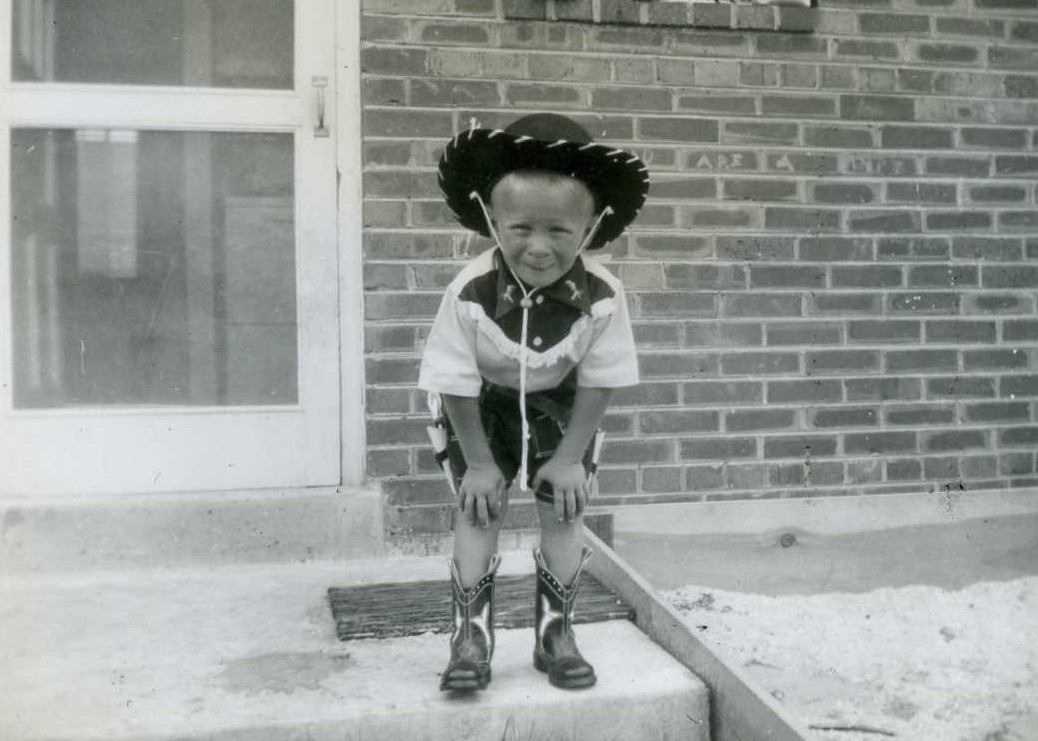
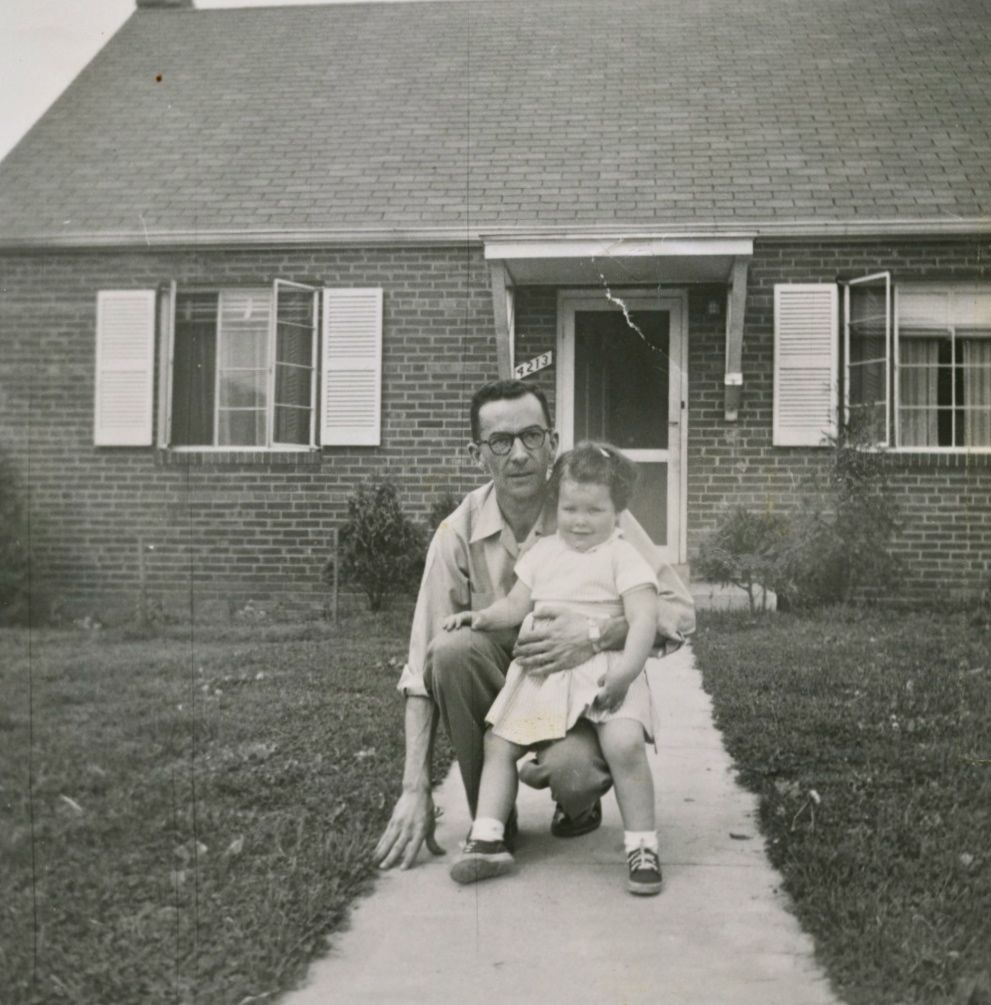
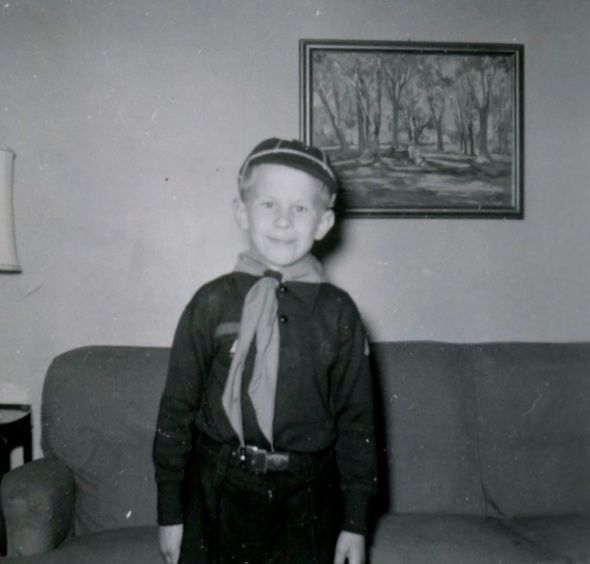
After completing his course work in Ohio in 1950 (personnel administration and training), Henry was assigned to the Office of Manpower Utilization at the Department of Defense, with offices at the Pentagon. Eileen packed up again, and moved the family into 4213 Matthews Lane in Kensington, MD, which had become a commuter suburb for Washington, DC. They jumped back into the fray, getting Scott established in school and signed up for Cub Scouts.  As Den Mother, Eileen led a summer project making “Indian” outfits and war shields (cotton muslin stretched over hoops). Meanwhile, Bruce played cowboy, refusing to take his boots off, even at night.

Bruce's 4th birthday

Bruce’s 4th birthday

It was during Henry’s duty at Department of Defense that the couple suspected something was wrong with little Midge. Henry’s brother, Ed Campbell, a hematologist-oncologist in Boston, diagnosed her as having leukemia. At the time, nearly all children with leukemia died (compared to the current survival rate in excess of 80%). Uncle Ed treated Midge with an experimental regimen of corticosteroids, supervising her care and that of other children at Walter Reed Hospital. Her pictures show her growing progressively heavier as a side effect of the medication.

Uncle Ed with Midge

Uncle Ed with Midge

As Midge became sicker, the family spent as much time together as possible, including treasured days on vacation in Rehoboth Beach, Delaware during the summer of 1953.

1953midgemomdad copy

Henry’s most painful memory wasn’t the war. It was Midge’s final days. After being in remission for a period, she sickened and was in an oxygen tent in the hospital. He remembered her calling out to him, “Daddy, help me.” He could do nothing, he said, and pounded his head against the wall in the hallway in frustration. She died on October 22, 1953, months before her fourth birthday.

In February 1954, having delayed his departure as long as possible, the Marines sent Henry on a solo tour to Gifu, Japan, where he assigned to serve as Division Assistant G-2 for the 3rd Marines. In rapid succession, he became Executive Officer of the 9th Marines and then Commanding Officer of the 2nd Battalion, 9th Marines.

Eileen had learned she was pregnant about the time that Midge’s health deteriorated. Medical officers advised her to abort the baby, suggesting that the stress would be too great for her. She would have none of it.

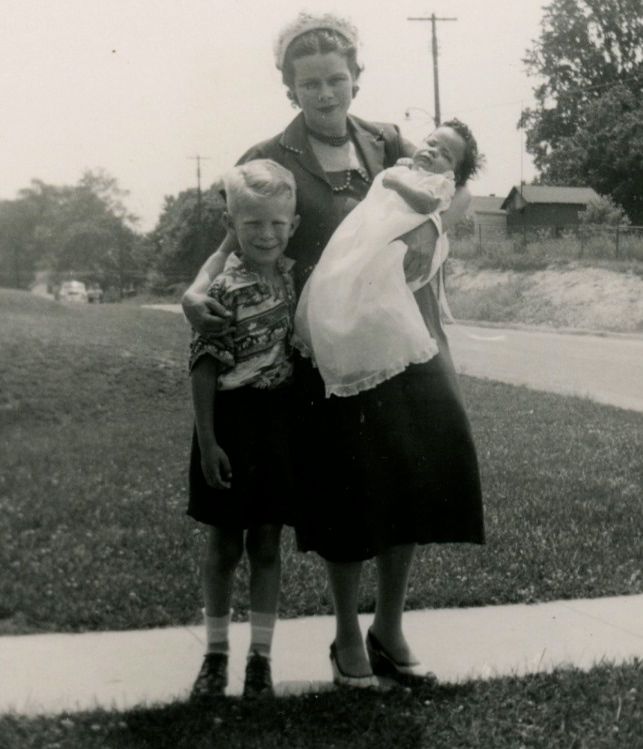
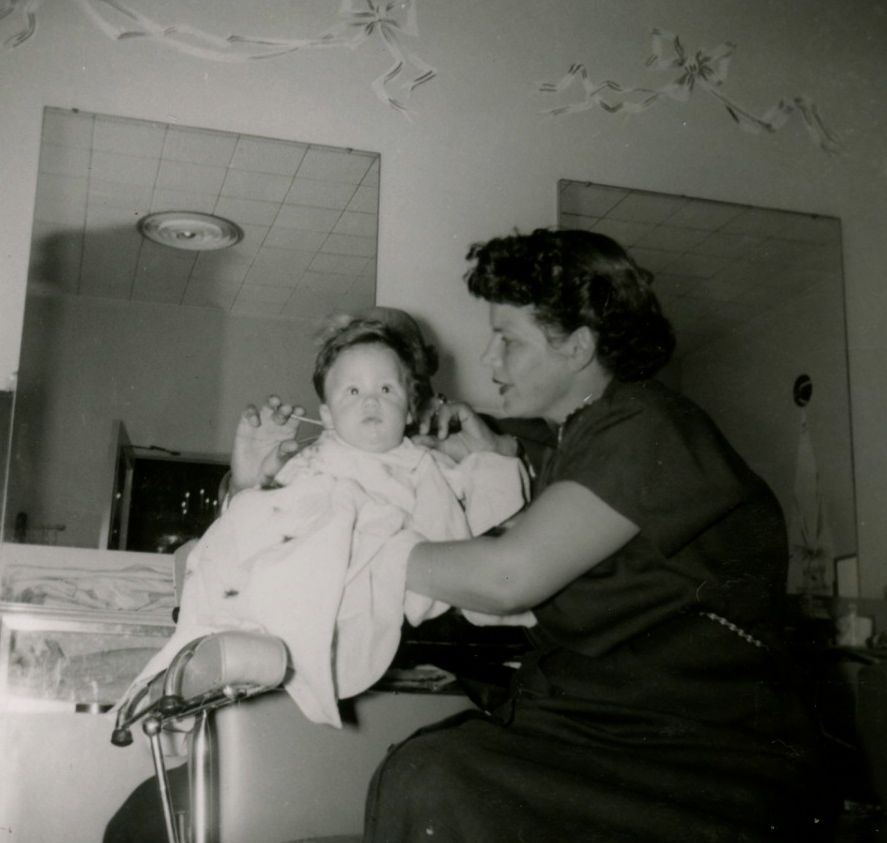
Henry’s letter to Eileen from Gifu, lost during his move to California, spoke of his agony in not being able to be with her in the period of mourning following Midge’s death. When Dean was born on April 20, 1954, “it was as if the sun came up,” Henry would say later. Within weeks, Dean needed a haircut.

Dean's christening

dean's first haircut

Scan

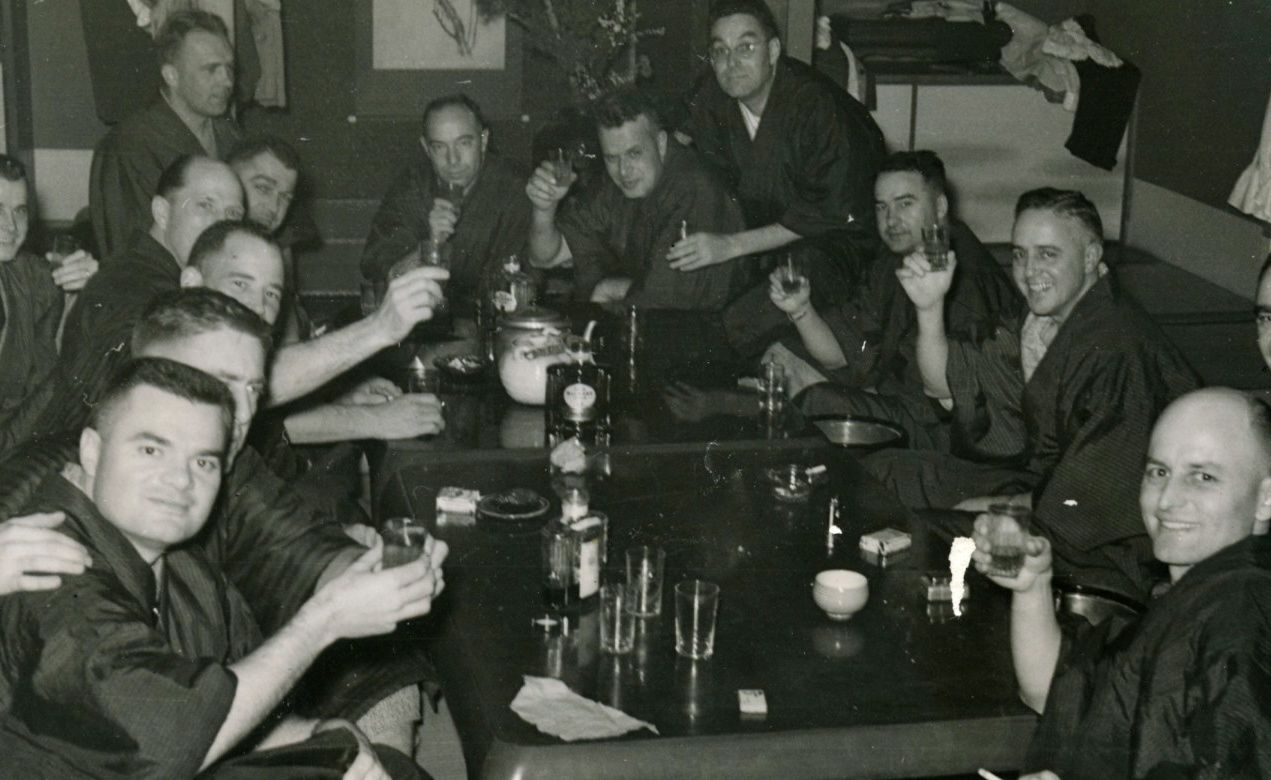
Henry’s pictures and stories suggest he did have some light moments in Gifu. He and Cliff Atkins shared a small cottage and had a housemaid named Musemei. “Around that time,” Henry said, “there was a political movement afoot in the Pentagon to try to fashion the Marines, Navy, Army and Air Force into a single armed force.  This led to us receiving a message from the Commandant which read, ‘No longer shine your leather with cordovan polish.  Polish it tan like the Army.’  We handed our shoes and belts to Musemei and asked her to shine them with tan polish instead.  ‘Hai, hai,’ she said.  About a week later, we received another message from the Commandant.  This one said, ‘Disregard former message.  Shine your leather cordovan.’  Henry called Musemei in and told her to change all of the belts and shoes back to cordovan colored polish.  Her response:  ‘Goddam Marine Corps.  All time changie changie.'”

1954gifudrink

By this time, Henry had been promoted to Major. He acknowledged that he had benefited from rapid transfers during his career and noted that that there were 37,500 men in the Marine Corps before WWII, and well over 500,000 by the end of the war.

With two children, a baby, her mother and Buffy the dog, Eileen was relieved when he returned from Japan in April 1955. She wrote on a picture, “The plane that brought him home.” Soon, however, it was time to pack up again and move the family to Kingston, Ontario, where Henry began a two year assignment as instructor at Canadian Army Staff College.

Eileen and Henry loved being back together and reveled in the camaraderie of the Canadians who were notorious for party games like passing the orange (without the use of hands) and curling (a form of shuffleboard played on an ice rink involving brooms and granite stones).

1956mom

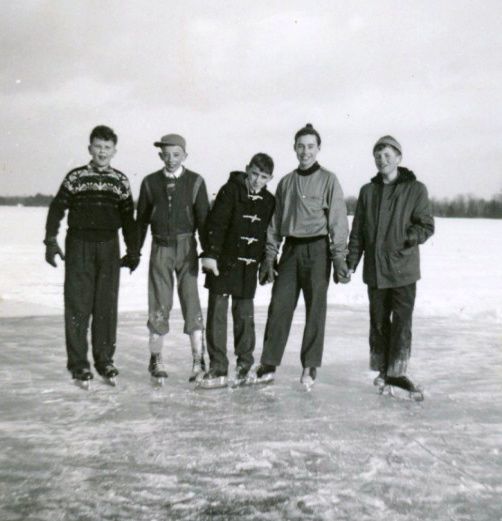
Scott, at 13, made friends with the locals and skated with them on the St. Lawrence River. Bruce took his turn as a Cub Scout. Dean, meanwhile, bravely set off in the neighborhood at two years old, going door to door. When a nice lady opened the door, he would announce, “I’ve come for my milk and cookies.” “How could I say no,” neighbors would tell Eileen. Henry later said that he used to worry about Dean the most because he was so trusting.

That open-eyed naïveté led to an incident that became family lore. When Dean was about three, Eileen realized that he wasn’t at the house. She immediately began canvassing the neighborhood, learning that another small boy was missing. Eventually their search took them down to the nearby St. Lawrence River, where the ice was begin to break up and ice floes float out into the river. There was Dean and his little friend. Eileen took a two by four and paddled his fanny all the way home.

1955

1955bruce

Dean Campbell

Weeks before returning for Henry’s assignment as Executive Officer, Marine Barracks, Betsy was born (Elizabeth Harrison) on June 15, 1957. The family packed up and settled back in Kensington again, this time at 9916 Old Spring Road.

This would have been the sixth move that Eileen managed. Each time they arrived at a new post, she paid a social visit to the Commanding Officer’s wife, calling card in hand, as expected. She joined the Officers’ Wives Club, and did an exemplary job of supporting their activities. She loved Washington, D.C. and the social whirl that went with an officer’s life in those days.

Henry and the Commanding Officer of Marine Barracks, then-Col. Leonard Chapman, innovated the evening parade a Marine Barracks, a proud tradition that continues today. Within a year, Col. Chapman – who Eileen called “Chappie” – was promoted to Brigadier General. He became the 24th Commandant of the nation’s oldest armed force in 1967.

1959chappie copy 2

Welcoming the Secretary of Defense

Welcoming the Secretary of Defense

In July 1959, Henry received his Colonel’s eagles and was assigned to Headquarters Marine Corps as Head of the Officer Detail Section. In an interview in 2000, he shared this explanation of his role:

“I spent two years as head of officer detail, a high visibility job. I had some very good junior officers and had read all of their fitness reports.  I said, “I have great respect for you, or you wouldn’t be here.  On your integrity relies the efficiency of the Marine Corps.  I will not permit anyone to play favorites or I’ll skin you alive.

“Not long after I joined the Officer of Manpower Utilization, Gen. Jim Masters, head of the intelligence section of Headquarters Marine Corps, called me to his office.  Had a young infantry man with him, a Captain, and told me he felt he was being mis-assigned to a staff job.  I pulled his record – he was a good man.  He’d been in Fleet Marine Force for 7 years, a great job, but he needed to let others have that opportunity.

“I called in Andy Hedish. We agreed the best thing we could do was order him to Marine Corps HQ and get his feet wet. I talked to Gen. Masters and said, ‘His transfer is strictly according to policy.  He needs staff experience.’  He just sat there and looked at me.   I said, ‘I have no doubt that the way to advancement is not by saying no to superior officers.  But I told my men if I caught them playing footsie, I’d skin them alive.  I can do no less.  If you have a problem with that, you should talk to my superior officer.’  I walked out.  The junior officer went to the staff job.  I heard no more about it.  There’s no power involved.  The policies are very carefully thought out.

“There was one exception and it was me.  I’d been in grad school at Ohio State in personnel administration and training.  I’d been assigned to the Military Occupational Project.   The joint staff at the end of WWII recognized there are people with very highly placed skills who end up being misplaced during the war.  They needed more info about what jobs  require people with high level skills and who the people are with those skills.

“They had 300 people working on it, led by Col. Dunn.  Because I’d been to this advanced schooling, I was assigned as the Marine Corps’ representative.  The joker is that I had Marine Corps HQ looking over my shoulder.

“The thing got bent around so that they decided to divide people by intelligence, based on their score on a test.  Navy said, ‘We have all the ships, we should have all of the brightest people.’  Air Force said the same thing.  Army said, ‘Bullshit!’  That’s what pulled the thing apart; they couldn’t agree.

“I convened a meeting with one representative of each force.  The Army guy was completely out of his depth.  Rubens asked, ‘Can we agree to this (I forget the details)?’  The proposal was a ringer.  If we agreed to the principles to take all the bright guys and give them to Navy or Army, what would the consequences be?  It was apparent this was a trap.  I said, ‘I’d like to say a few words.  Recognize that if we agree to this, we have agreed to everything else.’  All realized they needed to confer.  Rubens offered me a job!

“Gen. (David) Shoup (who later was Commandant) wanted to have a presentation made on all of the non-availables.  When you did a plan, you set aside a certain number of people for the “Jesus factor” – on leave, sick, etc.  That number runs about 80% for planning figures.  The meeting was to be a formal briefing in Gen. Larson’s office. ‘Who wants to do it, Gen. Larson asked. I said, ‘General, I’ll do it.’  I was assigned a planning officer to do the legwork.  He and I did our skull practice.  We took three slices of the entire Marine Corps on a given day and looked at where they were, using the latest records.  We counted every one of ‘em.  Not long before, we had instituted a transplacement battalion, which replaced an entire battalion at one shot.  It represented an enormous advance in a battle situation backfilling a battalion with individual replacements, where they don’t know their officers.  Transplacements are intact teams that remain together, and they can fight.  After Iwo Jima, the teams were broken. When a transplacement battalion was placed, you had a big flow of non-availables that week.  We made our presentation to the Commandant.  Then I stood by to take questions.  Gen. Shoup said, ‘Col., that’s an excellent presentation.’  He greeted me by name after that.  You can see why I hated to leave the Marine Corps.  I had an absolute ball.”

The Marines sent Henry for advanced education again in 1961, this time to the Industrial College of the Armed Forces in Washington, D.C., after which he was assigned to Headquarters, Fleet Marine Force, Pacific in Honolulu.

Dean on Old Spring Road

Dean on Old Spring Road

Three months before the family was due to travel to Honolulu, Eileen’s mother died. Betsy remembers being unable to wake her Nana from her nap. At 76 years of age, she had had a heart attack.

nana1961

19613women

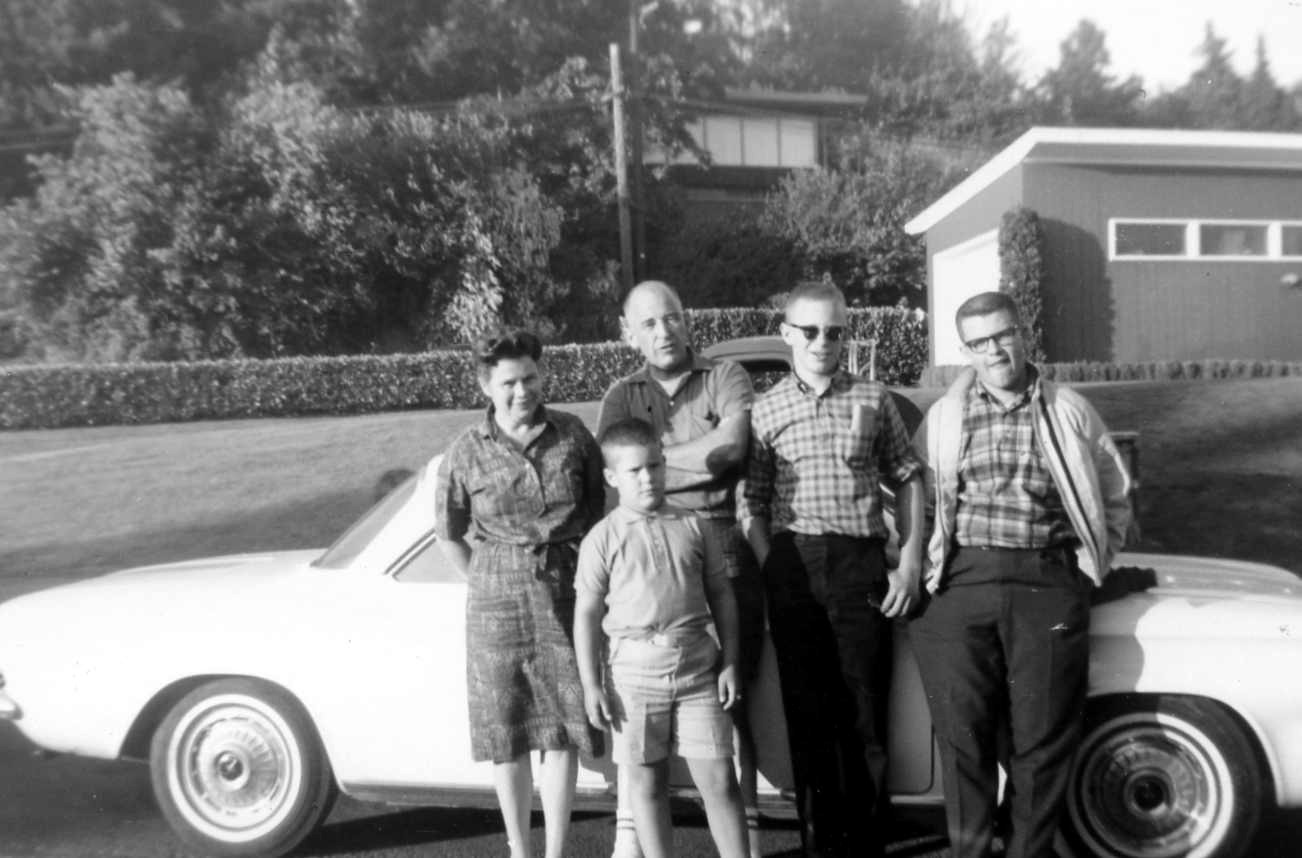
Buffy, the family’s beloved cocker spaniel, was deemed too old to make the 5,000 mile trip or survive the required quarantine upon arriving in the islands. Off the family of six headed across the country toward San Francisco with Bruce and Scott driving one, while Henry, Eileen, Dean and Betsy rode in the other.

Driving cross country

Driving cross-country

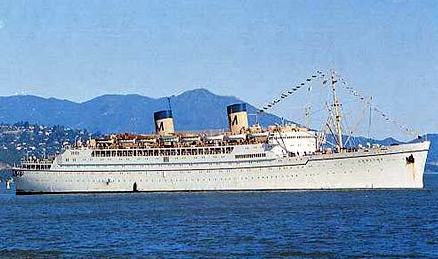
Although airliners became popular as a model of travel from the mainland to Hawaii in the early 1960s, the Campbell family cruised to Honolulu on the luxury ocean liner, the SS Lurline. As the top-ranking officer on board, the family enjoyed the Admiral’s quarters. The family arrived deeply tanned after their ocean crossing (except for Betsy, who remembered being dosed liberally with Dramamine to prevent seasickness).

Screen Shot 2013-06-06 at 10.03.24 PM

July 24, 1962 - Arriving in Hawaii

As Henry assumed his duties, the family settled into Pearl Harbor’s housing community, Makalapa. In the fall, Bruce attended Punahou, a private high school, Dean entered 3rd grade and Betsy started kindergarden.

Scott and Bruce took surfing lessons from a guy named Rabbit Kekai, a native Hawaiian who was a well-known surfer on Oahu, who worked at the Outrigger Canoe Club on Waikiki. Scott said, “Dad was really great about turning us loose with the family Chevy Corvair, and we’d load our surf boards on the roof and head off to whatever beach had good waves.”

Eileen grew her hair longer and pinned it up in a French twist, donning island muumuus for comfort. With help at home in the form of a Japanese maid, she had time for hobbies and took courses in Japanese flower arranging. Her spare, elegant creations were set in low bowls held by “frogs” that were camouflaged with pastel sea glass she found washed up on the beach. She collected Japanese “mud men” statuettes and sometimes added them to her designs. The family’s furnishings were adapted for the islands, too, with rataan furniture and electrified white ginger jars lamps with illuminated bases. The house smelled of plumeria, Brownie Surfrider suntan lotion and the pungent salt-and-grass smell of tatami mats.

1962mom

For social events, Eileen learned to make Asian- and Hawaiian-influenced “heavy pupus,” appetizers such as tempura, won tons and teriyaki-marinated chicken mock drumsticks. She even purchased some heavy, red silk brocade with the intention of having a cheongsam dress made for her. While demure at the neckline and buttoned to the throat with frog closures, they often have a dramatic slit in the side seam. While being fitted, Eileen reported that she tried to get the seamstress to make a slit to just above the knee. The seamstress kept pointing to a spot lower on Eileen’s calf, repeating, “Not Chinese lady.”

In his last years, Henry often remembered jumping up and down in the waves at Barber’s Point with Betsy on his shoulders (which they learned later had a notorious riptide). Looking back, it may have been days before the event that changed the family’s life.

Dad near Barber's Point, 1962

1962betsy copy

Henry felt a crushing pain in his chest and asked Scott to take him to the base clinic, where they quickly recognized he was having a heart attack and directed him to go to the hospital. In the 1960s, the chance of dying immediately after a heart attack was 30 to 40%. Even survivors might never be able to work again. For that reason, having a heart attack was cause for automatic and full retirement. Henry’s career in the Marine Corps abruptly ended.

As Henry was recovering, Eileen was hospitalized for emergency gall bladder surgery. Before she came home, Betsy was mauled in the throat and face by a neighbor’s German Shepherd. The family moved off base, to a house on the east side of Diamond Head, several blocks from the beach. The family was walking wounded by the time they sailed to the West Coast to begin a new life in the cooler climes of Western Washington, as suggested by Henry’s physicians.

Next: Civilian life in the Pacific Northwest

2 Comments

Filed under Family history, Uncategorized

My Mother’s War

(Second in a historical series for a family legacy book. Again, I will refer to Mom as Eileen in these years before she was Mom.)

When Eileen and Hank married, just 19 days after Pearl Harbor, the Marines were on full war footing. They found a minister who would marry them at the Post Chapel in Quantico on Dec. 26. No church wedding, no fancy dress, no friends in attendance – just Eileen’s mother and a couple of witnesses. Hank had a full 12 hours leave for his honeymoon.

Life Magazine's Hex Party

It’s hard to imagine the rapid changes that the couple confronted in 1941. A February 1941 copy of Life, the all-photographic news magazine that dominated the weekly news market, was still taking a light hearted tone with headlines like, “Bombed London Railway is Remade as Good as New in Four Hours.” An article explaining the aiming of field artillery boasted, “The gun crew works like a football team.” The rest if the issue was devoted to the belles of President Roosevelt’s birthday balls to raise money to fight “infantile paralysis” (polio), vacationing in Biscayne Bay, and “the blondest of the new crop of New York debbies” (debutantes). In the story, “Life Goes to a Hex Party,” amateur sorcerers in Washington try black magic against Hitler.”
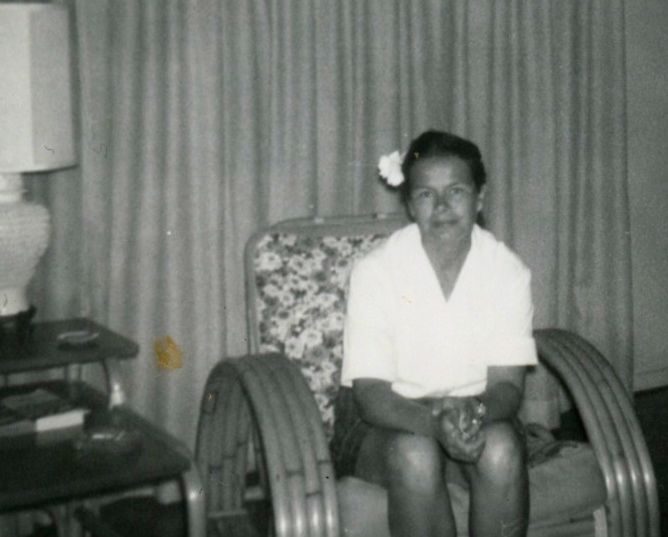
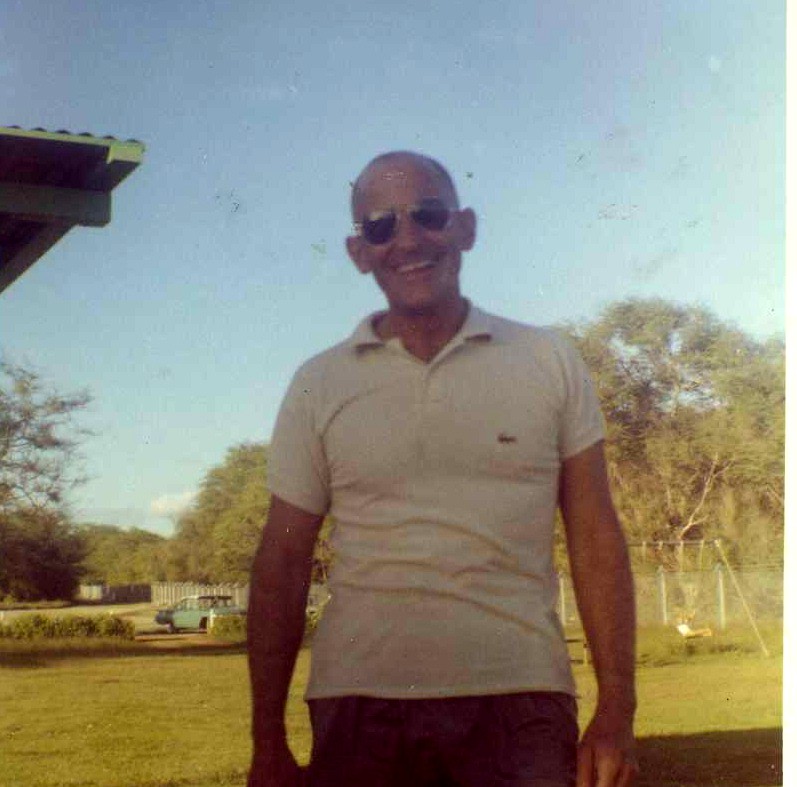
Even though the U.S. was not yet in the war, the seriousness of the situation was already personal to Eileen. Her cousin, John Driscoll, to whom she was very close, was killed in a training accident when his plane collapsed on September 26, 1941, a week before he was to have received his commission in the Air Corps of the Army. Having already lost her father that February, Eileen would have grown up fast.

Then Pearl Harbor was attacked on December 7. The war was no longer “over there.” It was here. Henry later noted that the Marines fully expected at attack up the Potomac River, aimed at the nation’s capital. Immediately, a nation-wide blackout went into effect. Gas masks were distributed. Machine-gun posts were added alongside the White House and U.S. government buildings.
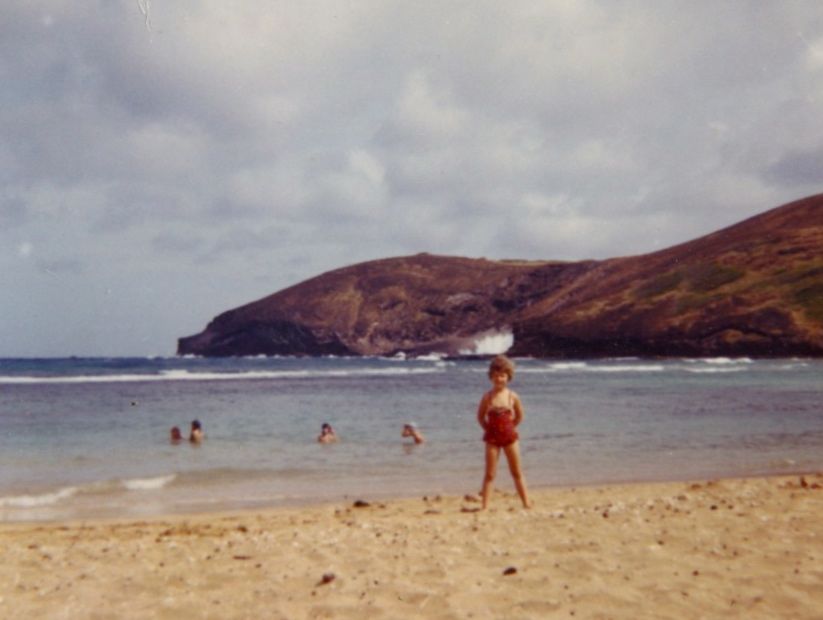
The two set up housekeeping together in married housing in Quantico, VA. In an interview with Betsy in 2000, Henry told her, “Because I was an expert shot, and also a good student, at the end of the ROC class I was selected to go back to Quantico as an instructor, which I did for two years. I went back to the same company I had been officer candidate in.”

Within two months, Eileen was pregnant, like many of the wives. Scott was born on November 13, 1942. With Hank working hard, she and other new mothers supported one another, and likely played occasional hands of bridge while swapping tips about baby care.

Scan

Eileen Driscoll Campbell and Scott Campbell

Henry was promoted from second lieutenant to first lieutenant during that first year, and wrote his brother, Ed, that he expected to remain in Quantico with the newly formed G Company until the early part of 1943.

So though Eileen would have known Hank would come safely home each night, at least for a time, they knew many others were in harm’s way. Hank explained later, “The first two years of the war were very tough on my classmates; they were expendable. The casualty rate among second lieutenants was high.”

Within months of Pearl Harbor, the Japanese Imperial Army invaded Wake Island and thousands of American forces surrendered in what would become the Bataan Death March. Corregidor was overrun and the Philippines were surrendered. Things finally turned in November 1942 after a victory at Midway and hard fought land and sea battles for Guadalcanal, which became Japan’s most staggering military defeat. Late in 1943, U.S. military forces deployed new amphibious warfare techniques that aimed to obliterate Japanese defenses. Even with the new strategy a success, U.S. Marine losses were heavy at Tarawa, a small atoll. On the first day of the attack, casualties were 20%. It took 18,000 Marines three days to secure the small island at a cost of 1,300 dead. Hank lost a close friend.

Hank shipped out in the third year of the war for the Pacific with the 23rd Marines, 4th Marine Division. He would have sailed out of Honolulu as part of the “Big Blue Fleet” on January 22, 1944, bound (although he didn’t know it yet) for the Marshall islands where he would join the attack on Roi-Namur.

Henry left with a memento that Eileen’s friend helped her to create: a pin-up style snapshot of her immersed in a bubble bath. The wives conspired to create the images as a way of reminding their men what awaited them at home.

bathtubshot

At some point, Eileen went West to stay with Hank’s family in Yakima.

In those years before the 24-hour news cycle, Eileen would have anxiously awaited news reports of actions, which were often delayed for security reasons. Or she might have seen news reels with thrilling images of victories and frightening scenes of destruction. She wouldn’t have known where Hank was until well after the fact, when V-mail arrived. Very likely she would have breathed a sigh of relief after learning he was safe following the victory at Saipan.

The Admiral Campbell home in Yakima settled in to a rhythm, with Scotty enchanting Grandmother Campbell and Aunt Janie. Upon meeting Eileen, Grandfather Campbell was reported to have said, “Son, a pretty face will fade away, but a good pair of legs is a joy forever.” Grandfather Campbell, who ran away from a hard-scrabble Kentucky home at the age of 14, had an eye for such things. He maintained an extra-marital relationship with Erma and retired to her home after dinner to play cards on most evenings; Mom was invited to play bridge with the pair and Grandfather’s friends.

As a mother of a young child, Eileen would have supported the war effort by caring for Scotty. More than two million women worked in war industries and another million as “government girls” in offices, while others plugged the hole in manpower by driving trucks and manufacturing in factories. Everyone pitched in, however, by adhering to wartime rationing, planting victory gardens and salvaging scrap metal, rubber, cooking fat and nylon and silk stockings which were needed for war supplies.

An article saved by Eileen explained how to fill out the consumer application required to obtain Ration Book Number Two.  The application was distributed via newspapers “in recognition of the fact that newspapers reach practically every individual in the United States.” To complete the form, you had to go to your pantry on Feb. 21, 1943 and count all cans, jars and bottles containing 8 ounces or more of store-bought food: canned fruits, vegetables, soups, etc. Coffee (and sugar) rationing had begun in 1942 and all citizens were required to inventory the coffee on their shelves on Nov. 28 of that year. You then calculated the amount of coffee to which you were entitled by stating the pounds of coffee you inventoried in November minus 1 pound for each person 14 or older in the household. Then you counted the units of cans on your shelves and subtracted five cans for every person in the house. Based on the answers provided, you would be issued Ration Book No. 2. If you had coffee or canned food above your allotment on hand, those stamps would be removed from your book. You couldn’t buy items at the grocery books without the appropriate ration stamps.

The Campbells and Eileen also wrote Henry regularly. Victory mail (“V-mail”) was censored, transferred to film, and printed back to paper, saving shipping space for war materials.

Saipan grabbed the U.S. imagination not only for its size and violence – it took 71,000 U.S. troops six weeks, over 3,000 losses and another 10,000 wounded – but for the horror of the mass suicide of roughly 1,000 Japanese women and children who lived on the island. Emperor Hirohito had declared that civilians who died there, rather than surrendering, would have equal spiritual status in the afterlife as soldiers.

Hank went on to Tinian, and then Iwo Jima. By February 15, 1945, a quarter of a million troops were ready to attack the island’s 20,000 Japanese Imperial Army troops, who were well defended by a warren of interlinking caves and tunnels. Iwo Jima’s casualty rate – with 24,000 wounded and 7,000 dead – was the highest in the history of the Marines.

In late March or early April of 1945, Eileen would have gotten word that Hank was safe after the 23rd was pulled back to Maui for R&R, and to reconstitue its ranks after so many were lost.

The atomic bomb was dropped on Hiroshima in August 1945, and on August 15, WWII was finally over with the surrender of Japan to the Allies.

Between Tinian and Iwo Jima, Hank wrote to Eileen about the effect of the war on who they were as a couple: “I expect we’ve both changed this year—-yet I think we’ll be surprised at the smallness of the change. The part of me that’s fought the war out here—-is NOT the part of me that is the half of ‘us.’—-I feel strongly that it is the mechanical person out here fighting, and that the real person—-the one YOU know—-is in a state of suspended animation.—-Perhaps an accurate explanation of the fact that I never write what I’m thinking about and feeling—-that I neither feel nor think—-and it is as if there is a hard shell around me and that ALL of this present life went on outside me.”

By November, 1945, Hank landed in Southern California where he was reunited with Eileen, Scott, Eileen’s mother, and Hank’s Aunt Janie.

Hank later said he had to fight for his pants at first, with Eileen so competently in charge at home. He and Eileen drove to Washington D.C. with Eileen’s mother and Scotty to find a place to live when Henry began his new assignment at Marine Corps HQ in its Plans and Policies Division.

Next: the post-war years

1 Comment

Filed under Family history, Uncategorized

Grief and Forgiveness

I went to a really difficult funeral yesterday, a memorial for a couple who died in a terrible accident, long before their time. There are deaths that seem in keeping with nature’s way, and those that are not. It is not nature’s way for a child to die before a parent or parents to die so young that their children are not settled well into their adult lives.

I cannot presume that my grief – losing Mom in 1999, and Dad this year – is anything like what that family’s grief is and will be. But it has taught me some things.

I have learned that grief has a lot to do with forgiveness. I wrote last month about coming to terms with some of my complicated feelings about my mother, and how facing her terminal illness gave me the opportunity to understand, forgive and embrace those differences.

Forgiveness has also been urgent and recurring theme in the immediate wake of loss. I was deeply disappointed by someone that I was counting on to be there for Dad and me during his final weeks. As warmed as I was by all of the people who reached out to me in the days and weeks after Dad’s death, I was sad not to have heard from one particularly important old friend who sent several messages saying he would call, but didn’t. I was and am still irritated every time I hear someone voicing their belief that a grieving person “has to let go.”

In our discomfort with death, we are too quick to seize upon Elisabeth Kübler-Ross’ model of the five stages of grief. It lulls us into thinking there is a purpose and an order to the messy business of grief.

Sometimes death just sucks. Sometime people just suck because they can’t be what we need them to be when we are caregiving or coping with loss.

Although it seems like I share so much on this blog, there’s plenty I haven’t shared. When I have been the most upset, I haven’t touched my keyboard because I am afraid of scorching the earth with words.

That break from July 16, 2011 to January 6, 2012? Not an accident. I was so deeply angry about something that happened that I couldn’t write anything publicly.

All of this is probably making me sound like one angry woman.

But I’m not. My husband figured out a long time ago that when I act angry, what I really am is hurt. And when I am the most angry, I have learned to wait. Slowly, over time, I begin to understand, empathize and finally forgive whoever set me off.

I can’t find my experience in Elisabeth Kübler-Ross’ model, perhaps because it was developed from the perspective of a terminally ill person rather than a person who loved and supported someone on their journey from this world.

I accepted the inevitability of my mother’s death due to terminal cancer, and my father’s from congestive heart failure. But even with that knowledge and acceptance, my caregiver and survivor experience included some moments of fierce and poisonous emotions.

I have even been angry with God. It still seems cruel to me that nature’s way is for people to degrade when they reach very old age. Why can’t dying of old age be a pinnacle of a life well lived, with a glorious exit?

I don’t stay angry. Neither did my mother, as quick as she was to raise her voice. Like her, I move on to forgiveness.

I understand that we all tremble in the face of death and loss. People I hoped would be there at my moment of need weren’t because they just couldn’t face it. Some I hoped to hear from in my immediate grief were too reminded their own losses and didn’t know what to say. People who insist that there is a schedule to moving on may be afraid of emotions that are not in control; they misguidedly think they are helping when they urge a grieving person forward.

In the weeks before and after Dad died, I felt as if I kept bumping the same vulnerable places, making fresh purple bruises on top of the old fading ones.

Four months later, I am healing. There is no schedule to grief, nor should there be. It took my Dad 96 years to come and go from this life, and he is worth considering still.

2 Comments

Filed under Uncategorized

The Kingdom of the Wing Chair

I knew that when Dad died, it would be hard to have a room in my home that was so linked to him in my mind. I didn’t want it to be a mausoleum nor did I want to purge it of his presence. I want it to be a sanctuary where guests are welcomed but where I can still retreat to remember the last seven years that he lived here. My big idea is to have a friend create a painting that honors my memory of him. And as time has gone on – now four months since he died – I realize there is no way to create something about Dad that doesn’t include Mom. Though they were strong individuals, they were that rare couple that becomes a single entity through the strange chemistry of attraction and the catalyst of shared experience.

When I initially imagined a painting, I thought about it honoring my parents as I knew them at the end of their lives. But now I picture it drawing upon a long-ago period, a period when they were the pillars of my world, and I was small.

I don’t write poetry – at least I haven’t in years – but somehow thinking about the painting prompted this:

It should have a wing chair in it.

We always had wing chairs.

It was where Daddy let the stress of the day ooze out of him

While he read the paper, sipped a scotch on the rocks,

And maybe another.

Sometimes his hand would rest lightly

On the head of one of our spaniels,

Who sat stock still for his attention.

It was where I sat on his lap.

Where he read to me about the Land of Oz.

I wanted to be like Ozma who rescues Dorothy

From the terrors of the disturbing Wheelers.

People shouldn’t have wheels where hands and feet should be.

But then Daddy’s shouldn’t have heart attacks,

And dogs shouldn’t bite you in the neck,

And Nana’s shouldn’t die.

I wanted to be brave.

Sometimes Mom would stand next to the chair,

Her hand resting lightly on the wing

The hand with her wedding ring

Loose at her side.

Smiling as a present was opened,

Laughing at a joke,

Meeting Daddy’s eyes and sparkling.

Sometimes he would look at her and quote something

About a barge with purple perfumed sails and love-sick winds.

Next to her I could smell the delicate scent of her bath powder,

Which she applied with a fluffy puff that made me sneeze.

There were fights sometimes, and those scared me.

Mother’s voice rising, then father’s, and mother’s right back.

I knew bad things could happen to parents,

Would it happen to mine?

But when it was over it was over.

But nothing bad ever seemed to happen in the kingdom of the wing chair.

It was sacred space.

1 Comment

Filed under Uncategorized

Conflicted and Conflicting

A friend who recently moved his father to a care facility near him told me that he’s feeling better about making the role switch from child to parent. His father, who has dementia, was no longer safe living with his mother. When his mother objected to staying in a hotel room overnight while he made arrangements, he said he had no compunction telling her she had no choice. He had to do what was necessary to get his father safely settled. Now he jollies his father along to get him to get his hair cut, and humors him when his father tells rambling stories that can’t possibly be true.

For himself, he hopes to go like his wife’s great aunt, who took a sudden turn during a recent hospitalization, drifted to sleep, and died. “I’ve told my kids,” he said, “if I get like my Dad, just take me up into the mountains, point me in one direction and you go the other way.”

It doesn’t work like that, I told him. The truth is that when we get to that age, or our cognitive abilities are compromised, those who love us will step in and do what they think is best. We can take care of ourselves physically, state our wishes, and get our house in order before we get to that point. But we still won’t control how we age.

The child-adult role reversal won’t be any easier on us than it is for our parents.

Leave a comment

Filed under Uncategorized