Category Archives: Uncategorized

Our Common Cause as Adult Children

Dad bird hunting

You won’t find this blog post until you’re ready to think about what we have in common: the sometimes-painful, sometimes-rewarding responsibility for caring for a parent during their “golden years.”

The senior years can be tremendously active and exciting – a period of freedom after a long life of work. But for our parents and most of us – yes, us, too – there comes a period when the world shrinks.

Our job, if we love our parents and choose to be involved, is to make their passage during these years as good as they can be.

Almost every day, I stumble across someone who faces their parents’ elder years with trepidation. It happened again this morning, walking with a neighbor.

These are the truths I hear over and over again:

  • Parents don’t want to be a burden; they actively wish to die in their sleep or go quickly, and don’t want the adult child to feel pain over their departure.
  • Parents often live near their lifetime’s worth of friends, while their children are sometimes states away. Adult children worry how they will provide the assistance needed when one or both parents need more help.
  • One sibling bears most or all of the responsibility for looking after their parents.
  • Often, there’s a sibling or sibling’s spouse who is not on the same page about what should happen.
  • We feel drawn and quartered. We may face pressure at work or be trying to support our young adult children or spouses through rough patches in their lives even while we are trying to pay more attention to our aging parents.
  • Having candid conversations with parents about their intentions, physical limitations and financial preparedness is very, very difficult. Few aging parents are realistic and proactive, leaving adult children to worry about whether (or when) they will have to step in and take over.

I learned some truths of my own along the way, truths that surprised me. I fully expected Dad, who had advanced heart disease for more than 50 years, to go out with a big bang. Instead, he rallied over and over again, never quite recapturing the ground he had lost, but persisting even so. He lived at least 15 years with congestive heart failure.

I also learned that quality of life didn’t depend on the things he thought it did. His perspective changed with time, and he was able to be pretty satisfied even though Mom was gone and he couldn’t hunt, fish and enjoy the outdoors as he once did. His world was small, but there were people in it who loved him.

I learned that Dad’s long decline was an important time for him in coming to terms with regrets. He regretted that his father wasn’t more interested in him. He regretted that he couldn’t save my little sister when she became ill with leukemia. He regretted that he couldn’t protect my mother from feeling afraid during her terminal illness with lung cancer. Eventually, those regrets ran their course and were replaced by peace.

I learned that I could give him my love and attention without resentment, even though it meant living my own life in the very slow lane.

I learned that I could have a far deeper relationship with Dad after my Mom’s death than we ever had before.

I learned so much from the last seven years caring for him.

But I understand the fears of those who stand at the precipice of their parents’ old age, wondering and worrying how they will handle it. All I can tell you for sure is that it won’t go quite the way you expect it to. There will be parts that are harder, but there will also be surprising gifts.

3 Comments

Filed under Uncategorized

Oohrah for Strong Women

The Major Marches

Not familiar with “ooh-rah”? It’s that explosive sound that Marines use to express enthusiastic approval. I heard it at Friday’s evening parade at Marine Barracks in Washington DC and I’ve been thinking about it ever since.

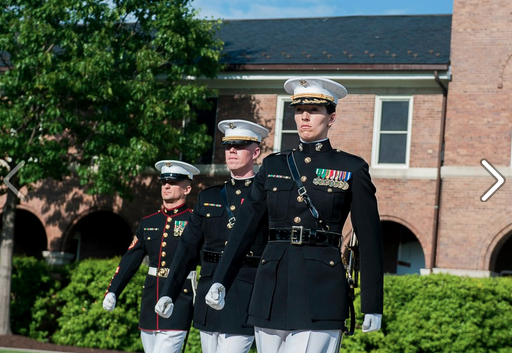
Among the precision marchers on the parade ground and ceremonial hosters were a few women in uniforms identical to their male counterparts. And they looked sharp.

I was saddened, then, when I saw the trolls out on Marine Barracks’ Facebook page commenting on the photo that appears up top:

Thank God I got out of the corps before I witnessed this political crap take place!

It seems that several of the Barracks’ Facebook followers were dismayed to learn that women had invaded the Corps, and in this case, were wearing the male uniform.

A woman Facebooker responded far more courteously than I might have (but knowing online trolls, I like to stay out of their line of fire):

Gentlemen, it’s the prescribed parade uniform for designated personnel at the Barracks. Pls keep your personal attacks/feelings against this Marine to yourselves.

The Major also received support from two men who follow the Marine Barracks page:

I look at it like this. I dont care which uniform of the Marines she is wearing. She a Major and by the looks of it, has had a pretty good career. Semper Fi Major!

I prefer that she wear this one as she carriers herself, the Ladies of the Corps and the Marine Corps well. Semper Fi

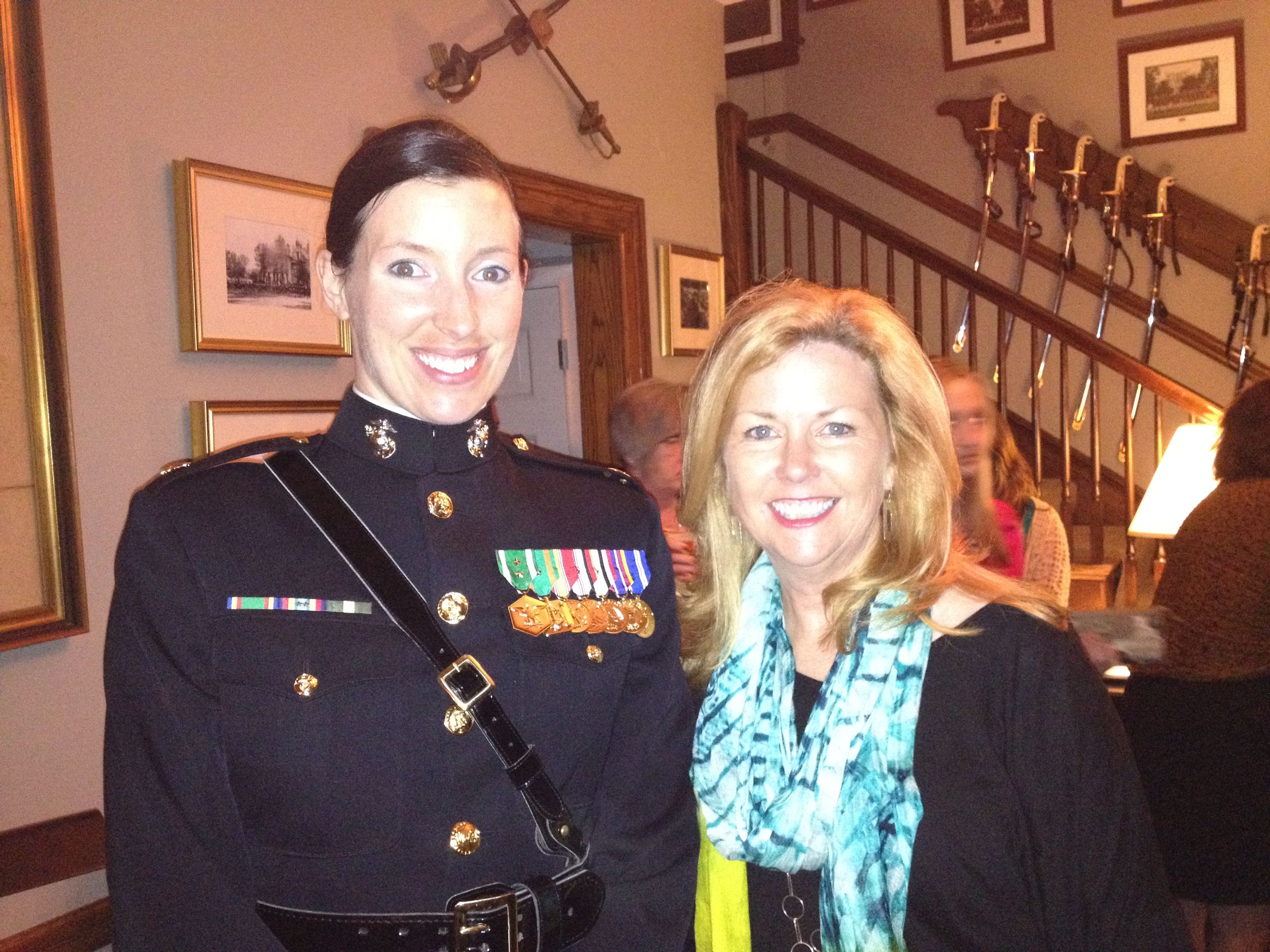
I had the honor and pleasure of meeting the Marine they were writing about. And she’s not just any Marine. Major Sarah Armstrong is the first female parade commander of a Friday Evening Parade, a tradition that started back in my Dad’s time as Executive Officer of Marine Barracks.

Those shiny medals on her jacket? They’re campaign and achievement medals. She earned ’em the hard way. At least one of those ribbons denotes her tour in Afghanistan.

My mother was a strong woman. My friends are strong women. My daughter is a strong woman.

In the place where my father served 56 years ago, at a time when only men achieved positions of leadership in the Marine Corps, I’m thrilled to see Major Armstrong doing her thing, and doing it so competently.

As one of the Facebookers concluded:

Ooorah ma’am!

Update:

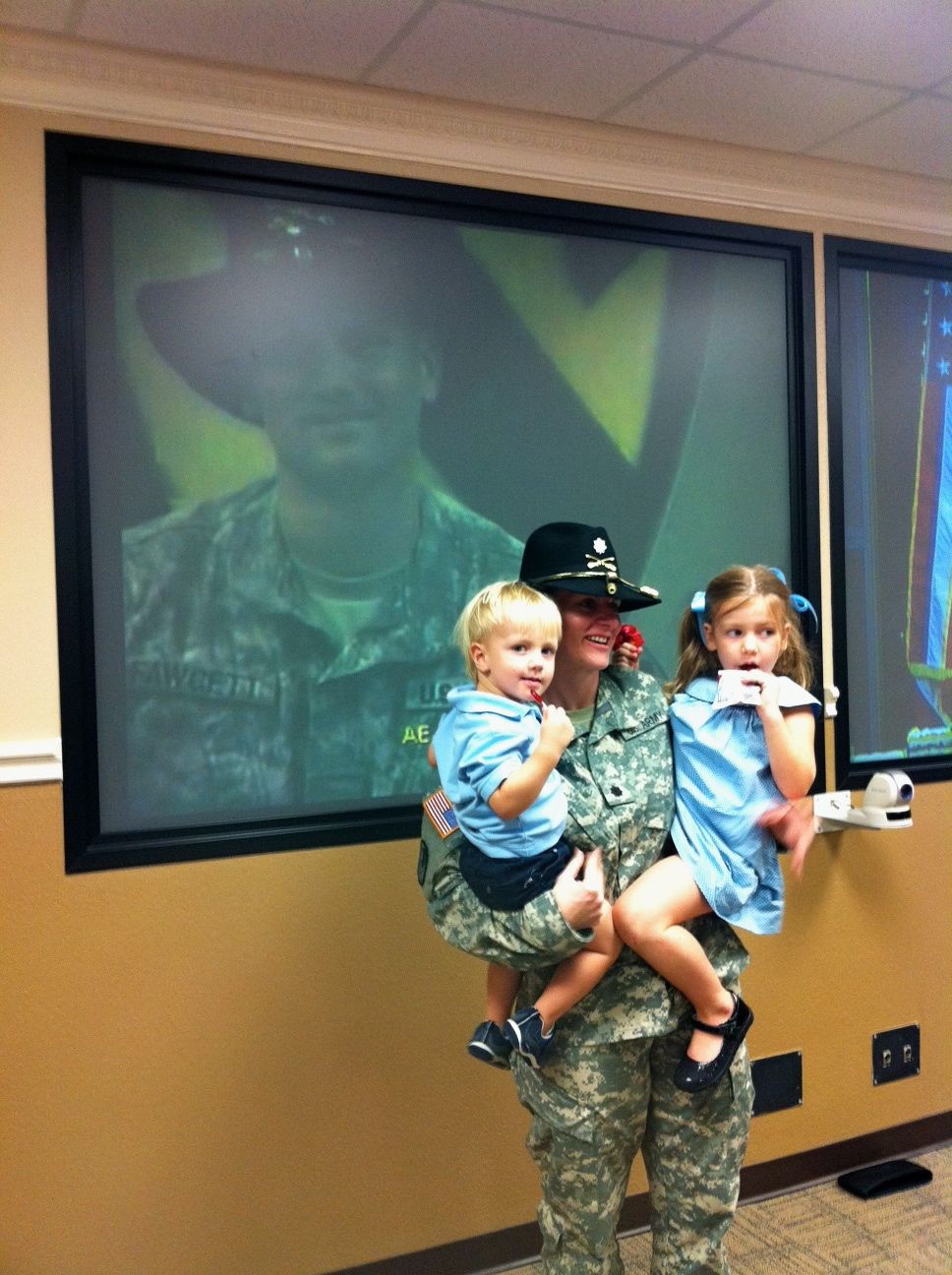
Per the comment I received from my second cousin John, turns out I’ve got a strong woman in my extended family in the form of Col. Marne Sutten, US Army. She’s married to John’s son, Col. Grant Fawcett. Between the two of them they served five tours in Iraq. They’re busy raising their two children in Tampa, FL. Photos provided by John Fawcett:

Just after Col. Megan Sutten's promotion ceremony, watched happily by her husband Grant via video

Just after Col. Megan Sutten’s promotion ceremony, watched happily by her husband Grant via video

Col. Megan Sutten and Col. Grant Fawcett

Col. Megan Sutten and Col. Grant Fawcett

Col. Grant Fawcett as the last convoys pull out of Iraq

Col. Grant Fawcett as the last convoys pull out of Iraq

6 Comments

Filed under Marines and those who serve, Uncategorized

Marine Corps Wife: My Mom’s Career

That's mom seated at bottom left, and Dad standing at upper right in 1959

That’s mom seated at bottom left, and Dad standing at upper right in 1959

Skimming through Mom and Dad’s photo albums from the late 50s, Dad is pictured at the pinnacle of his success in the Marines. While it was Dad’s obituary that carried the details of his promotions and assignments, in many ways his career was her career.

It wasn’t that she loyally followed Dad as Sarah followed Abraham. She was a woman with a mission. She kept the home front running and deployed her considerable social and organizational skills to the job of supporting Dad in the regimented social environment that surrounded officers’ wives.

Dad said he wasn’t keen on the idea of marrying in the tumultuous weeks that followed Pearl Harbor. Not that he didn’t love Mom. He did, passionately. But he was acutely aware of the potentially abbreviated life span of a Second Lieutenant in wartime, and he didn’t want to see her widowed.

When he shipped out in 1943, soon to join with the 4th Marine Division in the battle for Roi-Namur in the Marshall Islands, he left Mom at home with my brother, Scott, who had been born that November. When the war ended and he returned, he joked that he had to fight for his pants. Actually what he said was that had to fight for his pants every day of their marriage. When the war ended, he returned from the horrors of Saipain, Tinian and Iwo Jima to a home where Mom was comfortably and firmly in charge.

As Dad’s assignments took them from Quantico, to Washington DC, up to Kingston Ontario, back to Washington DC, and then across a country and an ocean to Honolulu, Mom packed and unpacked, settled kids in schools.

Each time they arrived at a new post, she paid a social visit to the Commanding Officer’s wife, calling card in hand, as expected. She joined the Officers’ Wives Club, and knowing Mom, she did an exemplary job of supporting their activities. She loved the social whirl that went with an officer’s life in those days, like the formal party in honor of the promotion of Leonard Chapman to Brigadier General.

In 1951, my Mom found herself running a busy household with a nine year old, a four year old and a one year old – oh, and Nana, her mother. Mom and Dad’s worst fears came to pass when little Midge was diagnosed with leukemia, for which there was no known cure.

As a mother, I can’t imagine how she coped, but it was in character for her to forge ahead, hoping against hope. My uncle, a hematologist-oncologist, came down from Boston to administer experimental treatments and oversee Midge’s care. To no avail. She died October 22, 1953, a few months short of her fourth birthday.

Dad’s orders to ship out for a solo tour of duty with the 3rd Marine Division in Gifu, Japan, were held during the last months of Midge’s illness. Mom had learned, as Midge lay dying, that she was pregnant for the fourth time.

On February 21, 1954, Dad wrote Mom from Okinawa while in transit:

Postcard from Japan 1954

Although it was lost in Dad’s move to California, I remember reading a lengthy letter he wrote from his tour in Japan, sharing the pain of their devastating loss, saying how he longed to be there to hold her.

When my brother Dean was born in April 1954, Dad said, “It was if the sun came out.” That may be true, but now Mom was alone, managing a household with an 11 year old, a six year old, her mother, and a newborn. She was on her own when she had Dean christened:

Eileen Campbell with baby Dean, flanked by Bruce and Scott

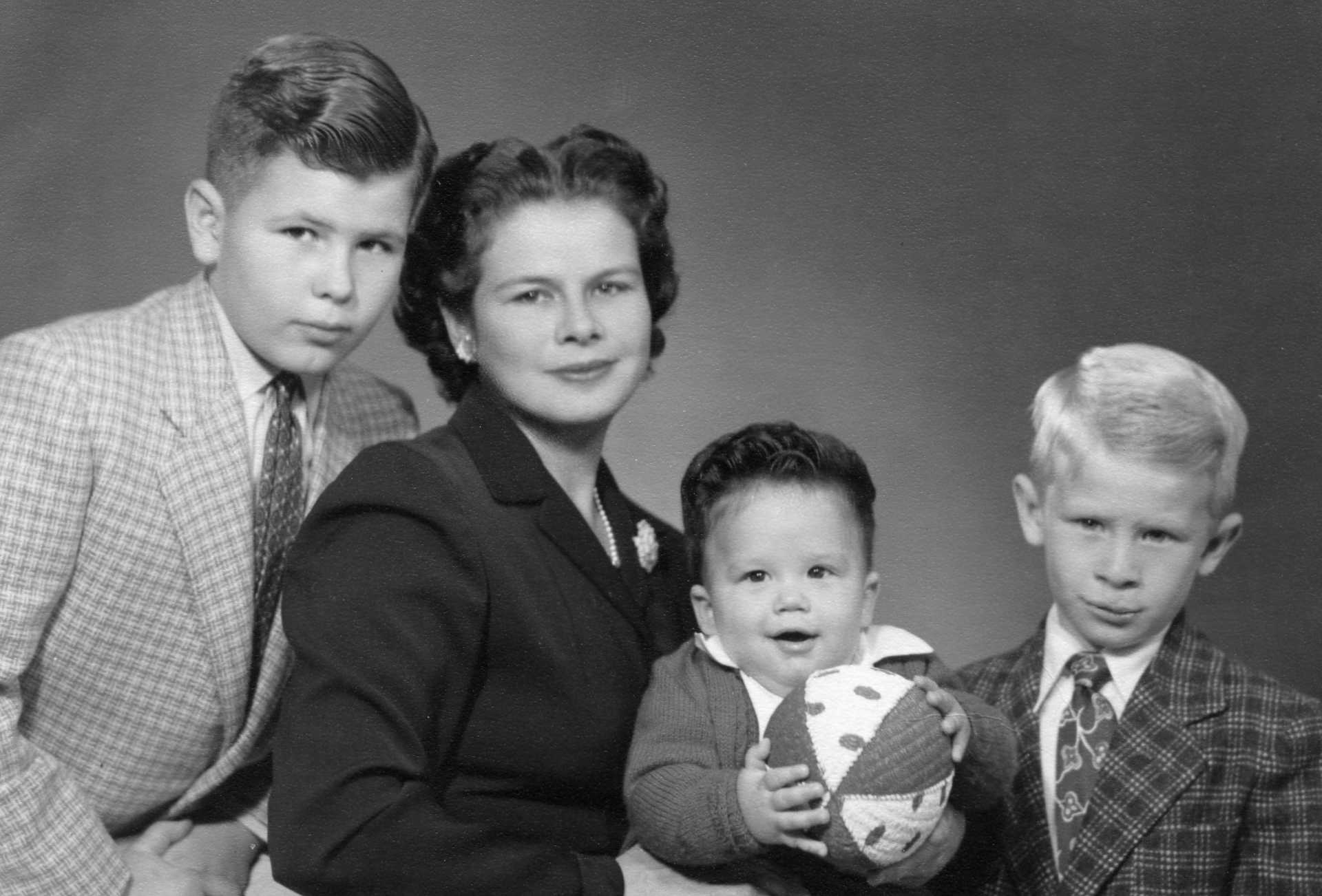
In a professional portrait she had taken the next year, her expression is serene but somber.

Eileen Campbell raising three boys, 1955

This summer, we will inter both Mom and Dad with Midge at Arlington National Cemetery. While visiting Washington DC this past week to make arrangements, I wondered if it was fair to put so much emphasis on Dad’s career. After all, the burial with honors is provided because of his service, not hers.

Then I realized that it wasn’t just Dad’s efforts that deserve the recognition. Like most military spouses, she earned it, too. Knowing Dad, he would be the first to say that Mom made it possible for him to do what he did.

2 Comments

Filed under Marines and those who serve, Uncategorized

Seeing Mom Among the Flowers

A member of the Washington National Cathedral Altar Guild

Friday was my “Mother’s Day.” Mom, gone since 1999, felt so present to me all day. I came east to see my friend Sharon and the premiere of the documentary she produced about the author Elizabeth Spencer, “Landscapes of the Heart,” but also for a mission: I hoped to secure a date for my father’s and mother’s interments at Arlington National Cemetery.

Though it was Dad who I focused on during the past seven years, and Dad who died in January, the trip was about both of them.

After meeting with a representative at Arlington, I asked Sharon if she would mind visiting Washington National Cathedral. My mother always talked about it, and continued to buy the Cathedral’s annual Christmas cards long after we left Washington, D.C.

Washington National CathedralUpon entering the Gothic-inspired masterpiece, we walked up the center aisle and diverted to the right around a stage that was being prepared for a concert.

Like many European cathedrals, the nave and transept are embellished with small side chapels.

In the first of these chapels, below a round contemporary sculpture of Jesus’ face, stood a woman in a pink shirt and apron, stoop shouldered, slowly trimming the stems of lacy blossoms that she was using to complete the final touches on two symmetrical arrangements of pink lilies. Her salt-and-pepper hair was short, mostly gray, a little curly. Perhaps the last vestiges of a perm that was nearly grown out.

For just a moment, she was my mother.

The woman in pink was an Altar Guild member, one of the stalwart legions of the Episcopal Church Women who do so much behind the scenes in fulfillment of their faith and commitment to the church, in camaraderie with one another.

My mind involuntarily summoned the smell of damp linens, starch and heat, a visceral memory of one of my mother’s monthly turns ironing the altar linens. Just as readily, I remember the scent of fresh-cut stems when she trimmed a gladiola, a rose, a peony, or greens harvested from our back yard for an altar arrangement.

In the sculpture above the altar, Jesus’ eyes are closed, but his head inclines toward her. I don’t know if the image is meant to represent him in death on the cross, or is meant to express sympathy for those who pray here. Blade-like rays extend beyond his halo through which a jagged hole is blown.

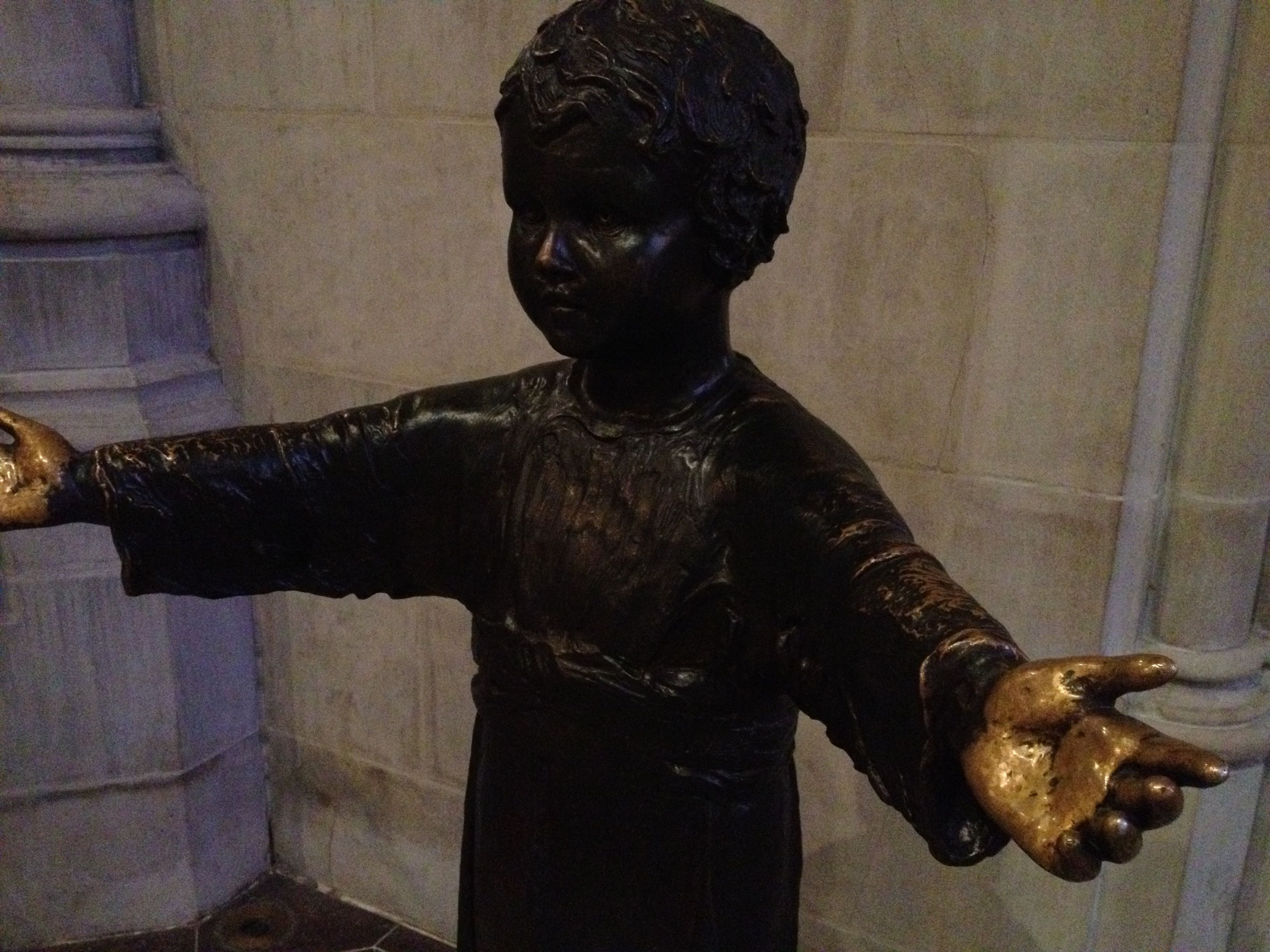
Washington National Cathedral's Christ Child statueLater I learned the chapel memorialized those who served and died in wars. Near it, a bronze statue of the Christ Child welcomes visitors to the adjacent the Children’s Chapel. The statue is the size of a six year old, its palms polished to a sheen from all of the touches to its outstretched chubby palms.

It felt meant, just as the whole week has felt perfect. Here is “Mom,” creating a striking decoration for the War Memorial, within the hour that we have confirmed a date and time for her burial along with Dad, joining Midge in her resting place. And there, next door, is the Children’s Chapel, with the child Jesus extending his arms in welcome.

My brother Scott sent this reply to a note I sent to my brothers confirming the interment date. “Has anyone thought about what day it is today? Nice that we got this confirmation on the 14th anniversary of Mom’s passing.”

1 Comment

Filed under Uncategorized

Seeing Dad at the Marine Barracks’ Evening Parade

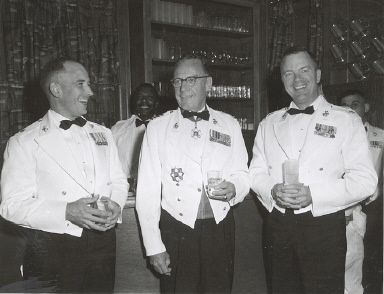
(Then) Lt. Col Henry S. Campbell, Gen. Pate and Gen. Leonard Chapman

As my plane ascends quickly out of Reagan National Airport, through the mist that hangs over Washington DC on this cloudy spring day, it banks steeply to the right, providing brief glimpses of the tree-lined suburbs below.

My mind is cycling just as rapidly through images from this past week and especially the last two days.

Last night, seated next to an older man in the VIP section at Marine Barracks’ evening parade, we approached the end of the 90-minute spectacle of Marine precision. Pass in Review had just concluded after the Marine Corps Band, Drum and Bugle Corps, Alpha Company and Bravo Company had marched smartly and precisely in front of the evening’s honorees and Col. Christian Cabaniss, Commanding Officer of the Barracks.

“There he is,” my seatmate Larry said. Looking up to the tall parapet, above which the reproduction 15-star flag snapped in the rapidly changing wind, I saw what he noticed, a lone figure in a red Drum and Bugle Corps uniform. The lights on the parade ground darkened and a spotlight lit the bugler. The crowd rose, and waited.

So slowly that it ached, the bugler blew the haunting refrain of Taps. I wondered who Larry was remembering, afraid to look in his direction lest I catch him welling up for friends lost in the Vietnam war, his first combat operation.

Though my Dad was here 55 years ago, when the evening parade was a “moonlight innovation” (as the newspaper described it at the time), he was a phantom by my side the whole evening.

Major Sarah ArmstrongBefore the parade, in the Drum Room of Center House, I chatted with Maj. Sarah Armstrong who was manning the log of drinks served to active duty personnel of the Barracks. Her demeanor easily toggled from a relaxed chat with the visiting daughter of a late Marine Colonel — socially at ease, articulate, with a ready sense of humor winking under the surface — to a direct gaze and ramrod straight bearing when greeting the Commanding Officer.

Photo credit: USMC, Marine Barracks Washington 8th and I Facebook page

I told the Commanding Officer that, as the youngest of my siblings, I had no memory of the Barracks. The silent drill that I remembered was a demonstration performed at home by my father with an umbrella. The umbrella did not always fare well for the experience.

Col. Cabaniss said that his youngest daughter seemed less than impressed by his position in the Corps. She was more likely to “Oh, Daddy” him than his eight year old, who liked the idea of giving orders. “Sir, she even orders me when she visits,” added Major Johnson.

As the reception progressed, I superimposed my father upon it. He was there, standing and smiling in the direction of Gen. Pate. On the other side of Gen. Pate stood Gen. Leonard Chapman, then Commanding Officer of the Barracks and later Commandant.

In the photo, Gen. Chapman is smiling broadly, looking directly at the camera. Given his rank and position, he cannot be a man to trifle with, but the warmth and welcome in his face is striking.

Dad looks a little less relaxed, but you can tell he likes these men under whom he serves. Respect and admiration shows on his face, but so does affection.

Having grown up outside the shelter of the Corps, this is one of the things that strikes me: the obvious affection between the men and women I see around me.

In corporate life, we may develop deep and long-lasting friendships. We learn to behave as a team. Inevitably, we work with a few who set us on edge.

I know from my Dad’s stories that there were men he didn’t like and men who didn’t like him. He once reported for duty to his new Commanding Officer (not Col. Chapman) and was greeted with the statement, “I didn’t ask for you.”

But I know he loved many of the people in the photos. It was in his eyes when he spoke of those he admired.

I saw the same mutual respect and warmth in the relationship between Col. Cabaniss and the current Executive Officer, LtC. Tom Garnett. In response to my question about how he came to be Executive Officer, LtC. Garnett said that he had previously served as Col. Cabaniss’ XO and was asked to join him in that role again when the Col. was given command of the post.

When I left Center House that evening, LtC. Garnett was standing by the door. I thanked him for his hospitality and told him how deeply the event had affected me. I told him I appreciated meeting Col. Cabaniss and could see why he would be pleased to be his XO, not once, but twice. I added, “And I can see why he is lucky to have you.”

He raised his index finger to his lips, smiled and whispered, “Shhhh.”

These are men and women who train together not just for the ceremonies that are a major part of the mission of the Barracks, but for survival and success. The officers I met had a common thread in their service history: Afghanistan.

I grew up in the time before 9/11, during a long period of peace. My generation had never been called upon to defend our freedoms. Most of what my generation knew about warfare came from movies and video games. It took becoming a parent to make me realize the vulnerability of the men and women on the line of fire, someone else’s sons and daughters.

I once asked Dad how he could have had the bravery to run toward enemy fire. He answered, “You do it for the guy next to you.” Your brother.

Here at the Barracks, you meet people who have been chosen to uphold the legacy of the Marine Corps, a storied history, ultimately, of military successes against terrible odds. The ribbons on the Marine Corps battle flag, presented during the ceremony, is a graphic reminder of each of the campaigns in which the Marine Corps has fought since the beginning of the country.

As the Marine Corps Hymn says: “… First to fight for right and freedom, and to keep our honor clean: We are proud to claim the title of United States Marine.”

3 Comments

Filed under Marines and those who serve, Uncategorized

Tracing My Father’s Footsteps

marineband

The whole time that I was getting ready to leave for my meeting this morning, I was rehearsing what I would say in my mind. Everything sounded wrong. Then I put on my just-ironed white blouse. Too sheer. Put a tank underneath it. Tied a colorful scarf around my shoulders. Untied it. Did it a different way.

I was representing my Dad to his contemporary counterpart and I had to get it right to meet the Executive Officer of the Corps’ oldest post.

Having allowed for traffic, I arrived at 8th and I about a half hour early and pulled into one of the diagonal parking spots. Turned off the car.

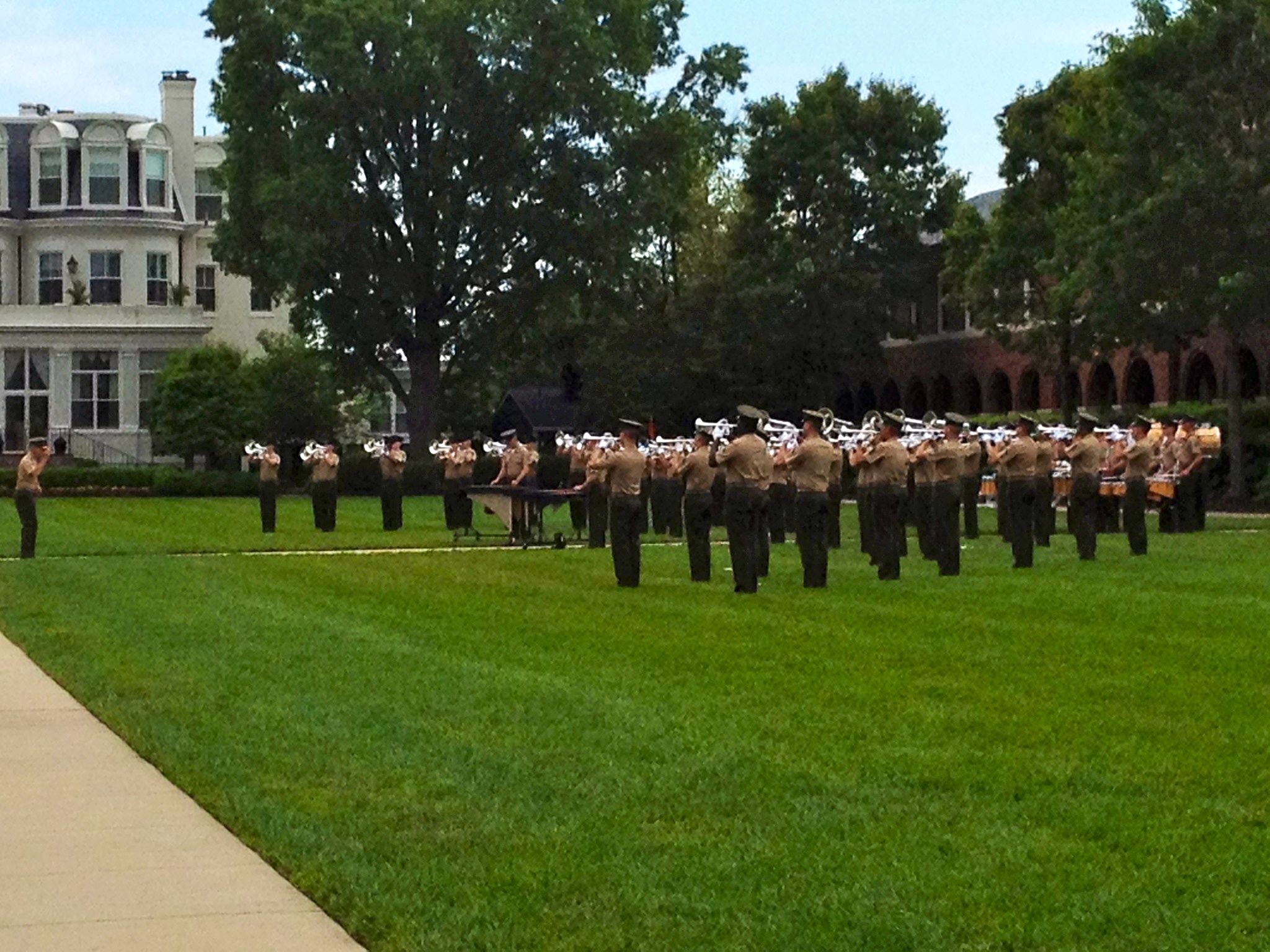
I heard a trumpet fanfare. Sounded like the Marine Corps band. I thought perhaps one of the restaurants across the street was piping it outside to appeal to the tourists. Then the music stopped. Started again. Stopped again. The same musical phrase was repeated several times in a row.

I got out of the car and looked behind me. Between the two-story brick buildings, past the tidy painted iron fence, I could see the edge of reviewing stands. That’s the parade ground, I realized, the one in Dad’s black and white pictures of the evening parade.

The Marine Corps band was practicing outside at the very moment I arrived.

Entering the gate on 8th, I parked as directed alongside the parade ground, next to the building marked “Center House,” and “Bachelor’s Quarters.” Immediately, a precisely-pressed Marine approached me. It was LtC. Garnett, the current Exec Officer of Marine Barracks.

We entered Center House, which functions – as it did in my Dad’s day – as the reception area for visitors and Marine officers. LtC. Garnett stowed his tan cap in the slots provided for that purpose in the entry. He ushered me into a room with two large leather couches that faced each other. He asked if I had memories of my Dad’s service there, and I explained that I was born while Dad and Mom were stationed in Canada, just a few months before my Dad assumed his role as XO. I said that Dad had some wonderful experiences, experiences I was sure he was having, too, as one wasn’t asked to serve as XO unless someone wanted you there.

He explained that he had served in Afghanistan as Executive Officer of the 2nd Battalion, 8th Marine Division. When his Commanding Officer of the 8th was appointed Commanding Officer of Marine Barracks, he asked LtC. Garnett to come with him.

I pulled out my book of photos, worried that I would bore him – the equivalent of inflicting your home movies on a stranger.

He pointed out that the grass on the parade ground, which doubled as a baseball field in my Dad’s time, now had to be maintained perfectly. The evening parade, now a tradition for more than 50 years, was started while Gen. Leonard Chapman was Commanding Officer of the Barracks, and the same format and traditions persist today. In some of the photos, there is a tree, which the Lt. Colonel explained was the ceremonial tree. It had died of a virus, and a post and sign about it still serve as the dividing line between the south and north viewing stands. Guests of the post are seated just to its south.

“This is like royalty,” he said, looking at the officers in Dad’s photos, many of whom had legendary careers in the Marines.

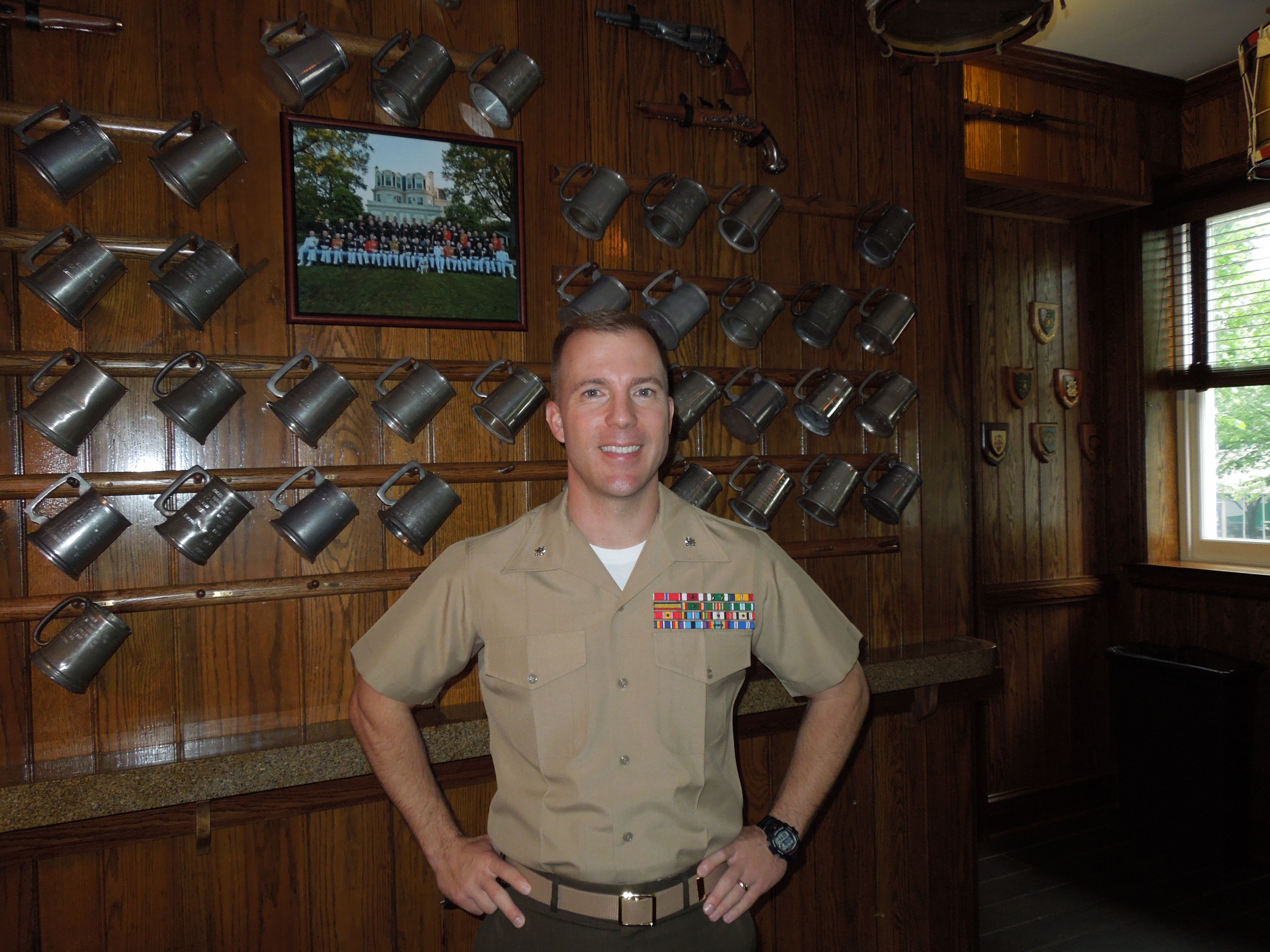
When we got to photos of men holding silver mugs, standing in front of a wall of mugs, he said, “That’s here. That’s the drum room.”

LtC GarnettOn a brief tour of Center House, he explained that it’s still the gathering place on Friday nights. The drum room has an ample number of beer taps. Each of the officers assigned to the Barracks have a mug associated with their position, and on the far side of the mug is engraved the names of those who have held it in recent years. When room for names is exhausted, the mug is retired. He explained that, when the building was renovated in the 70s, the mugs were sent to Quantico with the intent of returning them following the renovation. Unfortunately, they were lost and never restored to the Barracks.

My father served under Gen. Leonard Chapman, then CO of Marine Barracks

My father served under Gen. Leonard Chapman, then CO of Marine Barracks

I said several times that I didn’t want to take too much of his time. He explained, smiling, “This is part of what we do. This is the legacy of the Marines.”

He said that he hoped that some day his son would be interested in learning more about his father’s experience at Marine Barracks. His son, now three, was born while he was in Afghanistan.

I noted that it was my mother’s decision to come east to marry Dad, and that she sent him a telegram to that effect not long after Pearl Harbor.

“She was a pretty strong woman,” I commented. He smiled. “I guess we attract strong women,” he said, smiling. He had asked his wife to follow him on one of his deployments prior to Afghanistan. “She said she’d go… with a ring on her finger,” he noted.

After covering a few logistics, he walked me out to the car.

“I bet your Dad is up there organizing things in heaven,” he said. I replied, “Mom got there first and I’m sure she had it all under control.”

As I approached the car, the Marine Corps Band had just come to the finale of the song that always reduced Dad to tears: “Glory, glory, hallelujah, His Truth is marching on.” Dad said he cried because it reminded him of all of the good men he knew, men that died in the War. We ended Dad’s memorial with the Mormon Tabernacle choir version.

The way the Marines play it, it ends with what seems to be the final chord,  but after a pause, it crescendos in slow pulses, a half step higher, and another half step, and another half – again and again, until finally the trumpets blare in a massive, perfect chord. The air vibrates as the echo dies away.

It felt like Dad had arranged it, just for me.

2 Comments

Filed under Marines and those who serve, Uncategorized

Chaos and Comfort

Friend card

My friend Sharon has been laughing at me all weekend. It started soon after my arrival when I began straightening up, knowing that her family was coming in the next day.  It’s what a good guest does, I said. But she and I both knew the truth. I’ve become a teence obsessive, an aftermath, perhaps, of feeling that things were so out of control as my father lay dying a few months back.

Every time I open one of her cupboards, my palms literally itch to organize them. Most of the cans are on an upper shelf, but why are the canned clams on the shelf below it? Why is the sugar in a baggie on the floor?

I itch, but I don’t fix. I realize that this is her home, and she likes it comfy.

Walking Saturday, our conversation turned to families. She has been “an orphan” for some time, one of four children born within a five year span. I talked about my evolving relationship with my brothers. A recurring question for me in the months since Dad died has been, “Who is my family now? Who are we to each other?”

There is choice involved now, you see. Dad gave us a reason to come together for birthdays or holidays. He was the draw. Though there may still be obligation, it is less compelling.

In families like ours, where there are more than two siblings, there are affinities. A pair might feel more like-minded and naturally confide in one another. Or having the distance of a couple of years and a sibling in between, they might feel less competitive. A common interest — like trout fishing — may foster a bond.

We grow up with a natural place in the family architecture. My Dad’s family referred to the eldest brother as “the handsome one,” the youngest brother as “the sweet one,” and my Dad, the middle child, as “the smart one.”

My friend and her siblings are finding their way. It’s hard to say if their paths will draw them together, or push them apart. They may become more intransigent, or, like my Dad, more tolerant.

You can rearrange cupboards but you can’t rearrange your siblings. Their comfort may be my chaos, but we are the only people in the world who carry the precious and intimate knowledge of our family from childhood forward.

Leave a comment

Filed under Uncategorized

Loss and Its Companions: Love and Forgiveness

Eileen Driscoll Campbell

In grieving Dad, my mind has turned to my mother, who died in 1999. I love her for who she was and her many gifts to me, and I have long since forgiven her for the things that I once ached to receive from her.

If I want to, I can call to mind the feel of resting my head on her bosom, dozing on a long car trip, comfortably settled between Mom and Dad on the plastic-covered bench seat. I can’t exactly say that it’s a recollection. It’s more like a muscle memory, as if the tissues of my face can reconstruct the very feeling of her. She is soft and warm, a little damp with perspiration, and smells faintly of Shalimar talcum powder.

But I also remember Mom being perfunctory when I expressed feelings of hurt or sadness. Which seemed to happen often. “Stop crying like a fire engine,” she would tell me, exasperated. Her lips would compress above her strong jaw line.

A few years into my marriage, she bluntly told me that I would lose my husband if I continued my commitment to career. Prohibited from pursuing the career she had imagined in law, she found success in her role as wife. She believed I would succeed only by doing the same. Implied in her warning, I thought, was a threat that she would be on my husband’s side if I screwed things up.

This doesn’t seem like much of a homily to my mother. But I couldn’t have felt for her what I did by the time that she died if I hadn’t spent time pulling apart the threads of our relationship and reassembling them with the advantage of time, distance and age.

Several years before Mom passed away, when she slid more deeply into dementia, a blanket of sadness settled on my shoulders. I felt immobilized and I had no idea why.

This fits my pattern: having been well trained to ignore feelings of sadness, I don’t recognize them. They rise up. They demand my attention. When they are persistent enough, I attend to them.

Realizing that I was losing Mom made me examine our complicated relationship. I knew she loved me, sometimes with terms, but ultimately unconditionally, with fierceness and loyalty. I wasn’t like her. I would never be like her. But I knew she loved me.

By the time she developed lung cancer, I was at peace with my relationship with her. I forgave her for not always being able to give what I wanted from her. As cancer ate away at her personality and memory, love glowed in the gaze of her fading brown eyes.

Loss and forgiveness. They go together.

1 Comment

Filed under Uncategorized

Re-forming as Family

Selfie portrait Betsy and Sandy

As my Dad grew more frail, his world shrank. Eventually it consisted of what fell within the four walls of my home, augmented by the daily newspaper and the Military History Channel. My world shrank, too.

Dad’s passing has left a huge void, but it’s also given me the freedom to renew relationships. Last month, I was delighted to host my niece (who is more like my younger sister) and then my brother Dean.

Instead of a visit focused on my Dad, we focused on us.

Sandy’s visit was originally slated for January 19 as a chance to say goodbye to Dad, a visit that was postponed when he died January 12. I didn’t know how she’d feel, returning to a house still vibrating with his presence, sleeping in the guest room that has been known as “Dad’s room” since December 2006.

I like to whine that I was kicked out of my room upstairs when I was 10, relegated to a windowless room in our concrete block basement when my not-quite-21-year-old brother moved in with his wife and newborn. I was still unable to sleep away without becoming homesick, and not happy about losing proximity to my parents’ room and the living room, where I could hear the murmur of their bridge games long after my bedtime.

Then I fell in love. There are few loves like that of a pre-adolescent girl for a baby. Having Sandy in our home was even better than the Brenda Bride doll I received for Christmas that year (its trick was to catapult the bouquet).

Sandy on Stinson beachSandy is all grown up now, of course. She’s been married to a great guy for nine years and has two adorable boys, 4 ½ and 6 years of age. It was so comfortable to hang out with her – not the same, perhaps, as when we sat squished together in the recliner in the Rec Room downstairs, watching TV – but still so easy. We had lunch on the dock at Sam’s Anchor Cafe in Tiburon, drove to Stinson Beach, and made a dinner stop in Davis before returning to Sacramento.

Dean’s visit was as different from his prior one as can be imagined. The day after Dean arrived last January, Dad’s condition rapidly deteriorated. Disquieting symptoms eclipsed one another in rapid succession. We frantically conferred, called hospice, implemented steps to increase comfort. We were riding on the roof of a fast freight train that raced out of control, hanging on around the curves, never catching our breath.

After Dad died, we were breathless. We knew we had done our best, but our best couldn’t reverse the inevitable end. We gathered with Scott, Bruce, Maddie and Tommy. We held each other, talked about logistics. The “boys”(they’re still “the boys” though the eldest of us is now 70) relegated the medical equipment to the garage and sorted through Dad’s small store of effects.

When Dean arrived in April, what we did first recall that traumatic week in January.

Then we played.  By happenstance, Todd was away, so it was just Dean and me. I don’t remember the last time that we had time together with no responsibilities, no competition for our attention, no agenda. Maybe we’ve never had free time like that.

My brother and me at TasteWe drove up through the rolling green pastureland to the Gold Country and enjoyed a delicious, slow lunch at Taste. We sampled Barbera at a few wineries. After returning, we went to a mindless but entertaining movie (Oblivion).  We just had… fun.

I’ve been wondering: who is my family now that Dad is dead? A family is not one organism. It’s a system of relationships. Every single combination of individuals is a relationship, with logarithmic permutations. Until now, we have had Dad as a connecting fiber. Family as we knew it blew up, but the component parts are gravitating back toward each other, re-forming.

2 Comments

Filed under Uncategorized

Searching for Answers About Congestive Heart Failure (CHF)

photo credit: womenshealth.gov

When you’re caring for someone with a deteriorating health condition, you can often feel alone. It’s up to you to stay on top of symptoms, reach out to doctors, and try to make sense of information that is unlike anything we’ve ever tried to understand. It seems that congestive heart failure is one of the diagnoses that is most frustrating for health care professionals and caregivers to manage. It can proceed in so many different ways.

A few minutes ago, a woman named Karen commented on a blog post where I shared – in detail – my journal of my Dad’s 10+ year experience with congestive heart failure, as well as his last month of life. She wrote, “I was so lost with questions that couldn’t be found.”

Unfortunately I don’t have answers, but I put my Dad’s experience “out there” in the public view so that caregivers like Karen could see one example of how CHF developed and what happened during the rapidly-changing period that Dad was in hospice. I’m glad it was helpful to her in some way.

Curious, I looked at the statistics for The Henry Chronicles and was astounded to see that 20 people who found this blog in the past 30 days were searching for information about CHF.

Some of the queries were obviously clinical, like, “end stage congestive heart failure,” but others spoke to the painful and powerful experience of a caregiver trying to understand what to expect, how to prepare — emotionally if nothing else: “congestive heart failure journey.”

My Dad’s journey is over, but I am with you in spirit, fellow caregivers, as you try your hardest to make sure that your loved one has the best possible quality of life.

4 Comments

Filed under CHF and Other Medical Problems, Uncategorized