Tag Archives: end of life

The Circle Closes

Silent movies used to use a particular edit to denote finality: a circle that grew smaller and smaller until everything went to black. When Looney Tunes lampooned the technique, Porky Pig suddenly squeezed through the shrinking circle, to stutter “That’s all folks,” before popping back into Toon Town, the window closing behind him.

I’ve often thought of the end of life in those terms. The past few weeks,the circle has been closing.

With an underlying diagnosis of congestive heart failure, and the instinctive discipline of my Dad, it’s been hard to predict how the final years of his life might go. My Mom’s terminal lung cancer had a pretty known trajectory; although she was given weeks to live, she lived nearly four months, but either way – we knew it wouldn’t be long, and it wasn’t long.

Every day now gets a little tougher. Dad is growing weaker. He sleeps more, and sometimes is not strong enough to stand and walk. He is very short of breath even at rest, and eating and drinking is becoming more difficult. His heart rate is lower and becoming irregular, and his blood pressure is up. He is working hard just to breathe and talk.

So I wonder, perhaps for the first time: are we now in the final period? I won’t call it the home stretch because there’s nothing homey or relieving about it. I have been with two people when they died, and it was hard work for them, leaving this world, even with great comfort care.

A week ago, my brothers were worrying about Dad’s dignity as he left the ER with a catheter. One of them said it was “one more blow.”

Funny, as Dad has needed more personal care this week, dignity hasn’t felt like a big issue. Words from Tuesdays with Morrie came floating in to my head, so much so that I dug the book out this morning:

“Mitch, it’s funny,” he said. “I’m an independent person, so my inclination was to fight all of this — being helped from the car, having someone else dress me. I felt a little ashamed, because our culture tells us we should be ashamed if we can’t wipe our own behind. But then I figured, Forget what the culture says…. I am not going to be ashamed. What’s the big deal?

“And you know what? The strangest thing.”…

“I began to enjoy my dependency. Now I enjoy when they turn me over on my side and rub cream on my behind so I don’t get sores. Or when they wipe my brow, or they massage my legs. I revel in it. I close my eyes and soak it up. And it seems very familiar to me.

It’s like going back to being a child again. Someone to bathe you. Someone to lift you. Someone to wipe you. We all know how to be a child. It’s inside all of us. For me, it’s just remembering how to enjoy it.”

Hundreds of times, my Dad has said to me, “Everyone needs a mother.” Everyone does.

I am hoping that I can do what mothers do in these final stages: make the boo boos feel better, and chase the nightmares away.

4 Comments

Filed under Uncategorized

Love and Buckwheat Pancakes

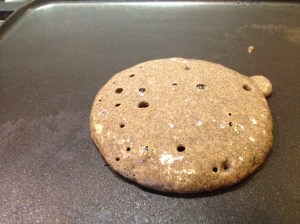
Buckwheat pancake on the griddle

My brothers and I all have our ways of demonstrating love for Dad. And right now Dad can use all the TLC he can get.

My brother, Dean, whipped up a batch of one of Dad’s favorite confections this morning: buckwheat pancakes.

My kitchen smells like stale beer the morning after a fraternity party. These grainy pancakes, tasting of yeast and looking like dirt, are an obsession that escapes me. “It’s an acquired taste,” Dean says. I guess.

I may dislike the smell and hate the taste, but I love these little rituals that my brothers bring with them when he visit. Dad eats it up. Literally.

1 Comment

Filed under Uncategorized

Taking Mom for Granted

Although my mother died in 1999, she lives on in my mind. In not a few of my mental pictures, she is busy in the kitchen in her quilted satin pink bathrobe — the one Dad bought her on one of his last minute Christmas Eve shopping expeditions. She’s sweating slightly and occasionally barking orders like the domestic commander that she was.

My brother and I huddle around a giant stainless steel bowl “picking the bread,” a chore that involved plucking slightly stale sandwich bread into suitably-sized increments for the sage and onion stuffing. We cooperated but were none too happy about it. I am sure I had been told – repeatedly – to get out of my luxurious four poster bed in the dark corner basement room where I would easily sleep until noon, given half the chance. But I wasn’t given the chance as (alas) Mom needs help.

The bread picked, my chores continue, or I should say, “chore.” The only other standing task I remember on holidays was setting the table. Holidays, of course, called for the household’s finest: Grandmother’s heavy silver place settings, Mom’s “Golden Wreath” china, Waterford “Lismore” crystal and lots of silver serving dishes that invariably needed polishing. I’m sure I emitted my share of heavy sighs while getting everything up to Mom’s standards, which is to say the standards of a Marine Corps officer’s wife.

In the meantime, my Mom finished the stuffing, got it in the bird, “jounced” the turkey up and down with Dad’s help to maximize room for the stuffing, stitched up the gaping maw of the turkey’s innards, and started the long, slow process of babysitting and basting the turkey to its golden, roasted peak. Somewhere along the line she prepared the side dishes, although turkey, mashed potatoes and stuffing were all anyone ever cared about.

When it came time to gather ’round the table for grace, a toast, and the ceremonial carving of the bird, we thanked Mom. Or at least I think we did. To be honest, I’m not sure.

I took our delicious holiday meals for granted. I took our lovely home and table setting for granted. I took my mother for granted.

And, as strange as it sounds, I am grateful that I could be so oblivious in my security. One of my mother’s greatest gifts was that she was utterly reliable and predictable in her role as mother. I never had to question whether she loved me, or how she would respond if I did something she approved of, or disapproved of. She was the same, day in and day out. An immutable force of nature.

As I look forward to the holiday tomorrow, I expect that I will be taken for granted. I hope those who I love don’t have to think about who I am, what to expect of me, and how I feel about them.

So, go ahead. Take me for granted. It’s one of the nicest compliments you could pay me as a legacy from my mother.

1 Comment

Filed under Uncategorized

Saying goodbye

While my “other mother” was lying in her hospital bed at St. Joseph’s Medical Center 10 days ago, in between periods of stark awareness, my mind kept rewinding and fast forwarding. I rewound to a night thirteen years ago when my mother was in a different bed in St. Joseph’s, fading in and out of lucidity following procedures that first discovered her late stage lung cancer and then sought to repair a hole in her lung so that she could go home with hospice. But I was also fast forwarding, imagining the day that I will hold my father’s hand while he struggles to leave this earth. I think that’s how it is for many people: when we lose someone we love, we also think about the others we have lost, and those who we cherish and are losing.

I almost published this journal entry from February 16, 1999 just before I headed up to Washington state. When I returned Monday night, it was the first thing I saw on my desk:

Last night, I spent the night with Mom at St. Joseph’s Medical Center. Two-and-a-half weeks into her stay, following her diagnosis of lung cancer, she was for the first time completely lucid.

At about 9:45 p.m., Mom was looking at the ceiling. I asked her if she was thinking or looking at something. She replied that she was thinking.

Over the next hour, in quiet and measured tones, she said goodbye to me. She began by saying, ‘You’ve been a wonderful daughter.’ After a few minutes, she added, ‘You’re a very competent woman.’

I realized that she was beginning to say goodbye. I wanted to tell her how much she meant to me but the words seemed so inadequate. I told her she was a wonderful mother — strong, loving and nurturing. I remember once, when I was quite old, that she had responded to my sadness by pulling me on to her lap in my Nana’s rocking chair.

I hugged her and apologized for crying. She said, ‘Why not?’ Then she said, ‘You are a beautiful daughter; now get some Kleenex and blow your nose.’

After a few minutes she said, ‘We’ve had a wonderful life together. Sons are special but there is something very important about a daughter.’  She tried to express her thoughts about what makes daughters different and struggled a bit with the right words. She said, ‘Daughters are more emotional.’ It seem to me that what she meant was that daughters are close to one’s heart in a different way.

I said to her that my brothers had been wonderful throughout her stay. I told her they had comforted her and been loving and compassionate. I told her that we had not left her in the entire 2 1/2 weeks. This seemed to surprise her. I added, ‘We didn’t think you would want to be left alone.’ She said, ‘You were right,’ and smiled softly.

She said that her grandmother was in her late 90s when she died and that she couldn’t remember how old her mother was when she died. Implicit in her remark was her consideration of the age she would be when she died.

‘It’s one of the hardest things you ever do to say goodbye to people you love,’ she said, ‘but it’s important.’

I asked her if she was worried. She said, ‘Not exactly.’ I said we loved her and would be with her every step of the way and that God was with her.

She asked, ‘How is your Dad handling all of this,’ glancing at her hospital bed and surroundings. I said that he was sad because she is so precious but that he was okay and taking care of himself. I said I would take good care of Dad.

She said, ‘I’m going to outlive your Dad,’ and then she added, ‘at least I think so.’ Then she reflected for a while.

I commented on her strength and said that we were raising another strong woman in Maddie. She agreed and added, ‘And Tommy is wonderful, too.’ I reminded her what she had said emphatically to Maddie that morning: ‘You know what? I like you.’

Finally I asked if there was anything I could do to make this easier. She said, ‘Well, one thing you can do is continue to be the marvelous woman that you are — competent, with a high level of activity, a very high level of activity. The world needs you.’

She drifted off to sleep. Not long after this was written, she did make it home with hospice. She passed away the day after Mother’s Day, on May 10, 1999. I miss her.

2 Comments

Filed under Uncategorized

Singing Mama Home

In the initial weeks after my mother was diagnosed with cancer in 1999, I wanted to comfort her as she drifted in and out of lucidity. I remember sitting quietly by her bedside at the hospital, holding her hand. My first instinct was to try to sing to her since, all through my early childhood years, so many of my memories were accompanied by her singing. But confronting her impending death, I couldn’t sing. Each time I tried, I choked up.

Music was, and is, inextricably linked to my attachment to my mother. When I was a little girl, my mother would tuck me in and sing me our family lullaby, “Jesus Tender Shepherd.” She would turn out the lights, and leave the door ajar. Through the crack in the door, I heard the murmur of our settling household. But instead of sleeping, I often lay awake. After a half hour or so, I’d get up and tell Mom. Again she would sing,”Jesus Tender Shepherd,” turn off the lights, and leave the door ajar. Sometimes, there was a third or even fourth cycle before she became completely exasperated.

In my mother’s twilight moments, I wanted to bring that comfort to her. For several weeks, I continued to try to sing to her. And one day, I found I could do it. As agonized as I felt while watching her slow departure, I finally had the control to sing. I sang that childhood lullaby then, and later when we celebrated her life.

This past weekend, my ‘other mother’ completed her journey on this earth. The family, and those of us who are extended family, didn’t see it coming. But her medical setbacks turned from a trickle into a cascade, and finally into a flood that she could not overcome. And yesterday, I found myself by her hospital bed with my best friend and her sisters and brother, trying to find a way to comfort my ‘other mother’ as she did the hard work of letting go.

That afternoon, we had attended a vocal choir concert by the Adelphians of the University of Puget Sound, which they ended with their traditional finale, Stephen Paulus’ “The Road Home.” I started crying as I listened to the lyrics:

Tell me where is the road I can call my own, that I left, that I lost, so long ago?

All these years I have wandered, oh when will I know, there’s a way, there’s a road that will lead me home?

Rise up, follow me, come away is the call

With love in your heart as the only song

There is no such beauty as where you belong

Rise up, follow me, I will lead you home

After wind, after rain, when the dark is done, as I wake from a dream in the gold of day

Through the air there’s a calling from far away, there’s a voice I can hear that will lead me home.

Rise up, follow me, come away is the call

With love in your heart as the only song

There is no such beauty as where you belong

Rise up, follow me, I will lead you home

Hours later, reflected in the hospital’s dark oval window, we gathered around an unquestionably beautiful woman who had loved us, chastised us, teased us, cheered us, cried for us, and stood up for us. My best friend, her daughter and I sang “The Road Home.”

As I remember it, just as we finished, my friend’s sister noticed that something had changed. Mama’s hand felt different. Then she didn’t take that next breath. She was gone.

Our quiet vigil was interrupted by a rush of awareness, then panic and confusion. Filling the void came the impulse to sing. And what came to mind was the lullaby that my mother sang so often to me. This time, I could sing it, joined by my best friend. We sang Mama home.

9 Comments

Filed under Faith journey, Uncategorized

Too much love?

Can you imagine this image as an older parent? It’s not how we think about our role as caregivers, is it? (courtesy Teach Through Love)

Our first instinct as parents is to surround our children in a cocoon of love that cushions them against hurts both physical and emotional. But eventually, we find out that we do our children no favors if we never let them struggle.

I am learning that being a caregiver for an aging parent is not that different.

Since I moved my father to California in 2006, he’s spent the majority of the time at my house. He has his own bedroom with a cushy La-Z-Boy, television and bathroom. After giving up the family house where he lived from 1969 to 2003, I wanted him to feel this was home. At the same time, I wanted to know I could leave town and trust that he would be secure, with all of the support services he needs. So he’s had a one bedroom apartment in a nice assisted living community.

The back-and-forth worked just fine until July, when his health became unstable. Although he is now almost fully recovered, his emotional health continues to suffer.

My mother, during the final stages of lung cancer, expressed fear of dying, despite the deep faith that sustained her for so many years. My father wondered why, if there is a God, would he abandon my mother in her hour of need? Now it is my father who fears dying – and, in particular, dying alone.

Ten days ago, he asked me, “Can I come live with you?” He continued, “Living alone is no way to live. I’m afraid to die alone.”

Using my strategic planning skills, it seemed to me that we had to revisit Dad’s living situation. My objective, and that of my brothers, is to ensure that Dad lives with as little physical and emotional distress as possible. To that I had to add an objective about meeting the needs of my own family — oh, and taking care of myself, too.

It seemed to me that there were three possible solutions: 1) Dad would come to live with me full-time; 2) we continue to muddle through with more companion services at his apartment on the days that I am not available; or 3) we limit the number of nights that Dad stays at my house because of his increased distress when he has to return to his apartment.

I sought input from a social worker, a mentor, our home church pastor, his doctor, and a psychologist. Along the way I also had Dad evaluated for hospice and found out that he’s not close to qualifying for that type of end-of-life care. I had to start thinking about what would be best for a period of gradual decline that could last for several years – something I never imagined given that Dad has had three heart attacks, three strokes and three open heart bypass surgeries.

I also had to “listen” to myself. I realized I felt overwhelmed by the possibility of Dad moving in full-time. I really want that to happen, but now isn’t the right time. My Dad isn’t the only one who needs me right now.  I had to admit to myself that I felt exhausted.

The social worker shared a little tough love with me. She said, “He is distressed about the prospect of going back to his apartment because it isn’t ‘home.’ And it isn’t home because you won’t let it be home. He spends enough time at your house that the transition is difficult. He doesn’t remember exactly what happens there and it feels unsafe to him to return.” She went on, “As family members, you’re responsible for providing the caring, but not necessarily the care.”

My beloved mentor Jim offered this advice:

This is very hard to do: separate what is in his best interest and his care needs from your heart duty as a loving daughter.  Like most elders in his situation, he is becoming more child like — likes what he likes and won’t budge; wants his mommy really to take care of him although he would not recognize that is what he is doing to you.  If he does move in and a caregiver is part of the team, you will have to force him to agree to let that caregiver do his/her thing.  You almost have to write out a ‘contract’ that he has to agree to.  Obviously it is not a legal thing, but you use it to force him to focus on reality when he just wants it all to be different and for you to be there constantly.

My church home pastor suggested that I facilitate a casual visit with a priest. “Throw him a lifeline,” he suggested. “He may choose not to talk about his concerns about death, but he may be ready to talk.” And my psychologist friend suggested having Dad evaluated for anti-depressants. His doctor agrees that may be worth trying.

So what was decided? I had a conference call with my brothers last Wednesday night and we decided to try out an arrangement where Dad is limited to three nights a week at my house. I’ve visited him at his apartment every day and joined him for lunch to reinforce the message that the staff knows him and is paying attention.

He doesn’t love it, but he is responding to the message that there are some things I need to do right now to take care of my family and myself. He asks how he can help, and I say, “Just be patient, Dad, and be supportive when I can’t be here.”

Week one went well, but the big test will come this weekend when I leave town for three days… Stay tuned.


1 Comment

Filed under Uncategorized

Sibling fight!

Why is it that food fights are fun and email fights are not?

I was quite smug last night when I told a friend that I thought my brothers and I were really communicating effectively with one another. She had just returned from 10 days of overseeing her mother’s recovery from pneumonia and surgery, during which she was repeatedly second-guessed by her out-of-state sister.

Then I got an email from one of my brothers today, who reacted to an email sent by another brother. I won’t get into the details but I’ll share the zinger with which he ended his message: “…have the two younger sib’s simply cut out the two older sib’s from having a voice?”

I thought we were past this.

But the truth is that it is very, very hard for people who act like grownups in most situations to behave that way when something triggers half-buried resentment. We are all suddenly six.

There are a lot of “perhapses” that come into my mind. Perhaps the brother who sent the original email should have called instead of sending this particular message by email. Perhaps the brother who seethed over the email should have picked up the phone and expressed his concern to the sender, or to me (since I was supposedly colluding in the decision in question). We could have done better.

When we are stressed, as we are in no small part by Dad’s deteriorating health, we are reduced to the ugliest side of our personalities and temperaments.

It’s hard to keep one’s eye on the real issues here: how to make sure that Dad feels loved and safe, and how to preserve and perhaps strengthen our sibling relationships for the time when Dad is no longer there to bind us.

Right now I’m working on that last part.

2 Comments

Filed under Uncategorized

My husband, the unsung hero

(Before you read this post, stop remembering the Andy Kaufman version of the Mighty Mouse theme song. I mean it. Stop. It. Right. Now.)

My husband and I have always had a 50-50 arrangement, if you average it over time. Statistical nerd that I am, I know that the average can mask a labile distribution of responsibility for household and familial duties. Sometimes it’s 75-25, sometimes 25-75, and occasionally even 90-10 (as in the time when we were preparing to move and my husband managed to break his knee on a guys’ trip).

Every time someone says to me that I’m an angel for taking care of my Dad, I remember that the guy holding my halo in place is my husband.

When I stop to take inventory, I realize that it’s a whole bunch of little things he does that accumulate to make a difference. When he comes home from work every evening, he asks if my Dad has his glass of wine. While I scramble to do my “magic” in the kitchen (anyone who knows me knows this is not a joyful experience), he’s contributing the comfortable routine of my Dad’s life. Dad used to have a couple of scotch and waters before dinner that over the years morphed into a glass of red wine. Dad’s almost lost his taste for wine at all, but that pre-dinner libation is a nicety in the not-so-nice world of advanced age.

Sometimes my husband “covers” for me if I have a morning meeting or am entertaining a couple of girlfriends. I’ve never detected a moment of resentment if I ask him to fix Dad’s breakfast or put his dinner on the table.

Taking care of Dad severely limits our flexibility to accept invitations from friends or go out of town for the weekend, things my extrovert husband would enjoy. But he never complains. Ever. I’ve never detected resentment, though he would be well within his rights to feel some.

And he shares his space often, as family members come to visit my Dad.

Perhaps most significantly, he doesn’t try to fix my problems when I feel down or a little worn out. Earlier in our marriage, we learned that my sharing a problem led to him trying to solve it, when sometimes all I wanted was the opportunity to vent. He sits with me and empathizes. I feel held inside even if we are not touching outside.

Next time your mental jukebox plays, “Here I am to save the day!” remember the great men who are out there standing behind the “angels” like me.

1 Comment

Filed under Uncategorized

What makes caregiving so hard?

I thought I knew what hard is. Hard was being nine months pregnant, diagnosed with pregnancy induced hypertension (ankles bloated to the exploding point), and getting ready to present the first full-scale consumer awareness study to the hospital system execs for whom I worked. Hard was working full-time, while trying to be a good mother of  a one-year-old and  studying for my M.B.A. during nap time and at night. Hard was working a full day with two hours of commute time on either end.

Being responsible for someone who needs your help and care, it seems to me, isn’t exactly training for the Olympics. But it can feel that way sometimes.

My Dad doesn’t need assistance with the basics. He dresses himself, puts his hearing aids in, eats independently, and has the toileting thing pretty much under control. My caregiving gig is a lot easier than many.

I think what’s hardest for me is the emotional burden – dodging obstacles, holding others up who worry from afar, and coping with the no-end-in-sightedness. I am constantly anticipating problems and talking steps to circumvent them, for example, clearing my Dad’s path of trip hazards and pre-emptively clearing dishes so that my he will not take it upon himself to do so, toodling from the breakfast table to the counter with dishes in both hands (and thus without either cane or walker). When a medication stops working and needs to be adjusted,  I run the gauntlet of conversations with doctors and care staff, trying to get accurate information about the situation (clarifying, clarifying, confirming) and calling and finally badgering someone into changing medical orders.

Dad is unstable enough that my brothers now worry from afar. I understand their vigilance, having felt just the same way when home in California during my mother’s four month hospice period in 1999. When I report setbacks, which have been more frequent during the last month, I get messages from my brothers asking if this is a crisis and whether they should book flights. I know their messages are code for, “Do you think he could die?” I try to reassure them. Understanding that you are going to lose someone is to begin grieving. I know they hurt. [Brothers who read this: this is not a complaint. I really appreciate your increased vigilance.]

We’re not there yet. Several times of late I’ve been asked what I will do when “this period is over” (code for “when Dad is dead”). I don’t know. I can’t plan. If I get my head in the future it will be even harder to manage the day-to-day. So I am actively avoiding long term planning.

Right now my whole world is the next two weeks, in which I hope we will stabilize Dad’s underlying congestive heart failure condition so that his weight swings and shortness of breath resolve, at least until the next unsettled period.

This shouldn’t be that hard. But some days it is. Fortunately, today is not one of them. So far.

3 Comments

Filed under Uncategorized

Family communication: seeing eye-to-eye through our diversity

Nephews, brother, sister-in-law, niece and Dad – out on a walk

Writer’s note: If you find this blog post of interest, you might want to check out a discussion on the NY Times New Old Age blog in which readers comment about communications techniques they have found helpful – a response to the article, “How Do You Keep Track of It All?”

My brothers and I look so little alike – and are so little alike – that it’s a matter of family jest. The brother who is closest to me in birth order and I once had to show our driver’s licenses to prove we were related to a woman who knew us both yet was unaware that we were related. My eldest two brothers are 15 and 10 years older than I am. The family unit they grew up in – which included a younger sister who died of leukemia in the 1950s – was a different one than the one my younger brother and I knew. It would be easy for us to have different ideas about “what to do” about our parents as they aged.

Instead, we seem to be in lock step.

Going back 15 years, when my mother’s dementia grew worse, and later, as she struggled with late stage lung cancer, my brothers and I evolved a system for communicating with one another. That system reduces stress for my Dad and makes it easier to ensure that he is getting the care he wants – and avoiding the care he doesn’t want. It also provides me with emotional support, and now it seems to be helping my brothers and I to imagine how we will be a family after my father’s eventual death.

That “system” started when my brother who is nearest in age called to suggest that we rescue Dad for a few weeks (by taking Mom on vacation) during the period when my mother had become increasingly agitated. Dad’s angina was increasing as her anger and confusion grew. Later, when my mother was eventually hospitalized and near death, our sporadic phone calls were replaced with much closer coordination by phone and email. We took turns staying with her in the hospital and took notes during our “shift”, briefing the next family member who arrived to sit by her bedside. On at least one occasion, our notes enabled us to correct what would have been a grievous medical error since her chart became so large that it was split in two – and some important information about her medication was not transferred to the active chart. When my mother came home with hospice, we tried to keep one another informed of her status as we rotated for three-to-five day stays at my folks’ house to oversee her care and my father’s recovery from his third bypass surgery.

In the past six years that Dad has lived partly with me and partly in an assisted living apartment, I’ve sent periodic “Dad Reports” to my three brothers with details about his spirits and physical health. Instead of quietly nursing resentment when I felt they weren’t doing enough to reach out to Dad via mail or email, I point blank asked them to step up their outreach to him. Our efforts were greatly enhanced by a “Presto” machine that automatically prints out emails sent to my Dad’s email address, thanks to a gift from my eldest brother.

As I have become more concerned about my Dad’s failing health, I have shared recent blog posts with my brothers, including my long rant after reading Joe Klein’s cover feature for Time magazine, “How to Die.” And it was that most recent outreach that uncorked a cascade of emails from my brothers that truly surprised and moved me. Not only were they aligned around preserving my Dad’s comfort and dignity, but they vocalized a commitment to our family unit.

My first reply came from “brother #2”:

I guess I’ll start by saying that for the past year I have been expecting a phone call from my Betsy or the staff letting me know that Dad had passed – I know that phone call is inevitable, and I know that every time I go up to provide respite for Betsy, I might be the one making that call to the rest of you. Selfishly, I don’t want that duty but if I have to be the one to make the call, I will respect Dad’s wishes. I know that he has lost everything he loved or took pleasure from in life, and has become a dependent. He can’t hear us, and I know it galls him.

Is there value in a rush to the ER? Well, the medical profession can certainly prolong a life that has become burdensome and often painful, but they cannot turn back the clock and give life in abundance. And ultimately, all the tests in the world probably won’t offer much that will give him a more abundant life.

I am conflicted by these thoughts – I like the family we have become and the strength that we siblings have found through Mom’s hospice. In many ways, I think that Dad has been the glue that bonded us all together, and I am fearful of losing more than just Dad when he passes away. But that’s not a reason to withold from Dad the end he wants.”

Then brother #1 weighed in:

(Brother #2) has done a good job of capturing my thoughts and feelings on this subject. And like him, one of my worries is that Dad’s passing will dissolve the glue that has kept the four of us close as siblings. I have the longest experience of the four of us with the reality of Dad’s mortality, going back to when Mom and I drove Dad to the Navy infirmary at Pearl Harbor when he had his first heart attack. I recall well how worried Mom was that Dad wouldn’t come out of the hospital alive, but yet he did, and he has hung on tenaciously for nearly 45 more years. As much as it distresses me, his race is almost run, and he has fully earned the right to let go when he thinks the time has arrived. Like (brother #2), I wouldn’t want him to die in distress, but neither do I think it’s fair to him to prolong his life if he wishes otherwise. 

It obvious that the time is drawing closer to when we will lose Dad, and as prepared as I have been for years for him to die, I still dread the reality. We have all been so incredibly lucky to have had Mom and Dad as our parents, and with Mom gone it will be even more wrenching to lose Dad as well. So, I think we should continue to dialogue about our courses of action and be available for one another. As the oldest sibling, I feel a good deal of responsibility for the three of you, even given the fact that you are all strong adults and don’t need me to look out for you. But old feelings and habits are hard to break…”

And lastly, brother #3:
“I have been acutely aware of Dad’s heart condition these many years, and recall thinking when we were off hunting by ourselves that something could happen anytime.As Dad approaches 96, he has clearly run a great race; he recognizes his time is coming and is at peace with that. I have always believed his end would come with a final MI/cardiac arrest; but who knows. Should we find ourselves in a situation where hospice is appropriate – perhaps the heart failure finally becomes unmanageable – then hospice would  be a good choice, and without further intervention other than palliative. On the other hand, if a condition presents that can be reversed or managed to maintain quality of life then I agree the right thing would be to obtain the care.
I agree with (brother #1’s) observation that Mom and Dad helped us to form a strong family. It’s unimaginable to me that we would somehow fall apart after Dad is gone. I enjoy being with each of you and will always love all of you.”
Not only did I find my brother’s emails restorative, but it gave me hope that we will find a way to enjoy one another into the future, despite our differences. Without this effort to communicate with one another, I am certain that the future would have seen us drifting apart, separated not only by physical, but emotional distance.

Leave a comment

Filed under Uncategorized