Tag Archives: aging

Dear Hospice, Thank You

Dawn in Sacramento

My father was admitted into Sutter Hospice today. All at once, I was sad and relieved. As my brother, Dean, said:

Glad to hear this. Don’t exactly feel like celebrating but definitely relieved to know we will be able to manage his symptoms better.

Exactly. I wish this wasn’t something we wanted or needed for Dad, but I know hospice will provide him with the best possible care.

Several people have asked, “What does hospice give you that you couldn’t get without it?”

Frequent nursing visits in the home so that you don’t have to drag your loved one to the doctor when symptoms develop. Medications (more types, and stronger) that work better for symptom control when you can’t fix the underlying problem with surgery or  procedure and physicians aren’t worried about long-term consequences. Equipment that helps to prevent more pain and problems, rather than address them once they’ve developed. 24/7 access to telephone advice from a nurse who is really knowledgeable about serious illnesses. Some volunteer support for respite. Professionals who visit with the person who is ill and his/her primary caregiver(s) to provide moral and spiritual support. In short, a whole gang of people who actually talk to each other so that you don’t have to chase down the support you need.

I’m not ready to think about “the end,” but I know it’s not in the distant, unimaginable future. I know hospice is a comprehensive form of care that will help to make my Dad’s present more worth living.

3 Comments

Filed under Uncategorized

Dear Hospice – A Plea

At the table with Henry Campbell

Dad’s still got a smile on his face in this picture, but if you know him, you can tell it’s a little more forced. I’m writing you – dear hospice angel – to say that I hope you will admit Dad into your program this week. When I’ve raised the possibility, every clinical person I’ve talked to this week has gone on at some length about how hospice isn’t what people think: it’s not “giving up”; it’s not stopping care. Then they explain that hospice is better care.

The thing is, my brothers and I know that. My mother was in hospice care for late stage lung cancer from mid-February until May 10, 1999. We know what you can do. We know why people donate to hospices: you may not be life-saving, but you are quality of life-saving.

I want to be able to step back from trying to figure out how to make Dad comfortable and just be his daughter. I know you will be a hell of a partner in this. This is what my dear friend Jim Jennings wrote me about the task ahead of me now:

All you have to do is just be with him — the Hospice team will keep him comfortable.  Keep this image in mind:  you can hold his hand and mother/daughter love him all the way up to the bridge over the river of life, but then he has to let go of your hand, and you of his, so that he can walk over that bridge on his own with his back turned to you and this world you share, into the world you will share together in eternity.  Tis the way for all of us.

He may, like others sometimes do, dwell on the bridge for a while, seemingly here and seemingly not here.  Some folks take their time.  If he gets to this point, just keep telling him you love him and it is OK to go — that you and your brothers will be OK — very important each of you tell him at some point it is OK for him to be on his way. Stay focused on each day and the little things.  You know, you have to help birth him into the larger life. Turn it all over to Love Divine.

Life is really hard for Dad right now, and it’s getting more painful. He struggles for breath most of the time, which is making it harder to eat and drink. His heartbeat is irregular despite being controlled with medication; it’s working awfully hard. He can still walk with his walker to the kitchen table in the morning, but by the end of lunch, he isn’t strong enough to do so. He hasn’t been strong enough to stand and step over the four inch threshold of the shower for two weeks. His beard is growing in mostly white because he’s too tired to shave: something a Marine Corp Col. Ret. hates to skip. By afternoon, transferring to the wheelchair or the John is a bear. He’s eating less chocolate cake. If you know Dad, that’s the biggest indicator of all.

I talked to Dad yesterday about whether he wanted to seek admission into hospice. His comment? “Makes perfect sense.” He has been saying since summer that he feels he is finished here. He asked, “Do we have any unfinished business?” No, and neither does he. He told me this week that he has lived a good life and “done some things right.” He’s always grateful and surprised that I am here for him, 100%.

But that’s his legacy. He loves me unconditionally, and always has. I love him back the same way.

Dear hospice,

Please help me love my Dad, now, the way that I want, by supporting my brothers and me in caring for him.

8 Comments

Filed under Uncategorized

The Circle Closes

Silent movies used to use a particular edit to denote finality: a circle that grew smaller and smaller until everything went to black. When Looney Tunes lampooned the technique, Porky Pig suddenly squeezed through the shrinking circle, to stutter “That’s all folks,” before popping back into Toon Town, the window closing behind him.

I’ve often thought of the end of life in those terms. The past few weeks,the circle has been closing.

With an underlying diagnosis of congestive heart failure, and the instinctive discipline of my Dad, it’s been hard to predict how the final years of his life might go. My Mom’s terminal lung cancer had a pretty known trajectory; although she was given weeks to live, she lived nearly four months, but either way – we knew it wouldn’t be long, and it wasn’t long.

Every day now gets a little tougher. Dad is growing weaker. He sleeps more, and sometimes is not strong enough to stand and walk. He is very short of breath even at rest, and eating and drinking is becoming more difficult. His heart rate is lower and becoming irregular, and his blood pressure is up. He is working hard just to breathe and talk.

So I wonder, perhaps for the first time: are we now in the final period? I won’t call it the home stretch because there’s nothing homey or relieving about it. I have been with two people when they died, and it was hard work for them, leaving this world, even with great comfort care.

A week ago, my brothers were worrying about Dad’s dignity as he left the ER with a catheter. One of them said it was “one more blow.”

Funny, as Dad has needed more personal care this week, dignity hasn’t felt like a big issue. Words from Tuesdays with Morrie came floating in to my head, so much so that I dug the book out this morning:

“Mitch, it’s funny,” he said. “I’m an independent person, so my inclination was to fight all of this — being helped from the car, having someone else dress me. I felt a little ashamed, because our culture tells us we should be ashamed if we can’t wipe our own behind. But then I figured, Forget what the culture says…. I am not going to be ashamed. What’s the big deal?

“And you know what? The strangest thing.”…

“I began to enjoy my dependency. Now I enjoy when they turn me over on my side and rub cream on my behind so I don’t get sores. Or when they wipe my brow, or they massage my legs. I revel in it. I close my eyes and soak it up. And it seems very familiar to me.

It’s like going back to being a child again. Someone to bathe you. Someone to lift you. Someone to wipe you. We all know how to be a child. It’s inside all of us. For me, it’s just remembering how to enjoy it.”

Hundreds of times, my Dad has said to me, “Everyone needs a mother.” Everyone does.

I am hoping that I can do what mothers do in these final stages: make the boo boos feel better, and chase the nightmares away.

4 Comments

Filed under Uncategorized

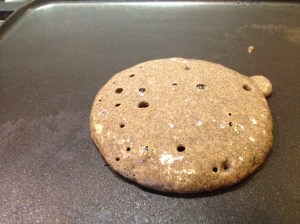
Love and Buckwheat Pancakes

Buckwheat pancake on the griddle

My brothers and I all have our ways of demonstrating love for Dad. And right now Dad can use all the TLC he can get.

My brother, Dean, whipped up a batch of one of Dad’s favorite confections this morning: buckwheat pancakes.

My kitchen smells like stale beer the morning after a fraternity party. These grainy pancakes, tasting of yeast and looking like dirt, are an obsession that escapes me. “It’s an acquired taste,” Dean says. I guess.

I may dislike the smell and hate the taste, but I love these little rituals that my brothers bring with them when he visit. Dad eats it up. Literally.

1 Comment

Filed under Uncategorized

Taking Mom for Granted

Although my mother died in 1999, she lives on in my mind. In not a few of my mental pictures, she is busy in the kitchen in her quilted satin pink bathrobe — the one Dad bought her on one of his last minute Christmas Eve shopping expeditions. She’s sweating slightly and occasionally barking orders like the domestic commander that she was.

My brother and I huddle around a giant stainless steel bowl “picking the bread,” a chore that involved plucking slightly stale sandwich bread into suitably-sized increments for the sage and onion stuffing. We cooperated but were none too happy about it. I am sure I had been told – repeatedly – to get out of my luxurious four poster bed in the dark corner basement room where I would easily sleep until noon, given half the chance. But I wasn’t given the chance as (alas) Mom needs help.

The bread picked, my chores continue, or I should say, “chore.” The only other standing task I remember on holidays was setting the table. Holidays, of course, called for the household’s finest: Grandmother’s heavy silver place settings, Mom’s “Golden Wreath” china, Waterford “Lismore” crystal and lots of silver serving dishes that invariably needed polishing. I’m sure I emitted my share of heavy sighs while getting everything up to Mom’s standards, which is to say the standards of a Marine Corps officer’s wife.

In the meantime, my Mom finished the stuffing, got it in the bird, “jounced” the turkey up and down with Dad’s help to maximize room for the stuffing, stitched up the gaping maw of the turkey’s innards, and started the long, slow process of babysitting and basting the turkey to its golden, roasted peak. Somewhere along the line she prepared the side dishes, although turkey, mashed potatoes and stuffing were all anyone ever cared about.

When it came time to gather ’round the table for grace, a toast, and the ceremonial carving of the bird, we thanked Mom. Or at least I think we did. To be honest, I’m not sure.

I took our delicious holiday meals for granted. I took our lovely home and table setting for granted. I took my mother for granted.

And, as strange as it sounds, I am grateful that I could be so oblivious in my security. One of my mother’s greatest gifts was that she was utterly reliable and predictable in her role as mother. I never had to question whether she loved me, or how she would respond if I did something she approved of, or disapproved of. She was the same, day in and day out. An immutable force of nature.

As I look forward to the holiday tomorrow, I expect that I will be taken for granted. I hope those who I love don’t have to think about who I am, what to expect of me, and how I feel about them.

So, go ahead. Take me for granted. It’s one of the nicest compliments you could pay me as a legacy from my mother.

1 Comment

Filed under Uncategorized

Saying goodbye

While my “other mother” was lying in her hospital bed at St. Joseph’s Medical Center 10 days ago, in between periods of stark awareness, my mind kept rewinding and fast forwarding. I rewound to a night thirteen years ago when my mother was in a different bed in St. Joseph’s, fading in and out of lucidity following procedures that first discovered her late stage lung cancer and then sought to repair a hole in her lung so that she could go home with hospice. But I was also fast forwarding, imagining the day that I will hold my father’s hand while he struggles to leave this earth. I think that’s how it is for many people: when we lose someone we love, we also think about the others we have lost, and those who we cherish and are losing.

I almost published this journal entry from February 16, 1999 just before I headed up to Washington state. When I returned Monday night, it was the first thing I saw on my desk:

Last night, I spent the night with Mom at St. Joseph’s Medical Center. Two-and-a-half weeks into her stay, following her diagnosis of lung cancer, she was for the first time completely lucid.

At about 9:45 p.m., Mom was looking at the ceiling. I asked her if she was thinking or looking at something. She replied that she was thinking.

Over the next hour, in quiet and measured tones, she said goodbye to me. She began by saying, ‘You’ve been a wonderful daughter.’ After a few minutes, she added, ‘You’re a very competent woman.’

I realized that she was beginning to say goodbye. I wanted to tell her how much she meant to me but the words seemed so inadequate. I told her she was a wonderful mother — strong, loving and nurturing. I remember once, when I was quite old, that she had responded to my sadness by pulling me on to her lap in my Nana’s rocking chair.

I hugged her and apologized for crying. She said, ‘Why not?’ Then she said, ‘You are a beautiful daughter; now get some Kleenex and blow your nose.’

After a few minutes she said, ‘We’ve had a wonderful life together. Sons are special but there is something very important about a daughter.’  She tried to express her thoughts about what makes daughters different and struggled a bit with the right words. She said, ‘Daughters are more emotional.’ It seem to me that what she meant was that daughters are close to one’s heart in a different way.

I said to her that my brothers had been wonderful throughout her stay. I told her they had comforted her and been loving and compassionate. I told her that we had not left her in the entire 2 1/2 weeks. This seemed to surprise her. I added, ‘We didn’t think you would want to be left alone.’ She said, ‘You were right,’ and smiled softly.

She said that her grandmother was in her late 90s when she died and that she couldn’t remember how old her mother was when she died. Implicit in her remark was her consideration of the age she would be when she died.

‘It’s one of the hardest things you ever do to say goodbye to people you love,’ she said, ‘but it’s important.’

I asked her if she was worried. She said, ‘Not exactly.’ I said we loved her and would be with her every step of the way and that God was with her.

She asked, ‘How is your Dad handling all of this,’ glancing at her hospital bed and surroundings. I said that he was sad because she is so precious but that he was okay and taking care of himself. I said I would take good care of Dad.

She said, ‘I’m going to outlive your Dad,’ and then she added, ‘at least I think so.’ Then she reflected for a while.

I commented on her strength and said that we were raising another strong woman in Maddie. She agreed and added, ‘And Tommy is wonderful, too.’ I reminded her what she had said emphatically to Maddie that morning: ‘You know what? I like you.’

Finally I asked if there was anything I could do to make this easier. She said, ‘Well, one thing you can do is continue to be the marvelous woman that you are — competent, with a high level of activity, a very high level of activity. The world needs you.’

She drifted off to sleep. Not long after this was written, she did make it home with hospice. She passed away the day after Mother’s Day, on May 10, 1999. I miss her.

2 Comments

Filed under Uncategorized

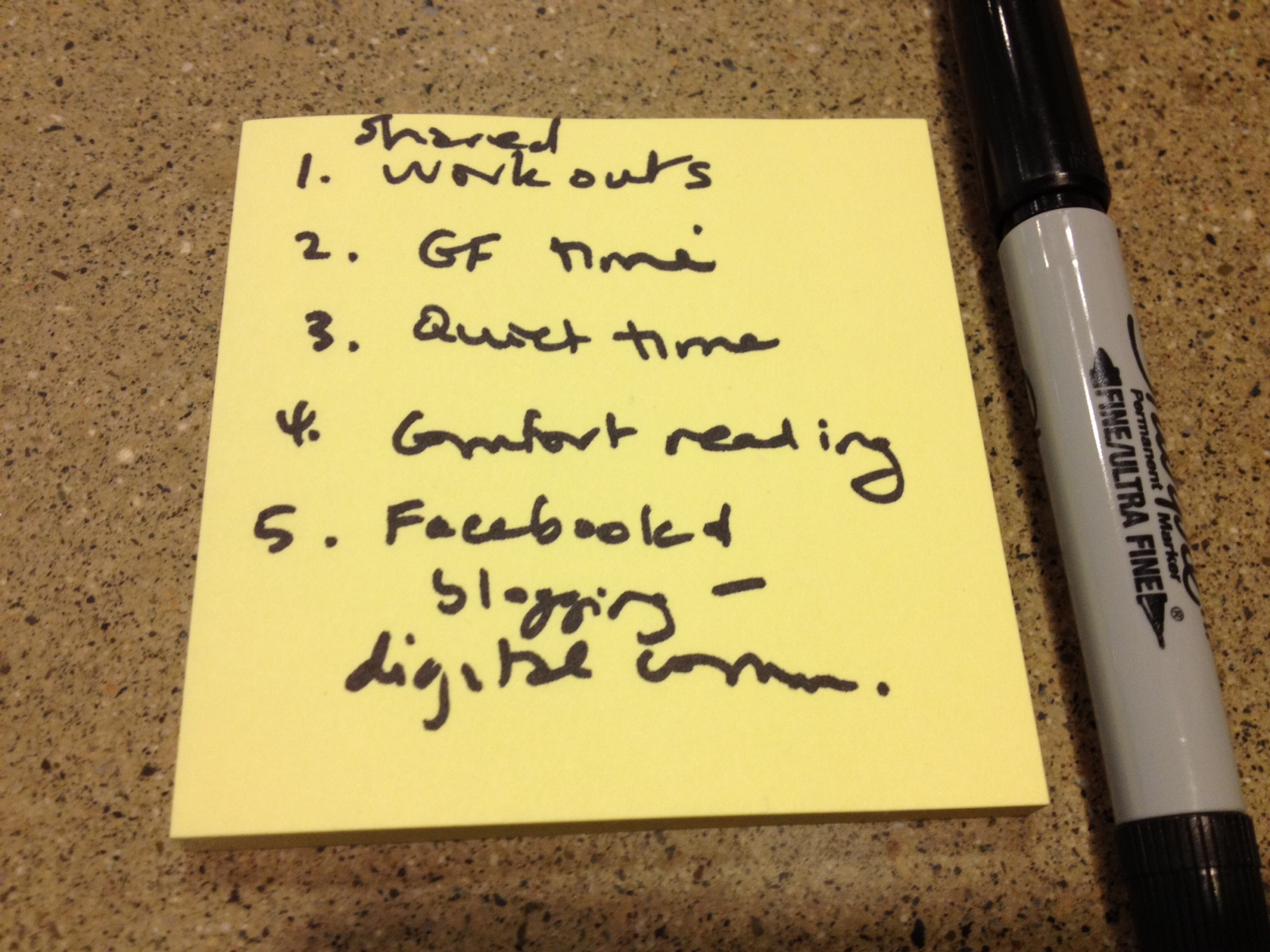
What’s on your list of 5 self care things you do?

My friends and I seem to have entered a new phase. Once upon a time, our calendars overflowed with weddings. Then it was baby showers, and until recently, children’s graduations. Now our email and text exchanges are more likely to pertain to a parent’s health crisis. Usually coupled with news of challenges facing our young adult children.

We’re savvy enough to know that we need to take care of ourselves as we care for others, but busy and stressed enough that it’s really hard to actually do it.

My friend just texted me to say she was leaving town tomorrow to look in on her Mom, who’s had a setback in her recovery from surgery. True to form, she asked me how I was doing, and I replied that things are a bit better on several fronts.

She then asked, “So what are you doing for you?”

To which I replied, “What are YOU doing for you?”

I wasn’t trying to play the “gotcha” game (this isn’t politics, after all), but that’s kind of how it turned out:

Crap. I knew you would turn that one back on me! You know I’m the worst at putting myself in the top 10, or 20, on any list!!! At best, I’m trying to learn to be a bit more compassionate for my own frailties. It’s a start.

I’ve actually been thinking about this self care thing since my guardian angel, Jim, instructed me to list 5 things I would do for self care. That it’s taken me three weeks to think of five things tells you something.

My five are below. I’d love to hear what YOU do to take care of yourself as you care for others. We can all learn from each other — and maybe encourage one another to actually follow through on these things.

1.  Work out with others.

I often say that I live with the future. When you’re around a 95-year-old you realize the importance of strength and balance. I walked but I knew that wasn’t enough. I admitted that I couldn’t motivate myself to do things like – ugh – sit-ups or pushups.  I also thought it was unlikely I’d get my butt out the door to a gym class given my caregiving responsibilities. So, my big plan was to work out 4-6 times with a trainer and then miraculously carry on alone, having formed a virtuous habit. During my first workout, I was shocked at how poor my balance was – that and the fact I couldn’t do 10 sit-ups without holding on to my thighs to heft my upper body from its prone position.

That was four years ago. After a year or so, my neighbors who walked together twice a week for years expressed interest in trying it on for size. Now my driveway is a boot camp at least twice a week. Scheduling that time, and keeping it, is absolutely at the top of the list in terms of things I do for myself.

I figured my trainer, the amazing Kylee Neff, was an absolute liar when she told me I’d have more energy from working out. For about three months, I wanted to go to sleep early on the days we trained. But she’s right. Now if I can’t work out for a week, my energy and outlook isn’t as good. It’s as important to me as – gasp! – coffee once was. (Strangely, I also feel almost no need for caffeine.)

Working out with one or more friends also makes it hard to slack. After all, they show up in my driveway. But the group banter has the extra advantage of taking my mind off the momentary pain of whatever circuit Kylee has dreamed up for that day.

2.  Comfort read.

You’ve heard of comfort eating? I comfort read. My literary diet changes completely when I’m under stress. When my mother was dying of cancer, I was soothed by re-reading The Wind and the Willows. I’m a big fan of Mr. Toad, with or without the Disney attraction. Though I still read heavier fare (for example, The Looming Towers), I am drawn to cheesy and breezy. I read things like Deborah Harkness’ Discovery of Witches series (all two of them), J.R.R. Martin’s Song of Ice and Fire series (a.k.a. Game of Thrones), and the utterly ridiculous Sookie Stackhouse series by Charlaine Harris. Apparently I find fairies, witches and vampires comforting.

3.  Spend time with girlfriends.

My friends save me, over and over. Just knowing they are there is a huge source of support. Nothing against guys, and my husband is the Rock of Gibraltar, but there’s something about deep conversation with trusted female friends. It’s better than wine and chocolate. Recently, a friend and I agreed to set up a weekly time to meet. Her husband has Alzheimer’s and both of us have to coordinate social activities around caregiving tasks. It just works better to put something standing on the calendar. And, yes, it involves wine. Duh.

4.  Stay connected with Facebook.

I actually surprised myself with this one. So much is written about Facebook as a time suck, or about how Facebook is no substitute for deeper, face-to-face connections. But caregiving is isolating, and Facebook helps me to feel there’s still a world out there.

I love the pictures of kids and the quick posts about the sweet or funny things kids say. I travel vicariously through some of my friends whose jobs or travel budgets seem to take them everywhere. I salivate over my foodie friends’ posts about the amazing seasonal recipes they’ve dreamed up. I read the links to articles that appeal to my interests and appreciate the fact they were shared. I catch up on a friend’s recovery from a brutal cycling accident. I feel for the people (and animals) in Eastern Washington when my friend in E-burg posts update on the terrible fires there. It may seem a little strange but I even love the beefcake pictures posted by my gay friends; it makes me happy to know someone’s romantic life is more exciting than mine! Pictures of weddings, funny bits from George Takei, updates from nonprofits I care about… I enjoy almost everything in my news feed. And of course, I can always block the political posts that get a bit annoying this time of year.

5.  Find quiet time.

I’m not a true extrovert, although most people would assume I am. It’s hard for me to find an hour when I can be alone in the house, or at least alone before anyone else is awake. I crave and need moments when NO ONE WANTS OR NEEDS ANYTHING FROM ME. You may have figured out that I blog during these rare quiet moments. And when I say quiet, I mean just that. I feel so over stimulated that I need moments without music or TV. Silence is a balm.

So I’ll ask it again: what do YOU do to take care of yourself? This inquiring mind wants to know.


4 Comments

Filed under Uncategorized

Too much love?

Can you imagine this image as an older parent? It’s not how we think about our role as caregivers, is it? (courtesy Teach Through Love)

Our first instinct as parents is to surround our children in a cocoon of love that cushions them against hurts both physical and emotional. But eventually, we find out that we do our children no favors if we never let them struggle.

I am learning that being a caregiver for an aging parent is not that different.

Since I moved my father to California in 2006, he’s spent the majority of the time at my house. He has his own bedroom with a cushy La-Z-Boy, television and bathroom. After giving up the family house where he lived from 1969 to 2003, I wanted him to feel this was home. At the same time, I wanted to know I could leave town and trust that he would be secure, with all of the support services he needs. So he’s had a one bedroom apartment in a nice assisted living community.

The back-and-forth worked just fine until July, when his health became unstable. Although he is now almost fully recovered, his emotional health continues to suffer.

My mother, during the final stages of lung cancer, expressed fear of dying, despite the deep faith that sustained her for so many years. My father wondered why, if there is a God, would he abandon my mother in her hour of need? Now it is my father who fears dying – and, in particular, dying alone.

Ten days ago, he asked me, “Can I come live with you?” He continued, “Living alone is no way to live. I’m afraid to die alone.”

Using my strategic planning skills, it seemed to me that we had to revisit Dad’s living situation. My objective, and that of my brothers, is to ensure that Dad lives with as little physical and emotional distress as possible. To that I had to add an objective about meeting the needs of my own family — oh, and taking care of myself, too.

It seemed to me that there were three possible solutions: 1) Dad would come to live with me full-time; 2) we continue to muddle through with more companion services at his apartment on the days that I am not available; or 3) we limit the number of nights that Dad stays at my house because of his increased distress when he has to return to his apartment.

I sought input from a social worker, a mentor, our home church pastor, his doctor, and a psychologist. Along the way I also had Dad evaluated for hospice and found out that he’s not close to qualifying for that type of end-of-life care. I had to start thinking about what would be best for a period of gradual decline that could last for several years – something I never imagined given that Dad has had three heart attacks, three strokes and three open heart bypass surgeries.

I also had to “listen” to myself. I realized I felt overwhelmed by the possibility of Dad moving in full-time. I really want that to happen, but now isn’t the right time. My Dad isn’t the only one who needs me right now.  I had to admit to myself that I felt exhausted.

The social worker shared a little tough love with me. She said, “He is distressed about the prospect of going back to his apartment because it isn’t ‘home.’ And it isn’t home because you won’t let it be home. He spends enough time at your house that the transition is difficult. He doesn’t remember exactly what happens there and it feels unsafe to him to return.” She went on, “As family members, you’re responsible for providing the caring, but not necessarily the care.”

My beloved mentor Jim offered this advice:

This is very hard to do: separate what is in his best interest and his care needs from your heart duty as a loving daughter.  Like most elders in his situation, he is becoming more child like — likes what he likes and won’t budge; wants his mommy really to take care of him although he would not recognize that is what he is doing to you.  If he does move in and a caregiver is part of the team, you will have to force him to agree to let that caregiver do his/her thing.  You almost have to write out a ‘contract’ that he has to agree to.  Obviously it is not a legal thing, but you use it to force him to focus on reality when he just wants it all to be different and for you to be there constantly.

My church home pastor suggested that I facilitate a casual visit with a priest. “Throw him a lifeline,” he suggested. “He may choose not to talk about his concerns about death, but he may be ready to talk.” And my psychologist friend suggested having Dad evaluated for anti-depressants. His doctor agrees that may be worth trying.

So what was decided? I had a conference call with my brothers last Wednesday night and we decided to try out an arrangement where Dad is limited to three nights a week at my house. I’ve visited him at his apartment every day and joined him for lunch to reinforce the message that the staff knows him and is paying attention.

He doesn’t love it, but he is responding to the message that there are some things I need to do right now to take care of my family and myself. He asks how he can help, and I say, “Just be patient, Dad, and be supportive when I can’t be here.”

Week one went well, but the big test will come this weekend when I leave town for three days… Stay tuned.


1 Comment

Filed under Uncategorized

Ghosts in the rocking chair?

The spat that I described in my last post ended with the receipt of a sincere apology from my brother after a three-day marathon of back-and-forth emails. He also asked to “start over” with not just me, but my other brothers.

After time for reflection, I learned a lot, albeit painfully, from the whole kerfuffle. In keeping with the Buddhist proverb, “When the student is ready, the teacher will appear,” I stumbled across some teaching from an unlikely source: a child advocacy and parent-teacher education resource called Teach Through Love. Teach Through Love shared an article link on its Facebook page, and highlighted this quote:

Similarly, our kids push our buttons precisely because they are our children. Psychologists call this phenomenon ‘ghosts in the nursery,’ by which they mean that our children stimulate the intense feelings of our own childhoods, and we often respond by unconsciously re-enacting the past that’s etched like forgotten hieroglyphics deep in our psyches. The fears and rage of childhood are powerful and can overwhelm us even as adults. It can be enormously challenging to lay these ghosts to rest.

My brother said that his temper flares when he feels overlooked, ignored, or otherwise “disrespected” and he attributed this sensitivity to some disappointments in his life. When we met for dinner last week, I asked him if he thought it might be related to a longing of his for respect from my father, and perhaps the respect of his siblings for him based on birth order.

He scratched his arm repeatedly as he described his experiences with Dad growing up, beginning with Dad’s return from WWII. Dad later asked him to be “the man of the house” when Dad was sent on a solo tour out to Japan just after my sister’s death from leukemia. And when Dad was disabled due to a massive heart attack in 1962, he was called upon again. He was the same age then that my son is now. Instead of focusing on college, he was trying to help the family pull through the crisis of my Dad’s near-death and the aftermath of my father’s forced retirement from the Marine Corps. (In those days, a heart attack meant automatic and full retirement because, with limited treatment options, military command didn’t believe that a soldier would recover sufficiently to fulfill his duties.)

My mother and father often said that they raised their two eldest children, but they let the two youngest raise themselves. We had the same parents, but grew up in different worlds. My younger brother and I mostly grew up in a civilian world — a world, I might add, that Dad found quite deflating. I admired my Dad, but I didn’t think he was perfect. And I told him off – royally – when I was 21. I was tired of feeling afraid of my father, who retained command presence long after leaving the Marines.

When my brother sent his angry email, he felt disrespected by my younger sibling and me. The email that triggered the original firestorm pushed a flashing red button in his brain. But that button was installed long before.


Leave a comment

Filed under Uncategorized

Sibling fight!

Why is it that food fights are fun and email fights are not?

I was quite smug last night when I told a friend that I thought my brothers and I were really communicating effectively with one another. She had just returned from 10 days of overseeing her mother’s recovery from pneumonia and surgery, during which she was repeatedly second-guessed by her out-of-state sister.

Then I got an email from one of my brothers today, who reacted to an email sent by another brother. I won’t get into the details but I’ll share the zinger with which he ended his message: “…have the two younger sib’s simply cut out the two older sib’s from having a voice?”

I thought we were past this.

But the truth is that it is very, very hard for people who act like grownups in most situations to behave that way when something triggers half-buried resentment. We are all suddenly six.

There are a lot of “perhapses” that come into my mind. Perhaps the brother who sent the original email should have called instead of sending this particular message by email. Perhaps the brother who seethed over the email should have picked up the phone and expressed his concern to the sender, or to me (since I was supposedly colluding in the decision in question). We could have done better.

When we are stressed, as we are in no small part by Dad’s deteriorating health, we are reduced to the ugliest side of our personalities and temperaments.

It’s hard to keep one’s eye on the real issues here: how to make sure that Dad feels loved and safe, and how to preserve and perhaps strengthen our sibling relationships for the time when Dad is no longer there to bind us.

Right now I’m working on that last part.

2 Comments

Filed under Uncategorized