Dancing on my father’s shoes

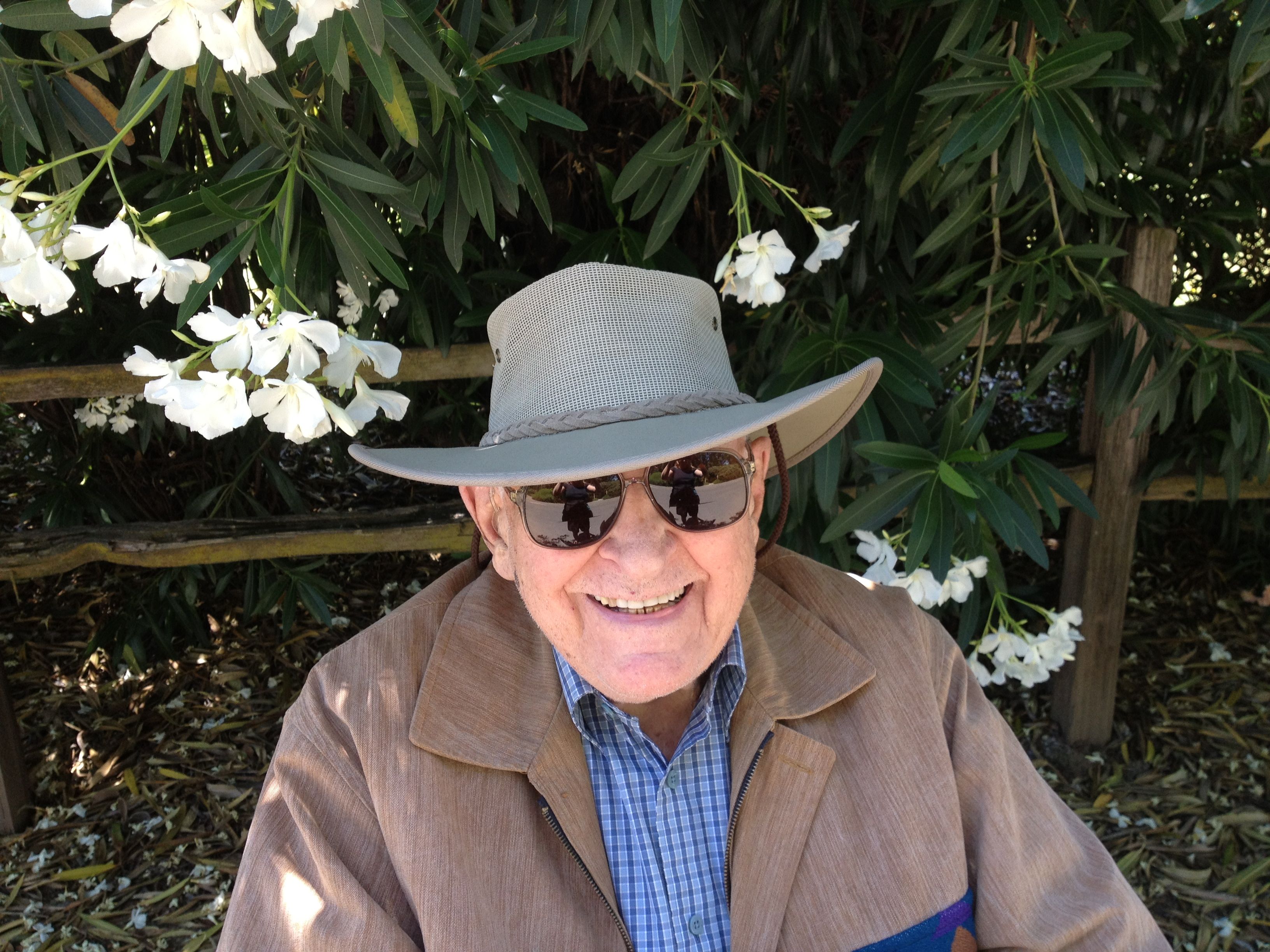
In an hour, I’m going to pick my Dad up at his assisted living apartment for a nice Father’s Day dinner. As I was dressing, choosing something kind of feminine, a memory flashed through my mind of my five-year-old self in a party dress and black patent Mary Jane shoes. I was waltzing with my Dad to live band music – perhaps on the S.S. Lurline ocean liner that took us from San Francisco to our posting on Oahu – transported across the floor as I stood on the tips of his well-shined shoes.

These days, my Dad leans on me for many of the simplest activities. But in many ways I am still carried and supported through life by the love he has given me in the fifty years since that waltz. I’m still dancing on my Daddy’s shoes.

1 Comment

Filed under Uncategorized

Is there value in prolonging life after 80? 90?

The title of this post is provocative, but so is this use of the politicized phrase “death panel” by Joe Klein in his June 11 Time feature article, “How to Die”: “My parents died serenely, with dignity. When you are a death panel — when the time and manner of their passing is at least partly in your hands — that is the very best you can hope for.”

Mr. Klein’s story — which encompassed his parents’ relationship, their struggles with very old age, his Dad’s tendency to act “as if old age were a reversible condition,” and finally his experience with Geisinger’s candid communications style and evidence-based approach to medical care — was truly moving. I recognized in his account the emotional tug-of-war that goes with being the caregiver who has the day-to-day responsibility of interpreting a parent’s end-of-life wishes.

The Time feature (click to see a video with the author here) and another article in the New York Times’ “New Old Age” blog has pushed to the front of my mind this question: will I send my Dad to the E.R. again?

Klein describes how his 91-year-old mother’s trips to the emergency room were becoming more frequent. When he was traveling out of state, he got a call that she was in the hospital, had pneumonia and wasn’t eating. He was told that she would die unless they put in a feeding tube. Although he knew she specifically didn’t want a feeding tube, he authorized it so that she might have the chance to recover. He later came to believe that he made a mistake in that decision and that “there are better ways to handle the end-game.”

The New York Times blog article, “At the End, a Rush to the E.R.,” by Paula Span, comments on a study just published in Health Affairs and calls the E.R. “a conveyer belt to hospitalization.” The analysis of the medical records of 4,158 people over 65 who died over a 14 year period revealed that 75% had visited an emergency room in their final six months and 68% of those died in the hospital.

To go to the hospital or not is almost certainly a decision I will face in the near future

In January, my 95-year-old Dad had a seizure-like episode while we were out walking.  I didn’t panic, but my heart was racing and I had to decide what to do almost instantly. (I blogged about my internal crisis last month.) Fearing that he was having a stroke, I immediately called 9-1-1 and first responders arrived minutes later. Dad quickly stabilized, so much so that the paramedic asked me if I wanted him to go to the hospital in the ambulance — or not. I know that t-PA, the drug used to break up clots associated with strokes (thus preventing many of a stroke’s worst effects), has to be administered within three hours of the event, so I opted for the ambulance run to the hospital.

After a long day of waiting on an uncomfortable ER “bed”, they weren’t able to figure out what caused Dad’s symptoms. He was admitted for observation and spent two nights. They did a bunch of tests (blood, X-ray, CT, MRI, ultrasound, echocardiogram, and even a nuclear medicine stress test) and concluded that he did not have a stroke, and that his heart is actually in very good shape except for the old damage from his original heart attack.

Although he had no procedures, the tests and just being in the hospital were very uncomfortable for him. Holding still during an MRI was excruciating. He was exhausted after his discharge.

But now we have information we didn’t before. He doesn’t have major blockages in his heart or his carotid arteries. His congestive heart failure — a condition he’s had for at least 10 years — will continue to be treated with medication.

So under what circumstances would I send my Dad to the hospital in an ambulance again?

My big concern is that Dad not be in acute pain or discomfort. If he falls and hurts himself, I won’t be strong enough to help him, and he could be in a lot of pain. So I would authorize the ambulance run, but I’d lobby like hell to get him out as soon as possible. If he has significant chest pain, I will also call 9-1-1. I stopped by an estate sale earlier today and talked with the son-in-law of a neighbor who passed away in December; his Dad went to the hospital after not being able to defecate for several weeks. I’d send Dad to the hospital under the same circumstances. If he was very ill and I thought he could recover with IV antibiotics — Dad’s still got the biceps of a 40 year old — I’d probably authorize a short hospital stay. But I will say “no” to anything but the most benign diagnostic tests; we’re done with long diagnostic procedures. And I’d say no to ventilation, feeding tubes and the like. But any time I say “yes” to the hospital, I know I’m taking a risk that he could decline and die there. He doesn’t want that, and neither do I.

My dilemma – like many caregivers’ — is the unpredictability of the period ahead

Although I love “The New Old Age” blog, another recent post pissed me off. “Among the Very Ill, Confusion about Life’s End” describes how annoying geriatricians find it that older Americans are unwilling to plan for the end of life. Seems that a study of people who met hospice criteria (expected to die within six months, although many live longer) most often answered “I don’t know” to a question about what they expected the course of their final illness to be (answer choices: suddenly, within a day or two of a health crisis, after a prolonged illness or “I don’t know”).

The article noted, “Each individual had a terminal disease with a somewhat predictable trajectory, though precise prognoses are always difficult.”

That’s what pissed me off… because with a few exceptions (mostly cancer), death isn’t very predictable. I’ve seen the data at hospice conferences. And in my experience doctors really don’t like to be asked to estimate how long someone might have.

Dad ought to have been eligible for hospice care, oh, about seven years ago. The cardiovascular surgeon who performed Dad’s third open heart bypass surgery in 1999 expected Dad would have five good years before his heart finally gave out. I’d have Dad in a hospice program in a skinny minute if someone could tell me that he is likely to only have six months to live. My mother was given an estimate of 4-6 weeks after being diagnosed with terminal lung cancer in January of 1999. I fought with the hospitalist to bring her home to die, despite his telling me, “It’d be kinder for all parties concerned if she just winked out here in the hospital.” She died on May 10, at sunset, with my Dad holding her hand, thanks to great hospice care that kept her mostly comfortable to the very end.

Putting a value on the end of life

Mr. Klein noted that his mother had a heart valve operation when she was 80 for a heart murmur that was getting worse. He went on to explain how much it cost.

My father would have died without that last open heart surgery in 1999, when he was 82. I’m sure it cost a lot, too. But in the 13 years since then, some very important things have happened.

He has spent many hours with me reviewing his life and some of the things that have caused him the greatest pain – especially his father’s lack of interest and involvement, and the death of my sister due to leukemia at age four. He’s also had a chance to tell lots of stories about things he’s proud of, moments he relishes. I know him in a way that wouldn’t have been possible while my Mother was still alive. He has given so much love and acceptance to my three brothers and me in these intervening years.

Though I am all for improving care coordination and undoing the perverse incentives of Medicare fee-for-service, I hope we never discount the value of having the time and health to come to terms with the approach of death.

My Dad feels ready to go, and I am ready to say goodbye when the time is right. And in the meantime I will do everything in my power to keep him happy and comfortable, which (unfortunately) may mean at least one more run to the hospital before he can be enrolled in a hospice program.

2 Comments

Filed under Uncategorized

My Dad wonders, “What’s the alternative?”

For Father’s Day, I’m putting together a digital scrapbook of sorts. I came across some notes I scribbled after talking with Dad in 2009. We had talked a little about the fact that he doesn’t live in the past despite some agonizingly painful memories, as when my sister died of leukemia at the age of four:

The past is over. And I can’t live in the future. So I live in the present. I have these distinct periods of my life. They’re almost separate lives. I wish your sister had lived. In my last memory of her she was in an oxygen tent, holding out her arms and saying, “Daddy help me.” I couldn’t do a thing.

It struck me that, as emotional as Dad is, he has been – and is – a very practical man.  He does what has to be done.  When memories are too painful, he doesn’t dwell on them.

A few days later, we talked a little more.

“I’m getting to be an old crock,” he said.  I commented, “You do so much better than most people your age – you’re hardly an old crock.”  Then he said, “I hope it doesn’t shock you, but I look forward to being with your mother again.”

Now, Dad and I had talked about his concept of faith and God many times in the past, and he had expressed regret that he couldn’t quite believe in God, much as he might want to.  Further, he found it unfair that my Mom, a woman of so much faith in God, would express fear of death when she was in the late stages of terminal lung cancer.  So I said, “I take it you do believe in an after-life.”  He replied:  “What’s the alternative?” I’ll take that as a yes.

1 Comment

Filed under Faith journey, Uncategorized

Real emotions from a real man

Dad started singing the “Battle Hymn of the Republic” today at the kitchen table, and as always, he choked up.

“It was a terrible war,” he said. “They all are.”

Then he went on to say, “I’m a sentimental man. But it’s real. I mean it.”

I know Dad means it. I’ve known it for a long time. In a strange bit of juxtaposition, today I came across a letter I wrote to my Dad when I was 22. I was very, very angry at him for an argument we had. It ended badly, with him physically throwing me out of his room when I stood my ground. In retaliation, I took his car and drove very, very fast around the Olympic peninsula, returning to my parents’ home in the wee hours of the morning. (Like that was really intelligent.)

I wrote:

A long time ago, I wrote an essay about myself. I found myself struggling with words to describe you, and to describe my feelings about you. I kept coming up with metaphors about rocks — things that reflected both strength and immovability. And no one would question that you are both of those things.

Somehow, Dad, it is different growing up as your daughter and not as your son. For all the femininity that is within me, I am still as strong and independent as my brothers – a person quite capable of standing on her own two feet. To accept this in a son, I believe, is less difficult than to accept it in me. Perhaps it is for this reason that years of feelings welled up inside me as we spoke tonight, and I realized I needed to be accepted, in the same way my brothers are respected, once and for all….

I understand your strength. I understand your pride, and that you cannot show weakness most of all to me. I see the softness and warmth that you have as a father. But I have never seen the side of you that could say to me, ‘I am wrong,’ or ‘I am sorry.’

Tonight, however, just for once in my 22 years, I needed to hear something. I needed to hear something other than ‘dismissed.’

I believe you rejected me tonight because for the first time in my life I was terribly insubordinate to you. I said no.

I love you but I have always been afraid of you. Part of my growing up and turning twenty-two was finally fighting this love-fear feeling about my father. “They” say some things like this are never gotten over, but I’m not writing a psych book and I could care less what anyone else has to say about my need for ‘reaffirmation.’

…Do you know how much it meant to me when you said you wanted to take me fishing and just to talk to me this summer? I guess that was the first time you had ever really wanted to sit down and share those words of wisdom with me that I have always imagined you have with my brothers. I don’t think I’ve ever been as happy as the day you asked me about going fishing.

This is the grown-up me that you may not always notice, Dad. It isn’t the woman that you and Mom have often doubted would have enough love — unselfish love — to be happy in marriage. This is the me that my friends have come to know, the one that has a lot of love to give, but needs it in return, too.

I need to hear that you could say you were sorry. I need, just once, to see that side of you. And I’m sorry, but I’m not sure why. I just know it’s a fact.

You may not like me very well after you read this letter. You may be able to dismiss it, or say I’m upset, or say I’m trying to fight you. I’m not, however, doing any of those things. With every once of love in my heart, I’m showing you everything that’s there. And Dad, that more than anything else demonstrates my tremendous love and trust and admiration for you.

Please don’t take this letter as any form of criticism. Take it as what it is — just a very big step in your daughter’s final transition into adult and womanhood.”

How did the story end? My Dad said he was sorry. He showed me the love and respect I so desperately needed then. Our relationship changed forever.

2 Comments

Filed under Uncategorized

In the end, there’s…. chocolate


My goals as a daughter and caregiver have changed since 2006, when I moved my Dad to California. I imagined we’d make the grand tour of the foothill wineries, in search of the very best Zin. But then he lost his taste for wine (although he still enjoys a small glass before dinner), and car trips became uncomfortable. I find that I am no longer trying to ensure “a fun old age” for him.

My goals now are simple: keep him from feeling lonely, and make sure he gets chocolate every day. I think I’m succeeding at both.

As I returned him to his assisted living apartment the other day (which he views as purgatory), I told him I’d be back the next day and explained that I don’t want him to be lonely. “I don’t get lonesome,” he said. “But I do miss you.”

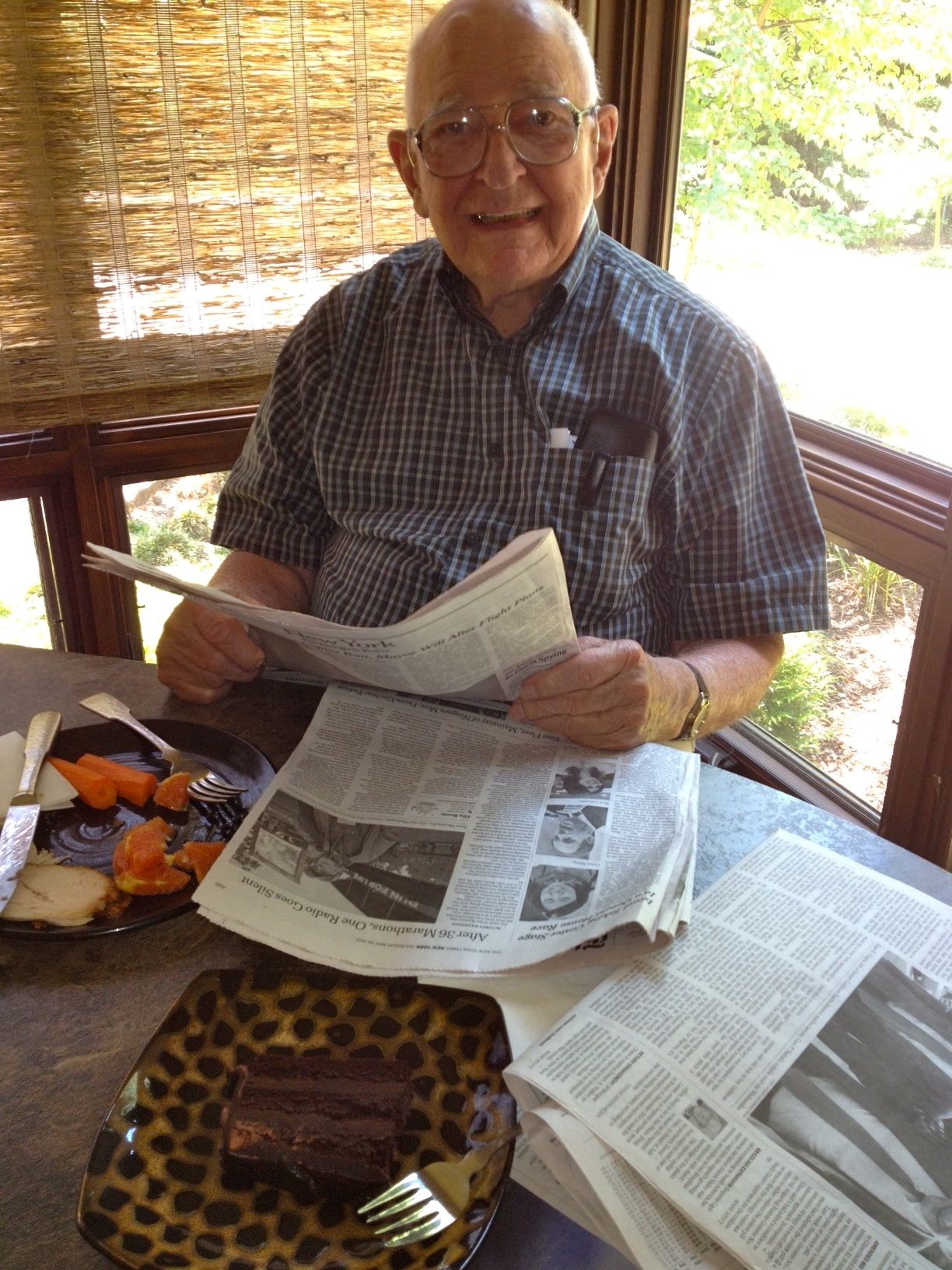
And as for chocolate, well, here’s the proof. This is a typical scene of Dad at lunch. What could be better than chicken, milk, the New York Times and a side of chocolate cake?

He’s lost so much of his former life (and glory, he would add). The 5th USMC Reserve Officers Commission class (of May 1941) is down to 25 members from its original complement of 304. His closest friends and brothers are long gone.

But he’s still got me, as well as other family members who love him. And chocolate. Lots of chocolate.


Leave a comment

Filed under Uncategorized

Finding myself on the front page, kind of

I was shocked last Sunday when I saw the Sacramento Bee’s front page: “Many types of loss mark midlife for boomers.” The online version has an even more depressing headline, “Boomers’ lives full of losses expected and unexpected.”

I felt like I’d seen a reflection of myself in a carnival fun house mirror. Me, but distorted.

The article by Anita Creamer, consistently one of the Bee’s best columnists and writers (in my humble opinion), reports that boomers are being hit by divorce, the death of parents, fading youth, failing health and economic loss.

Parts of the image I recognize. They call people my age “the sandwich generation” for a reason. We’re often squished between the needs of our children and those of our elders. In 2005, I answered an internal call to care for my Dad and gave up a job and identity that I truly loved.

For the first six months after I “retired,” before my Dad actually made the move from Washington, I felt a profound loss of identity. I didn’t know how to measure the value of my day: what had I produced? I didn’t know how to answer when people asked me, “What do you do?” The hole that I left in my team of co-workers slowly filled in. The hole they left in me was slower to heal.

But loss isn’t what I feel now, with this big caveat: nothing truly bad has happened. We’ve been hit by the economy (who hasn’t?) and we don’t have the resources that we did when I worked, but we’re secure enough.

My marriage is probably stronger and my relationship with my children better, despite the energy that funnels into caring for Dad.

And my health is better. One of the priorities I made for myself starting four years ago was a regular exercise program, something I’d never been good about but knew I needed as an outlet from the stress of caring for Dad. I started by having a trainer come to the house once a week, knowing that I would wimp out when it came to something like – oh, I don’t know – getting my heart rate up above 90. If our appointment was at my house, I figured, I couldn’t escape.

Several women in my neighborhood noticed (since I looked pretty dorky doing lunges in my driveway). They were interested in trying it, too. Four years later, we continue to split the cost of a trainer and added more workouts.

I no longer look at productivity the way I once did. I am better at being in the moment with my father. A friend recently sent me this email:

I have found in my Hospice work that heart time is different from mind time.  Culturally you and I are programmed to be productive — even in our sleep we should be productive with our psyche!!  Foolishness. Just being with each other, and not doing is a major blessing few really get.  The ancient ways here understood it fully.

My elderly friend, Jackie, who lives nearby can sit quietly in her meditation room for a long period.  She can see in a simple flower bloom a beauty that most miss, or the little birds in her back yard.  She absolutely relishes ‘living’ instead of doing although she is a doer too.

Glad you are having this time.  Just remember, sometimes with those who are really advanced in age, they are here but en route to the other side, they spend some moments in the nether region — the space between — maybe a way of getting used to letting go.  When they are in it, they are distant from those around them even when those around them are physically present.  Don’t take it personally — tis the way of the universe — turn it over to God.

I’m grateful to Ms. Creamer for covering this important topic. I’m grateful for this time with my Dad. I’m grateful for the changes this period has wrought in me. I guess I’m just plain grateful.

2 Comments

Filed under Uncategorized

The crisis within, for caregivers

Most often, I write about understanding the experience of aging from my Dad’s perspective. That’s what caregivers do: think mostly about the “them” and not so much about the “me.” I wrote the following email to a friend whose husband had a mini-stroke, based on my remembrance of how I felt when my Dad had a health crisis in January:

There are really TWO crises when you’re the caregiver and something bad happens to the one you love. Their crisis is some onset of scary symptoms. But the caregiver has one, too. Your heart beats faster, your eyes probably dilate and there you are rapidly assessing what the hell is going on:
 
“Is this something that is going to escalate right here and now? Should I call 9-1-1? Or if it subsides will it wait until a doctor’s appointment tomorrow? How will it affect my loved one to be dragged somewhere in an ambulance and wait hours in the hospital for testing and evaluation, in an uncomfortable ER bed? If I don’t do anything, will it be my fault if it turns out this was a stroke and I could have prevented permanent symptoms by making sure he/she got that shot? Was has he/she told me he/she wants, and doesn’t want, and how does it relate to this situation? Oh, shit, who’s going to take care of me? Can I handle this?”
 
Then you get in the holding pattern, where you are afraid to leave the bedside for a minute lest you miss the ER doc or a chance of some snippet of information.
 
And then there’s coming home when you are so, so, so exhausted and your family member still needs you – in fact needs you more than ever. “Tired” just doesn’t cover it.
 
Sometimes it’s scary being a caregiver, no matter how grown up and skilled we are. We have to give ourselves time to recover after a crisis, too… 

1 Comment

Filed under Uncategorized

When nothing is something

One of the unexpected consequences of our Pilgrim upbringing is a tremendous emphasis on work as a moral virtue. Time we are sitting can seem like time we are wasting, or at the very least, remind us of our endless lists of uncompleted tasks.

When a parent is growing older but not really “up there,” it’s easy to find ways to brighten their days: lunch or dinner in a restaurant, an outing to the theater, a trip to see family. But as the burden of age sets in, making “play dates” with a parent can get hard on the caregiver and care recipient. It’s easy to revert to  the mode we grew accustomed to when our children were small.

A little while ago, I offered to take Dad out for his daily walk, and he said, “I don’t know what’s wrong but I really don’t feel up to it today.” So I heated up some leftovers for his lunch and started tidying up in the kitchen. And then I realized: this is it. Through shared meal times, I can give Dad some normalcy. So I sat down. Ate a peanut butter and jelly sandwich. He read the paper. I read the paper.

These moments of nothing have the potential to be something. For the older person, perhaps having someone sit with you at the kitchen table mirrors the mundane (but missed) moments they may have had with their spouse. It’s quiet but companionable. For the adult child, these quiet moments say, “I’m willing to stop my life long enough to just be present with you.” Or, “I’m here if you have a memory that comes to mind.” Or, “I just like sitting with you.”

We don’t always have to do something to make the time pleasurable. Sometimes nothing is everything.

2 Comments

Filed under Uncategorized

When an aging parent dies: the underground river

This week a friend of mine posted on Facebook: “My Dad has been gone for 13 years or thereabouts, just thought of him. I sure hope all of your dads are still alive. I miss him.”  Immediately five friends posted responses. Here’s one example: “(Dad’s) been gone for 11 years now. His boots are by my back door. There’s never a day that I don’t think about or miss him. We never, nor should we ever get over the loss of our parents. We just figure out another way to live without them.”

Then today, I received a call from the daughter of my Dad’s next-door-neighbor at his assisted living community (I’ll post her name if the family gives me permission). Her Mom died in late March at 97 after a rough couple of years. I really miss seeing their Mom – who had a remarkable spirit and great sense of humor – and had written the daughters a note.

One of the things “E” said to me really hit home, “This is a special experience no one knows about until you’ve had it.”

And she’s right. Since my Mom died in 1999, I have often thought of this shared experience as an underground river. When you lose a parent, people suddenly come forth with a deep empathetic response based on their own experience. Not just a few people, but many, people you never thought would express themselves in such emotional terms. These are people who have been in your life all along, but you never knew that they were still feeling their own deep-seated loss.

“E” said that she was surprised that so few families seem to visit at the assisted living community. A friend of mine and senior expert, Marsha Vacca, once told me that people have to sort through “what they will do, what they won’t do, what they can do, and what they can’t do” when it comes to supporting a parent.

Many people are too far away, have too much on their hands or are too financially constrained to be much of a presence. Others choose not to. As “E” said, when a parent gets older, it’s time to get over “smoldering issues” that lie in the past.

There are exceptions. A dear friend’s mother may have given birth to her, but has treated her badly for many years. She is justified in keeping her distance.

“E” also reminded me about the ways that siblings can each make a contribution to an aging parents’ happiness. “We all had our role,” she said. “For example, my sister felt it was important to provide a festive atmosphere for our mother, and she was the one to set out gin and tonics on cocktail napkins.”

Finally, we talked about what people say when your parent dies, and we both admitted that we would write a few sympathy cards over if we had the chance. “He/she lived a good long life” turns out not to be very comforting, even if your parent is 96 or 97. You can never have someone that you love in your life for long enough.

If you’re fortunate, you’ll know that you made a difference in their quality of your aging parent’s life. But you will still feel the urge to stop by for an impromptu visit or pick up the phone to talk to him or her. For a long, long time.

Leave a comment

Filed under Uncategorized

“I’m not really a Dad anymore”

Walking with my Dad on the American River Bike Trail yesterday, he was feeling his age. During a rest stop, he looked out at the birds circling over the river and said, “I’m not really your Dad anymore.”

I stopped and stood in front of him, wanting to be sure that he not only heard my response, but saw my face as I said it: “You are and will always be my Dad. No one could ever love me the way you do.”

He replied, “And you’ll always be my Bets.”

2 Comments

Filed under Uncategorized