Category Archives: Uncategorized

“Crooked as Snively”

Visiting the University of Washington special collection on Friday, I was shocked to run across my great grandfather’s name in the old-fashioned card catalogue of regional newspapers:
UW Special Collection card for Snively scrapbook

According to my cousin Louise, Henry Joseph Snively was the inspiration for an old Yakima expression: “crooked as Snively.” H.J., a prominent criminal defense attorney in the early days of Yakima, and a Washington state gubernatorial candidate in 1892, used to pay my father 25 cents to rub his bald pate. There’s a visual I wish I didn’t have.

The yellowing scrapbook contains dozens of articles Great Grandfather carefully clipped and pasted onto pages with rubber cement. Some he must have saved for their legal possibilities — creative arguments and unusual precedents. Others spotlighted him in the era of yellow journalism. Like coverage of the Demerce divorce case, circa 1890:

Demerce divorce case Henry Joseph Snively 1890

“Well, that settles it; I’ll have nothing more to do with that woman,” said George Higgins Demerse, as Justice Rodman imposed a fine of $25 and costs on him for assaulting Belle Demerse, to whom he was married a few months ago. Mrs. Demerse claims to be the relict of David Seamon, whose tragic death occurred in the Caswell building in July-last. Seamon’s former wife who he abandoned some fourteen years ago in Missouri, to skip out with the present Mrs. Demerse, says there has been no divorce; but Mrs. Demerse claims that a divorce was granted in Pennsylvania in 1890, and that she and Seamon were legally married.”

Are you following this? This is reality TV before TV.

“At any rate her relations, marital or otherwise, do not seem to have been happy; for Attorneys Snively and [Fred] Miller are now preparing the papers to free her from her connection with Demerse… ”

The plot thickens:

“Demerse had been drinking steadily for the previous ten days, and on Saturday morning he struck his wife several times in the face and breast, threw the lamp from the center-table onto the stove, and in other ways demolished things. This was too much; and Mrs. Demerse went before Justice Clark and had him arrested on the charge of assault and battery…. [Demerse] asked for a change of venue, and said that he couldn’t get a fair trial in that court — which caused Justice Clark to grant the request for a change of venue, but to commit Demerse to jail for contempt. On Tuesday he was taken before Rodman, pleaded guilty to the charge, and was fined as before mentioned. …(He) is apparently content, for he says he would rather be there than living with his wife.”

Another article, about a horse thieving case, gave me an idea how Snively may have earned his reputation.

Fred Bickle was charged with stealing a horse owned by Dan Goodman. He posted $1,000 bond and was released from jail. Almost immediately, he was charged with stealing horses from William Buchholtz and was due to appear in court (busy guy); bail of $1,500 was set. Snively sued a writ of habeus corpus on the grounds that taking the horses to Oregon — no matter how many owners were involved — was still one offense, and thus should be one charge and not two (with two different bails). The court agreed. Bond was kept at $1,000.

But this was my favorite: “Last Saturday at North Yakima Judge Davidson released the bondsmen of J.K. Edmiston, the absconding Savings Bank swindler, on the ground that Edmiston was not in custody when the bond was executed. The reason given by the court for this outrageous decision is exceedingly weak and flimsy and bears the ear-mark of that shrewd manipulator H.J. Snively, the late attorney for Edmiston and at present the attorney for the bondsmen. That Snively himself had little faith in such a plea before the court is proven by his efforts to induce the commissioners of this county to compromise the case for $500. Failing in this after repeated efforts, Mr. Snively returned to North Yakima and by some hook or crook persuaded the court to make a decision that is lacking in common sense and wholly inconsistent with the facts of the case.”

Ah, the shrewd manipulator. His were the footsteps in which my father was supposed to follow. My father gave up on law school in 1941, when he joined the Marines, and never looked back.

(This bit of history is a byproduct of research I’m doing for my memoir project, The Henry Chronicles. Next stop: Yakima. Special thanks to Sandy at the U.W. Special Collections reference desk for her help in locating the Snively scrapbook.)


Leave a comment

Filed under Uncategorized

Kudos for The Seattle Post-Intelligencer… in 1887

Editorial cartoon credit: washingtonhistoryonline.org

Editorial cartoon credit: washingtonhistoryonline.org

Doing some research for a memoir about my father, who grew up in Yakima, I waded through microfiche of old — very old — newspapers. When Washington was still a territory, women had the vote. It may have won statehood, but women lost… until 1910 when the state constitution was amended to grant voting rights to women. The Yakima Republic ran this editorial piece on February 17, 1887, during one of many unsuccessful suffrage pushes:

The Seattle Post-Intelligencer says ‘it has recently been charged with being in league with the devil. It will now probably be charged with being in league with the Democratic party. The first accusation was bad enough, but the second would be unbearable.’ And this, because it had the nerve and independence to express its views upon woman suffrage, as a question of public policy. When the press is sought to be throttled because of independence and utterance of its convictions, by those who do not happen to agree with such convictions of public policy, it shows a narrow and illiberal spirit, and, if it yields to an attempt to bulldoze it for opinions [sic] sake, it losses [sic] its influence and becomes a mere weather cock, turned by every varying breeze. An intelligent press is a public teacher, and its mission, like the pulpit, is to mould public opinion for the best interest of the greatest number of society, and of a higher civilization. This should be done, not by bluster, by threats, by command nor by ridicule but by addressing the reason, and presenting the advantages and disadvantages of a measure sought to be adopted, modified or abrogated, to the judgment of the public. Ours is a Republican form of government, which guarantees the free utterance of convictions, whether of speech or of the press, and they who seek to silence or stifle them by any species of restraint, because they are not in accord with their own, exhibit a dogmatism partaking of tyrany [sic]. The Republic admires the independent utterance of convictions, whether in accord with them or not.

Source: Washington State Library

Leave a comment

Filed under Uncategorized

My Grandmother’s Legacy of Suffering

Quip in The Yakima Republic, 1887

Quip in The Yakima Republic, 1887

I’ve come to realize my grandmother had an enormous impact on my life, though not in the way you’d expect. Born in 1885, Jessie Harrison Snively Campbell was raised to promulgate the standards of her patrician ancestors, who traced their footprint in the New World back to the 1600s. Late in his life, my father admitted my grandmother didn’t approve of me. I was too outspoken and (thus) headed for trouble.

I’ve spent the week sleuthing about my grandmother, background for a memoir I’m writing about my father. In my self-indulgent fantasy, I wanted to demonstrate that she believed in the value of women in the same way that I do: that they are just as intelligent, have at least as much to offer society as men; that they have the right to fulfill their ambitions, to being heard, to earning a wage commensurate with their talents. In other words, I was examining my grandmother’s life through a feminist lens.

When I discovered that my grandmother’s mother, Elizabeth Harrison Martin Snively, helped found the Women’s Club of Yakima in the late nineteenth century, I thought I was on to something. Women’s clubs were one of the primary tactics used by the suffrage movement, and the Yakima club was affiliated with the Washington State Federation of Women’s Clubs, which played an important role in the movement. In 1919, the year that the 19th Amendment to the U.S. Constitution was approved, Yakima’s women’s club presented a program — “history in the making” — on Elizabeth B. Phelps, who had served as vice president of the National Woman Suffrage Association when it was founded.

In my great grandmother’s 1937 obituary, it was noted that the Yakima women’s club started as an afternoon card club, but it was decided that women could play cards in the evening and use the meetings to “increase their knowledge.” Hmmm. Hardly the stuff of firebrands.

The West did play a critical role in securing the vote for women. In 1910, Washington was the first state in 14 years to modify its state constitution to give women the vote. That momentum propelled the movement in Oregon and then California.

In 1910, my grandmother was 25 and, for another year, still living under her father’s roof. Her father, a prominent attorney, had been the Democratic candidate for governor in 1892. Suffrage must have been discussed at home, but to what extent did my grandmother have an opinion or voice it?

Five days before the election, the Yakima Morning Herald quoted a prominent suffragist as saying, “The way men vote next Tuesday on this matter will depend largely on the light in which they regard their wives. If they consider the women they have married fairly intelligent human beings, capable of thinking for themselves on matters of general interest and welfare, if in a word, they consider them helpmates, equally responsibly with themselves for the success of the homelife and the family prosperity, they will vote ‘yes’ and no question about it.”

The day after the election, November 9, 1910, the Yakima Morning Herald trumpeted election results across the top of the page:

Democrats Gain Control of Five States

LOCAL OPTION ELECTION LEAVES NORTH YAKIMA IN “WET” COLUMN BY PRACTICALLY SAME MAJAORITY AS YEAR AGO ALTHOUGH MANY OTHER CITIES VOTE REVERSE


The “local option” referred to the prohibition of alcohol.

The lead story began:

“What have you heard?”

“The entire east has gone democratic.”

“To h__l with the entire east. Is she wet or dry here?”

And there is the story of the election day interest in North Yakima Tuesday.

The same paper carried its first story about voting rights four days after the election:

WOMEN HAVE OPPORTUNITY

To Demonstrate That Confidence Shown in Them by Men Is Not Misplaced

DON’T KNOW WHETHER TO BE PLEASED OR NOT

Activity in Legislation Will Probably Work Itself Out Along Lines Affecting Welfare of Children and Home

Here, finally, were the results: the change to the state constitution was approved by a two-to-one margin, a landslide.

This was what caught my eye:

“There had been little suffrage agitation here, practically none of the women’s organizations… coming out pronouncedly for it, though there were individual suffragists in their ranks… [M]ore men voted for suffrage than against; this, too, when in many cases the men asked their wives how they would vote and were told to vote against it.”

I could imagine my great grandmother and grandmother among the women protesting that women needn’t vote.

I grew more offended as I read on:

“…[T]he vote on the suffrage amendment reflects greater credit on the fair-mindedness of the men than on the public spirit of the women. At one or two club meetings held since the returns were in, it was hard to discover whether the women were pleased or not. There is still talk, and among intelligent women, too, of the duty of the home, and the unwomanliness of going to the polling places.”

And then came the veiled threat:

“If the women go to extremes of impractical reform, the men will soon feel that the confidence was misplaced. If they take the matter rationally and quietly, making their points slowly and intelligently, they will not only get what they are after, but the admiration and support of their fellow voters as well. In matters pertaining to the welfare of the children and the home, in measures for the sanitation and beautifying of the cities, and in the cleanliness and freedom from adulteration of the food supply, they are pretty sure to meet little opposition, and these are the lines along which the women will naturally work. It isn’t likely they will be out after the offices.”

As long as women remained obsequious, stuck to “women’s issues,” and didn’t steal opportunities for public office from men, things would be dandy.

So why do I credit my grandmother for shaping my life? My grandmother stayed with my grandfather for over four decades before she finally divorced him. From the very beginning of their marriage, he maintained a second household with his mistress. He bullied his sons and my grandmother. According to my cousin, my uncle begged her to leave. Divorce wasn’t impossible even when she married; four were reported in the paper on her wedding day. In 1910, one woman won the “immense verdict” of $16,000 against her in-laws for alienation of her former husband’s affections. The plaintiff alleged they turned her husband against her.

I don’t know if my father ever spoke to his mother directly about her marital situation. What I do know is what he did when raising his own daughter. He made sure I had marketable job skills so that I would never be trapped in a loveless marriage.

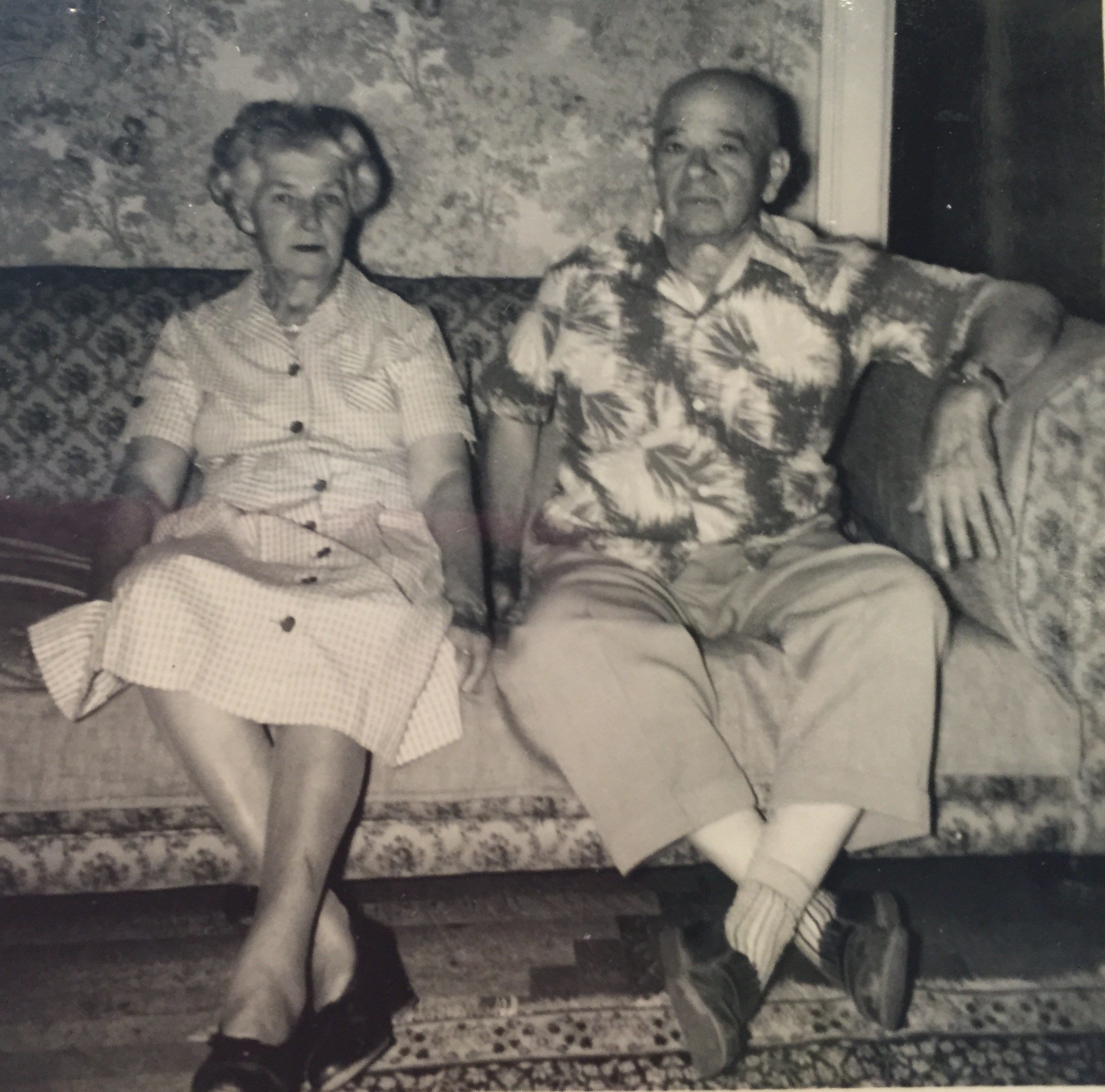
The unhappy couple in 1953

The unhappy couple in 1953

Copies of The Yakima Republic/Daily Republic, the Yakima Morning Herald and The Yakima Democrat were accessed on September 15, 2015, at the Washington State Library in Tumwater, Washington.

2 Comments

Filed under Family history, Uncategorized

Memory and Moment

What makes us remember one particular moment out of the millions that raced past? I should remember the moment I was told my father had a serious heart attack. I was five, and old enough to understand. But so many of my early memories are single images, unconnected to the moments that preceded them and those that followed: looking through the pink chiffon of my mother’s evening dress, sucking a sugary droplet from a honeysuckle blossom, watching the tall swells through a porthole on an ocean crossing.

Most of the moments I remember aren’t decisive instants, neither augur nor anchor. From them I imagine: I was a scaredy-cat; I was a whiner; I was a tomboy. I imagine my father, too. He’s been dead for over two years. When I write, I meet him again for the first time.

No one can confirm who my father was. The people who might have had better answers — his brothers, his friends, his Marine Corps brothers, my mother — are all dead. Even if they were alive and could return to the periods that escape me, I’m not sure their account would be closer to the truth. Not even my brothers can confirm or deny my account because their relationship was son to father. I’m the only one who knew my father as I did.

The images are pushpins that hold up my stories. The story of how I wanted to feel close to him. The story of how I did. They’re not much, but maybe they’re enough.


2 Comments

Filed under Uncategorized

Silent Drill

marine barracks change of command 1958

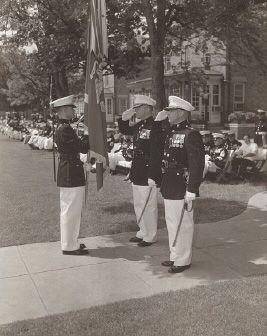
My father, at right, receiving temporary command of Marine Barracks, July 1958

On nights when my father was in his party mood, I begged him to do the Silent Drill. He was still too weak to go back to work in that year following his heart attack, but I liked to pretend he still wore his Marine Corps blues.

He began by standing in the archway of the dining room in our new Seattle home: stick straight, eyes forward, the tip of an umbrella resting on the floor by his right toe. Then he stepped forward, landing on his heel. He was walking, just walking, but the steps didn’t look human, slowed to half speed. He rapped the umbrella next to his foot and lifted it to his left shoulder, where his left hand caught it with a smack and pushed it to the right. As he marched, he slapped his thigh.

This percussion was the drill’s only accompaniment: the slap on the thigh, the catch on the shaft, the rap of the tip. It reminded me of the ta-ta-tee-tee-tah chant that my first grade teacher used to introduce rhythm. The steps themselves were silent, like a cat padding down the hall.

The best part came near the end: roundhouse twirls, once, twice, three times around, performed with the right hand, then with the left, over the head, in front of the body, and for the finale, a toss in the air. There my father gave up. An umbrella was too light compared to the drill rifle he was used to.

I didn’t remember the Silent Drill Platoon, the highlight of the Marine Barracks’ Evening Parade. The first time I saw it, when I visited the Capitol to arrange my father’s burial at Arlington National Cemetery in 2013, I began to understand what I’d witnessed 50 years before.

The Barracks is the spiritual home of the Marine Corps, its oldest post. Its site was chosen for its location “within marching distance of the Capitol” in 1801 by the second USMC Commandant and President Thomas Jefferson. Early in the twentieth century, the first ceremonial parades were organized to boost the post’s military preparedness. Ten years after WWII, the twentieth Commandant recognized the Barracks’ new strategic importance — fighting for the continued existence of the Marine Corps. He called the Parade his “muscle” and used it to entertain elected officials and influential guests.

The Evening Parade was established during the summer of 1957. I was born on June 15 of that year. My father came aboard as the Barracks’ Executive Officer in August. In October, the Commandant asked Lt. Gen. Victor “Brute” Krulak to respond to this question: “Why does the U.S. need a Marine Corps?” Gen. Krulak had first addressed this question in 1946, he told the Commandant, when the USMC had last faced elimination. Playing devil’s advocate, he and a group of officers acknowledged that the Marines have no “mystical competence.” The Marines’ distinction, they concluded, lay in the country’s grassroots belief that when trouble comes, the Marines will be ready to do something useful, at once.

When the Commandant asked Gen. Krulak his question in 1957, the Marines were once again threatened by Washington’s amnesia. Nearly forgotten was the Corps’ feat during the first battle of the Korean war. The Marines’ fighting force had been reduced to six battalions and 12 aircraft squadrons by the end of the 1940s, and the Secretary of Defense had declared his intent to further cut the Marines and transfer its remains to the Army and Air Force. Then on June 25, 1950, the North Koreans invaded the south with a force of 75,000 soldiers. Within three weeks, the Marines pieced together an air-ground force of 30,000 and improvised a landing, despite tidal swells that were amplified by two typhoons prior to D-Day. The battle for Inchon, which lasted four days, was a decisive victory. Through Inchon and every other battle to which the Marines had been called, Gen. Krulak believed the USMC had earned the support of the American people. But between conflicts, the Marines foresaw the need to remind decision-makers of its value through traditions like the Evening Parade.

The memory of my father’s slow cadence seized me that first time I saw the Evening Parade.  When my father executed his gliding steps — each knee rising to regulation height, each stride stretching to regulation length — it was a solo performance, mesmerizing and weird. At the Barracks, it was like watching him multiplied in a house of mirrors, marching alongside an invisible legion.

2 Comments

Filed under Uncategorized

The Clueless Bride

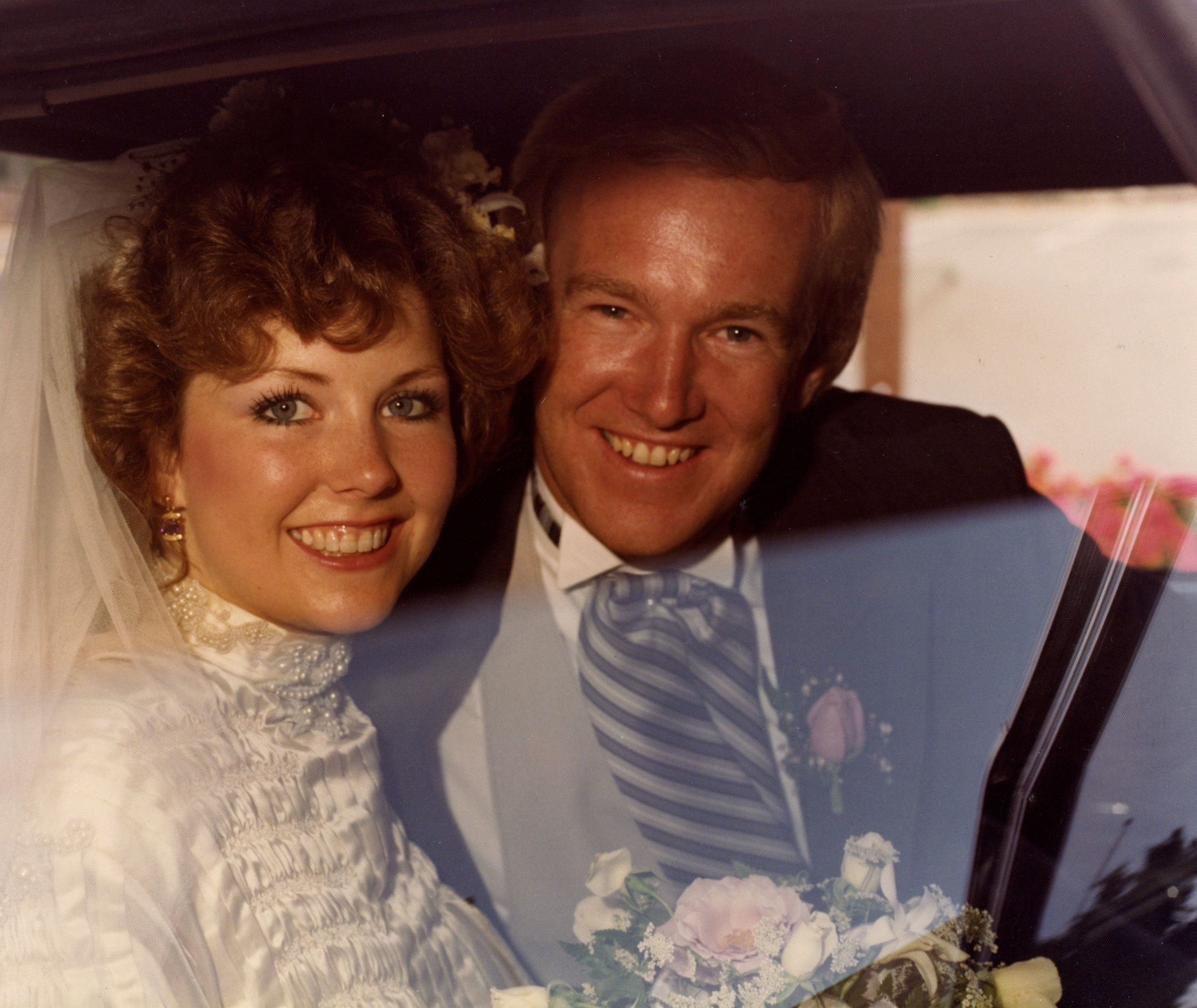
The happy couple - wearing a 1906 wedding dress and tux in 100+ degree heat!

I had no idea what I was doing when I married my husband, 33 years ago, at almost this exact time. Oh, I thought I did, in the way 25 year olds think they have everything figured out. I remember how I felt the morning of my wedding. After a restless night, I woke up next to Ellen, my best friend, who would stand up for me later. I had expected to sleep deeply, as I had done so many times before, when Ellen and I talked deep into the night. But I was nervous. And that was silly, I thought. I was in love and marrying a good guy and I knew what I was getting in to. Being anxious about the ceremony — that was silly, too. In our hearts Todd and I were already married.

I could write a book about what I didn’t know. Practical things like: how to sleep with a 6’3″ person in a water bed; where to look for missing things when you live with someone who likes things neat.

None of the practical things mattered. I quickly learned to search the drawer closest to where I last saw a missing item, even if it made no sense to put it there. We got rid of the water bed after a year of rough seas. Those early lessons were mere anecdotes.

It took years, decades, to understand the big themes. How hard a man will work to preserve a marriage. How unconditionally loving he is of his children. How there for family — mine and his. How supportive of friends. How committed to faith through service. How responsible to people he does business with.

When I was 25, I glimpsed these qualities but, without context, without experience, didn’t know what I was seeing. Is he perfect? No, but he’s pretty damned special. I’ve now lived with him longer than I lived without him. Clueless no longer, I know what I’ve got.


Leave a comment

Filed under Uncategorized

Atoms of the Soul

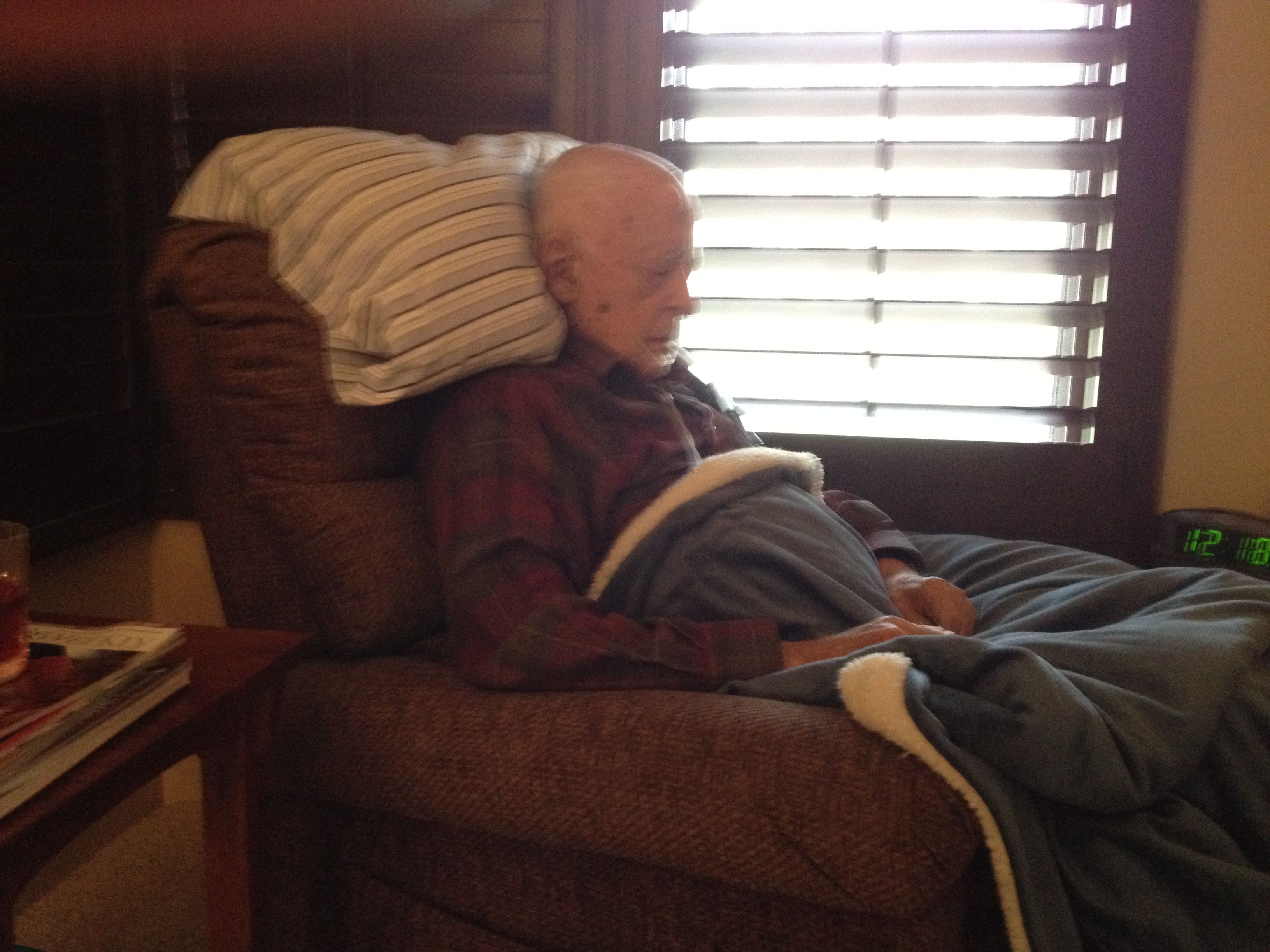
Dad sleeping

I dug this little piece out for a friend who is beginning a writing project. Pick an image, I told her. This is one of the first bits I wrote almost year ago with that same prompt. For some reason, the piece ended up on the cutting room floor. Maybe I’ll bring it back:

I think I’m done actively grieving, and then I open my eyes. On top of my white king-sized pillow is a smaller one in a rose-colored pillowcase. When I open my eyes in the morning, lying on my side, it’s what I see first. A rose-colored world.

My husband says it barely qualifies as a pillow. It’s a suggestion, a flattened wisp. If I fluff it out and smooth it with my palm, it rises above the bed less than three inches. Strange when I see it that way. It almost looks normal, a utilitarian object that happens to be enclosed in a mismatched bed linen. Its wonder is its malleability. It can be curled into a ball, or laid softly across my chest like a cat.

I wonder if it began its pillow-life full of stuffing and somehow, as it was carried from one bed to the next, it lost a feather here, a feather there. If its diminishment fell beneath notice.

This is the pillow that cradled my father’s head when he died. I remember it from my mother and father’s house in Tacoma. I remember it – or one just like it – on my mother’s bed when she died. If it is the same pillow, I imagine it was encased, then, in a cover with yellow roses. My mother loved yellow. The pillow followed my father to his assisted living apartment in Seattle, then to my house. He tucked tissues under it each night. By morning, he had compacted it into a tight roll. Toward the end, when he was half-conscious in his recliner, I lifted his head and molded it around his neck.

I cannot let go of the pillow. A superstitious person might feel it is bad luck to keep something that came into such direct contact with death, that in those sloughed off skin cells, now reduced to dust, atoms of the soul remain. When I clutch it to my chest, I cradle the little bit of my father that remains.

Leave a comment

Filed under Uncategorized

“Why Don’t People Write More Poetry?”

Why I Wake Early book cover by Mary Oliver

That’s the question my friend G. asked me today. She’s just a few years older than me and has had a dozen strokes; the doctors don’t know why. She struggles with words — fidgets with her hands as if trying to create  words out of invisible clay — and her short term memory is shot. But she gets poetry.

During my visit today, I brought along “Why I Wake Early” by Mary Oliver, the poet known for revealing the marvelous in her minute observations of nature. For some reason, I’d dog eared the poem “October.” When I started to read it, I immediately thought I’d made a mistake. It’s written in seven numbered sections with abstract imagery in which Oliver seems to hover above a scene. Gail was intrigued, had me read it seven times. As she listened she closed her eyes, enraptured.

When I read “Peonies,” she picked up on the phrase “beauty the brave,” and repeated it over and over. That one we read three times. Then “Goldenrod.” She loved the language of it, the assonance of “rumpy bunches,” the alliteration of “dumb dazzle.” She rolled the phrases around in her mouth like marbles. I don’t know how many times we read that one.

When I read her the last few lines, in which the goldenrods “bend as though it was natural and godly to bend,/they rise in a stiff sweetness/in the pure peace of giving/one’s gold away,” I told her that she has gold to give — her unfettered love and sense of humor. Though her abilities have changed, her value has not. If anything she is more cherished than ever by those who love her.

We almost didn’t make it past the first line of “Blue Iris”: Now that I’m free to be myself, who am I?

Each time I started down the 15-line poem, she laughed and stopped me.

Why don’t more people write poetry, or at least read it?


3 Comments

Filed under Uncategorized

Tall Tale

Henry Campbell hunting in Eastern Washington

My father stands at the kitchen sink, cleaning the dirt out from under his fingernails with a nail brush when my son asks him, “Papa, what happened to your finger?”

My son eats his snack at the kitchen table, no longer so small that he needs the phone book for his elbows to clear. The table has been draped with the yellow plastic tablecloth because, when a young grandchild visits, milk is often spilled. At the moment, however, his milk is in no danger. Its position to the north of his plate suggests that either my mother or I moved it out of harm’s way.

My father glances over at my son when he hears the question, then returns to his scrubbing. His eyes skew skyward for a moment. “Well,” my father says in his story-telling voice. I know my father is fanning out the possible responses like a deck of cards. My son knows it, too; he sets his sandwich on the plate and folds his hands in his lap. On either side of my father’s lumberjack suspenders, his upper back flexes with his movements. Then he flicks the faucet off, shakes his hands dry, and leans back against the sink.

“When I was a boy of six or seven,” he begins, “my father gave me a BB gun and told me to go learn how to use it. I’d get up before dawn, 3:30 or so in the morning, and walk through our backyard through the Howard place into the Gibson’s orchard. Then I’d hunt English sparrows, which the farmers hated because they ruined the fruit. After I got pretty good at it — I must have been about 10 — my father brought me a 22, a real gun.”

My son’s eyes widen.

“Of course I wanted to try it out. My brother Bill and his running mate Jack Callahan and I came up with a game. We’d go up to Cowiche Canyon to hunt rock marmots. The farmers didn’t like the marmots either, because they tore up the alfalfa fields. For every marmot we each killed, we’d earn a point. The one who got the most points would win.”

Until this point, my father’s voice has been percolating along at a steady pace. He stops. When he begins again, his voice is low and slow, as if sharing a secret.

“I had just laid down in a shady spot on the ledge when I spotted a marmot come out of his burrow on the far side of the canyon. So I sighted down my barrel.” My father raises the imaginary gun to his shoulder and squints one eye.

“I had just one problem.” With his arms still in position, he looks over at my son.

“When I went to pull the trigger, the tip of my finger got in the way.” As he says this, he wiggles the stub of his finger. “It stuck out so far that I couldn’t see where I was shooting. What could I do?”

My son doesn’t know where the story is going. He shakes his head. “Well, I had to fix the problem. So I took out my pocket knife and cut it off!”

As punctuation, my father emits his loud “skeesix” sound from the side of his mouth, startling my son.

For a few beats the helium of belief keeps the tale aloft. A look ricochets back and forth from boy to man, many to boy, until the boy’s chin tips sideways. The connection broken, my son asks, “What really happened?”

1 Comment

Filed under Uncategorized

After Gravity

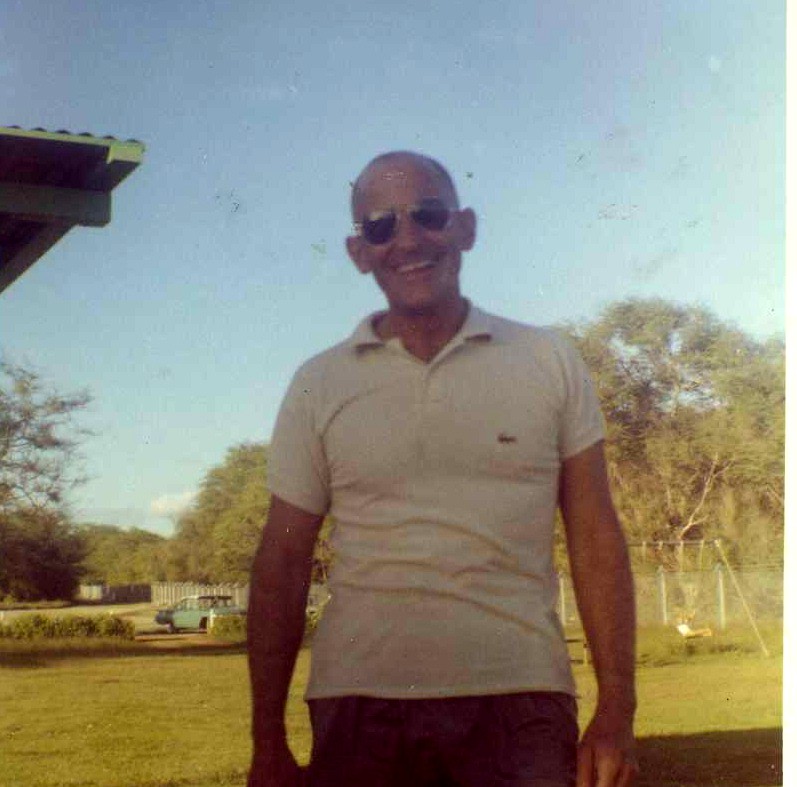
Dad near Barber's Point, 1962

“Do you remember riding on my shoulders in the surf off Barber’s Point?”

I wanted to remember that father, handsome and fit at 46, but I had to tell my father I didn’t. I could see the memory in his eyes: the hot sun, the warm water, the feel of his little girl’s smooth legs, wet like a seal, on his shoulders; her fear, overridden by the knowledge that she was safe, which converted it into a frisson of excitement.

I forgot father-the-Marine. I forgot the father who came after, with the clear youthful voice. I forgot the father with the farmer’s tan who smelled of sweat after lifting weights.

All I could remember, for a long while, was the sleeping man in the recliner — eyes closed, mouth open, white hair swept forward, belly distended from fluid, feet and legs twitching like a dreaming dog’s.  The man with the gravelly voice often mistaken for gruff.

Sometimes I imagine my father as a Russian doll — patient teacher within dogged salaryman within rugged outdoorsman within devoted caregiver within sleeping ancient— until finally I can see the curly brown-haired boy with the chubby knees and then the infant in his mother’s arms.

This is the memory of my father I would like to have from that day on Barber’s Point: the feel of his shoulders inside my embrace, the tickle of his chest hair as it rises and falls, the sensation of floating together.

Leave a comment

Filed under Uncategorized