Category Archives: Uncategorized

Singing Mama Home

In the initial weeks after my mother was diagnosed with cancer in 1999, I wanted to comfort her as she drifted in and out of lucidity. I remember sitting quietly by her bedside at the hospital, holding her hand. My first instinct was to try to sing to her since, all through my early childhood years, so many of my memories were accompanied by her singing. But confronting her impending death, I couldn’t sing. Each time I tried, I choked up.

Music was, and is, inextricably linked to my attachment to my mother. When I was a little girl, my mother would tuck me in and sing me our family lullaby, “Jesus Tender Shepherd.” She would turn out the lights, and leave the door ajar. Through the crack in the door, I heard the murmur of our settling household. But instead of sleeping, I often lay awake. After a half hour or so, I’d get up and tell Mom. Again she would sing,”Jesus Tender Shepherd,” turn off the lights, and leave the door ajar. Sometimes, there was a third or even fourth cycle before she became completely exasperated.

In my mother’s twilight moments, I wanted to bring that comfort to her. For several weeks, I continued to try to sing to her. And one day, I found I could do it. As agonized as I felt while watching her slow departure, I finally had the control to sing. I sang that childhood lullaby then, and later when we celebrated her life.

This past weekend, my ‘other mother’ completed her journey on this earth. The family, and those of us who are extended family, didn’t see it coming. But her medical setbacks turned from a trickle into a cascade, and finally into a flood that she could not overcome. And yesterday, I found myself by her hospital bed with my best friend and her sisters and brother, trying to find a way to comfort my ‘other mother’ as she did the hard work of letting go.

That afternoon, we had attended a vocal choir concert by the Adelphians of the University of Puget Sound, which they ended with their traditional finale, Stephen Paulus’ “The Road Home.” I started crying as I listened to the lyrics:

Tell me where is the road I can call my own, that I left, that I lost, so long ago?

All these years I have wandered, oh when will I know, there’s a way, there’s a road that will lead me home?

Rise up, follow me, come away is the call

With love in your heart as the only song

There is no such beauty as where you belong

Rise up, follow me, I will lead you home

After wind, after rain, when the dark is done, as I wake from a dream in the gold of day

Through the air there’s a calling from far away, there’s a voice I can hear that will lead me home.

Rise up, follow me, come away is the call

With love in your heart as the only song

There is no such beauty as where you belong

Rise up, follow me, I will lead you home

Hours later, reflected in the hospital’s dark oval window, we gathered around an unquestionably beautiful woman who had loved us, chastised us, teased us, cheered us, cried for us, and stood up for us. My best friend, her daughter and I sang “The Road Home.”

As I remember it, just as we finished, my friend’s sister noticed that something had changed. Mama’s hand felt different. Then she didn’t take that next breath. She was gone.

Our quiet vigil was interrupted by a rush of awareness, then panic and confusion. Filling the void came the impulse to sing. And what came to mind was the lullaby that my mother sang so often to me. This time, I could sing it, joined by my best friend. We sang Mama home.

9 Comments

Filed under Faith journey, Uncategorized

What’s on your list of 5 self care things you do?

My friends and I seem to have entered a new phase. Once upon a time, our calendars overflowed with weddings. Then it was baby showers, and until recently, children’s graduations. Now our email and text exchanges are more likely to pertain to a parent’s health crisis. Usually coupled with news of challenges facing our young adult children.

We’re savvy enough to know that we need to take care of ourselves as we care for others, but busy and stressed enough that it’s really hard to actually do it.

My friend just texted me to say she was leaving town tomorrow to look in on her Mom, who’s had a setback in her recovery from surgery. True to form, she asked me how I was doing, and I replied that things are a bit better on several fronts.

She then asked, “So what are you doing for you?”

To which I replied, “What are YOU doing for you?”

I wasn’t trying to play the “gotcha” game (this isn’t politics, after all), but that’s kind of how it turned out:

Crap. I knew you would turn that one back on me! You know I’m the worst at putting myself in the top 10, or 20, on any list!!! At best, I’m trying to learn to be a bit more compassionate for my own frailties. It’s a start.

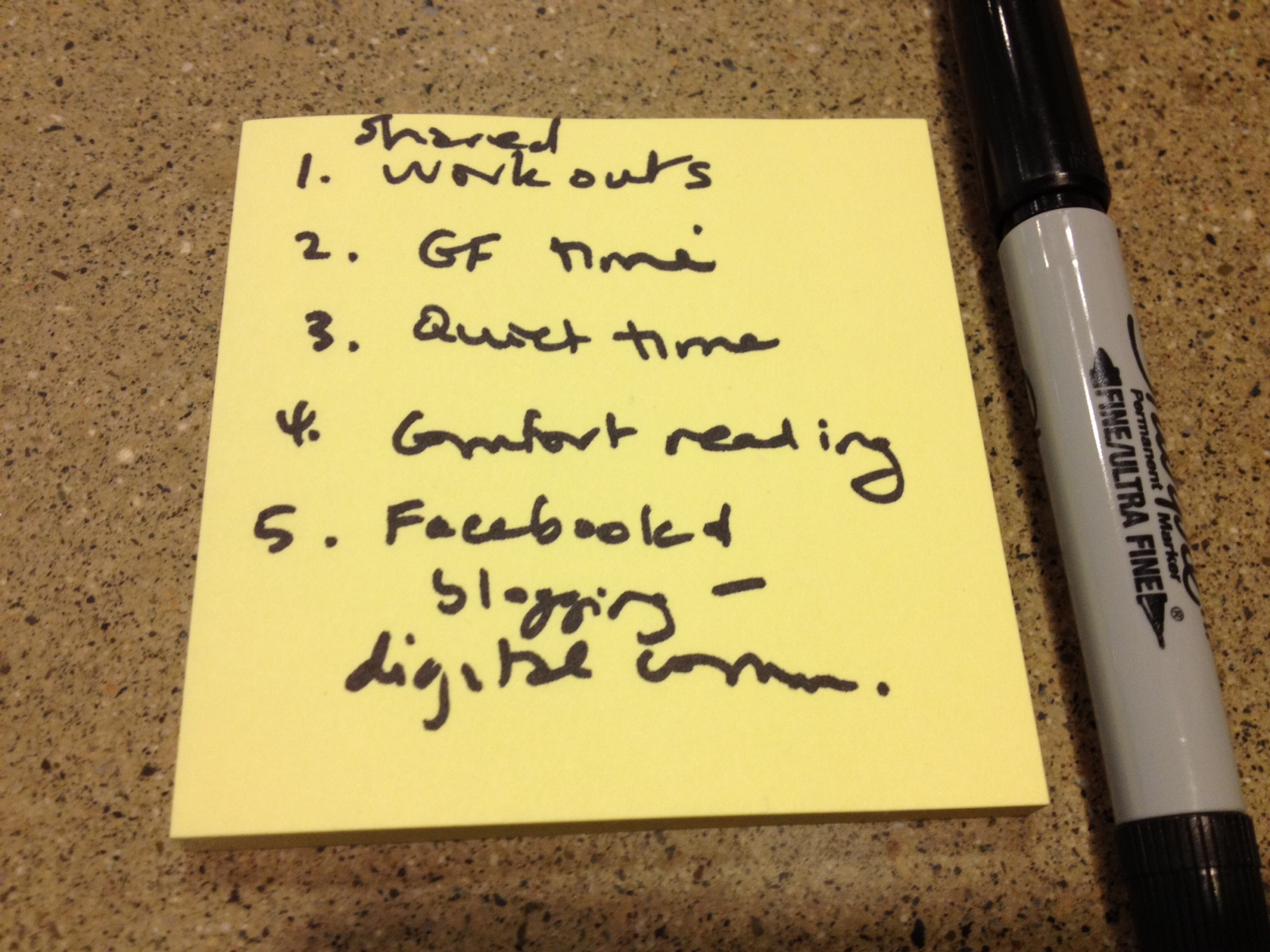
I’ve actually been thinking about this self care thing since my guardian angel, Jim, instructed me to list 5 things I would do for self care. That it’s taken me three weeks to think of five things tells you something.

My five are below. I’d love to hear what YOU do to take care of yourself as you care for others. We can all learn from each other — and maybe encourage one another to actually follow through on these things.

1.  Work out with others.

I often say that I live with the future. When you’re around a 95-year-old you realize the importance of strength and balance. I walked but I knew that wasn’t enough. I admitted that I couldn’t motivate myself to do things like – ugh – sit-ups or pushups.  I also thought it was unlikely I’d get my butt out the door to a gym class given my caregiving responsibilities. So, my big plan was to work out 4-6 times with a trainer and then miraculously carry on alone, having formed a virtuous habit. During my first workout, I was shocked at how poor my balance was – that and the fact I couldn’t do 10 sit-ups without holding on to my thighs to heft my upper body from its prone position.

That was four years ago. After a year or so, my neighbors who walked together twice a week for years expressed interest in trying it on for size. Now my driveway is a boot camp at least twice a week. Scheduling that time, and keeping it, is absolutely at the top of the list in terms of things I do for myself.

I figured my trainer, the amazing Kylee Neff, was an absolute liar when she told me I’d have more energy from working out. For about three months, I wanted to go to sleep early on the days we trained. But she’s right. Now if I can’t work out for a week, my energy and outlook isn’t as good. It’s as important to me as – gasp! – coffee once was. (Strangely, I also feel almost no need for caffeine.)

Working out with one or more friends also makes it hard to slack. After all, they show up in my driveway. But the group banter has the extra advantage of taking my mind off the momentary pain of whatever circuit Kylee has dreamed up for that day.

2.  Comfort read.

You’ve heard of comfort eating? I comfort read. My literary diet changes completely when I’m under stress. When my mother was dying of cancer, I was soothed by re-reading The Wind and the Willows. I’m a big fan of Mr. Toad, with or without the Disney attraction. Though I still read heavier fare (for example, The Looming Towers), I am drawn to cheesy and breezy. I read things like Deborah Harkness’ Discovery of Witches series (all two of them), J.R.R. Martin’s Song of Ice and Fire series (a.k.a. Game of Thrones), and the utterly ridiculous Sookie Stackhouse series by Charlaine Harris. Apparently I find fairies, witches and vampires comforting.

3.  Spend time with girlfriends.

My friends save me, over and over. Just knowing they are there is a huge source of support. Nothing against guys, and my husband is the Rock of Gibraltar, but there’s something about deep conversation with trusted female friends. It’s better than wine and chocolate. Recently, a friend and I agreed to set up a weekly time to meet. Her husband has Alzheimer’s and both of us have to coordinate social activities around caregiving tasks. It just works better to put something standing on the calendar. And, yes, it involves wine. Duh.

4.  Stay connected with Facebook.

I actually surprised myself with this one. So much is written about Facebook as a time suck, or about how Facebook is no substitute for deeper, face-to-face connections. But caregiving is isolating, and Facebook helps me to feel there’s still a world out there.

I love the pictures of kids and the quick posts about the sweet or funny things kids say. I travel vicariously through some of my friends whose jobs or travel budgets seem to take them everywhere. I salivate over my foodie friends’ posts about the amazing seasonal recipes they’ve dreamed up. I read the links to articles that appeal to my interests and appreciate the fact they were shared. I catch up on a friend’s recovery from a brutal cycling accident. I feel for the people (and animals) in Eastern Washington when my friend in E-burg posts update on the terrible fires there. It may seem a little strange but I even love the beefcake pictures posted by my gay friends; it makes me happy to know someone’s romantic life is more exciting than mine! Pictures of weddings, funny bits from George Takei, updates from nonprofits I care about… I enjoy almost everything in my news feed. And of course, I can always block the political posts that get a bit annoying this time of year.

5.  Find quiet time.

I’m not a true extrovert, although most people would assume I am. It’s hard for me to find an hour when I can be alone in the house, or at least alone before anyone else is awake. I crave and need moments when NO ONE WANTS OR NEEDS ANYTHING FROM ME. You may have figured out that I blog during these rare quiet moments. And when I say quiet, I mean just that. I feel so over stimulated that I need moments without music or TV. Silence is a balm.

So I’ll ask it again: what do YOU do to take care of yourself? This inquiring mind wants to know.

4 Comments

Filed under Uncategorized

Too much love?

Can you imagine this image as an older parent? It’s not how we think about our role as caregivers, is it? (courtesy Teach Through Love)

Our first instinct as parents is to surround our children in a cocoon of love that cushions them against hurts both physical and emotional. But eventually, we find out that we do our children no favors if we never let them struggle.

I am learning that being a caregiver for an aging parent is not that different.

Since I moved my father to California in 2006, he’s spent the majority of the time at my house. He has his own bedroom with a cushy La-Z-Boy, television and bathroom. After giving up the family house where he lived from 1969 to 2003, I wanted him to feel this was home. At the same time, I wanted to know I could leave town and trust that he would be secure, with all of the support services he needs. So he’s had a one bedroom apartment in a nice assisted living community.

The back-and-forth worked just fine until July, when his health became unstable. Although he is now almost fully recovered, his emotional health continues to suffer.

My mother, during the final stages of lung cancer, expressed fear of dying, despite the deep faith that sustained her for so many years. My father wondered why, if there is a God, would he abandon my mother in her hour of need? Now it is my father who fears dying – and, in particular, dying alone.

Ten days ago, he asked me, “Can I come live with you?” He continued, “Living alone is no way to live. I’m afraid to die alone.”

Using my strategic planning skills, it seemed to me that we had to revisit Dad’s living situation. My objective, and that of my brothers, is to ensure that Dad lives with as little physical and emotional distress as possible. To that I had to add an objective about meeting the needs of my own family — oh, and taking care of myself, too.

It seemed to me that there were three possible solutions: 1) Dad would come to live with me full-time; 2) we continue to muddle through with more companion services at his apartment on the days that I am not available; or 3) we limit the number of nights that Dad stays at my house because of his increased distress when he has to return to his apartment.

I sought input from a social worker, a mentor, our home church pastor, his doctor, and a psychologist. Along the way I also had Dad evaluated for hospice and found out that he’s not close to qualifying for that type of end-of-life care. I had to start thinking about what would be best for a period of gradual decline that could last for several years – something I never imagined given that Dad has had three heart attacks, three strokes and three open heart bypass surgeries.

I also had to “listen” to myself. I realized I felt overwhelmed by the possibility of Dad moving in full-time. I really want that to happen, but now isn’t the right time. My Dad isn’t the only one who needs me right now.  I had to admit to myself that I felt exhausted.

The social worker shared a little tough love with me. She said, “He is distressed about the prospect of going back to his apartment because it isn’t ‘home.’ And it isn’t home because you won’t let it be home. He spends enough time at your house that the transition is difficult. He doesn’t remember exactly what happens there and it feels unsafe to him to return.” She went on, “As family members, you’re responsible for providing the caring, but not necessarily the care.”

My beloved mentor Jim offered this advice:

This is very hard to do: separate what is in his best interest and his care needs from your heart duty as a loving daughter.  Like most elders in his situation, he is becoming more child like — likes what he likes and won’t budge; wants his mommy really to take care of him although he would not recognize that is what he is doing to you.  If he does move in and a caregiver is part of the team, you will have to force him to agree to let that caregiver do his/her thing.  You almost have to write out a ‘contract’ that he has to agree to.  Obviously it is not a legal thing, but you use it to force him to focus on reality when he just wants it all to be different and for you to be there constantly.

My church home pastor suggested that I facilitate a casual visit with a priest. “Throw him a lifeline,” he suggested. “He may choose not to talk about his concerns about death, but he may be ready to talk.” And my psychologist friend suggested having Dad evaluated for anti-depressants. His doctor agrees that may be worth trying.

So what was decided? I had a conference call with my brothers last Wednesday night and we decided to try out an arrangement where Dad is limited to three nights a week at my house. I’ve visited him at his apartment every day and joined him for lunch to reinforce the message that the staff knows him and is paying attention.

He doesn’t love it, but he is responding to the message that there are some things I need to do right now to take care of my family and myself. He asks how he can help, and I say, “Just be patient, Dad, and be supportive when I can’t be here.”

Week one went well, but the big test will come this weekend when I leave town for three days… Stay tuned.


1 Comment

Filed under Uncategorized

Ghosts in the rocking chair?

The spat that I described in my last post ended with the receipt of a sincere apology from my brother after a three-day marathon of back-and-forth emails. He also asked to “start over” with not just me, but my other brothers.

After time for reflection, I learned a lot, albeit painfully, from the whole kerfuffle. In keeping with the Buddhist proverb, “When the student is ready, the teacher will appear,” I stumbled across some teaching from an unlikely source: a child advocacy and parent-teacher education resource called Teach Through Love. Teach Through Love shared an article link on its Facebook page, and highlighted this quote:

Similarly, our kids push our buttons precisely because they are our children. Psychologists call this phenomenon ‘ghosts in the nursery,’ by which they mean that our children stimulate the intense feelings of our own childhoods, and we often respond by unconsciously re-enacting the past that’s etched like forgotten hieroglyphics deep in our psyches. The fears and rage of childhood are powerful and can overwhelm us even as adults. It can be enormously challenging to lay these ghosts to rest.

My brother said that his temper flares when he feels overlooked, ignored, or otherwise “disrespected” and he attributed this sensitivity to some disappointments in his life. When we met for dinner last week, I asked him if he thought it might be related to a longing of his for respect from my father, and perhaps the respect of his siblings for him based on birth order.

He scratched his arm repeatedly as he described his experiences with Dad growing up, beginning with Dad’s return from WWII. Dad later asked him to be “the man of the house” when Dad was sent on a solo tour out to Japan just after my sister’s death from leukemia. And when Dad was disabled due to a massive heart attack in 1962, he was called upon again. He was the same age then that my son is now. Instead of focusing on college, he was trying to help the family pull through the crisis of my Dad’s near-death and the aftermath of my father’s forced retirement from the Marine Corps. (In those days, a heart attack meant automatic and full retirement because, with limited treatment options, military command didn’t believe that a soldier would recover sufficiently to fulfill his duties.)

My mother and father often said that they raised their two eldest children, but they let the two youngest raise themselves. We had the same parents, but grew up in different worlds. My younger brother and I mostly grew up in a civilian world — a world, I might add, that Dad found quite deflating. I admired my Dad, but I didn’t think he was perfect. And I told him off – royally – when I was 21. I was tired of feeling afraid of my father, who retained command presence long after leaving the Marines.

When my brother sent his angry email, he felt disrespected by my younger sibling and me. The email that triggered the original firestorm pushed a flashing red button in his brain. But that button was installed long before.


Leave a comment

Filed under Uncategorized

Sibling fight!

Why is it that food fights are fun and email fights are not?

I was quite smug last night when I told a friend that I thought my brothers and I were really communicating effectively with one another. She had just returned from 10 days of overseeing her mother’s recovery from pneumonia and surgery, during which she was repeatedly second-guessed by her out-of-state sister.

Then I got an email from one of my brothers today, who reacted to an email sent by another brother. I won’t get into the details but I’ll share the zinger with which he ended his message: “…have the two younger sib’s simply cut out the two older sib’s from having a voice?”

I thought we were past this.

But the truth is that it is very, very hard for people who act like grownups in most situations to behave that way when something triggers half-buried resentment. We are all suddenly six.

There are a lot of “perhapses” that come into my mind. Perhaps the brother who sent the original email should have called instead of sending this particular message by email. Perhaps the brother who seethed over the email should have picked up the phone and expressed his concern to the sender, or to me (since I was supposedly colluding in the decision in question). We could have done better.

When we are stressed, as we are in no small part by Dad’s deteriorating health, we are reduced to the ugliest side of our personalities and temperaments.

It’s hard to keep one’s eye on the real issues here: how to make sure that Dad feels loved and safe, and how to preserve and perhaps strengthen our sibling relationships for the time when Dad is no longer there to bind us.

Right now I’m working on that last part.

2 Comments

Filed under Uncategorized

My husband, the unsung hero

(Before you read this post, stop remembering the Andy Kaufman version of the Mighty Mouse theme song. I mean it. Stop. It. Right. Now.)

My husband and I have always had a 50-50 arrangement, if you average it over time. Statistical nerd that I am, I know that the average can mask a labile distribution of responsibility for household and familial duties. Sometimes it’s 75-25, sometimes 25-75, and occasionally even 90-10 (as in the time when we were preparing to move and my husband managed to break his knee on a guys’ trip).

Every time someone says to me that I’m an angel for taking care of my Dad, I remember that the guy holding my halo in place is my husband.

When I stop to take inventory, I realize that it’s a whole bunch of little things he does that accumulate to make a difference. When he comes home from work every evening, he asks if my Dad has his glass of wine. While I scramble to do my “magic” in the kitchen (anyone who knows me knows this is not a joyful experience), he’s contributing the comfortable routine of my Dad’s life. Dad used to have a couple of scotch and waters before dinner that over the years morphed into a glass of red wine. Dad’s almost lost his taste for wine at all, but that pre-dinner libation is a nicety in the not-so-nice world of advanced age.

Sometimes my husband “covers” for me if I have a morning meeting or am entertaining a couple of girlfriends. I’ve never detected a moment of resentment if I ask him to fix Dad’s breakfast or put his dinner on the table.

Taking care of Dad severely limits our flexibility to accept invitations from friends or go out of town for the weekend, things my extrovert husband would enjoy. But he never complains. Ever. I’ve never detected resentment, though he would be well within his rights to feel some.

And he shares his space often, as family members come to visit my Dad.

Perhaps most significantly, he doesn’t try to fix my problems when I feel down or a little worn out. Earlier in our marriage, we learned that my sharing a problem led to him trying to solve it, when sometimes all I wanted was the opportunity to vent. He sits with me and empathizes. I feel held inside even if we are not touching outside.

Next time your mental jukebox plays, “Here I am to save the day!” remember the great men who are out there standing behind the “angels” like me.

1 Comment

Filed under Uncategorized

What makes caregiving so hard?

I thought I knew what hard is. Hard was being nine months pregnant, diagnosed with pregnancy induced hypertension (ankles bloated to the exploding point), and getting ready to present the first full-scale consumer awareness study to the hospital system execs for whom I worked. Hard was working full-time, while trying to be a good mother of  a one-year-old and  studying for my M.B.A. during nap time and at night. Hard was working a full day with two hours of commute time on either end.

Being responsible for someone who needs your help and care, it seems to me, isn’t exactly training for the Olympics. But it can feel that way sometimes.

My Dad doesn’t need assistance with the basics. He dresses himself, puts his hearing aids in, eats independently, and has the toileting thing pretty much under control. My caregiving gig is a lot easier than many.

I think what’s hardest for me is the emotional burden – dodging obstacles, holding others up who worry from afar, and coping with the no-end-in-sightedness. I am constantly anticipating problems and talking steps to circumvent them, for example, clearing my Dad’s path of trip hazards and pre-emptively clearing dishes so that my he will not take it upon himself to do so, toodling from the breakfast table to the counter with dishes in both hands (and thus without either cane or walker). When a medication stops working and needs to be adjusted,  I run the gauntlet of conversations with doctors and care staff, trying to get accurate information about the situation (clarifying, clarifying, confirming) and calling and finally badgering someone into changing medical orders.

Dad is unstable enough that my brothers now worry from afar. I understand their vigilance, having felt just the same way when home in California during my mother’s four month hospice period in 1999. When I report setbacks, which have been more frequent during the last month, I get messages from my brothers asking if this is a crisis and whether they should book flights. I know their messages are code for, “Do you think he could die?” I try to reassure them. Understanding that you are going to lose someone is to begin grieving. I know they hurt. [Brothers who read this: this is not a complaint. I really appreciate your increased vigilance.]

We’re not there yet. Several times of late I’ve been asked what I will do when “this period is over” (code for “when Dad is dead”). I don’t know. I can’t plan. If I get my head in the future it will be even harder to manage the day-to-day. So I am actively avoiding long term planning.

Right now my whole world is the next two weeks, in which I hope we will stabilize Dad’s underlying congestive heart failure condition so that his weight swings and shortness of breath resolve, at least until the next unsettled period.

This shouldn’t be that hard. But some days it is. Fortunately, today is not one of them. So far.

3 Comments

Filed under Uncategorized

Turn off, brain, and let me go the f* to sleep!

The lovely view from where I didn’t sleep

Just when I feel overwhelmed by my Dad’s declining health, it seems that the sleep gods conspire against me.

My anxiety – and accompanying sense of hyper-vigilance – built to a pitch over the weekend, even while my husband and I attempted to relax in Northern California’s playtime paradise of Lake Tahoe.

Over the past month, the medication that had been working so well to control the symptoms of Dad’s long-term congestive heart failure sputtered and stalled in its effectiveness. His weight dropped from 204 lbs. to 188.5 over three weeks, and then, when we cut back the dosage, spiked back up to 198 in less than a week.

My brother, who came into town to “spell” me for my anniversary trip, called me Saturday night. His voice was choked with emotion as he explained that Dad looked as weak and worn out as he’d seen him. When he asked Dad how he was doing, Dad replied, “I don’t think I can pull through this…”

That night, I left my cell phone on in case my brother needed to reach me in an emergency. Then starting at 1:30 a.m. that night, I started this exchange via text with my young adult son, who was finishing up packing for a 5 day cruise the next day. What’s funny about this is that I just couldn’t let go. I felt utterly driven to ensure that my son did not – gasp! – make a mistake packing:

Him: Do I really need a carryon? I was just gonna keep it simple with a rollaboard.

Me: It if fits that’s fine

Him: Fits what? I was gonna check it

Me: Rollaboards can go in the overhead bin. Then it can’t get lost. If you are going on a cruise your bag will never catch up if it gets lost. When you connect there is more of a chance of it not getting on the 2nd plane. It’s up to you but it’s safer

Me: ‘nite

Him: I have the red one, will that fit? [The red rolling bag is ginormous.]

Me: No. It has to be one of the small black ones. Sounds like you don’t have a choice unless you have a duffel that qualifies as a carry on. Southwest is pretty good about getting bags there so you’ll probably be fine. Don’t check your computer – keep it with you.

Me (again): The carry on can’t be longer than 24″ [Note: I have now gone on SWA via my cell phone to actually check the limitations.]

Me (again): Be careful not to oversleep

Me (yet again): Can I go back to sleep now?

Him: Yeah, sorry, I’m just gonna check it

Me: OK but keep your computer with you. Put your name and home address on a piece of paper inside the checked bag. Make sure it has a luggage tag too or put a paper one on it at the airport. Travel safely.

Me (again): Got your passport? Keep that with u too

Him (now at 2:02 a.m.): Found a duffel, using it instead & I’m not bringing a computer

Me: OK but if they make u check it remember to keep your passport with you, preferably in something by your feet. Passports can get stolen out of backpacks in bins. Students get targeted by thieves.

Me (finally): OK goodnight. I love you. Have fun.

Him: Gnight mom! Love you too & I’m sure we will

You can guess how the night went after that. I didn’t fall gently back into slumber.

On Monday, I made a record 20 phone calls to my father’s doctor, to friends and family who visited my father at his assisted living apartment, and to family to report in. At the time, Todd and I were attempting to complete a 7 mile hike.

That night, I was awake from 3 a.m. to 5:45 a.m. I’d drift into sleep and pop right back out of it.

I know I am not alone. Over the weekend, a dear friend lost someone she’d known and loved since childhood. She texted me last night, “Just took pill… haven’t slept in five days.” My brother who had been upset over the weekend texted me Tuesday, “I slept finally last night, though I had a 90 minute break in the middle.” Another close friend posted on Facebook: “Being the ‘sandwich’ generation and responsible for taking care of both parents and children sucks! Why do both generations have issues at the exact same time?????”

Five question marks is about right.

“Grief is a journey, I’m told,” my friend texted last night.

Yes, it is. But I am fortunate to not be on the trail alone.

2 Comments

Filed under Uncategorized

30 Years of Opposites, Happily Ever After

Today, my husband and I celebrate 30 years of marriage. You know that old saw, “And they said it wouldn’t last”? The Episcopal priest who married us, who’d known me since I was nine, actually expressed his reluctance to read the banns because we were too different. He based this opinion on the results of a psychometric questionnaire that he had both of us complete.

He was right that we were different, and we still are.

  • My husband is a true extrovert who comes home from a party so jazzed up that he can’t go to sleep; I collapse in a heap, worn out from having to be that extroverted.
  • Members of his family, men included, cry easily. Crying was pretty much trained out of us in my family, which faced most hardships and losses with stoicism.
  • My approach to strong disagreement, like my mother’s, was to yell, with the occasional “god dammit” and “hell” thrown in for seasoning. Then we forgot about it. My husband learned to conquer other people’s anger by withdrawing. He prefers to stew a bit before sorting things out.
  • My husband is an ESTJ in Myers-Briggs parlance and, if you’re in to that sort of thing, a Virgo. His world view is pretty black and white – it’s right or it’s wrong. He’ll give people a long leash, but if feels they’re taking advantage of him – bam! – they will get an unambiguous shove back. He likes to know the rules up front, and he likes to follow them. I, on the other hand, am an ENTJ with a healthy dollop of Gemini sauce. Rules, schmules. How I react depends on whether I’m feeling extroverted or introverted at that moment. But always, I tend to put logic before feeling.
  • He likes things neat. I like things clean.
  • He loves to listen to music all day long. I love quiet.
  • He’s definitely conservative, in the sense of can’t-stand-the-idea-of-our-son-getting-a-tattoo. I figured it was inevitable, but I find I actually appreciate the fact that the tattoo honors that interconnectedness of people and the earth (I just didn’t think it needed to be emblazoned on one’s body).

I could go on, but you get the idea. It’s not a marriage made in heaven – I see Fr. Dave’s point – but it wasn’t made in hell, either.

What it has been is interesting – and, for the most part, good. My Dad often says that he views his life in distinct phases that feel discontinuous. Our early marriage years were horny and busy, very much about having fun with each other and fun with other people. The second phase of our marriage, after our children were born, found us fully engaged in demanding careers, squeezing every drop out of our schedule to put into parenting.

Those mid-kid years were tough, so tough that we ended up doing three years of marriage counseling. Where we learned – guess what? – how different we are. We were there because we had grown distant, because we had become great business partners, but weren’t such great lovers. Something had to change.

But the miraculous thing is that things did change. We reassessed, listened, got over our anger, and regrouped. We found better ways of being together that worked for both of us and honored our differences.

The result? I admire my husband’s integrity, his stability, and his rock-solid values, which include commitment to me. He laughs and cries more freely than I do, and both his humor and his empathy have helped me to be a happier, healthier person. Though we have been very angry with each other on occasion, he has never treated me poorly or tried to wound me. I know a lot more about music than I would have, although I am still hard pressed to “name that band,” or remember lyrics. Our kids, now young adults, are better people for having had parents who learned to listen to them and each other through our differences; they could not be more forthright, and they actually continue to seek our counsel. And our house is both neat and clean. Call ours reconcilable differences.

While this particular post honors the differences that have challenged us through the years, we had a lot of commonalities that provided a foundation. Belief in God (shaky at times, but nonetheless there), priority on family, empathy and respect for one another. And love.

It’s 30 years later, and we’re 55. I feel like we’re in phase three of our marriage, and I look forward to the phases to come. I enjoy being with him more than I did 10 years ago, and as much as I did 30 years ago. Having said that, I don’t feel at all like I did in my mid 20s. I’m not the same person. Neither is he. But we’ve found a way to be together.

It’s like getting married all over again.

5 Comments

Filed under Uncategorized

Road Trip: The Hot Pavement of Memory Lane

Horseshoe Bend image/yakimamemory.org

Sun-drenched has always struck me as an oxymoron here in toasty Sacramento where people often say the old cliche, “it’s a dry heat,” with more than a little acid in their tone. Samuel Taylor Coleridge recognized the sun in a less friendly form in a favorite quote of my Dad’s from The Ancient Mariner: “All in a hot and copper sky,/The bloody Sun, at noon,/Right up above the mast did stand,/No bigger than the Moon.”

During a hot spell, old time Sacramentans would have opened their windows at dawn and shuttered them at 9 a.m. to keep in the cool. At night, they might have dragged their mattresses out into their one-car garage and slept under a wet sheet, hoping for the Delta breeze to come up. Damn the mosquitos.

Having spent most of my formative years in the cool Pacific Northwest, “hot” was reserved for road trips. Every so often, we drove over Chinook Pass and headed to Yakima to visit my grandmother and great aunt. The first part of the drive was spectacular, past sparkling streams of snow runoff, through fields of lupine and Indian paint brush. But then came the hellish drive on the winding canyon road that snaked beside the Yakima River, where no breeze penetrated, and where the sun was amplified by basalt ridges thinly felted with dead, brown grass.

When two of my three brothers were along, I rode pressed next to my father and mother on the bench seat in front. Where the fabric of my shorts left off, skin adhered to the plastic or leather upholstery. My mother, never modest, unrolled the window, unbuttoned her sleeveless blouse and let the breeze of the open window serve as fan. When it got to be too much, my mother advocated a stop to “hot our feet off,” often near Horseshoe Bend. Bliss, even if it was cut short by having to put our shoes back on and pile back into our then-hotter car.

Our summer drives often included a trip to Boise, where my mother grew up, or McCall, Idaho, where my mother’s uncle maintained a summer home. Driving to Idaho was a lot like driving to Yakima in our pre-air-conditioning-era car, but without the benefit of a river for relief.

Remembering those drives, I fully understand the meaning of the ad slogan, “the pause that refreshes.” Coca-Cola never tasted so good as when you were sweating profusely. I remember the excitement of pulling up to a gas pump in the Horse Heavens, past Rattlesnake Ridge, and being given a dime or a quarter. The gas station in my minds’ eye had an old fashioned (1950s) machine that looked like a big cooler or a small freezer. You reached in and pulled out one one of the frosty bottles, held by metal clamps that were released when you inserted your coin. Six ounces of caramel-colored, fizzy heaven.

I don’t remember those drives as especially comfortable, but I remember feeling secure between my Mom and Dad, with my brothers in the back seat, passing the time by playing “red car.” There’s something to be said about the days before air conditioning.

1 Comment

Filed under Uncategorized