Category Archives: Uncategorized

My Mother’s War

(Second in a historical series for a family legacy book. Again, I will refer to Mom as Eileen in these years before she was Mom.)

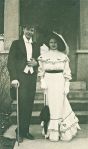
When Eileen and Hank married, just 19 days after Pearl Harbor, the Marines were on full war footing. They found a minister who would marry them at the Post Chapel in Quantico on Dec. 26. No church wedding, no fancy dress, no friends in attendance – just Eileen’s mother and a couple of witnesses. Hank had a full 12 hours leave for his honeymoon.

Life Magazine's Hex Party

It’s hard to imagine the rapid changes that the couple confronted in 1941. A February 1941 copy of Life, the all-photographic news magazine that dominated the weekly news market, was still taking a light hearted tone with headlines like, “Bombed London Railway is Remade as Good as New in Four Hours.” An article explaining the aiming of field artillery boasted, “The gun crew works like a football team.” The rest if the issue was devoted to the belles of President Roosevelt’s birthday balls to raise money to fight “infantile paralysis” (polio), vacationing in Biscayne Bay, and “the blondest of the new crop of New York debbies” (debutantes). In the story, “Life Goes to a Hex Party,” amateur sorcerers in Washington try black magic against Hitler.”

Even though the U.S. was not yet in the war, the seriousness of the situation was already personal to Eileen. Her cousin, John Driscoll, to whom she was very close, was killed in a training accident when his plane collapsed on September 26, 1941, a week before he was to have received his commission in the Air Corps of the Army. Having already lost her father that February, Eileen would have grown up fast.

Then Pearl Harbor was attacked on December 7. The war was no longer “over there.” It was here. Henry later noted that the Marines fully expected at attack up the Potomac River, aimed at the nation’s capital. Immediately, a nation-wide blackout went into effect. Gas masks were distributed. Machine-gun posts were added alongside the White House and U.S. government buildings.

The two set up housekeeping together in married housing in Quantico, VA. In an interview with Betsy in 2000, Henry told her, “Because I was an expert shot, and also a good student, at the end of the ROC class I was selected to go back to Quantico as an instructor, which I did for two years. I went back to the same company I had been officer candidate in.”

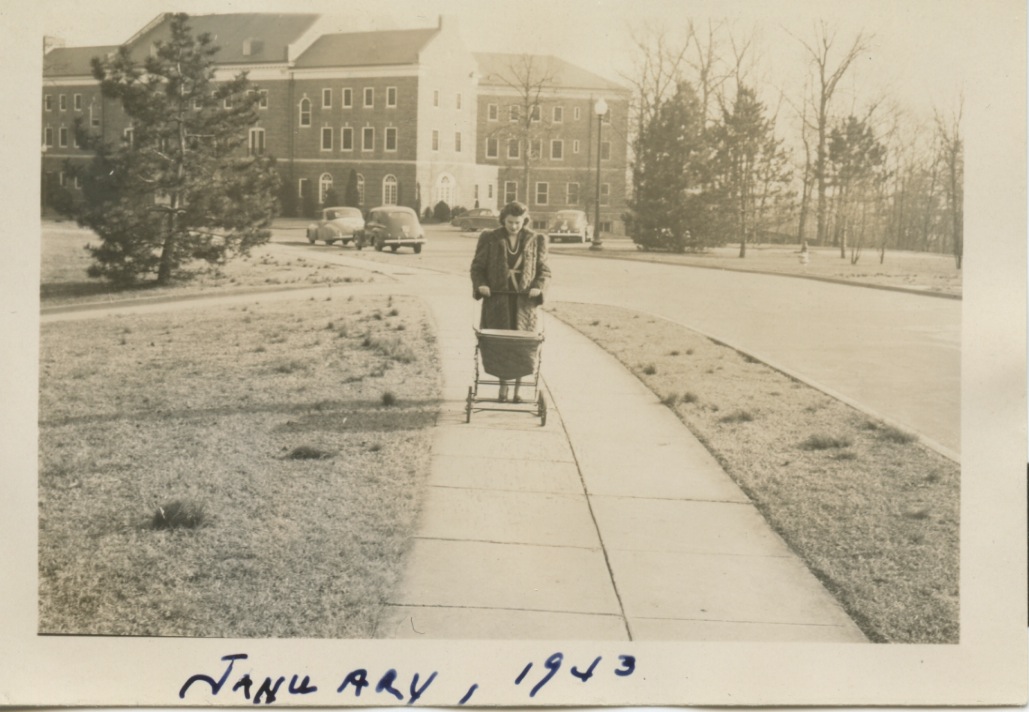
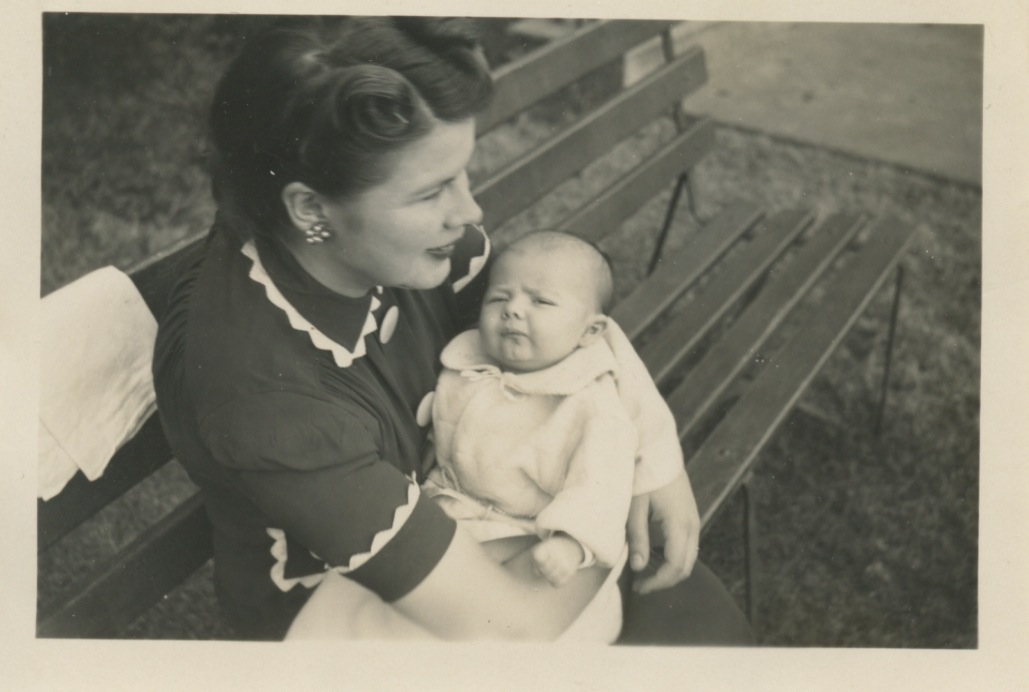
Within two months, Eileen was pregnant, like many of the wives. Scott was born on November 13, 1942. With Hank working hard, she and other new mothers supported one another, and likely played occasional hands of bridge while swapping tips about baby care.
Scan

Eileen Driscoll Campbell and Scott Campbell

Henry was promoted from second lieutenant to first lieutenant during that first year, and wrote his brother, Ed, that he expected to remain in Quantico with the newly formed G Company until the early part of 1943.

So though Eileen would have known Hank would come safely home each night, at least for a time, they knew many others were in harm’s way. Hank explained later, “The first two years of the war were very tough on my classmates; they were expendable. The casualty rate among second lieutenants was high.”

Within months of Pearl Harbor, the Japanese Imperial Army invaded Wake Island and thousands of American forces surrendered in what would become the Bataan Death March. Corregidor was overrun and the Philippines were surrendered. Things finally turned in November 1942 after a victory at Midway and hard fought land and sea battles for Guadalcanal, which became Japan’s most staggering military defeat. Late in 1943, U.S. military forces deployed new amphibious warfare techniques that aimed to obliterate Japanese defenses. Even with the new strategy a success, U.S. Marine losses were heavy at Tarawa, a small atoll. On the first day of the attack, casualties were 20%. It took 18,000 Marines three days to secure the small island at a cost of 1,300 dead. Hank lost a close friend.

Hank shipped out in the third year of the war for the Pacific with the 23rd Marines, 4th Marine Division. He would have sailed out of Honolulu as part of the “Big Blue Fleet” on January 22, 1944, bound (although he didn’t know it yet) for the Marshall islands where he would join the attack on Roi-Namur.

Henry left with a memento that Eileen’s friend helped her to create: a pin-up style snapshot of her immersed in a bubble bath. The wives conspired to create the images as a way of reminding their men what awaited them at home.
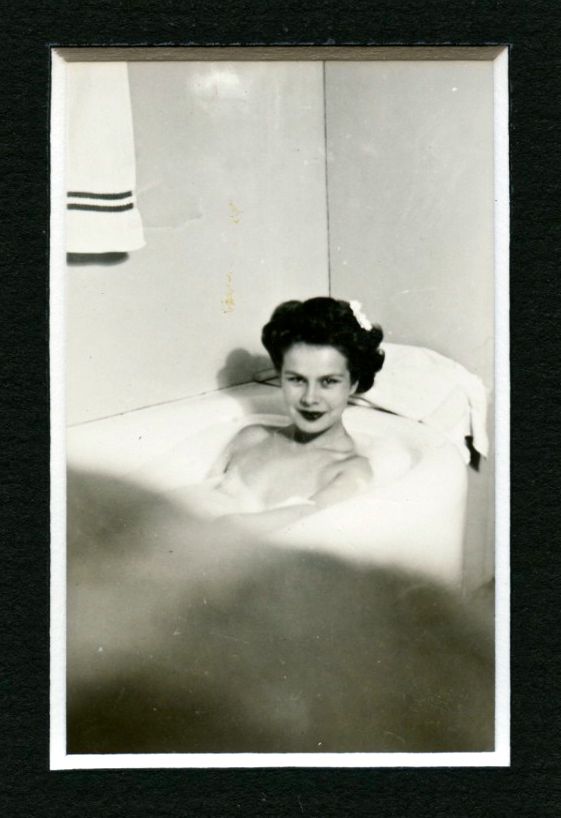
bathtubshot

At some point, Eileen went West to stay with Hank’s family in Yakima.

In those years before the 24-hour news cycle, Eileen would have anxiously awaited news reports of actions, which were often delayed for security reasons. Or she might have seen news reels with thrilling images of victories and frightening scenes of destruction. She wouldn’t have known where Hank was until well after the fact, when V-mail arrived. Very likely she would have breathed a sigh of relief after learning he was safe following the victory at Saipan.

The Admiral Campbell home in Yakima settled in to a rhythm, with Scotty enchanting Grandmother Campbell and Aunt Janie. Upon meeting Eileen, Grandfather Campbell was reported to have said, “Son, a pretty face will fade away, but a good pair of legs is a joy forever.” Grandfather Campbell, who ran away from a hard-scrabble Kentucky home at the age of 14, had an eye for such things. He maintained an extra-marital relationship with Erma and retired to her home after dinner to play cards on most evenings; Mom was invited to play bridge with the pair and Grandfather’s friends.

As a mother of a young child, Eileen would have supported the war effort by caring for Scotty. More than two million women worked in war industries and another million as “government girls” in offices, while others plugged the hole in manpower by driving trucks and manufacturing in factories. Everyone pitched in, however, by adhering to wartime rationing, planting victory gardens and salvaging scrap metal, rubber, cooking fat and nylon and silk stockings which were needed for war supplies.

An article saved by Eileen explained how to fill out the consumer application required to obtain Ration Book Number Two.  The application was distributed via newspapers “in recognition of the fact that newspapers reach practically every individual in the United States.” To complete the form, you had to go to your pantry on Feb. 21, 1943 and count all cans, jars and bottles containing 8 ounces or more of store-bought food: canned fruits, vegetables, soups, etc. Coffee (and sugar) rationing had begun in 1942 and all citizens were required to inventory the coffee on their shelves on Nov. 28 of that year. You then calculated the amount of coffee to which you were entitled by stating the pounds of coffee you inventoried in November minus 1 pound for each person 14 or older in the household. Then you counted the units of cans on your shelves and subtracted five cans for every person in the house. Based on the answers provided, you would be issued Ration Book No. 2. If you had coffee or canned food above your allotment on hand, those stamps would be removed from your book. You couldn’t buy items at the grocery books without the appropriate ration stamps.

The Campbells and Eileen also wrote Henry regularly. Victory mail (“V-mail”) was censored, transferred to film, and printed back to paper, saving shipping space for war materials.

Saipan grabbed the U.S. imagination not only for its size and violence – it took 71,000 U.S. troops six weeks, over 3,000 losses and another 10,000 wounded – but for the horror of the mass suicide of roughly 1,000 Japanese women and children who lived on the island. Emperor Hirohito had declared that civilians who died there, rather than surrendering, would have equal spiritual status in the afterlife as soldiers.

Hank went on to Tinian, and then Iwo Jima. By February 15, 1945, a quarter of a million troops were ready to attack the island’s 20,000 Japanese Imperial Army troops, who were well defended by a warren of interlinking caves and tunnels. Iwo Jima’s casualty rate – with 24,000 wounded and 7,000 dead – was the highest in the history of the Marines.

In late March or early April of 1945, Eileen would have gotten word that Hank was safe after the 23rd was pulled back to Maui for R&R, and to reconstitue its ranks after so many were lost.

The atomic bomb was dropped on Hiroshima in August 1945, and on August 15, WWII was finally over with the surrender of Japan to the Allies.

Between Tinian and Iwo Jima, Hank wrote to Eileen about the effect of the war on who they were as a couple: “I expect we’ve both changed this year—-yet I think we’ll be surprised at the smallness of the change. The part of me that’s fought the war out here—-is NOT the part of me that is the half of ‘us.’—-I feel strongly that it is the mechanical person out here fighting, and that the real person—-the one YOU know—-is in a state of suspended animation.—-Perhaps an accurate explanation of the fact that I never write what I’m thinking about and feeling—-that I neither feel nor think—-and it is as if there is a hard shell around me and that ALL of this present life went on outside me.”

By November, 1945, Hank landed in Southern California where he was reunited with Eileen, Scott, Eileen’s mother, and Hank’s Aunt Janie.

Hank later said he had to fight for his pants at first, with Eileen so competently in charge at home. He and Eileen drove to Washington D.C. with Eileen’s mother and Scotty to find a place to live when Henry began his new assignment at Marine Corps HQ in its Plans and Policies Division.

Next: the post-war years
1 Comment

Filed under Family history, Uncategorized

Grief and Forgiveness

I went to a really difficult funeral yesterday, a memorial for a couple who died in a terrible accident, long before their time. There are deaths that seem in keeping with nature’s way, and those that are not. It is not nature’s way for a child to die before a parent or parents to die so young that their children are not settled well into their adult lives.

I cannot presume that my grief – losing Mom in 1999, and Dad this year – is anything like what that family’s grief is and will be. But it has taught me some things.

I have learned that grief has a lot to do with forgiveness. I wrote last month about coming to terms with some of my complicated feelings about my mother, and how facing her terminal illness gave me the opportunity to understand, forgive and embrace those differences.

Forgiveness has also been urgent and recurring theme in the immediate wake of loss. I was deeply disappointed by someone that I was counting on to be there for Dad and me during his final weeks. As warmed as I was by all of the people who reached out to me in the days and weeks after Dad’s death, I was sad not to have heard from one particularly important old friend who sent several messages saying he would call, but didn’t. I was and am still irritated every time I hear someone voicing their belief that a grieving person “has to let go.”

In our discomfort with death, we are too quick to seize upon Elisabeth Kübler-Ross’ model of the five stages of grief. It lulls us into thinking there is a purpose and an order to the messy business of grief.

Sometimes death just sucks. Sometime people just suck because they can’t be what we need them to be when we are caregiving or coping with loss.

Although it seems like I share so much on this blog, there’s plenty I haven’t shared. When I have been the most upset, I haven’t touched my keyboard because I am afraid of scorching the earth with words.

That break from July 16, 2011 to January 6, 2012? Not an accident. I was so deeply angry about something that happened that I couldn’t write anything publicly.

All of this is probably making me sound like one angry woman.

But I’m not. My husband figured out a long time ago that when I act angry, what I really am is hurt. And when I am the most angry, I have learned to wait. Slowly, over time, I begin to understand, empathize and finally forgive whoever set me off.

I can’t find my experience in Elisabeth Kübler-Ross’ model, perhaps because it was developed from the perspective of a terminally ill person rather than a person who loved and supported someone on their journey from this world.

I accepted the inevitability of my mother’s death due to terminal cancer, and my father’s from congestive heart failure. But even with that knowledge and acceptance, my caregiver and survivor experience included some moments of fierce and poisonous emotions.

I have even been angry with God. It still seems cruel to me that nature’s way is for people to degrade when they reach very old age. Why can’t dying of old age be a pinnacle of a life well lived, with a glorious exit?

I don’t stay angry. Neither did my mother, as quick as she was to raise her voice. Like her, I move on to forgiveness.

I understand that we all tremble in the face of death and loss. People I hoped would be there at my moment of need weren’t because they just couldn’t face it. Some I hoped to hear from in my immediate grief were too reminded their own losses and didn’t know what to say. People who insist that there is a schedule to moving on may be afraid of emotions that are not in control; they misguidedly think they are helping when they urge a grieving person forward.

In the weeks before and after Dad died, I felt as if I kept bumping the same vulnerable places, making fresh purple bruises on top of the old fading ones.

Four months later, I am healing. There is no schedule to grief, nor should there be. It took my Dad 96 years to come and go from this life, and he is worth considering still.

2 Comments

Filed under Uncategorized

The Kingdom of the Wing Chair

I knew that when Dad died, it would be hard to have a room in my home that was so linked to him in my mind. I didn’t want it to be a mausoleum nor did I want to purge it of his presence. I want it to be a sanctuary where guests are welcomed but where I can still retreat to remember the last seven years that he lived here. My big idea is to have a friend create a painting that honors my memory of him. And as time has gone on – now four months since he died – I realize there is no way to create something about Dad that doesn’t include Mom. Though they were strong individuals, they were that rare couple that becomes a single entity through the strange chemistry of attraction and the catalyst of shared experience.

When I initially imagined a painting, I thought about it honoring my parents as I knew them at the end of their lives. But now I picture it drawing upon a long-ago period, a period when they were the pillars of my world, and I was small.

I don’t write poetry – at least I haven’t in years – but somehow thinking about the painting prompted this:

It should have a wing chair in it.

We always had wing chairs.

It was where Daddy let the stress of the day ooze out of him

While he read the paper, sipped a scotch on the rocks,

And maybe another.

Sometimes his hand would rest lightly

On the head of one of our spaniels,

Who sat stock still for his attention.

It was where I sat on his lap.

Where he read to me about the Land of Oz.

I wanted to be like Ozma who rescues Dorothy

From the terrors of the disturbing Wheelers.

People shouldn’t have wheels where hands and feet should be.

But then Daddy’s shouldn’t have heart attacks,

And dogs shouldn’t bite you in the neck,

And Nana’s shouldn’t die.

I wanted to be brave.

Sometimes Mom would stand next to the chair,

Her hand resting lightly on the wing

The hand with her wedding ring

Loose at her side.

Smiling as a present was opened,

Laughing at a joke,

Meeting Daddy’s eyes and sparkling.

Sometimes he would look at her and quote something

About a barge with purple perfumed sails and love-sick winds.

Next to her I could smell the delicate scent of her bath powder,

Which she applied with a fluffy puff that made me sneeze.

There were fights sometimes, and those scared me.

Mother’s voice rising, then father’s, and mother’s right back.

I knew bad things could happen to parents,

Would it happen to mine?

But when it was over it was over.

But nothing bad ever seemed to happen in the kingdom of the wing chair.

It was sacred space.

1 Comment

Filed under Uncategorized

Conflicted and Conflicting

A friend who recently moved his father to a care facility near him told me that he’s feeling better about making the role switch from child to parent. His father, who has dementia, was no longer safe living with his mother. When his mother objected to staying in a hotel room overnight while he made arrangements, he said he had no compunction telling her she had no choice. He had to do what was necessary to get his father safely settled. Now he jollies his father along to get him to get his hair cut, and humors him when his father tells rambling stories that can’t possibly be true.

For himself, he hopes to go like his wife’s great aunt, who took a sudden turn during a recent hospitalization, drifted to sleep, and died. “I’ve told my kids,” he said, “if I get like my Dad, just take me up into the mountains, point me in one direction and you go the other way.”

It doesn’t work like that, I told him. The truth is that when we get to that age, or our cognitive abilities are compromised, those who love us will step in and do what they think is best. We can take care of ourselves physically, state our wishes, and get our house in order before we get to that point. But we still won’t control how we age.

The child-adult role reversal won’t be any easier on us than it is for our parents.

Leave a comment

Filed under Uncategorized

Bringing Back Mom

I stopped talking about Mom the past two years. As Dad’s memory faded, he no longer seemed to mourn her. When I did bring up the topic of Mom – perhaps commented on something she would have enjoyed or her birthday – his pain was visible. So I stopped bringing her up.

But now we are preparing to bury Mom and Dad in the plot at Arlington National Cemetery that was reserved for them when they buried my sister Midge there in 1953. I’ve set an ambitious goal for myself to write some sort of a legacy book for the family, something that tells the story of Mom’s Driscoll side as well as Dad’s Harrison/Snively/Campbell clan.

I’m posting bits of memories here, augmented by some historical stuff. Since this series of posts is not about the experience of caring for or losing a parent, its primary interest for readers may be as a peek at life in the West in the early 20th century. Because Mom was Eileen long before she was Mom, I refer to her by her birth name when I get to the section about her personal history before my brothers and I came along.

* * *

Dad said it best, “Eileen is a personage.”  Eileen Driscoll Campbell did more than fill up her corner of space. She could fill a room with her personal power and presence, and she influenced the course of everything and everyone around her.

Beginning

The older I got, the more I wondered how it was that my parents were 40 and 41 when I was born, when most of my friends’ parents were younger. My brothers are 15, 10 and 3 years older than I am.

Eventually I became old enough to ask whether I was planned. Mom would demur, answering only, “Every once in a while, we just said oh what the hell.”

Two characteristics were apparent in her statement: she wasn’t hung up on being proper, though she was every inch a lady, and she had the ability to live in the moment.

Some of that character came from being an only child. Born on July 3, 1917 in Boise, her mother, Madeline (born Maude Grace Spieles on Nov. 30, 1885 in Chicago) and father, Dean (born April 24, 1883 in Tekamah, Nebraska) met and married only two years prior, in 1915.  When Eileen was born, they were 31 and 34, old for the times.

But some of Eileen’s independent streak may have derived from growing up in the West, when the West was still wild. Eileen had grown up on her grandmother Hannah’s knees, hearing stories about how “Han-Han” came “West”… when the West was Minnesota.

Hannah Driscoll, 1935

Hannah Driscoll, 1935

Hannah’s family left Pennsylvania to take advantage of land grants created under the Homestead Act, claimed 160 acres of land in Martin County, and erected a rudimentary sod house on the prairie. After almost 10 years, they gave up, tired of Minnesota’s terrible blizzards lasting days, the menace of prairie fires and the last straw, the grasshopper scourge of 1873. “Settling to the earth they were a crawling mass devouring every green thing except the wild greens,” Hannah wrote in her memoir.

In 1874, the family struck out for Nebraska in two horse-drawn covered wagons, where they established a farm in Tehama. Hannah married John Driscoll in 1881, who landed in town following his discharge from the 64th N.Y. voluntary infantry after the end of the Civil War. When John’s health failed, years later, they sold the bank and lumberyard John had established, and struck out for the west coast. The family had tickets to the Lewis and Clark Exposition in Portland in 1905, but never made it farther than Boise, where they permanently settled.

Mom's father, Dean Driscoll

Mom’s father, Dean Driscoll

Dean’s photo album from the early 1900s look like a movie set, with Native Americans on the streets and horse-drawn carriages. Letters from John to his Dean’s younger brother Lynn, away at college, shared news big and little of Boise (population 17,000) at the turn of the 20th century: a visit by William Jennings Bryan, foreclosures of businesses by the Sheriff, plunging land values, small pox and ptomaine poisoning outbreaks, fatal auto accidents as cars replaced horseless carriages, an arrest of an acquaintance for insulting a woman (“he said he was drunk”) and the institutionalization of another into a “mental asylum” in Seattle.

Eileen must have felt the world ripped out from under her when her father died in February 1941 of hypertension. It is perhaps because of his early death, at the age of 58, that we heard so much about Dean.

Eileen and her mother were extraordinarily proud of Dean’s reputation in the community as a respected attorney in private practice and later as a one-term Representative to the state legislature and Assistant Attorney General. (Aunt Janie, Grandmother Campbell’s sister, apparently had a real snit about the Driscoll focus on Dean, writing from Oceanside where Dad had returned home from the war, “I am so sick of Mrs. D’s everlasting hammering on the Driscolls.”) A Harvard Law School graduate, Dean was admitted to practice at the U.S. Supreme Court, though he never argued a case before it.

Short (5’6″) and energetic, he had a shock of thick brown hair and dressed immaculately, never appearing on the streets of Boise without a fresh flower in the lapel buttonhole of his fresh white Palm Beach suit in the summertime (and rarely without an Antony Y Cleopatra cigar parked in his mouth). The buttonhole flower came from his mother Hannah’s yard “starting with the snowdrops, first flowers through the snow, and as spring and summer progressed, violets, lily-of-the-valley, pansies, pinks, through the fall-flowering marigolds,” Mom wrote in a letter to historian Gwynn Barrett to assist in his research for a book on Uncle Lynn. Dean had a strong sense of duty to his parents and stopped to visit his mother on the way to the office every morning, eating buckwheat pancakes whenever they were offered.

Despite his reputation, the Driscolls weren’t wealthy. His income level may have been due to the small town nature of a law practice. In a letter in 1912 to Lynn, Dean’s father wrote, “…Dean says he has made $200 a month since he commenced business but has only collected $400 of it. He is well satisfied but I hope he will get money soon as I have been putting up for him so far….”

Dean held most of the details of his law practice close to the chest, but we know he represented immigrant communities including Basque Americans, which had (and has) the largest concentration in the U.S.; in Mom’s last years, lamb was the dinner entree for which she always had an appetite, a holdover from her memories of participating in the Basque community’s annual lambing camp. She recalled that her Dad could dance the traditional La Jota, and Christmas Eve dinners didn’t begin until her father had stopped by the Archabals, a Basque sheep ranching family. He was posthumously awarded the Order of the White Rose of Finland for service to that community as chairman of the State for the Finnish Relief Fund.

He liked vigorous sports and sparred with professional boxers when they came to town.  Mom later wrote that he like long runs – “five miles at least” – up into the foothills. At the Y, he played handball often and boxed nearly every day, in addition to playing on the “Bankers” Twilight Baseball League team.

Mom wrote:

“The first thing anyone should say about Dean Driscoll is that he had absolute integrity. I don’t think it was possible for him to compromise — or “adjust” or “compensate,” as we say these days. He had extremely high standards of ethics and performance for himself (probably a contributing factor to the high blood pressure which killed him) and for those close to him. And he simply didn’t bother with people who didn’t meet those standards.”

Mom also wrote that her Dad had a “keen wit and sense of humor and was a master at rather cutting repartee. He used words sparingly – but very much to the point – and often devastatingly.”

Pranks were big in those days, and Mom remembered this story of his youthful mischief: when a minister came to visit and put his hat near the heater, Dean slipped a piece of Limburger cheese inside the hat band, with predictable results. She wrote, “My Dad didn’t think I was very funny, tho, when I tried the same trick in the pocket of a leather jacket belonging to a friend, thereby ruining the coat. I never could figure out a way… to equal or emulate his Halloween feat back in Nebraska boyhood when he and his friends put a cow astride the church roof. Even he didn’t remember how they got it there – but it was a community effort to get it down.”

She also recalled the story of a widowed friend of her parents who coquettishly said to Dean, “Oh, Dean, no one loves me and my hands are so cold. Will you hold them?” He retorted, “God loves you and sit on your hands.”

Mom was very close to her mother, who she described as loving, caring and shy. Madeline was embarrassed by her lack of a college education, to which we were told Dean would reply, “You have an educated heart.”

We have few insights into life at their home at 1504 N. 17th Street. We know Eileen was fond of their Chinese cook, Fong Wing, who disappeared during periodic “tong wars” between the two competing societies in Boise.

Dean was hardworking, even a workaholic. Mom wrote, “It was his habit, as long as I can remember, to go back to the office after dinner, work until midnight or so – and then drive out across the desert, to ‘blow the cobwebs out of his brain’ as he put it.”

At his mother’s insistence, Dean had signed a temperance pledge so Dean and Madeline’s home was alcohol free. Every family has its “oft-told-tales” and Mom often recalled one about an especially hot evening when her father said, “You know, Madeline, I think I’d like to have a drink.” After conferring, he set about preparing a Tom Collins and brought one out to Madeline, who was sitting on the porch. She declared, “I believe this is the best Tom Collins I’ve ever tasted.” After a moment, Dean exclaimed, “Oh my god, I forgot to add the gin.”

Childhood

Age 7

Age 7

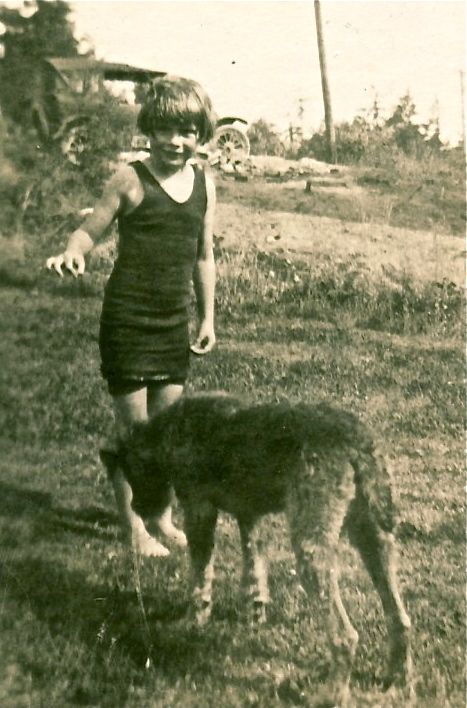
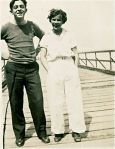
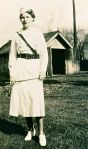
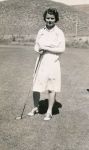
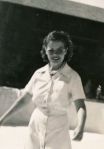
In her childhood pictures in the 20s, Eileen’s dark brown brown hair was cut in a chin-length page boy that complemented her strong chin, and high and prominent cheekbones. She had an outdoorsy look about her, with toned arms and legs, and coloring associated with the “Black Irish” (leading one family friend to inquire if there might have been a little racial mixing in generations past). Her brown eyes sparkled and her generous lips framed a bright smile. Even in the pictures of her as a teenager in the 30s, when the style was for girls to look demure, her face still conveyed a sense of individualism, determination and intelligence.

Mom rides on the shoulders of a pal

Mom rides on the shoulders of a pal

Either because of her father’s model or her own innate competitiveness, Mom was a Tomboy. It wasn’t that the boys on the street wanted to play with her; it was just that she was the only one who had footballs and other sports equipment. Because she hunted with her father nearly every weekend (until high school when she said she found dances and dates too exciting to miss), he taught her to drive when she was 11.

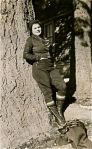
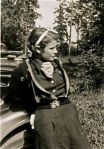
Eileen’s photo album shows her out and about in her elementary days, in her sailor-style uniform at Girl Reserve Camp, rowing a canoe, on a class bird-hunting trip, climbing a tree. Several friendships formed in childhood stayed with her for life, especially Barb Kidder Ringrose, Betty Ash Hearne and Raine (Lorraine) Moats. Many of the pictures display nicknames: Mugs for Barb (Eileen was Mug-Wug), “Prunes” for Eugene Stokes. They learned to play bridge and took ballroom dancing lessons together. Especially important to her from childhood on was her relationship with her cousins Harriet and John Driscoll. (John died in a training mission during WWII, a loss that Eileen always carried with her.)

Even in her youth, Eileen wasn’t one to back down from a fight. In 1999, Raine wrote to share this memory after their grade school, Lowell, beat Park School, which had a reputation for being tough: “One of those girls kept coming up behind me and hitting me on the back of the head. I was the timid one and so tried to ignore it. This apparently got the best of Eileen because she ran back and started hitting and fighting this girl, maybe because she was hurting and annoying her friend. She really tore into her.”

By the age of 14, Eileen’s pictures show her “cutting up” with groups of friends, a growing circle of boys and girls. The girls got together and formed their own mock sorority, Eta Beta Pie.

Eileen’s social circle expanded in high school. Based on pictures, boys began to appeal to her beyond their utility for sports and horseplay. In the picture below, she coquettishly styles herself for the camera, perhaps a precursor to her turn as a shoe model for the prestigious I. Magnin department store during college. She spoke later of a romantic interest in Stanton Stringfellow, with whom she was featured in the Flora Dora follies. Stanton set a Robert Herrick poem to music for her with the lyrics, “I dare not ask a kiss/I dare not beg a smile/Lest having that, or this/I might grow proud the while. No, no, the utmost share/Of my desire shall be/Only to kiss the air/That lately kissed thee.”

College

Leaving for college, 1935

Leaving for college, 1935

After Eileen graduated, she initially attended Mills College in California, an all-women’s college. She participated in the choir, and eventually transferred to University of Washington where she majored in music (focused on vocal performance) and was an active member of Gamma Phi Beta.

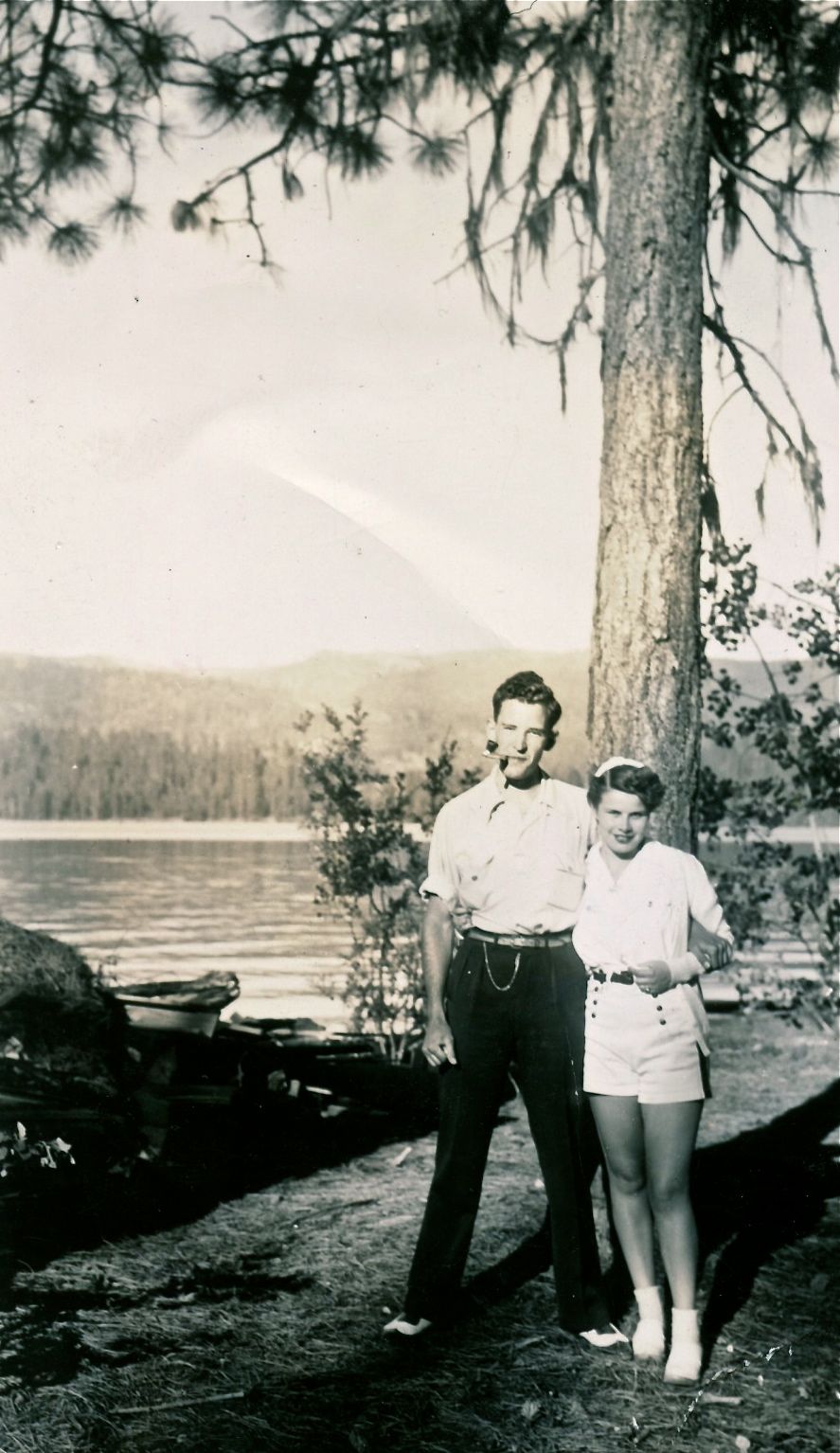
In the spring of 1939, Eileen and Hank were both enrolled in “the grand old man” Dr. Padelford’s course on Browning. Every couple has a how-they-met story, and Henry would usually tell it. He would set the stage by explaining that he did not attend class the first few days, having a free pass – thanks to a fraternity brother – to taste the wares at the Rainier Brewery. But the third day of class, he was there, albeit disheveled and worse for wear. As class began, most of the seats were filled, but one remained open next to him. “Then this vision entered the room,” he would say, “dressed to the nines.” Eileen took one look around the room, saw the chair next to Hank, and promptly took another seat in the back corner. “She came into class that first day on Brook Fink’s arm,” he would say, “but after two weeks, she left on mine.”

Their courtship wasn’t entirely smooth sailing. A houseguest at the Gamma Phi house turned out to be from Yakima, so Eileen ask her if she knew Hank. “Oh, yes,” the visitor replied, going on to note that he was the boy who had his pin on a girl back home. When Henry arrived to collect Eileen for their date, he said he knew something was wrong the minute he set eyes on her. She gave him $5 for train fare and told him not to come back unless he had his pin.

After that, they were an item. Both graduated in 1939. Eileen once expressed to her father an interest in becoming an attorney, but he rebuffed the idea, saying there would be no “female barristers” in the family. After graduating, both lived in Seattle, Eileen in an apartment where Henry spent a great deal of time. He entered law school, since the family expected him to become the family lawyer, while Eileen took clerical courses. By late 1940, Henry knew that the law was not for him, and he became increasingly convinced that the U.S. would soon be in the war that was tearing apart Europe.

eileen1939

In love, 1940

In love, 1940

Henry enlisted in the 5th Reserve Officer’s Commissioning program of the Marine Corps in January 1941. From there, Eileen and Henry’s stories diverged. Eileen said that Henry wrote her in September or October of 1941 and asked her to join him; Henry held that he sent no such offer. After Pearl Harbor, however, Eileen immediately took a train east and the two married on December 26, 1941.

Next: the war years

Leave a comment

Filed under Family history, Uncategorized

Older Men’s Urinary Problems (and what I wish I’d known)

Okay this is a bit crass, but it’s the first thing that came to mind as I started this post. My Dad used to cite the three rules of being an older man: 1) never pass up an erection, 2) never trust a fart, and 3) never pass up a bathroom.

As I look back on his last year or two of life, I know we did things mostly right, but I wasn’t aware of the options for urinary incontinence, and I wish I’d known to pursue it a little harder. I’ve been surprised to find how many people found my blog posts about end-stage congestive heart failure, so I’ve decided to put one more bread crumb out there for adult children who are trying to figure out how to help their fathers with urinary urgency, benign prostatic hyperplasia or acute urinary retention.

Urinary urgency – especially that interrupts sleep — is a common complaint of older men. My Dad, like many, took Proscar (the generic is finasteride) for the presumed source of the problem: an enlarged prostate.

His concern about having to “go” urgently kept him from activities he might have enjoyed. When he had an independent living apartment, he said the reason he wouldn’t participate in group outings was the lack of a bathroom on a bus. He didn’t want to go to movies for the same reason. The first thing he did in any new location was to locate the nearest bathroom.

His urgency increased significantly over the 12 months before he died. On a trip to Seattle, he couldn’t make it from the dining room to our guest room and wet himself – twice. It was heart breaking. Those accidents increased in frequency.

The month before he died, he was in excruciating pain in the morning when he was unable to void — at all. For a long time, he had experienced a weakened stream. But looking back on it, I realize that he was also having real trouble starting to go. And that had been true for some time.

When my brother took him to the urgent care center at the nurse practitioner’s urging, they drained 1 liter of fluid from his bladder and he came home with a diagnosis of acute urinary retention. Three days later, the same thing happened. This time, he went home from the ER with a catheter, which became permanent. (To his credit, the Sutter General triage nurse listened to what we said about how much urine was drained a few days prior and he immediately admitted Dad, saying, “Wow. That must hurt.”)

It had never occurred to me that there was more he could do besides taking the Proscar. I knew he had some kind of prostate surgery years before, but apparently the prostate can enlarge again.

In conferring with the urologist, we learned that he wasn’t on a second medication that is frequently used for benign prostatic hyperplasia (BPH), Flomax (tamsulosin). He started on the drug, but later discontinued it when his condition deteriorated (and we realized that the potential of a fall due to a dizziness as a known side effect was worse than dealing with the catheter).

Unfortunately, Dad’s health went into a slide about the same time that we figured out the BPH problem, and the urologist, Dad and I agreed that he needed to get stronger before it made sense to remove the catheter and try a non-surgical treatment. (Though my brothers and I were very concerned about Dad’s dignity and comfort, the catheter turned out to be a blessing in disguise. Dad quickly lost strength, and having the catheter kept him from having to endure adult diaper changes.)

If Dad had improved, he would have been a candidate for cooled thermotherapy, a therapy that is feasible even for patients on blood thinners. This is how the urologist’s brochure described it:

Cooled ThermoTherapy™ is performed in your urologist’s office in just under 30 minutes. You will be on an exam table in a comfortable position. You will be given medication to help you relax and may receive local anesthesia. The treatment is performed with a small flexible catheter that is inserted into the urethra. This catheter contains channels to circulate cooled fluid around an antenna that produces targeted heat within the prostate. The heat reduces excess prostate tissue. The proprietary cooling technology protects the healthy urethra and maintains patient comfort during treatment.  Once the treatment is completed, you will be able to go home. You will typically wear a temporary catheter for a few days to allow the prostate to begin its healing process.

For us, it’s all water under the bridge. We did the best we could. But maybe we could have made life a little less anxiety producing if we’d known sooner that there were some options for Dad’s urinary urgency. I hope you find this helpful.

By the way, I found MayoClinic.com to have the best information about BPH symptoms, causes and treatment options.

2 Comments

Filed under CHF and Other Medical Problems, Uncategorized

Things My Mother Said

My husband and I both got a smile on our face when Talk of the Nation’s guest Mary Schmich said how much she loved the term, “lollygag,” as part of Monday’s show, ‘From Groovy to Slacks: The Words That Date You.'” Though the thrust of the show was about changes in the popularity of words — bring back “nincompoop” please! — it reminded me that my Mom, who died in 1999, had some doozy turns of phrase.

She teased Dad that she had to stay home with the children when he was assigned to Canadian Army Staff College in Kingston, Ontario, while he went “gallivanting” all over Canada.

When my room was dirty, she said I had things “spread from Hell to breakfast.” When things were in disarray, she might also say everything was “cattywompus,” as my brother Dean reminded me.

When I was making out with my high school boyfriend downstairs, she yelled down to ask if we were “making love” down there. By which she meant kissing. We jumped up like we had been branded and screamed, “No!”

When we stopped at Horseshoe Bend in the Yakima River on one of many blisteringly hot treks to visit Grandmother, we “hotted off our feet.”

When she was doing this and that around the house, she was “piddling around.”

When she became upset about something, she was having “a major snit.”

There were no “heavens to Betsy”‘s in our house (given that I was in residence) but there were a fair amount of “honest to God”‘s.

She also liked, “Ye Gods,” as in: “If you could see what Dad spends on shooting…. Ye Gods, the entry fee for today’s meet is $60.”

I don’t think my mother considered “damn” and “hell” to be swear words. Her answer as to whether I was planned — since I was born when they were 40 and 41 — was, “Every once in a while we just said “Oh what the hell.”

She didn’t mind the occasional pejorative term. When she hospitalized early in 1999, I flew back from a business trip to Washington DC and arrived at her bedside. She asked, “Did you say hi to everyone except that jackass in the White House?” (Bill Clinton’s impeachment hearings were underway.)

Her colorful language may have been imparted to her by her father, an attorney of some repute. He referred to a certain shade as “baby s*** brown.”

Mom wasn’t one to sit around and feel sorry for herself, or to say or write things that were too heavy; those sentiments she would call “maudlin.”

When popular usage failed her, Mom turned to a made-up word, “sorensified.” You won’t find it in the dictionary, but it’s what you feel after a truly satisfying meal.

What funny phrases of your parents do you remember?

Leave a comment

Filed under Uncategorized, Words

Cracking Open

By Hectonichus (Own work) [CC-BY-SA-3.0 (http://creativecommons.org/licenses/by-sa/3.0) or GFDL (http://www.gnu.org/copyleft/fdl.html)], via Wikimedia Commons

Bereavement can be strange.

It’s been more than four months since Dad died. Immediately after his death, I was bone tired, contemplative, somber without being sad. Having a day stretch ahead of me felt like a balm. I could think what I wanted, feel what I wanted, do what I wanted.

For a time after that, I ran away, though not consciously. I had a backlog of people I wanted to spend time with. It was suddenly feasible to visit them rather than ask them to visit me.

It no longer feels strange not to be caring for Dad, nor unsettling when awareness comes suddenly upon me that I am no longer his caregiver. I’ve stopped startling when I realize I can be without my phone as my constant companion; I can take a walk without carrying it, or go to the movies without it turned upside down against my knee, on silent mode, so that I will feel any urgent texts or calls. We can eat dinner when we want, and linger at the table for as long as we want. I’ve stopped listening for the click of the brakes on his walker, mentally following his path to the john during the evening and night to make sure he safely settles back into bed.

I am untethered. But now I feel directionless. And I am restless.

I’ve known restlessness in the past: intellectual restlessness, physical restlessness, even sexual restlessness. This restlessness has a different tenor.

I am pent up, ready to do something, something else, but what? I have the attention span of a squirrel. (Which, when combined with ready access to Google, can be downright dangerous. I just learned, for example, that a squirrel has an attention span on normal things of about one second and about four minutes on acorns and nuts.)

I want to hike. I want to learn to sail. I want to create a template from the strategic planning I’ve been doing for nonprofits. I want to write.

I know that I am fortunate to have this time of freedom. When my mother died after four months in hospice, my employer at the time was clearly unhappy with me; that “take all the time you need” turned into “get back in here and start generating revenue!” I was thrown back into a political maelstrom at work, settling in to a new house, and worrying about my newly widowed father.

Time to think, feel and figure things out is a luxury. Time is something I’ve never had much of. It makes me uncomfortable.

An old friend who specializes in organizational development used to say, “Break down, break through.” I have disassembled the pieces of my life and am looking at them like so many Legos, wondering what to build.

1 Comment

Filed under Uncategorized

Memorial Day: A Friend Never Forgets

Photo credit: fkehren via flickr under CC license

Photo credit: fkehren via flickr under CC license

Announcement time at church. There was a reminder about the hiking club outing, a request for sign-ups to bring a salad or cake for the parish picnic on June 9, and a woman who said she had become a great-grandmother once in January and twice in April.

An older man dressed neatly in a coat and tie took the microphone. “I want to remember friends who never came back,” he began.

The rustling of papers and quiet conversations ceased.

— I remember George Monroe who died in the invasion of Saipan. He was a lieutenant in the Marines. He had a contract to play baseball with the Boston Braves but he never returned.

— And my friend Rocky Rogers. He had been captain of the swim team at Amherst. He was shot down over the Channel.

— These are the friends I want to remember on this day of days, Memorial Day.

Because the George’s and Rocky’s who never came back are remembered by fine men like Herb, men with big hearts and long memories, we remember the meaning of Memorial Day.

1 Comment

Filed under Marines and those who serve, Uncategorized

The Anxiety of Aging Parents

hospital bill

The title of this post can be read two ways. As parents age, they become more anxious, but we adult children become more apprehensive, too. Like a migraine headache, financial security just keeps pounding away. Especially when bills like the one above arrive. Dad came out one morning unable to speak clearly, having experienced what we later learned was a TIA or mini-stroke.

My Dad was unusual for recognizing his increasing limitations as he had plenty of medical reason to expect that a period of incapacitation could precede his death. He had a will, gave one of my brothers financial power of attorney, had a checking account with two of us on it in addition to himself, turned over bill-paying to us, and purchased long term care insurance (though, regrettably, without an inflation rider making those years of premium payments a ridiculously bad investment).

That said, he constantly worried about whether his financial resources were adequate. Anytime an “Explanation of Benefits” arrived from his supplemental Medicare plan insurer, it set off a new round of questions – even if it clearly stated that he did not have to pay the amount. I took to carrying with me a handwritten ledger of his monthly income and monthly obligations.

“See? You’re fine,” I would reassure him.

The flip side of the parent-adult child financial anxiety coin is harder to solve. How do you have “the talk” with a parent who doesn’t think his or her financial situation is an appropriate topic of conversation? At a financial seminar hosted by UBS last week, I learned that the average age of a widow is 55. Older married women – still – don’t necessarily know the details of their financial accounts.

This morning’s New York Times carries a great article, “The Talk You Didn’t Have With Your Parents Could Cost You.” Among other tips, it quotes Amy Goyer, a caregiving expert at AARP, who offered these practical suggestions:

  • Know what type of information you are seeking before you start a conversation, such as: whether a will exists, a financial power of attorney, a medical power of attorney or health care directive; what their health insurance covers, including long term care insurance; whether they have life insurance; and if there is a list of every singe account they owe or collect money from.
  • Start conversations with an “I” statement such as, “I’m concerned about doing the right thing when you pass.”

Although my Dad shied away from the Internet (after a few attempts), the article also reminds adult children to secure passwords for any Internet-only accounts. And the worst place to keep legal documents and instructions, the article suggests, is a safe deposit box, because survivors often lack access to them.

I know it’s “nature’s way,” but certain aspects of aging have always struck me as cruel; high among them, our parents’ feeling of insecurity as they lose ground. Though adult children have a moral obligation to protect aging parents’ security, we can’t lose sight of the need to ease their hearts and minds. That often takes finesse, driven by caring concern.

Leave a comment

Filed under Uncategorized