Tag Archives: grief

Birthdays Remembered

Just now, my fingers hovered over the keyboard, not quite ready to land. If I don’t write about it, if I pretend that tomorrow is just another day, maybe it won’t be real: one year since my Dad’s last birthday.

I have a parade of Dad’s birthdays marching through my head. There was his 87th birthday when he had a speech all prepared beginning with, “Four score and seven years ago….” That was the last time I tried to faithfully match the number of candles to his age.

Five years earlier, Dad’s surgeon had emerged after an eight hour cardiac bypass operation with the good news that the procedure was a success, and the bad news that he expected this one, Dad’s third, would last only five years. When we gathered the family for his 87th, the five year timer had gone off. We faced the possibility, even the likelihood, that Dad would die within the year.

We drank a lot that night, liquid accompaniment to the many toasts, stories and recitations of Dad’s favorite poems. In the midst of it, Dad cocked his head, raised his glass and looked directly into my eyes. I think of the smile in this picture as my smile. He would purse his lips gently, the way I do when I’m about to cry, and the corners of his lips would lift. He held that pose, for one beat, two, three. That gaze remained on his face for as long as I wanted to look back. To me, it said it all.

Scan 2

Two years later, Dad moved permanently to California. The word went round before every birthday: you should come, it might be his last.

When someone’s death is predicted for nine years running, it starts to become comedic. We began spreading out family visits to provide Dad with something to look forward to. Two years in a row, I turned Dad’s birthday into a road trip, taking him to Monterey to enjoy an ocean front room and a visit to the Monterey Bay Aquarium.

As Dad gazed up at the aquarium’s 28 foot high tank, the pale blue light of the tank washed over him. He seemed to drink in the majesty of the display before him: swaying fronds of kelp, swirling sardines, cruising fish. Its beauty moved him.

Dad and me at the Monterey Aquarium 2010

By his birthday last year, his 96th, much of that joy had slipped away. His rich, brown eyes had faded, and it was harder to rise to the occasion of a party in his honor, even a small one. He was quiet, though he enjoyed his lamb, and of course there was chocolate cake. He always had room for chocolate cake.

IMG_0965

I could not envision celebrating his next birthday with him. And I was right.

This year, there’s no Pendleton shirt wrapped and ready, no bacon-and-eggs breakfast planned, no chocolate cake in the refrigerator. For most of the world, it will be just another day. But for me, it’s the first birthday that wasn’t.
Leave a comment

Filed under Uncategorized

After Time Goes By

It’s now been almost nine months since Dad died. Nine months, enough time for an egg to become a fetus and a fetus to become an infant. Because I am still writing about the experience, some people approach me with concern and ask, “How are you doing? Are you all right?”

I am really, really all right. Maybe better than ever. The experience of caring for my Dad, losing my Dad and grieving my Dad — hard as it was — enriched my life in ways I find difficult to express.

Then came a little blue flyer in the mail from the nice folks at Sutter Hospice, who made such a difference in Dad’s life and mine between December 21 and January 12. I’m sharing it here in the hopes that it may speak to others, as it did to me:

Reflections About Time and Change by Dennis Klass, Ph.D., Webster University, St. Louis, MD

I often wonder what people are thinking when they say, “You’ll get over it.” Sometimes it sounds to me as if they are talking about a case of mumps or my despair at income tax time. But what can they mean when they say it about grief? Maybe they mean that grief is just an interruption in life. Their theory seems to be that life is basically happy — buying stuff, working, watching TV — but that a time of death and grief is an unnatural sad time in that happy life. I can’t agree with that view.

Time can lessen the hurt; the empty place we have can seem smaller as other things and experiences fill our life; we can forget for periods and feel as if our loved one didn’t die; we can find sense in the death and understand that perhaps this death does fit into a bigger design in the world; we can learn to remember the good and hold to that.

But we cannot “get over it,” because to get over it would mean we were not changed by the experience. It would mean we did not grow by the experience. It would mean that the child’s death made no difference in our life.

There is an interesting discussion in the Talmud, an ancient Jewish writing. Jews had the custom of rending their garments – literally tearing their clothes – to symbolize the ripping apart that death brings. But the question was asked, after a period of mourning, could you sew the garment up and use it again? The teachers answered yes, but when you mended it, you should not tuck the edges under so it would look as if it had never been torn. This symbolized the fact that life after grief is not the same as before. The rent will show. The next question was, can you sell that garment? The teachers answered no. The rending and mending of our life is ours and others cannot wear it.

No, we don’t get over it. We change and grow. Our life has a difference which is ours alone. Perhaps we can help each other make that difference — the kind of difference that increases the world’s supply of compassion, love and healing.


1 Comment

Filed under Uncategorized

10,000+ Views: Thanks for Stopping By

A blogger's home computer

Blogging is kind of magical to me. Not the writing part (though the way I write sometimes feels that spontaneous). The community part.

The Henry Chronicles was my little cry in the wilderness. It felt natural to share joyful little stories of my journey with Dad, because finding the joy kept me going. Writing about the tough days gave me a way to move through the pain.

What has surprised me about The Henry Chronicles has been the people who find it.

I wrote my first post on June 28 two years ago, an answer to my Dad’s doctor’s question about whether he was there on D-Day, meaning Normandy. I felt the urge to record what D-Day meant to my father. He had lots of D-Days, but they were in the Pacific.

That was 138 posts ago. I’m still writing, because I’m still remembering, and still coming to understand my mother and father’s legacies.

The blog didn’t go as planned. I thought I would write helpful tips about caring for an aging parent based on my experience just as I write a blog tips and practical information for small, local nonprofits. (I write a travel and hiking blog, too – call me crazy.)

The Henry Chronicles became something far more personal. I poured out my heart here. And the more honest I got, it seems the more people found it and resonated with my little glimpses of life with Dad. The less I tried to advise people and just shared, the more helpful the posts became – at least based on comments and views.

I’ve felt supported and honored by many of the comments people have shared.

Sean wrote, “I understand well what your words mean. But, from a non-experience perspective. I was never emotionally close with my mother and never ever with my father who was emotionally and physically ‘not there’. But, I know they felt a good deal of what you say, but, they just were not themselves brought up to explain and talk about ‘feelings’ and emotions.”

Jane said: “I wish I could have been as patient and giving when my paremts died (fortuunately a much quicker process) and I hope that one or more of my children will be patient and giving when my own time comes…”

Richard jumped on after reading about my visit to Marine Barracks:  “My father never spoke of the trials he endured on Tarawa, Saipan and Tinian – I only learned from others. I know my visit to the Barracks will be an emotional and moving experience for me. My father was proud of being a Marine but spoke of war as the horrific tragedy which it is and the friends of he lost. In a way, our visit is like a ‘coming home’.”

Karen, and other family members watching the last stages of Congestive Heart Failure, appreciated hearing about my Dad’s last weeks, as hard as it was to write about them: “Thank you for sharing your father with everyone who reads this. My mother is 75 & has chf. By following each step you have taken.I now have more insight & answers.before I was so lost with questions that couldn’t be found. Your dad will live on forever in the hearts of families that struggles with this disease. Thank you henery for giving your daughter the strengh to share & a heart as big as yours!”

When Dad died, Kristi and others came on the blog to send love and condolences: “In the tears that have welled in my eyes are full measures of gratitude for your father – his role as husband and parent, his contributions in service to his family, country, faith, vocation and avocations – and for your love, devotion, care and eloquence in sharing so much with so many. Your service has been a benediction, Betsy. In sympathy and with joy for his life and legacy – your good fortune in having such a wonderful Dad. Love.

Thank you, those who have stumbled across Henry Chronicles, for your support. It made a difference to me.

If you’re curious (I was), here are the top five posts:

1.  The Consequences of Dad Losing His Filter (July 10, 2011)

2.  A Wish and a Dream Fulfilled (August 16, 2013)

3.  A Long Day’s Journey into Night with Congestive Heart Failure (January 29, 2013)

4. 30 Years of Opposites, Happily Ever After (August 7, 2012)

5.  With Love, to the Last Breath (January 12, 2013)

Leave a comment

Filed under Uncategorized

After: the Pull of Family, Redefined

Circa 1960 - Dean, Scott, Betsy, BruceJust before flying to Washington DC for the burial, I laughed when my son and I passed through the New Age vortex that is City of Mt. Shasta on our drive with his belongings back to college. “Amorandre’a” promised “evolutionary transformation sessions and workshops transforming the Body Mind to the level of the Atom.”

I’m remembering the “stick and ball” model of a testosterone molecule that my son had to create in 7th grade. The atoms (balls) of the model had to be connected with bonds (toothpicks) that shaped them into the angles dictated by nature: straight lines, angles and tetrahedrals. The shapes aren’t created by logic; the atoms are propelled and repelled into relationship with one another.

In the absence of Mom and Dad, we are forming new bonds across family units, relationships that seem to have an agency of their own.

After Dad died, one of the big questions that seemed to float in space before me was, “Who is my family now?” The phrase, “Friends are the family you choose,” implied to me a corollary: that family was something I could choose to define. I now think that was too simplistic.

My brothers and I are very different. We look different, we have different temperaments and we grew up in different eras. Mom and Dad’s life experience changed the way that they parented by the time my youngest brother and I entered the picture, so effectively we grew up with different parents.

In the months that have followed Dad’s death, I have increasingly felt that my brothers and I belong together, that they belong in my life and I in theirs. In the Marine Corps, you receive your “standard issue,” the equipment that you are expected to maintain. Take care of your equipment and it will take care of you. My brothers are my “issue.” I am theirs. We don’t get to exchange. We have to discover and value each other as we are.

Perhaps the most surprising thing about our weekend in D.C. – with 20 of us present – was the way that new relationships took shape.

Some of us were just plain new to each other. My nephew remarried and the weekend was the first opportunity his spouse and step-children to meet our clan. My brother’s fairly recently adopted teenage son is finding his way into the family, something that’s new to him after spending most of his life with foster families.

Family members’ messages popped up on Facebook:

The only thing I regret about my life is not having all the people I love in one place. Goodbyes are hard, so …let’s just say see you later.

one thing i hate: one day your having fun with family the next day you have to enter reality again grrrrr 

finally home whoooooo!!!!!!!! happy but sad to leave family 

At Washington National Cathedral Sunday, the jumping-off point for the sermon was a discussion of family. The Dean of the Cathedral, Dean Hall, said he was skeptical about the nuclear family; the Hebrew Bible, after all, unfolds like a dysfunctional family Thanksgiving dinner (remember Cain and Abel?). Though the family is the structure we’ve developed for mutual support and nurture, it “contains all of the contradictions of what it means to be human.” He went on to say that family alone cannot sustain us, that Jesus alone offers us a community, “a table where all are welcome and equal.”

Mom and Dad left us all a legacy, a multi-faceted legacy of the things they so obviously believed in, through their actions. One of the most important things they stood for was family.

They felt present to me throughout the long weekend that followed the burial on Thursday. I felt their smile as they watched us stumble our way toward one another.

This message, from my niece, said it best:

A wise man once gave me advice that changed the way I thought about life. He told me that family is the meaning of life. He said to me that try as we might, most of us will never do the sort of things about which great books are written. In time, the world will forget all but a very few of us. But in the hearts of those we love, lies our chance to be remembered. 

The wise man was my grandfather. I thought of his words today as I watched the faces of my family gathered to remember. I can’t help thinking that my grandparents’ story isn’t over. They may be laid to rest among heroes, but theirs was not a war story. It was a love story, and it’s one that is still being written.

The pen is in our hands now. Let us remember well, and may we never stop writing. 

1 Comment

Filed under Uncategorized

Perseverance

Photo cityoflennoxsd

I’m in a time warp. Everything at home is just as I left it, last Sunday’s paper mostly unread, the Sunday NYTimes Magazine still open to an article about the mid-career time out, cat toys on the coffee table. But the shriveled tomatoes and brown mangoes on the counter remind me that I’ve been gone for a week, as does the cat who won’t let me out of his sight.

When I see the souvenirs on my desk from a July trip to Japan, I expect to see dust. How could that have been just three weeks ago?

It feels as if I’ve been gone longer. I feel… different.

I didn’t expect to experience a greater sense of finality by burying Mom and Dad at Arlington last Thursday. “There’s a sense of closure,” a family member suggested before I left Washington, D.C.

No, that’s not it. Not it at all. Nothing felt unclosed.

This feels more like coming to the end of an enthralling book series that, in its coda, left me with certainty that my favorite characters could not return. There will be more books, but the plot will move on. New characters will be introduced. But the new protagonists will never quite equal that first story and I will not forget.

This feels final.

My role was final. At Washington National Cathedral yesterday, the second reading had this phrase: “…let us run with perseverance the race that is set before us…” (from Hebrews 11:29-12:2)

God knows Dad ran his race with perseverance, caring about all of us, and for us, to the end.

We persevered, too.

I finished what I promised Mom when she thought she was dying in the hospital: I took care of Dad.

I finished gathering the family for this final event.

My brothers and I finished the final task set for us: Mom and Dad’s wish to be buried next to Midge at Arlington.

We did it.

1 Comment

Filed under Uncategorized

Grief and Forgiveness

I went to a really difficult funeral yesterday, a memorial for a couple who died in a terrible accident, long before their time. There are deaths that seem in keeping with nature’s way, and those that are not. It is not nature’s way for a child to die before a parent or parents to die so young that their children are not settled well into their adult lives.

I cannot presume that my grief – losing Mom in 1999, and Dad this year – is anything like what that family’s grief is and will be. But it has taught me some things.

I have learned that grief has a lot to do with forgiveness. I wrote last month about coming to terms with some of my complicated feelings about my mother, and how facing her terminal illness gave me the opportunity to understand, forgive and embrace those differences.

Forgiveness has also been urgent and recurring theme in the immediate wake of loss. I was deeply disappointed by someone that I was counting on to be there for Dad and me during his final weeks. As warmed as I was by all of the people who reached out to me in the days and weeks after Dad’s death, I was sad not to have heard from one particularly important old friend who sent several messages saying he would call, but didn’t. I was and am still irritated every time I hear someone voicing their belief that a grieving person “has to let go.”

In our discomfort with death, we are too quick to seize upon Elisabeth Kübler-Ross’ model of the five stages of grief. It lulls us into thinking there is a purpose and an order to the messy business of grief.

Sometimes death just sucks. Sometime people just suck because they can’t be what we need them to be when we are caregiving or coping with loss.

Although it seems like I share so much on this blog, there’s plenty I haven’t shared. When I have been the most upset, I haven’t touched my keyboard because I am afraid of scorching the earth with words.

That break from July 16, 2011 to January 6, 2012? Not an accident. I was so deeply angry about something that happened that I couldn’t write anything publicly.

All of this is probably making me sound like one angry woman.

But I’m not. My husband figured out a long time ago that when I act angry, what I really am is hurt. And when I am the most angry, I have learned to wait. Slowly, over time, I begin to understand, empathize and finally forgive whoever set me off.

I can’t find my experience in Elisabeth Kübler-Ross’ model, perhaps because it was developed from the perspective of a terminally ill person rather than a person who loved and supported someone on their journey from this world.

I accepted the inevitability of my mother’s death due to terminal cancer, and my father’s from congestive heart failure. But even with that knowledge and acceptance, my caregiver and survivor experience included some moments of fierce and poisonous emotions.

I have even been angry with God. It still seems cruel to me that nature’s way is for people to degrade when they reach very old age. Why can’t dying of old age be a pinnacle of a life well lived, with a glorious exit?

I don’t stay angry. Neither did my mother, as quick as she was to raise her voice. Like her, I move on to forgiveness.

I understand that we all tremble in the face of death and loss. People I hoped would be there at my moment of need weren’t because they just couldn’t face it. Some I hoped to hear from in my immediate grief were too reminded their own losses and didn’t know what to say. People who insist that there is a schedule to moving on may be afraid of emotions that are not in control; they misguidedly think they are helping when they urge a grieving person forward.

In the weeks before and after Dad died, I felt as if I kept bumping the same vulnerable places, making fresh purple bruises on top of the old fading ones.

Four months later, I am healing. There is no schedule to grief, nor should there be. It took my Dad 96 years to come and go from this life, and he is worth considering still.

2 Comments

Filed under Uncategorized

Cracking Open

By Hectonichus (Own work) [CC-BY-SA-3.0 (http://creativecommons.org/licenses/by-sa/3.0) or GFDL (http://www.gnu.org/copyleft/fdl.html)], via Wikimedia Commons

Bereavement can be strange.

It’s been more than four months since Dad died. Immediately after his death, I was bone tired, contemplative, somber without being sad. Having a day stretch ahead of me felt like a balm. I could think what I wanted, feel what I wanted, do what I wanted.

For a time after that, I ran away, though not consciously. I had a backlog of people I wanted to spend time with. It was suddenly feasible to visit them rather than ask them to visit me.

It no longer feels strange not to be caring for Dad, nor unsettling when awareness comes suddenly upon me that I am no longer his caregiver. I’ve stopped startling when I realize I can be without my phone as my constant companion; I can take a walk without carrying it, or go to the movies without it turned upside down against my knee, on silent mode, so that I will feel any urgent texts or calls. We can eat dinner when we want, and linger at the table for as long as we want. I’ve stopped listening for the click of the brakes on his walker, mentally following his path to the john during the evening and night to make sure he safely settles back into bed.

I am untethered. But now I feel directionless. And I am restless.

I’ve known restlessness in the past: intellectual restlessness, physical restlessness, even sexual restlessness. This restlessness has a different tenor.

I am pent up, ready to do something, something else, but what? I have the attention span of a squirrel. (Which, when combined with ready access to Google, can be downright dangerous. I just learned, for example, that a squirrel has an attention span on normal things of about one second and about four minutes on acorns and nuts.)

I want to hike. I want to learn to sail. I want to create a template from the strategic planning I’ve been doing for nonprofits. I want to write.

I know that I am fortunate to have this time of freedom. When my mother died after four months in hospice, my employer at the time was clearly unhappy with me; that “take all the time you need” turned into “get back in here and start generating revenue!” I was thrown back into a political maelstrom at work, settling in to a new house, and worrying about my newly widowed father.

Time to think, feel and figure things out is a luxury. Time is something I’ve never had much of. It makes me uncomfortable.

An old friend who specializes in organizational development used to say, “Break down, break through.” I have disassembled the pieces of my life and am looking at them like so many Legos, wondering what to build.

1 Comment

Filed under Uncategorized

Seeing Mom Among the Flowers

A member of the Washington National Cathedral Altar Guild

Friday was my “Mother’s Day.” Mom, gone since 1999, felt so present to me all day. I came east to see my friend Sharon and the premiere of the documentary she produced about the author Elizabeth Spencer, “Landscapes of the Heart,” but also for a mission: I hoped to secure a date for my father’s and mother’s interments at Arlington National Cemetery.

Though it was Dad who I focused on during the past seven years, and Dad who died in January, the trip was about both of them.

After meeting with a representative at Arlington, I asked Sharon if she would mind visiting Washington National Cathedral. My mother always talked about it, and continued to buy the Cathedral’s annual Christmas cards long after we left Washington, D.C.

Washington National CathedralUpon entering the Gothic-inspired masterpiece, we walked up the center aisle and diverted to the right around a stage that was being prepared for a concert.

Like many European cathedrals, the nave and transept are embellished with small side chapels.

In the first of these chapels, below a round contemporary sculpture of Jesus’ face, stood a woman in a pink shirt and apron, stoop shouldered, slowly trimming the stems of lacy blossoms that she was using to complete the final touches on two symmetrical arrangements of pink lilies. Her salt-and-pepper hair was short, mostly gray, a little curly. Perhaps the last vestiges of a perm that was nearly grown out.

For just a moment, she was my mother.

The woman in pink was an Altar Guild member, one of the stalwart legions of the Episcopal Church Women who do so much behind the scenes in fulfillment of their faith and commitment to the church, in camaraderie with one another.

My mind involuntarily summoned the smell of damp linens, starch and heat, a visceral memory of one of my mother’s monthly turns ironing the altar linens. Just as readily, I remember the scent of fresh-cut stems when she trimmed a gladiola, a rose, a peony, or greens harvested from our back yard for an altar arrangement.

In the sculpture above the altar, Jesus’ eyes are closed, but his head inclines toward her. I don’t know if the image is meant to represent him in death on the cross, or is meant to express sympathy for those who pray here. Blade-like rays extend beyond his halo through which a jagged hole is blown.

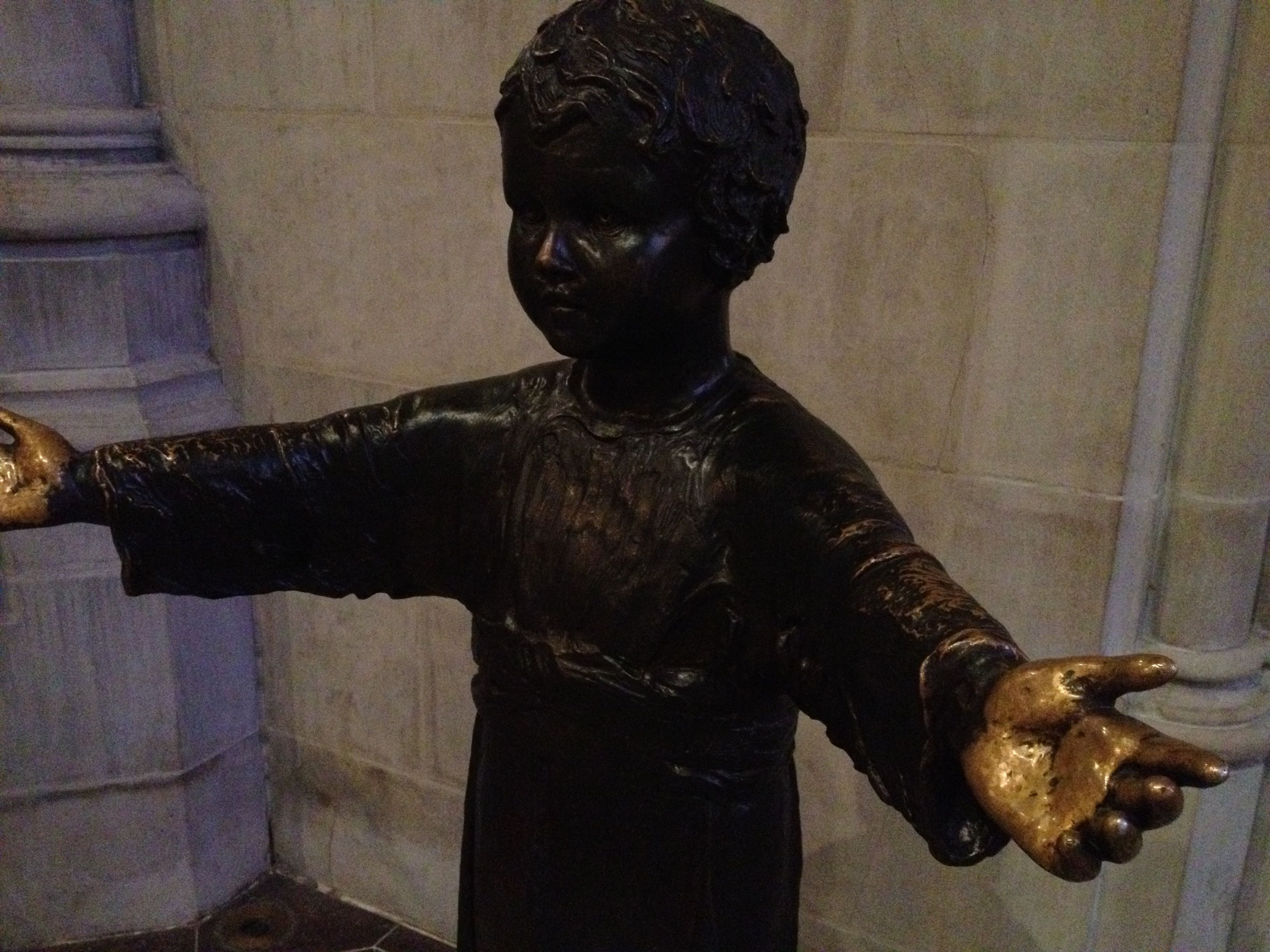
Washington National Cathedral's Christ Child statueLater I learned the chapel memorialized those who served and died in wars. Near it, a bronze statue of the Christ Child welcomes visitors to the adjacent the Children’s Chapel. The statue is the size of a six year old, its palms polished to a sheen from all of the touches to its outstretched chubby palms.

It felt meant, just as the whole week has felt perfect. Here is “Mom,” creating a striking decoration for the War Memorial, within the hour that we have confirmed a date and time for her burial along with Dad, joining Midge in her resting place. And there, next door, is the Children’s Chapel, with the child Jesus extending his arms in welcome.

My brother Scott sent this reply to a note I sent to my brothers confirming the interment date. “Has anyone thought about what day it is today? Nice that we got this confirmation on the 14th anniversary of Mom’s passing.”

1 Comment

Filed under Uncategorized

Chaos and Comfort

Friend card

My friend Sharon has been laughing at me all weekend. It started soon after my arrival when I began straightening up, knowing that her family was coming in the next day.  It’s what a good guest does, I said. But she and I both knew the truth. I’ve become a teence obsessive, an aftermath, perhaps, of feeling that things were so out of control as my father lay dying a few months back.

Every time I open one of her cupboards, my palms literally itch to organize them. Most of the cans are on an upper shelf, but why are the canned clams on the shelf below it? Why is the sugar in a baggie on the floor?

I itch, but I don’t fix. I realize that this is her home, and she likes it comfy.

Walking Saturday, our conversation turned to families. She has been “an orphan” for some time, one of four children born within a five year span. I talked about my evolving relationship with my brothers. A recurring question for me in the months since Dad died has been, “Who is my family now? Who are we to each other?”

There is choice involved now, you see. Dad gave us a reason to come together for birthdays or holidays. He was the draw. Though there may still be obligation, it is less compelling.

In families like ours, where there are more than two siblings, there are affinities. A pair might feel more like-minded and naturally confide in one another. Or having the distance of a couple of years and a sibling in between, they might feel less competitive. A common interest — like trout fishing — may foster a bond.

We grow up with a natural place in the family architecture. My Dad’s family referred to the eldest brother as “the handsome one,” the youngest brother as “the sweet one,” and my Dad, the middle child, as “the smart one.”

My friend and her siblings are finding their way. It’s hard to say if their paths will draw them together, or push them apart. They may become more intransigent, or, like my Dad, more tolerant.

You can rearrange cupboards but you can’t rearrange your siblings. Their comfort may be my chaos, but we are the only people in the world who carry the precious and intimate knowledge of our family from childhood forward.

Leave a comment

Filed under Uncategorized

Loss and Its Companions: Love and Forgiveness

Eileen Driscoll Campbell

In grieving Dad, my mind has turned to my mother, who died in 1999. I love her for who she was and her many gifts to me, and I have long since forgiven her for the things that I once ached to receive from her.

If I want to, I can call to mind the feel of resting my head on her bosom, dozing on a long car trip, comfortably settled between Mom and Dad on the plastic-covered bench seat. I can’t exactly say that it’s a recollection. It’s more like a muscle memory, as if the tissues of my face can reconstruct the very feeling of her. She is soft and warm, a little damp with perspiration, and smells faintly of Shalimar talcum powder.

But I also remember Mom being perfunctory when I expressed feelings of hurt or sadness. Which seemed to happen often. “Stop crying like a fire engine,” she would tell me, exasperated. Her lips would compress above her strong jaw line.

A few years into my marriage, she bluntly told me that I would lose my husband if I continued my commitment to career. Prohibited from pursuing the career she had imagined in law, she found success in her role as wife. She believed I would succeed only by doing the same. Implied in her warning, I thought, was a threat that she would be on my husband’s side if I screwed things up.

This doesn’t seem like much of a homily to my mother. But I couldn’t have felt for her what I did by the time that she died if I hadn’t spent time pulling apart the threads of our relationship and reassembling them with the advantage of time, distance and age.

Several years before Mom passed away, when she slid more deeply into dementia, a blanket of sadness settled on my shoulders. I felt immobilized and I had no idea why.

This fits my pattern: having been well trained to ignore feelings of sadness, I don’t recognize them. They rise up. They demand my attention. When they are persistent enough, I attend to them.

Realizing that I was losing Mom made me examine our complicated relationship. I knew she loved me, sometimes with terms, but ultimately unconditionally, with fierceness and loyalty. I wasn’t like her. I would never be like her. But I knew she loved me.

By the time she developed lung cancer, I was at peace with my relationship with her. I forgave her for not always being able to give what I wanted from her. As cancer ate away at her personality and memory, love glowed in the gaze of her fading brown eyes.

Loss and forgiveness. They go together.

1 Comment

Filed under Uncategorized