Tag Archives: aging

When nothing is something

One of the unexpected consequences of our Pilgrim upbringing is a tremendous emphasis on work as a moral virtue. Time we are sitting can seem like time we are wasting, or at the very least, remind us of our endless lists of uncompleted tasks.

When a parent is growing older but not really “up there,” it’s easy to find ways to brighten their days: lunch or dinner in a restaurant, an outing to the theater, a trip to see family. But as the burden of age sets in, making “play dates” with a parent can get hard on the caregiver and care recipient. It’s easy to revert to  the mode we grew accustomed to when our children were small.

A little while ago, I offered to take Dad out for his daily walk, and he said, “I don’t know what’s wrong but I really don’t feel up to it today.” So I heated up some leftovers for his lunch and started tidying up in the kitchen. And then I realized: this is it. Through shared meal times, I can give Dad some normalcy. So I sat down. Ate a peanut butter and jelly sandwich. He read the paper. I read the paper.

These moments of nothing have the potential to be something. For the older person, perhaps having someone sit with you at the kitchen table mirrors the mundane (but missed) moments they may have had with their spouse. It’s quiet but companionable. For the adult child, these quiet moments say, “I’m willing to stop my life long enough to just be present with you.” Or, “I’m here if you have a memory that comes to mind.” Or, “I just like sitting with you.”

We don’t always have to do something to make the time pleasurable. Sometimes nothing is everything.

2 Comments

Filed under Uncategorized

When an aging parent dies: the underground river

This week a friend of mine posted on Facebook: “My Dad has been gone for 13 years or thereabouts, just thought of him. I sure hope all of your dads are still alive. I miss him.”  Immediately five friends posted responses. Here’s one example: “(Dad’s) been gone for 11 years now. His boots are by my back door. There’s never a day that I don’t think about or miss him. We never, nor should we ever get over the loss of our parents. We just figure out another way to live without them.”

Then today, I received a call from the daughter of my Dad’s next-door-neighbor at his assisted living community (I’ll post her name if the family gives me permission). Her Mom died in late March at 97 after a rough couple of years. I really miss seeing their Mom – who had a remarkable spirit and great sense of humor – and had written the daughters a note.

One of the things “E” said to me really hit home, “This is a special experience no one knows about until you’ve had it.”

And she’s right. Since my Mom died in 1999, I have often thought of this shared experience as an underground river. When you lose a parent, people suddenly come forth with a deep empathetic response based on their own experience. Not just a few people, but many, people you never thought would express themselves in such emotional terms. These are people who have been in your life all along, but you never knew that they were still feeling their own deep-seated loss.

“E” said that she was surprised that so few families seem to visit at the assisted living community. A friend of mine and senior expert, Marsha Vacca, once told me that people have to sort through “what they will do, what they won’t do, what they can do, and what they can’t do” when it comes to supporting a parent.

Many people are too far away, have too much on their hands or are too financially constrained to be much of a presence. Others choose not to. As “E” said, when a parent gets older, it’s time to get over “smoldering issues” that lie in the past.

There are exceptions. A dear friend’s mother may have given birth to her, but has treated her badly for many years. She is justified in keeping her distance.

“E” also reminded me about the ways that siblings can each make a contribution to an aging parents’ happiness. “We all had our role,” she said. “For example, my sister felt it was important to provide a festive atmosphere for our mother, and she was the one to set out gin and tonics on cocktail napkins.”

Finally, we talked about what people say when your parent dies, and we both admitted that we would write a few sympathy cards over if we had the chance. “He/she lived a good long life” turns out not to be very comforting, even if your parent is 96 or 97. You can never have someone that you love in your life for long enough.

If you’re fortunate, you’ll know that you made a difference in their quality of your aging parent’s life. But you will still feel the urge to stop by for an impromptu visit or pick up the phone to talk to him or her. For a long, long time.

Leave a comment

Filed under Uncategorized

“I’m not really a Dad anymore”

Walking with my Dad on the American River Bike Trail yesterday, he was feeling his age. During a rest stop, he looked out at the birds circling over the river and said, “I’m not really your Dad anymore.”

I stopped and stood in front of him, wanting to be sure that he not only heard my response, but saw my face as I said it: “You are and will always be my Dad. No one could ever love me the way you do.”

He replied, “And you’ll always be my Bets.”

2 Comments

Filed under Uncategorized

Why it’s a good thing that my Dad talks to himself

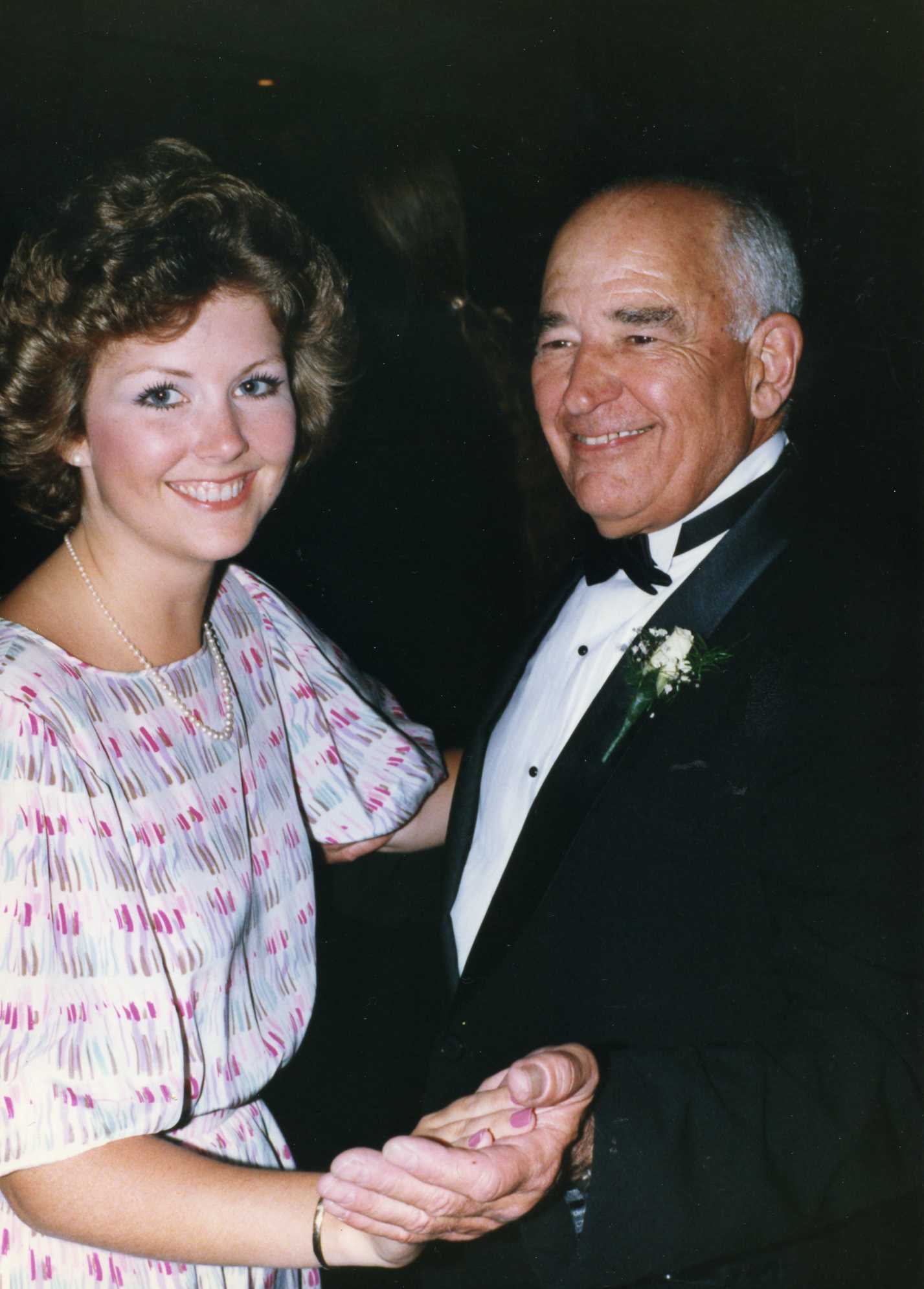
Back in the day, Dad could dance!

I thumbed through the February issue of SELF magazine earlier today and read this: “Find out if your crew is confidence-boosting and how to connect with pals who buoy you, even on ‘I feel fat’ days.”

An hour later, I took my 95-year-old Dad out for his daily constitutional, a two-block walk that now takes about 40 minutes to complete since he frequently stops to let his moderate chest pain subside.

Every time we start on our walk, he has to confront the steps. He approaches them very cautiously, especially since having a stroke eight years ago.

Out loud he says, “I think I’m gettin’ to be an old man.” Or, “Woo, I feel tottery today.”

After we cross the street and he takes his first rest stop, he says, “C’mon, Henry. You can do better than that.”

But sure enough, his joints eventually loosen up and he gets into a slow but comfortable walking rhythm. Momentum is on his side.

Then he says, “Atta boy, that’s the Henry we know and love.”

Although my Dad usually expresses his dismay at how difficult it is when he begins his walk, he never fails to cheer himself on when he starts to walk more confidently.

SELF suggests readers use alternative scripts to use in response to friends when those friends say things like, “I’d kill to have Gwyneth’s abs.” SELF tells women to stop beating themselves up.

While Dad often begins by commenting on his frailties, he also verbally encourages himself to keep trying, and then compliments himself when he sees improvement.

I doubt that SELF will ask my Dad to submit his workout tips, as they have with Jillian Michaels and other hard bodies. But we could all learn a few things from him!

3 Comments

Filed under Uncategorized

Understanding my Dad through poetry

A cartoon created as part of a book given by Dad's colleagues at Canadian Armed Forces Staff College in 1957

Communication has become very difficult for my Dad: bad hearing, slowed comprehension, harder articulation. But my Dad has something most people do not: a bottled up store of memorized passages that seem to uncork of their own accord.

As my Dad lay on a gurney in an Emergency Department exam room last Sunday, he suddenly exclaimed:

I am Ozymandius, King of Kings. Look on my Works ye Mighty, and despair!”

I don’t think the ER staff was impressed. In fact, if I hadn’t been there, they might have though he’d jumped the track. But I knew exactly what was going on. My Dad’s unconscious mind summoned up a passage that he felt was germane to the situation.

Though I wasn’t familiar with it, I quickly googled the phrase on my iPhone and found it in a poem written by Shelley in the 19th century.

The poem describes an old statue with a powerful visage that survives despite being shattered and sunk in desert sands. Dad’s exclamation was the inscription on its pedestal.

The more I thought about it, the more I felt it was the perfect passage for a unplanned visit to the hospital. It was Dad’s way of saying, “I may be diminished by age and illness, but I am still here.”

Then, later in the week, another fragmentary bit of poetry served as Dad’s way of saluting his nurse, Dawn. He offered, “And the dawn came up like thunder, outer China ‘crost the Bay.” Kipling’s poem “Mandalay” celebrates his love of the Orient. While Dad’s memory was jogged by his nurse’s name, I’m not at all surprised that he came up with a poem that celebrates a “neater, sweeter maiden in a cleaner, greener land.”

And then today, after Dad was complimented for his meticulous oral hygiene during his six-month check up at the dentist, out came this one: “My strength is as the strength of ten, because my heart is pure.”

I’m sure my Dad meant it a little self-mockingly. But while he may not be everyone’s idea of Sir Galahad as described by Tennyson, I think the phrase somehow fits him. He’s always been a straight-up-no-bullshit kind of guy; in fact, that trait almost got him court martialed during the war when he disregarded an order that he knew would have been a mistake.

He may not be everybody’s idea of Sir Galahad, but he is my Sir Galahad.

4 Comments

Filed under Uncategorized

Expectations and aging: finding pleasure in what we CAN do

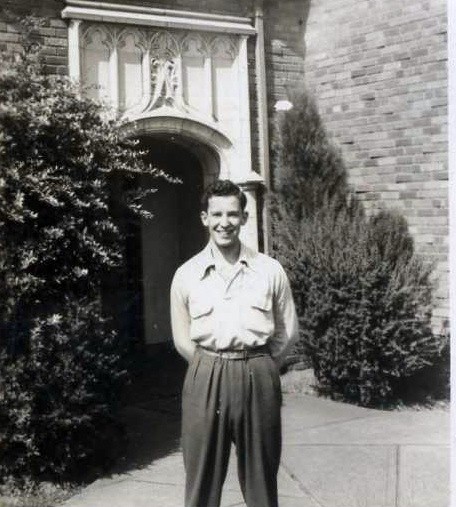
Dad with the world before him, in 1939

If you’ve seen one person over 80, you’ve seen one person.

I have a large number of older people in my life, including my 95-year-old Dad, to whom this blog is dedicated. A rare few, like Win, a 95-year-old compatriot of my Dad’s, seem to have found a magic elixir. Win recently wrote that he is still driving, keeping up a 4 bedroom house and pool, and only has physical difficulties rising from a chair.  Sheesh! He sounds like me!

Another important person in my life is getting older, and he’s kicking and screaming his way into his “golden years.” He is pissed that women treat him like – well – an old guy. In his mind, he is still virile and desirable. Physically, he’s doing pretty well. He’s a good conversationalist, still enjoys athletic pursuits, and remains involved in business. Emotionally, however, he’s not very happy about this aging thing.

As I’ve written, my Dad’s world is rapidly shrinking. His poor hearing cuts him off from most conversations, and now he has chest pain every time we go for a walk. He’s had to give up beloved pursuits like hunting and fishing. And yet, most of the time, he’s in a good mood. I’d go so far as to call him an optimist. Even though he often comments, “Lo, how the mighty have fallen,” when he carefully tackles the four stairs descending from my house, he takes heart from the fact he can complete a walk at all. “Now that’s the Henry I know,” he’ll say when a walk has gone well.

What’s the difference? Why do some people, even in the face of medical or physical challenges, remain fairly happy?

I was really struck by an article in today’s New York Times about the impact of one’s expectations on one’s well-being. Research reported in Your Brain at Work by David Rock suggests that dopamine is released, causing a feeling of pleasure when something positive happens — that is, if it beats our expectations on the upside. Unfortunately, when an experience is worse than we expect, our negative feelings are stronger than the positive ones we get from the favorable better-than-expected experience. (For you engineers and math lovers, Mr. Rock puts it algebraically: “If we expect to get x and we get x, there’s a slight rise in dopamine. If we expect to get x and we get 2x, there’s a greater rise. But if we expect to get x and get 0.9x, then we get a much bigger drop.”

The article concludes:

It seems as if it is best to have low expectations of things out of our control, realistic expectations of things we can control to some degree and high expectations of ourselves.

My Dad has had a lot of experience in his life with things that are outside of his control. He had an influence on the progress of battles for the Pacific in WWII, but he didn’t have control. He couldn’t control the leukemia that eventually claimed my sister in the 1950s. And he could not control his way out of heart disease, although he has been able to successfully manage it since 1963.

He also epitomizes what the article describes in terms of having high expectations for himself. He has emotionally muscled his way through many difficult circumstances.

Who’s happier? The fighting-every-step-of-the-way senior, or my Dad, with far more disabilities at 95. I think I have to conclude that my Dad is. He’s an optimist, but apparently is able to roll with it when things don’t turn out as hoped.

I know we Baby Boomers are going to have a VERY difficult time coming to terms with age. We have changed our world through our sheer numbers, but we will not be able to get God – and medicine – to serve up challenge-free “golden years.” It’s up to us to manage our expectations… and choose happiness.

Leave a comment

Filed under Uncategorized

Having something to look forward to matters more to seniors

We didn’t take many family vacations when I was a kid.  In the picture above, we’re getting in two cars – that’s Dad’s Corvair Monza – to drive from Maryland to the West Coast where we would board the S.S. Lurline to Hawaii, where Dad would begin a new tour of duty.

Dad at 44 had lots to look forward to: an exciting new phase in his career, the opportunity to live in Honolulu, maybe a trip to take his children hunting in Eastern Washington when he visited his mother there.  And then there were our milestones to anticipate within a few years: brother Scott’s graduation from college and Bruce’s from Punahou.  My milestones?  I think my Mom was just hoping I’d stop clinging and learn to ride my bike (for the record, that didn’t happen until we moved to Seattle two years later).

I think one of the hardest things about being in your 90s must be that you don’t naturally have positive milestones to anticipate.  It’s not likely you’re going to  hunt and fish more, entertain friends more, or take up that hobby you’ve always been meaning to try.  A few do, but they have the rare gift of resilient energy and decent health.  For most, just getting up, dressed, shaved and showered is hard work.

I had big ideas when Dad moved to Sacramento that we would do lots of field trips – taste Zinfandel wines in the foothills, for example.  But regular outings have proven impractical.  Dad worries about being away from a john if he’s in the car for long, and he says he’s lost his taste for wine.

I therefore turned to planning periodic 3-day trips.  My brothers and I have taken Dad on several fishing trips: two on the Feather River, and last summer on the Williamson River near Klamath Falls, Oregon.  For his fall birthday last year, I took him to the Monterey Plaza where we enjoyed lots of room service breakfasts overlooking the ocean, and visited the Monterey Aquarium.

Wednesday we leave for our biggest trip yet: a 2-day visit to Seattle and 3 days in Suncadia near Cle Elum, Washington. Seattle was once home, so no doubt we’ll drive by the old family homestead on 11th Avenue East.  We’ll have the chance to connect with some old friends, my Dad’s niece, my brothers, and some grandchildren.

Dad’s gotten in the habit of asking, “So what’s coming up in the future?”  Just having an orientation to the future is remarkable.  My son, Tommy, recently interviewed a WWII Japanese Imperial Army veteran (now U.S. citizen) who is participating in a program called “Thrill of a Lifetime.”  Through the program, Eskaton, where the man lives, is trying to reunite the elderly man with his brother, who he hasn’t seen since 1951.  The goal of the program is to inspire each resident to live every day to its fullest.

Once upon a time, the days stretched ahead of my Dad full of opportunity.  Now his day-to-day world is confined, but it can be expanded by the anticipation that something good is ahead.  Let’s hope the trip lives up to its promise.


Leave a comment

Filed under Uncategorized

The consequences of Dad losing his “filter”

In most ways, my Dad has mellowed as he’s gotten older.  I’ve read that, when it comes to anger, older people – especially women — are less likely to let things make them mad.  They have better control of their emotions internally and externally.

Very old people, however, are less likely to “edit” when a thought crosses their mind that would be inappropriate or uncomfortable for those around them.

This can lead to awkward but hilarious situations, especially when the very old person in question has hearing problems and speaks a little louder than the average person.  Six or seven years ago, our house was on the market and we left to give the REALTOR a chance to show it to a couple who was interested.  They arrived in front as we left in back.  I couldn’t close the window fast enough to mute my Dad’s comment, “She certainly knows how to fill a pair of pants.”  And he didn’t mean that in a good way.  We did not get an offer from that couple.

Or there was the time my Dad commented while still within ear shot, “That must have been quite a hat… before she sat on it.”  Or, “She has a face like a pudding.”

I am a slow learner when it comes to asking if my Dad likes the dinner I’ve prepared.  Occasionally I get a thumbs up, but I am equally likely to get the “so-so” fluttering hand signal.  And once he offered this little gem, “It looks like the dog’s breakfast.”

I shouldn’t be surprised that my Dad complains when he has to return to his assisted living community.  He hates it there.  It’s a good enough place, and he probably would like it if it wasn’t compared on a weekly basis to life at my house.

My house is, well, a house.  With a family that he’s part of.  With lots of room to move around, and people who bring you coffee and wine, serve up three square meals a day and talk to you.  His experience at his assisted living community simply can’t compete with that.

So why is it so painful to me when he complains that returning to the “hacienda” (as he calls it) is like going to prison?  Or that he’s in a drought when he’s there for a few days?  Or that he can’t get the temperature right at night and it’s like an oven (although he was wearing a wool sweater when I picked him up)?

He can no longer filter his comments, and his short term memory loss means that he will keep feeling and commenting on the same anxiety about returning to his apartment, over and over.  It’s the perfect recipe for my guilt.

It isn’t that different than when I had to drop my son or daughter off at day care, and they didn’t want to be there.  They might cling or cry, but I reassured myself that they would get caught up with activities once I left the scene.  I go through a similar exercise when it’s time for Dad to return to his apartment.  He doesn’t cling or cry, but he can’t help repeating his distress about returning.

At least I knew my children would move on to a new developmental phase.  With Dad, I  have to comfort myself.  He won’t outgrow it.

1 Comment

Filed under Uncategorized

Rx for aging #1: Get outside and walk

I call my Dad a miracle man for good reason.  Besides surviving Iwo Jima and personal tragedies, he has come back time and time again from serious medical conditions.  After his third heart attack and subsequent bypass surgery at the age of 82, his cardiovascular surgeon told the family that he likely would only have five years before his arteries became clogged and life-threatening.  I thought of it like shelf life.  Dad’s “expiration date” was therefore 2004.

Since then, he’s had two small strokes and one big one.  In 2004, the physicians and stroke rehab specialists told us he would probably never be able to walk independently or without dragging his weakened left leg.  When he was assessed following his small stroke last month, the various physicians who checked his strength said that they couldn’t detect any difference in his left side strength.

So what keeps Dad keepin’ on, besides the discipline of being a retired Marine?  I think the number one thing that contributes to Dad’s physical and mental well-being is walking. We’re a funny sight in my neighborhood or on the levee beside the American River: me pushing Dad’s walker, while he holds on with his left hand and steadies himself on the other side with a cane.  Our double-wide approach to walking overcame what he didn’t like about walking with the walker — freedom of stride — while providing stabilization on both sides.

I realize that Dad is unusual — and lucky — for having someone who will take the time to walk with him, almost daily.  But what if walking buddies were a part of senior care programs, or a popular volunteer program?  If we can have dog-walkers, why not “Dad walkers”?

On the “about” description for this blog, I explained my vision: …a celebration of (my Dad’s) indomitable personality and wisdom, a rant about the injustice of the challenges of aging, a plea for better models of healthcare and support services for older people, a prayer for forgiveness — especially my own — when my patience runs low.  This post falls into the category of pleading for better models of healthcare and support services for older people.

Lots of clinical evidence attests to the health benefits of walking (strength, balance, release of endorphins), but I see several benefits that make me think there are more benefits than just getting out there and exercising your heart and leg muscles:

  • The outdoor connection – Getting outside provides a connection with nature that you lose if you’re confined inside your home or senior community
  • Personal validation – A “good day” provides hope and inspiration that helps to counterbalance fears that one is declining and deteriorating toward the final finish
  • Touch and community  – Walking with someone can provide a gentle moment of communion and love that feeds and sustains.

The outdoor connection:  My Dad has always been an outdoorsman — an avid game hunter, skeet shooter and fly fisherman.  I never liked to hunt, but I loved crunching through frozen wheat fields in the cold pre-dawn hours in Eastern Washington as my Dad hunted pheasant, dove, Hungarian partridge, quail or chukkar.  One of his fondest memories was hiking the Sand Ridge Trail with high school classmates near Rimrock Lake in Eastern Washington.  But for anyone, it seems unnatural and disorienting to spend your days indoors.  You miss the details that Dad always notices: new buds, bird calls, beautiful cloud formations.  When nature is removed from our world, we suffer.

Personal validation:  My Dad doesn’t have troops to order anymore, so he orders himself.  So many of our walks begin with him saying, “I think I’m gettin’ old.”  But then he regroups and starts saying things like, “C’mon, Henry.  You can do better than that.”  And when he starts to loosen up, he comments on that, too:  “That’s better.”  Not every day is a good day, or a good walk.  But when things go well, it helps him feel more confident that he is not beginning “the big slide” toward the end.  Yesterday’s walk ended with, “I’m encouraged.”

Touch and community:  A friend who did massage on the side once told a story about an elderly widow who cried after her massage.  “No one ever touched her anymore,” my friend said.  My Mom and Dad were big on hand-holding and patting one another.  Now there is no one who pats him as a part of his daily routine.  So when we walk, and Dad rests, I make it a point to put my arm around his shoulders, and give him a pat-pat-pat.  “We’re three-pat people,” he always said.

Leave a comment

Filed under Uncategorized