Category Archives: Uncategorized

The Empty Place

My father Christmas 2012

On my son’s last night in the country before moving to Japan, I served cake at the kitchen table.

“That’s weird,” my son said.

I looked at him for explanation.

“It doesn’t seem right to serve food at that place.”

I followed his gaze to the slice on the far side of the table. It took me a beat or two to understand. My father’s place.

The far side of the table gave my father the best vantage point on the household comings and goings, and the brightest natural light. My children sat across from him; my husband to his left. I sat at his right hand.

He is there even when he isn’t.

2 Comments

Filed under Uncategorized

Imagined Righteousness

The man who sat next to me at a dinner last night said he’d never had a massage. We’re in Napa, and the conversation had turned to what people did during the five-hour break in the meeting schedule. One of our company had immersed herself in the cocooning heat of a mud bath, followed by a wrap and massage.

Oh my god, I thought, someone who’s never had a massage! Why it’s un-Californian!

I swooped in.

“Why not?”

“I just don’t want to,” he said.

“Todd used to feel that way,” I told him, nodding my head at my husband, who was seated on my other side. “But he fell in love with it after I booked one for him.”

I smiled smugly, the efficient wife.

Todd piped up. “A good masseuse can really get in there and get rid of knots in my neck and shoulders. And it’s a great stress reliever.”

The man next to me said nothing.

“And,” I said, taking a different tact, “it’s one of the few alternative therapies that is actually efficacious. That and guided imagery.” (I thought the interjection of a big word like efficacious might sound kind of authoritative.)

He looked unmoved, but must have felt compelled to respond.

“Man or woman, I just don’t want a stranger touching me,” he said.

At about this moment I started to get a grip on myself. Who declared me Head Marketer of Massage? Why was I evangelizing for Deep Tissue?

When I turned in a couple of hours later, I returned to reading Meghan O’Rourke’s The Long Goodbye. I was about a third of the way in and feeling vaguely skeptical. Why I was I not enraputured by her memoir, the story of her mother’s two year losing battle with colon cancer? Her sentences are gorgeous, after all, and her story telling effective.

Something about her premise, early on, bothered me:

Nothing prepared me for the loss of my mother. Even knowing that she would die did not prepare me… Waking up in a world without her is like waking up in a world without sky: unimaginable. And because my mother was relatively young — fifty-five — I feel robbed of twenty years with her I’d always imagined having. I know this may sound melodramatic.

Yes, I thought when I read those sentences, it does.

She continued a page later:

In the months that followed my mother’s death, I managed to look like a normal person. I walked down the street; I answered my phone; I brushed my teeth, most of the time. But I was not OK. I was in grief.

She was selling grief. I wasn’t buying. No, I was judging.

This morning I remembered the instructions I gave my husband a month or two before my father died. I don’t know how I’ll feel, I told him, but I don’t want to be rushed to “closure.” I have a friend who has a pretty specific idea about how long it is permissible to grieve before wrapping things up. I told my husband to keep that friend away from me. I didn’t want to hear it.

I now realize that I had — have — a construct for the right way to grieve. One should not rush to closure, but should also avoid melodrama. Having built this model for myself, I seemed to be imposing it on others… exactly like the friend who advocates for swift closure.

Leave the man alone, I finally said to myself last night. It’s his business, not mine.


1 Comment

Filed under Uncategorized

The Last Frost Call?

Scan 2

The first time a “Frost Call” landed in my inbox, I was startled. It turned out to be a death notice from a member of my father’s USMC 5th Reserve Officers Commissioning class — a group of 304 men who became second lieutenants just before the United States entered WWII. Talk about gallows humor, I thought when I looked back to the subject line.

I’d taken my father to a reunion of the the “Fighting Fifth” at the Marines Memorial Club in San Francisco. One of his classmates, I soon figured out, had taken on the role of communicator and regularly sent out “the poop” on gatherings and classmates. I added myself to the email list.

“Frost Calls,” which came with increasing frequency, heralded the passing of another classmate. I debated whether I should tell my father. What’s it like when the only news of old friends is of their death? When they are dropping like flies? In the end, I printed out the emails and gave them to him at the breakfast table. Some were — had been — good friends. He’d say something short like, “Good man.” Then he was quiet. I couldn’t tell if he was remembering his friend, Quantico, wondering when he might die, or refocused on the day’s paper.

Once a year, two lists were mailed out: the long list of Fifth R.O.C. members who were deceased, and the short list of those who were hanging on.

In 2009, the class was down to 38.

In 2011, 31.

In 2012, 28, then 25.

On New Year’s Dad, 2013, Dad’s classmate sent out an email with the subject “Geezers.” He announced that five classmates were 96 years old. I wrote back, asking how he was doing. He responded:

I’m doing OK, hard to get out of chairs, it’s now 14 years of living alone in a big house with pool to tend to, but no complaints.  I purchased a walker with a seat in it, works fine.  I can walk with it because it is something to hold on to, like a grocery cart. So walk with it about a mile every day without difficulty.  Knees bad, have to push with both arms to get out of chairs, and resist all stooping over to pick up things.  Result:  Clutter, but still enough room to get over it, or around it. Driving OK, with license renewal due when I’m 100 in Aug 2016.

I wrote him when Dad died on January 12, 2013, sent him the obit. He sent out my father’s Frost Call on January 15, 2013, adding, “We are all in the zone, and it is another marker for our Quantico Commissioning Class of 29 May 1941.  …Semper Fi!”

Since then, I’ve tried several times to reach Dad’s classmate. I’ve emailed and snail mailed. According to Google, he signed up for a youtube channel seven months ago. No death notice. I sent him a friend request on Facebook. He hasn’t responded.

I went back to the last list of living officers, dated 9 December 2011. As best I can tell from online search, 17 more classmates have died. Funeral notices usually show up high on the list of search results.

Fourteen members of the 5th R.O.C. remain. So few. Maybe that’s why Dad’s classmate stopped sending out Frost Calls.

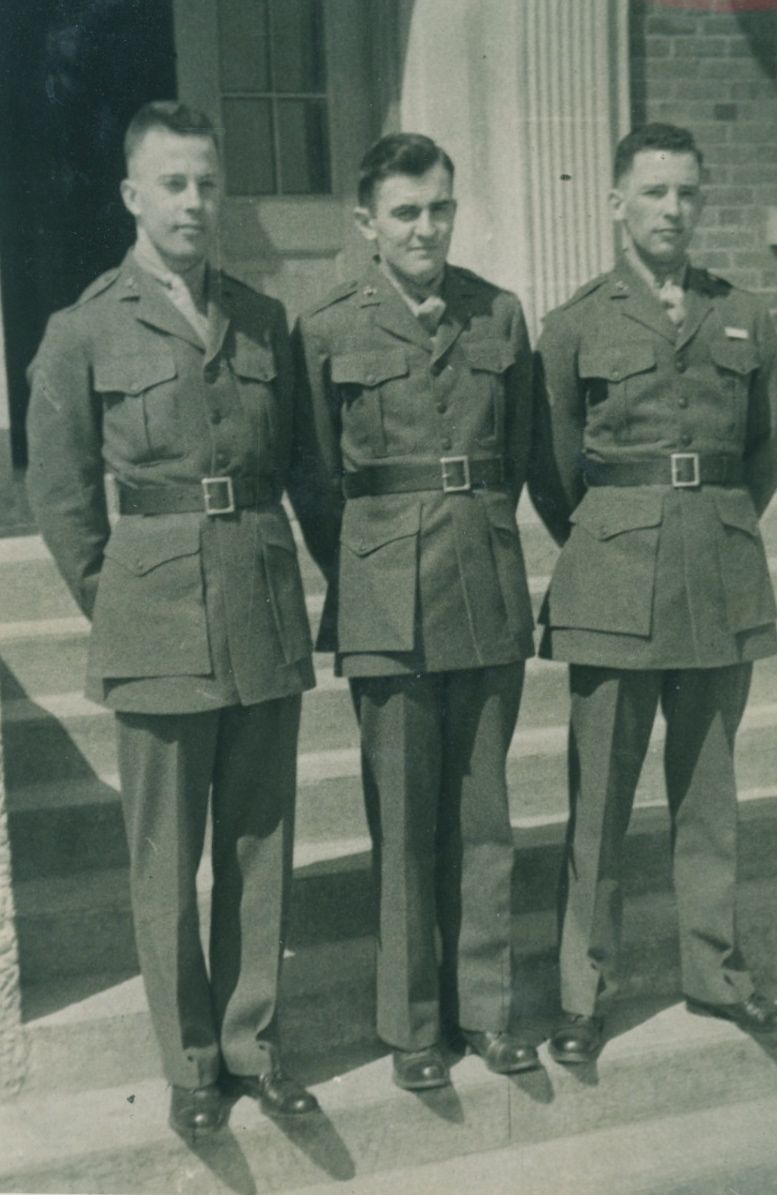
Meade Whitaker, Harry Guinivan and Henry S. Campbell, USMC 5th R.O.C.

Left to right: Meade Whitaker, Harry Guinivan and Henry S. Campbell, newly promoted to Second Lieutenant, USMC, as part of the USMC 5th Reserve Officers Commissioning class, May 1941

Scan 2

Robert A. Campbell, Henry S. Campbell and J.P. Campbell on graduation day: the caption for the photo at left reads, “A la Pall Mall (cigarette) ads”

Robert A. Campbell, San Diego, CA

Robert A. Campbell (late of San Diego, CA) — the caption reads, “R.A. feeling his oats” (Graduation day of the USMC 5th R.O.C., 1941)

Scan 4

J.P. Campbell on graduation day, USMC 5th R.O.C. The caption reads “iron man of Kentucky.”

Henry S. Campbell, Robert A. Campbell, Joseph Anastasio, USMC 5th R.O.C.

Left to right, standing: Henry S. Campbell, Robert A. Campbell, J.P. Campbell, R.N. Barrett, Bill Bray, Leon Case, Cakin (?). Kneeling: Joseph Anastasio (recently late of Woodbridge, CT). Graduation day of the USMC 5th R.O.C., May 29, 1941

close-to-war officer training, Quantico, VA, 1941

Members of the USMC 5th R.O.C. The caption reads, “between classes.” Henry S. Campbell leaning against the car.

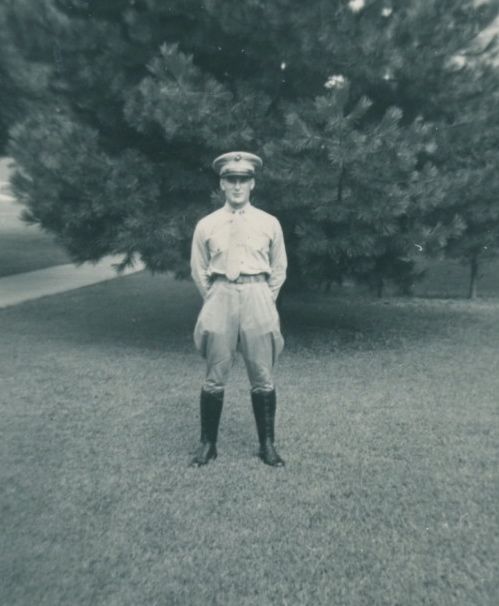
Henry S. Campbell, USMC 5th R.O.C., 1941

Henry S. Campbell, graduation day, USMC 5th R.O.C., Quantico, VA, May 29, 1941

USMC officer candidates training, 1941

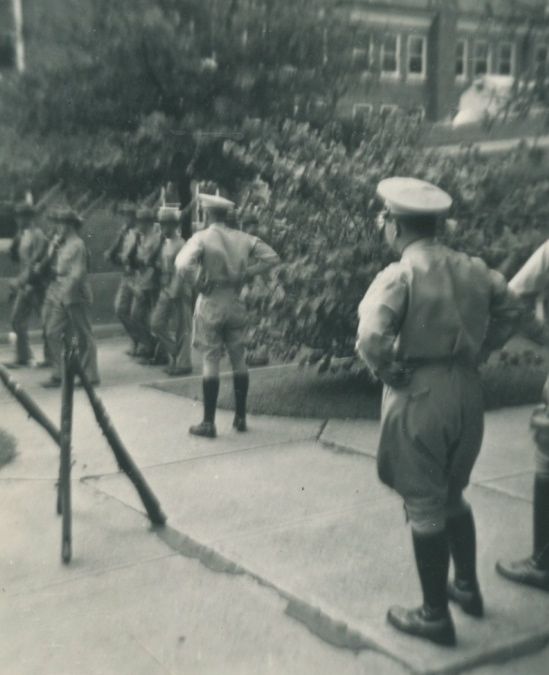
The caption reads, “R.O.C. boys watch the candidates march by.” Quantico, VA, 1941

USMC 5th R.O.C., 1941

Getting ready for graduation: USMC 5th R.O.C., May 29, 1941

3 Comments

Filed under Uncategorized

A Little Moment

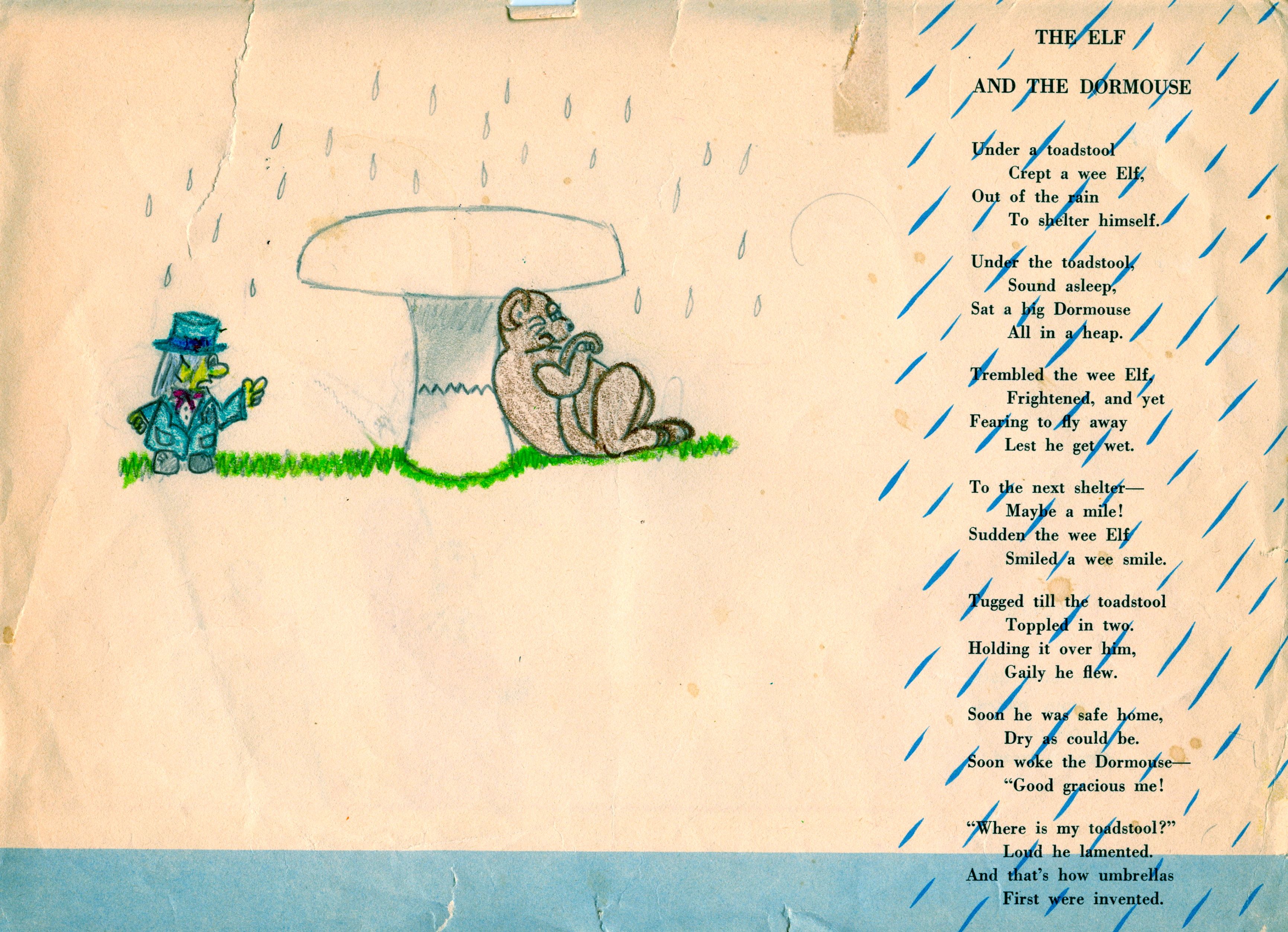
My brother's drawing

I remember sitting at our dining room table with an activity book of children’s rhymes when I was about six. On the right side of the page was a poem about a wee elf who seeks shelter from the rain under a toadstool, only to discover that a big dormouse already occupies it. The left side of the page was left blank for the picture that would come from a child’s imagination.

My coloring skills always failed to achieve what I hoped. When, on another page, I had tried to draw a woman in profile, she ended up looking like a cyclops. My brother came upon me with my crayon hovering in mid air as I willed the waxy instrument to conform to my ideal.

I see what happened next in snapshots. My brother Bruce came alongside, leaning over to examine the source of my consternation, his arm draped around my shoulder. I don’t know if I asked for his help or he offered, but he sat down and started drawing.

To watch him draw was to see magic in slow-motion: with pencil he outlined the toadstool, then the big dormouse slumped over in sleep, his paws folded over his chest, his legs hunched against his round tummy.  To the left he outlined the elf — a leprechaun to my way of thinking — with a top hat, jacket and and bow tie. Pointed ears protruded from the elf’s long hair and his finger wagged at the dormouse. Then Bruce traced his outline with crayons — he was careful to use the sharp ones — and lightly shaded the figures. Brown for the dormouse (of course), teal blue for the elf’s jacket and hat, red for the little bow. Bruce implied the grass with a zig-zaggy line of green (I would have scribbled it all in) and left the background alone. As he proceeded step-by-step, my brother gave a tutorial. He explained that I should always start with pencil; pencil can be erased. If I followed my initial lines with color and then shaded the interior, the product would be neater. His eyes met mine often while he demonstrated.The last touch: he penciled in tear-drops of rain. I treasured the drawing as if it were an oil painting of Jesus.

The masterpiece is less important than what it symbolized: that I was worth my brother’s time, his precious teenage time. At the point I am remembering, Bruce would have been sixteen. Older brothers couldn’t be expected to lower themselves to entertain little sisters. But Bruce was different. He smiled with encouragement from the pedestal I had erected for him.

Leave a comment

Filed under Uncategorized

What We Remember

peanut butter and knife

I’m having a hard time finding enough sympathy cards this month, so many beloved mothers and fathers and husbands have succumbed to time and health challenges. Perhaps it’s the sheer quantity of losses, but I finally noticed: what funny, seemingly unimportant moments become the stuff of stories.

One lovely woman, my neighbor’s mother, was remembered from the pulpit by her four grandchildren. The one who is my son’s age said he remembered three things about “Grandy.” I’ve forgotten what one was but I remember the other two: peanut butter and a knife.

He listed the objects first. Then he started talking about what he remembered from his visits to see his grandmother. He said he’d never forget how she let him eat peanut butter out of a jar with a knife.

It conjures up a perfect moment, doesn’t it? This go-ahead-help-yourself-when-you’re-here-dear approach to visiting? There’s a grandmother who knew enjoying time together was more important than rules. She knew, literally, the sweet spot of her grandchildren, and in small indulgences, showed how well she understood them.

Sometimes it’s the smallest things we remember. The little rituals that stick.

1 Comment

Filed under Uncategorized

Foot Fetishes and Objective Correlatives

I don’t much like feet, but it’s hard to get around without them. These days, my bunions bark at me when I try on shoes with heels over two inches, shoes without arch support, shoes that bind across the inside joint. (In other words, most footwear I might fancy.)

But my much maligned metatarsals do not explain why shoes are on my mind. Earlier this month I learned a new word while attending my second residency at Bennington MFA Writing Seminars: objective correlative. Lisa Doublestein defined it in her graduate lecture as “a symbolic article used to provide explicit rather than implicit access to emotion in art.” An objective correlative offers a shortcut to the feeling the author wants to convey — connecting readers, stories and characters. An objective correlative says it without saying it.

Objects, I realized, are my way in: objects lead to memories, and memories lead to feelings. My mind — racing to the next thing and the thing after that — rarely stops to consider feeling. But objects, real or imagined, can pull me to a stop.

When I looked back at what I’ve written over the past six months, I was astonished to recognize a recurring thread.

First I wrote about walking with my father:

“Remember to pick up your left foot, Dad, I reminded him as we proceeded. I listened for the telltale scrape of his left shoe brushing the sidewalk. A year after his stroke, he still had to think to swing his left leg all the way forward and strike with the heel.

Then I described “the puddle of his feet, seemingly devoid of bones.”

This past week, I wrote about how he ministered to his shoes:

Every weekend—Sundays I think—my father would assemble his kit: a brown towel, an old nylon stocking, Aqua Velva aftershave, thin rags coated in polish, two horsehair brushes (one for brown, one for black), shoe black, and several cans of Kiwi shoe polish—cordovan brown, black, and clear.

On the floor in front of him he lined up his shoes—at least two pair and sometimes three. His shoes were of high quality, leather that would last, in enduring styles: wing tips, I remember, with thick soles. After laying the brown towel across one knee, he began his standard operating procedure: remove laces, wipe with damp towel, twist open lid of brown or black shoe polish, apply thin coat with previously used cloth, set aside to cure. Repeat with mate. Returning to the first shoe: buff the tongue, inside, heel, outside and toe with the brush matching the shoe polish; repeat application of polish; when ready, buff: swipe shoe with aftershave to harden the polish. Then: rest shoe on the cloth-covered thigh, heel toward the belly, grasp nylon with two hands roughly 18 inches apart, see-saw across the nose of the shoe. If necessary, tidy up soles with shoe black.

I wrote about the shoes he was reduced to wearing in very old age:

He hadn’t polished his shoes for at least ten years before he died, having exchanged his oxfords for sensible shoes, most recently black Brooks Addiction Walkers. Their wide soles helped stabilize his balance, or in the manufacturer’s promotional language, their “energy-returning MoGo midsole cushioning… provides study support mile after mile by supporting low arches and keeping pronation under control.” I replaced them every six months, inserting the orthotic that shoved his collapsed arch — (the left or the right? how could I forget?) — into a shape resembling a normal foot.

When I met with the Academics Officer at Officer Candidate School in conjunction with research I’m doing, he told me they can tell something about a recruit’s commitment from the way he or she selects his boots on day one. Footwear, again.

I remember how my father loved to recount how his flat feet almost barred him from consideration by the Marines… how my mother was inordinately proud of her shapely feet (a former I. Magnin shoe model)… how my father rubbed my mother’s feet at night. She had bunions just like mine.

Leave a comment

Filed under Uncategorized

“Warm and Human Soldierly Philosophy”

Henry Snively Campbell 2012

Today and tomorrow, I’m doing reconnaissance of a sort, albeit not of an opposing force. I’m looking for information that will help me understand my father better.

After spending seven years as his caregiver, I thought I had Dad figured out. But almost two years since his death, I remain curious. I was so busy caregiving that I missed the window when he could have answered my questions.

How did he become the gracious man I knew in old age? After hurdling heart disease to support his family, raise four children and be there for my mother during her final illness, he could finally relax. With his fighting years behind him — in the literal and figurative sense — I thought perhaps he returned to the person he was when young. Smart and sensitive, he had been the middle child who empathized with others, particularly his mother, who bore the brunt of his father’s criticisms. His career in the Marine Corps, I thought, explained his emotional distance when I was growing up, his command presence at home.

I’m rethinking that. Watching my brother’s taped 2003 conversation with him, I was struck by my father’s expression when he described the personal connection a leader must have with the troops for whom he is responsible. In his memory, he was back in 1941, soon to be commissioned second lieutenant, preparing to lead men in war. He was 24.

Then I read a passage in General Victor Krulak’s book, First to Fight: An Inside View of the U.S. Marine Corps. “Brute,” as he was known, gave his take on the brotherhood of the Marines. It is embodied, he suggested, in a section of the Marine Corps Manual written by General John A. Lejeune in 1921 called “Relations Between Officers and Enlisted Marines.” In six short subsections, Gen. Lejeune laid out what officers must do to preserve the “spirit of comradeship and brotherhood” that came out of WWI. I saw my father in this:

b. Teacher and scholar — The relation between officer and enlisted men should in no sense be that of a superior and inferior nor of master and servant, but rather that of teacher and scholar. In fact, it should partake of the nature of the relation between father and son, to the extent that officers, especially commanding officers, are responsible for the physical, mental and moral welfare, as well as the discipline and military training of the young men under their command who are serving the nation in the Corps.

At the end of the passage, Gen. Krulak noted this:

“This warm and human example of soldierly philosophy, in addition to its enduring wisdom, implies a lesson for anyone who aspires to lead men. In it, General Lejeune uses the term officer ten times, the term men ten times, and leadership or leader three times, but he never used the more sterile terms personspersonnel, supervision or management at all. Lejeune knew he was talking about warm, living human beings.”

Seems my father didn’t leave the Marine Corps behind at all. Perhaps it taught him to be a better man, a better father, the one he never had.


Click here to read General Lejeune’s order in its entiretyIt remains in the Marine Corps Manual nearly 100 years later.


2 Comments

Filed under Uncategorized

The Intimacy of Leadership


Henry S Campbell, 1945, 23rd Marine base camp Maui

What makes young men and women willing to risk their lives on the front line? What is leadership in a military organization? How is it taught and instilled? These are some of the questions I’m pondering in preparation for some research I’m undertaking as background for a memoir.

My father, a retired Marine Corps Colonel who fought in World War II, rarely talked about his wartime experiences. Sometimes his emotions overwhelmed him, but more often, he didn’t think they were worthy of elaboration; like many of his era, he didn’t consider himself a hero. The heroes were the other guys. The ones who died.

My brother Dean recently stumbled across a video recording of his conversation with my father in 2003, ten years before his death. Talking about his officer training in Quantico in 1941, he recalled that his mother and aunt visited the base just as he came off the bayonet course. He remembered that he “ran it for blood.” Then he explained why he took the training so seriously — not because he needed to save his own skin when facing an enemy, but because, as a second lieutenant, he would likely be responsible for his platoon:

“You’re going to teach kids this stuff. You’re their mommy, you’re their daddy. They depend on you for literally everything at the platoon level, which is the message I drilled my young candidates on. It’s your monkey. It ain’t going anywhere. You better fly it.

“If you’re good at this, you’ll know their names, and if they’re married, you’ll know their wive’s names and the names of their kids, be interested in them as individuals. Because when you get into battle time, there’s no time to get an introduction. All that should be behind you. You’re familiar with the guy; you’ll know what he’ll do and what he won’t do. You’ve got to know this and that takes intimate contact. That’s a serious matter, which is why the Marine Corps is good at what they do. There’s nothing impersonal about any of it, no matter what you see in the movies.”

1 Comment

Filed under Uncategorized

The Night I (Finally) Understood Christmas

Animal onesie hugsMy favorite Christmas moment was the last one before I fell hard asleep.

I’d been in commandant mode all day, maybe all month, but finally — finally — the presents were opened, the meal was produced, and the family was unpleasantly full after gorging on turkey and all the fixin’s plus some extra fixin’s for good measure. “Ben!” I’d barked at my nephew, “move it!” as I motioned for him to step away from the counter where I planned to set the brimming dishes. Then I added, “I want you to know I speak to you like my own children.”

As if he would understand that I only bark at those I love.

In the moment this picture was taken, this delicious moment after I emerged from bed to take it, my adult daughter and son had returned from checking on two pooches that my son was babysitting over the holidays. He seemed too tired to drive so my daughter, his older sister, agreed to go with him. When they returned, they had concocted the idea to take a picture in front of the tree in his-and-hers animal onesies.

They could hardly stand, they were so tired. I could hardly stand. But I’m so glad that I got out of bed to say goodnight just as my daughter was telling her brother that no one was around to take the picture. Then they saw me: problem solved.

Pictures were taken: arms flung wide, arms wrapped around each other. They’ve been this close since the beginning, a true gift to one another.

Why is it that I just figure Christmas out — remind myself what the season means — about the time it’s over? Until then, it seems, there’s just so much work to do to make it perfect for everyone. Or (let’s be honest, Betsy) to make it perfect enough for my own standards.

Christmas had begun to seep in on Sunday when I finally made it to church. As the advent candle was lit for the fourth Sunday, this blessing was said:

“Love surpasses the secure locations we would choose, the holy nests in precarious places and roots in the fragile.”

I’d been feeling overwhelmed. Broken. With my son applying to teach English in Japan, it had been like college app season all over again, characterized by my own frantic feeling that I needed to make sure he didn’t miss a step. He wanted this, after all, so I was all in. I know what they tell parents — it’s supposed to be their problem, not ours (there’s yet another “should” from whoever “they” are) — but I’m terrible at disconnecting.

So I was sitting in church feeling like a failure, like a rotten mother who, in her effort to ensure that things got done and done right, was turning the holiday season into boot camp. Instead of offering love, I was draining it. Ninety percent of the time I’d been in bitchy mode; the other 10 percent I tried to make up for it.

As the week continued, I couldn’t stop thinking about the blessing of the Advent candle. About precarious and fragile places. About brokenness.

Was this a reminder that love conquers all? That I could make all things right with enough love?

No, I had it on its head. It was a reminder that I was loved — am loved — even in my fragility and weakness. Even when I confuse motherhood with sovereignty.

Then I read Pope Francis’ homily on Christmas Eve. The meaning of the birth of Jesus, he said, “is the humility of God taken to the extreme; it is the love with which, that night, he assumed our frailty, our suffering, our anxieties, our desires and our limitations. The message that everyone was expecting, that everyone was searching for in the depths of their souls, was none other than the tenderness of God: God who looks upon us with eyes full of love, who accepts our poverty, God who is in love with our smallness.”

God’s love could surpass my smallness? The way I sometimes fail in mothering, the most important role entrusted to me?

Here were my children, standing by the Christmas tree, engulfing one another in a hug, goofy in zebra stripes and leopard spots. Here it is, I thought, what Christmas is really all about. Love, just love. If only I let it in.


1 Comment

Filed under Uncategorized

Egg Beater Drawers


egg beater drawers

There it was this morning, my mother’s voice. In my head, of course, since it’s been 15 years and counting since she passed away. But I heard it, clear as her prized Waterford crystal: “Dammit, Betsy, my drawer looks like you’ve gone through it with an egg beater!”

She was right. Her underwear drawer did look a mess after I got through with it. My mother wasn’t particularly neat — she considered piles a perfectly appropriate organizational system in the kitchen — but her drawers were another matter. That woman knew how to fold. And the neatest drawer of all was her underwear drawer. I know because I raided it every time I needed a half slip.

Her underwear was practical but silky with bits of lace on the bras and panties, camisoles and slips. All of it was folded into neat squares — the slips set toward the back, the underwear and bras toward the front. Bras were folded in half and stacked on top of one another, a miniature mountain in a landscape of lingerie.

Some people hear their mother’s voice critically — there she is again, bitching at me from the grave — but (thankfully) that’s not what I heard. She sounded exasperated, to be sure, but loving. As if wondering how she was going to survive my teenage hood while in her mid 50s. And just that phrase — her distinctive “dammit!” — was like having her back again, if only for a minute.

I never did master underwear folding, and my underwear drawer does look like it’s been mixed with an egg beater. But at least I stowed my stuff, Mom, so it doesn’t look like it’s been spread from “hell to breakfast.” And, by the way, Merry Christmas… and I miss you. Thanks for stopping by.


1 Comment

Filed under Uncategorized