Tag Archives: #writinglife

Aging Gracefully… or Disgracefully?

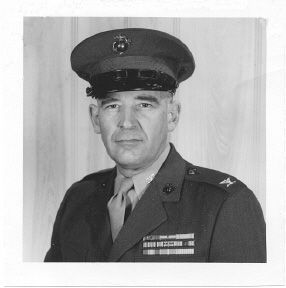
Official Portrait, Promotion to Colonel, 1959

Official Portrait, Promotion to Colonel, 1959

Somewhere along the line, word got out that I knew something about aging parents. During the seven years that I cared for my father, and the eighteen months since, I’ve received many a call or email from adult children – correction, daughters – who were deeply concerned about their parent’s welfare and at sea when it came to figuring out solutions. One was a friend who was actually collecting information on behalf of her husband, although the husband didn’t know she was looking for advice and she was uncertain how much she could suggest to him. If the wise men had been women, so the old joke goes, they would have arrived on time, helped deliver the baby, cleaned the stable, made a casserole, brought practical gifts and there would be peace on earth – all because they asked directions.

After a while, my marketer’s brain started to look at their stories as data that fell into two groups: those whose parents who were grateful for a little help, and those who seemed to become nasty and difficult. Call it aging gracefully versus disgracefully. I don’t mean to be flippant or suggest that a bunch of elders are out there besmirching the family reputation. Aside from a few outliers who were sociopaths in their youthful years and whose tendencies ripened with time, the latter group is made up of people who were once decent human beings before age stripped them of their filter and embittered them. Their younger selves would be disappointed in their older selves.

My father fell into the changed-for-the-better group. When I was growing up, his authority was absolute. He did not yell or hurl scornful statements or fling barbs. He said little. He didn’t have to. I knew – my brothers and I all knew – when we were on thin ice. It was in my father’s eyes. He froze and simply looked at us – a level stare, unflinching. We were put on notice without a word. He transformed into The Colonel. There were no coiled muscles waiting to explode – the telltale sign of a violent father. Nothing in our experience suggested that he would strike. He was too controlled. But something in his eyes hinted at a potential. He later described his own father as “severe” and his older brother as a bully; harassed to the point of retaliation, he described futilely trying to wound his brother only to be held out of reach as his brother laughed at him. Maybe my sense of threat came from a glimpse of something long buried, the soldier self that enabled him to survive WWII. He said nothing, he did nothing, but I feared my father; loved him, longed for his approval, competed for his attention, but feared him.

The danger dissipated with age; whatever reservoir of anger he had stored up leaked away. He did not rail at the indignities of aging, though he did not like them. This business of the bladder for example. Whose idea was it to make peeing both difficult – a long time coming and an anemic stream once started – and hard to control, so much so that my father avoided going anywhere without a bathroom in sight and more than once ended up urinating in my neighbor’s yard when he couldn’t make it back to my house during a walk? And no one expects an old person to be funny. My father would jest and I would have to explain to his audience, in the silence that followed, “That was a joke.” Most people did not address my father; they would first address me, speaking of my father to me, treating him like an imbecile. His aging made me angry but it did not seem to affect him that way.

I can’t let go of my questions. During those seven years and in the time since he’s died, I continue to wonder: how is it that one elder becomes kinder, and another mean? Is there a way to influence or control how one feels about the many cruelties of aging? What will happen to me?

I read and hypothesize. An op-ed by Arthur C. Brooks in the New York Times boils things down to an equation. One describes oneself as a happy person when one’s happiness (y) is greater than one’s unhappiness (x): when y > x. He wasn’t writing about aging, in fact his point was that the most unhappy people are self-aggrandizing, materialistic fame-seekers or promiscuous hedonists, people who are generally in their prime. The answer to happiness, he concluded, is to love people, not things: “It requires the courage to repudiate pride and the strength to love others – family, friends, colleagues, acquaintances, God and even strangers and enemies.”

Aging is nothing if not a punch to the solar plexus of pride. But assaults on one’s pride don’t seem to explain who will transform into kinder and gentler versions of their younger selves.

One friend of mine theorizes that women are better prepared for old age because of the many adjustments they have to make in their self-image. With the arrival of one’s “monthly visitor” or “period” or “curse,” suddenly you’re transformed into a woman, someone capable of bearing another human being. Being pregnant is a different kind of shock. Love or hate the experience, hardly anyone is neutral. Besides feeling like an alien in one’s own body, or worse, feeling like one is gestating an alien, the cultural rules bend sideways and suddenly someone you’re meeting for the first time puts his hand on your belly by way of introduction and says, “Hi, I’m Pete and I see you’re expecting a baby.” And let’s not even talk about menopause. (Beware, says the menopausal woman.) Unfortunately, I’ve heard just as many stories about difficult mothers as difficult fathers. Maybe more, because mothers more often push the hidden buttons that fathers don’t even know exist.

Then there is the school of suffering. As David Brooks wrote in the New York Times, “Recovering from suffering is not like recovering from a disease. Many people don’t come out healed; they come out different.” I know this was true in my father’s case. He was a different father after the death of my sister Midge, who died just short of her fourth birthday. He often referred to the different way he and my mother parented my two older brothers compared to how they raised us two “youngers.” The difference can’t be explained by the seven year gap between the pairs of children or my parents’ increased age – 40 and 41 when I was born. David Brooks continues: “Instead of recoiling from the sorts of loving commitments that almost always involve suffering, they throw themselves more deeply into them. Even while experiencing the worst and most lacerating consequences, some people double down on vulnerability. They hurl themselves deeper and gratefully into their art, loved ones and commitments.”

In Brooks’ statement, “vulnerability” sounds right, but it’s the “gratefully” that resounds. My father became more grateful as he aged, grateful for the wife and daughter he loved, even when they were beyond his reach in death, grateful to be welcomed into a family, even though he lost his independence, grateful for the years of life that had somehow, miraculously, been granted to him, even during the days of pain and confusion. Did gratitude make him more tender, or did tenderness make him more grateful?

This is a problem I am unable to solve. My father’s kindness overflowed; I know because I experienced it everyday. Gordon Morino, professor of philosophy at St. Olaf College, wrote, “…in moments of tenderness it is as though the ego and all its machinations momentarily melt away so that our feelings are heightened and we are perhaps moved by the impulse to reach out with a comforting hand.” My father did not mourn what he lost – his virility, his independence, his place in the world. On Christmas Day, eighteen days before he died, I asked if he had enjoyed his holiday morning. He answered, “It’s enough being here.”
2 Comments

Filed under Uncategorized

Poco Loco

photo

I heard the coffee first, a gurgling fountain of sound emanating from the kitchen. With sleep still swaddling me, only my bare feet were awake enough to follow its call down the hall and around the corner. Like an old Pepé Le Pew cartoon, the scent of the coffee floated across the room in a thin undulating cloud, stretching until it tickled my nostrils. Good morning, coffee.

My awareness, trailing behind me or still curled in the bed sheets perhaps, caught up and slipped into place. If the coffee was brewing, my husband must have risen first. I glanced past the coffee pot and saw him slouched there in the comfortable club chair, his hips scooched almost to the end of the seat, one leg crossed on top of the other. Wifely thoughts: he’s going to get a backache sitting like that. Readers perched on his nose, eyes on his iPad, he hasn’t noticed my entrance. I know he’s reading the news, catching up on emails. He takes his time these days, Sleep is often illusive to him, not going to sleep but staying asleep. He usually drops off well before I do, right before he leans over to my side for a kiss. Within minutes his breath has fallen into a regular, slow rhythm. I often awaken once in the middle of the night but I don’t know why. I pay attention to the sounds inside the house: the quiet tells me our son is out or asleep. He said he’d be in by midnight but he almost never makes it by then; he’s twenty-two and recently graduated, hasn’t lived at home in several years and not used to broadcasting his whereabouts to his mother. I wonder if I should get up and see if his door is closed. He always sleeps with it closed, a sure sign that he’s in for the night. Then I argue with myself: that’s ridiculous, he’s fine, and if he’s not home he’s probably better off staying where he is. Then I worry: what if he went off the road somewhere, what if he’s missing?

The house is quiet. I’m almost sure our son is home, asleep. Then I realize that my husband’s breathing is quiet. I don’t hear the whistle that his nose sometimes makes when he inhales deeply. He’s probably awake. I don’t say anything in case he’s on the verge of sleep. And if we start talking, I won’t be able to go back to sleep.

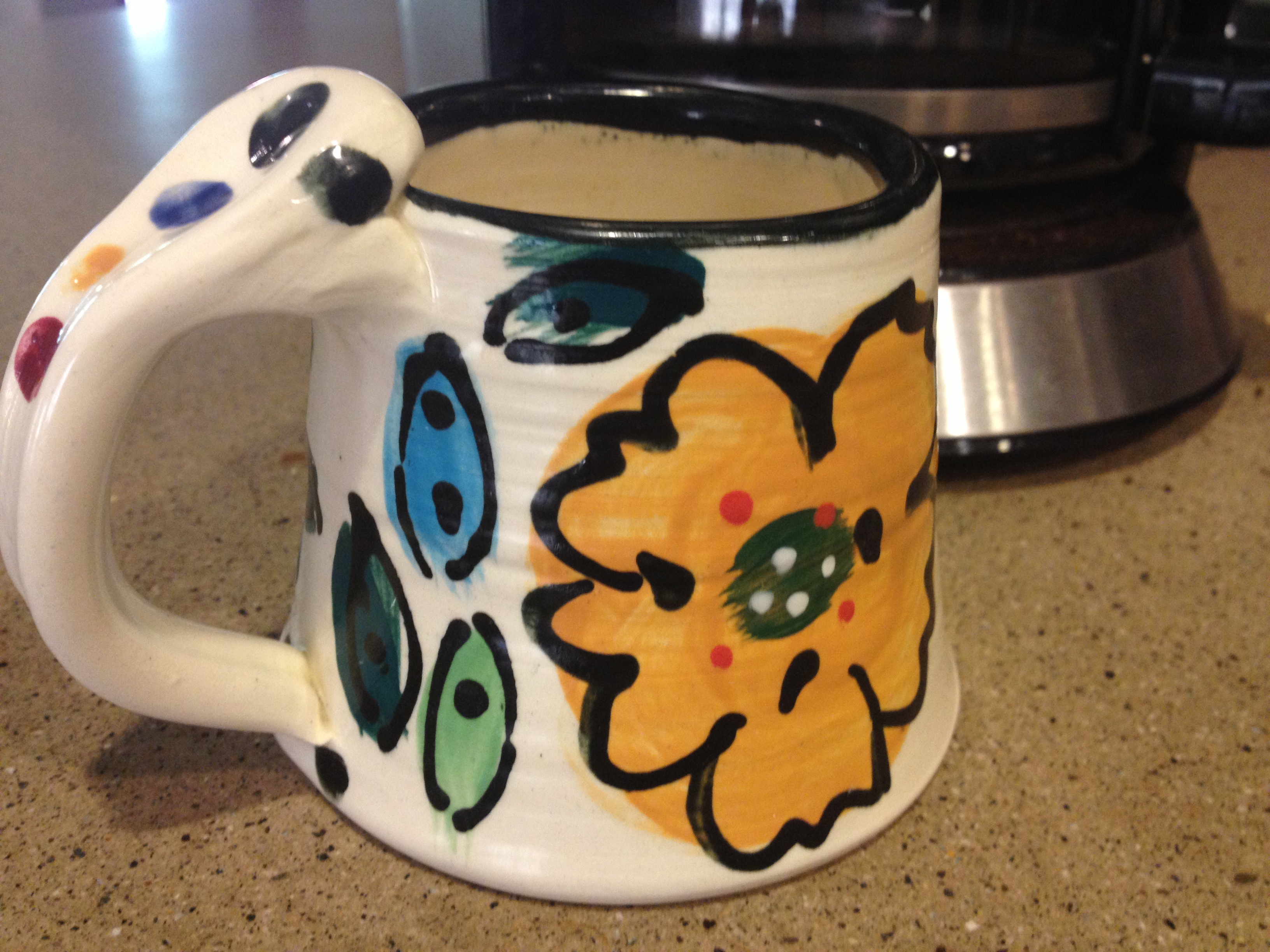
When I’m up first, which is most days, my husband offers to refill my coffee. I should return the favor. Without thinking, I pull a flowered ceramic cup from the cabinet, one of a set we purchased in Bisbee, Arizona from a local potter, Sonja something. The town, described as an artist’s colony, was romantic, although not in the way I’d expected. I imagined Southwestern sunsets in a quaint restored town, the Old West but with better coffee. We decided to follow the snowbirds south during a particularly rainy January in Northern California. Bisbee, that January, was freezing. It actually snowed. The wind whistled – it actually whistled — down the narrow lane that shot precariously up the hill, rising so nearly vertical that it reminded me of those paintings of San Francisco where the streets appear to bend at a ninety degree angle and head straight for a vanishing point in the sky. How could the cars stay on it? That’s the joke, of course. The artist – Thiebaud I think – has managed to capture what the eye sees, but exaggerated it so much that the image turns comic. Now I remember. The ceramic mugs we purchased that day were a pattern called Poco Loco.

The coffee maker finishes brewing in a final whoosh of steam as if to say “ta da!” Still blinking in the bright kitchen light, I notice that the dark liquid only comes up to the eight cup mark. I usually make ten cups since we have a third coffee drinker in the house these days. I carry the mug to the refrigerator, noticing how the smooth indentation at the top of the handle cradles the pad of my thumb. Without thinking, I pour a half inch of milk into Todd’s cup and start toward the microwave. And stop.

This was what I did for my father every morning. He liked the milk warmed for twenty seconds before the coffee was added. If you didn’t warm the milk first, you’d have to reheat it, he said. Whenever I forgot, he would rise from the table, cane in his right hand, coffee cup in his left, starting toward the microwave. Sometimes he would have made it from the kitchen table to the center before I rushed in to take over. Dad, here, let me! He would assure me that he was perfectly happy to do it himself – perfectly capable – but his unsteady walk said differently. He walked slowly, his right bicep flexing as he shifted his weight onto the cane; that side was sturdy enough. It was the left side that couldn’t be trusted. On that side, he still had to concentrate to achieve a natural stride. Swing it all the way forward and strike with the heel, the P.T. had coached him. When he didn’t consciously swing it, the sole of his sturdy walkers made contact with the floor too soon, turning the forward movement into a shuffle. His shoulder dipped as his left thigh muscle bore his weight and gave a little. From the back, he looked like he was limping.

Milk in a flowered ceramic mug, microwaved for twenty seconds, then two packets of Equal, and then coffee. That was the recipe. This morning, half asleep, I started to prepare it the same way for my husband. When I carried it to him in his chair, I realized he already had a cup. Two cups of coffee is better than one, I said. He slept well, didn’t wake up once. A rare morning.


Leave a comment

Filed under Uncategorized

A Handkerchief Man


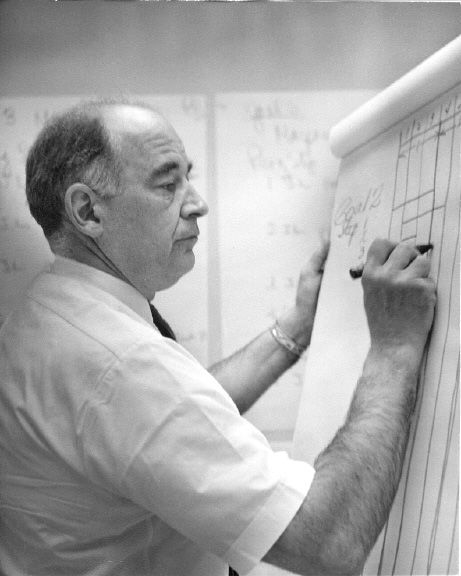
Circa 1972 - Hank - Weyerhaeuser

A few days ago, a brown Kleenex box triggered a flood of images – all of my father in his last year of life. He had shrunk by then so that we stood eye to eye, his broad shoulders rounded as if chipped away by a sculptor. All of his sharp edges were gone. Even his feet had lost their original conformation and spread like puddles (the same flat feet that nearly prevented his entry into the Reserve Officer’s Commissioning Corps but for an obstinate doctor who said he sure as hell was going to accept him).

As I wrote about the tissue box, I was thrown back forty years to a time when my father would never have carried tissues. He was a white handkerchief man.

Although my father was no longer on active duty, he still wore a uniform: neat pants, lightly starched white shirt, tie, belt and shoes (polished). Under protest, he capitulated to my mother’s demand, grew his hair longer and altered his grooming regimen in conformance to the “dry look.” Though a civilian, he remained prepared for inspection. Every Sunday, he assembled his gear to maintain his shoes: the brown terry cloth towel that would protect his trousers, the Kiwi shoe polish (brown and black), the mesh leg from a pair of pantyhose (successor to silk hosiery, back in the day), the long brush with natural bristles, and a bottle of Aqua Velva. Next to him, a row of sturdy Oxfords awaited at attention. In a process that seemed to take hours, he inspected a shoe, wiped off any dirt with a damp cloth, and applied a thin coat of shoe polish. Resting the shoe on his thigh, he buffed it to a sheen, rhythmically dashing the brush back and forth across the toe, along the side and around the heel. One-two, one-two, the same number of strokes each time. Then he paused to regard the result. Although any normal person would have stopped there, he was not done (he would say finished — he often corrected waiters who asked if he was “done” when they wanted to clear his plate). The process was not complete until the shoe had been dabbed with after-shave tonic to set the polish, and then buffed with nylon, see-sawing back and forth until the shoe was so shiny it reflected. Periodically my father would notice the sorry state of my shoes and suggest I polish them. What a waste of time, I thought.

My father looked out of place in the 70s. When he grew his hair longer to match the style, it flared out from his head in waves below his bald pate. I look like Guy Kibbee, he said, referring to the old actor known to play jovial buffoons. Shearing his hair in the style he preferred would expose him as the former Marine he was, an identity my mother was sure would limit his advancement, when protests against the Vietnam were at a crescendo.

My mother and I each had a part in maintaining my father’s standards of appearance. (The “boys,” my brothers, performed masculine chores like mowing the lawn.) My mother laundered Dad’s prodigious supply of white V-necked undershirts, white boxers and wool socks, ironed his shirts (permanent press though they were) and dropped and retrieved his light-weight wool trousers from the dry cleaner’s. But ironing my father’s handkerchiefs was my responsibility. One of few. I was hardly overburdened with chores like my best friend who seemed to be grounded every other week for failing to load or unload the dishwasher when it was her turn.

I am standing by the ironing board in the laundry room, setting the hot appliance on its heel while I lay a damp hankie across its surface. In this small utility room off the kitchen, crowded with the extra refrigerator at one end and the washing machine on the side opposite the wooden ironing board, I can barely turn around without collapsing the flimsy drying rack behind me. On the washing machine is the roll of handkerchiefs that I sprinkled with water the night before and then rolled in towel. It was the third time I’d prepared them for ironing — and then didn’t do it. My mother hollered at me, angry that my father was out of stock and exasperated that the hankies had been abandoned once again (they will get moldy, dammit).

I look out the laundry room window, half noticing the white spring sun as it lights on the hummingbird feeder sparkling with cherry-colored liquid. I’d rather bike over to my friend Ellen’s. Or go downstairs, where I get left alone. I’d rather be doing anything but ironing or be anywhere but home. In my reverie, I almost scorch the hankie.

Those were tough financial times for my family. So tough that my father convened a series of family meetings run according to Management By Objectives (complete with flip chart), a technique he used in his work as a human resources director. We play our roles according to type: Dad the planner, laying out the problem and situation; Mom the annoyed, noting that she had more house to manage than ever before, with less help; Bruce the eager, brimming with ideas about how he could help; and Dean the loyal, committing to find part-time work at a gas station (and doing so, within a week). Me the self-absorbed teenager. I did not see how I could possibly help, given how busy I was with homework and activities. I also contributed to the meeting evaluation by complaining that a family should not be run like a business. Duly noted by my mother in the typewritten minutes.

I finish my chore. I have ironed each square flat, folded it in half, then in halves and halves again. My father will fold it one more time when he places it in his pocket. I probably gave it to him. I never know what to get him, the man whose only interests are hunting and fishing. He knows exactly what he wants – another rod, another shotgun – or needs – another pair of Filson tin cloth pants, wool socks. Nothing in my budget, anyway, and nothing I’m interested in. So he gets handkerchiefs. I know he will open the gift ceremoniously, slicing the ribbon with his pocketknife (ever at the ready) and displaying the contents of the box with a flourish. (Handkerchiefs! Great, just what I needed, Betz!) I think, he is the most predictable human being ever.

I never predicted that he would become old, so old that we would stand eye to eye, so old that he would rely on Kleenex, wouldn’t even remember that he was once a handkerchief man. I feel ashamed by my teenage annoyance, my flickering embarrassment about my father, my glowering thoughts that I hid behind thickly mascaraed eyelashes. I remember the days when I still looked up at him, and he was a handkerchief man.

3 Comments

Filed under Uncategorized

Happy Birthday, Mom

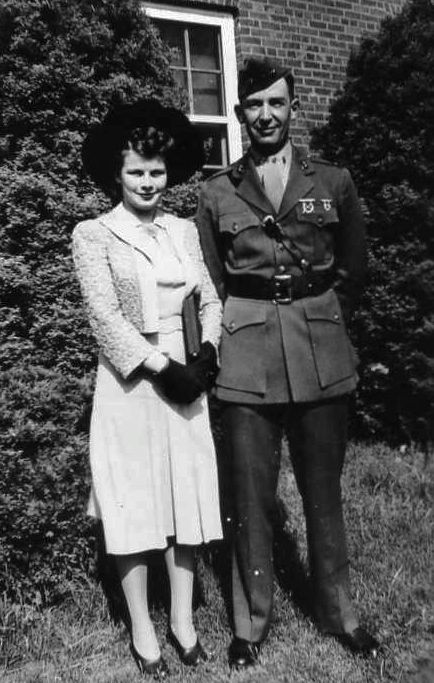
Eileen D. Campbell and Henry S. Campbell, 1941

My mother would have been 97 today. I’m sitting at the laptop in my office in front of a wall cluttered with pictures, my son’s and daughter’s art projects, and Mary Oliver’s poem that ends, “I don’t want to end up simply having visited this world.” I’m here because I need to start working on my writing assignment to “follow the image”: see something or remember something and trace its association back to wherever memory takes me.

My mother’s clothes float into my mind. (Why my mother’s clothes?) She was partial to wool and crisp cotton, blouses paired with pleated skirts and sharp jackets. Her style was tailored, classic, unfussy. Chanel style without the Chanel. Her favorite color, red, was emblematic of her personality. Red, the color of berries and lipstick and blood.

In my parents’ courtship story, her attire is a factor in my father’s first impression, “Then this vision entered the room dressed to the nines.” She was never a woman to be taken lightly, and her clothes said as much. So did her shoes. Though she never talked about clothes (other than the trouble she got in for intentionally ruining a classmate’s leather coat by slipping Limburger cheese in its pocket), her selection as an I. Magnin shoe model in college was offered as evidence of her superior calves and ankles. When my grandfather met my mother, he reportedly said, “Son, a pretty face will fade away but a good pair of legs is a joy forever.”

Two “nevers” as I describe her. Funny that I find it easier to describe my mother in terms of what she wasn’t rather than what she was: not the slightest bit kittenish, not shy, not retiring, not patient, not passive.

I know a lot about what drove my mother: only child of older parents, self-described Tomboy, hero worshipper of her pugnacious attorney father whom she lost in her 20s, treasured lap child of a grandmother she adored (whose one-size-fits-all medical remedy was to “make up your mind and throw it off by morning”). I know what made her mad (almost everything I did). I know what she believed (in God but not virgin birth). I know what she thought (she told me). But I know almost nothing about her longings, fears, worries, hurts, regrets. Her vulnerabilities.

Why are my mother’s clothes on my mind, today? Clothes make the woman. Though she adapted to fashion trends throughout the years (hostess dresses being among the least attractive on a short full-figured woman), she knew what suited her hourglass shape. Having been told by her father that there would be no “female barrister” in the family, she focused on the domestic front, becoming the best officer’s wife and mother that she could imagine, performing her duties with ferocious commitment. Image came with the territory. She may not have stopped conversation when she arrived for P.E.O., the Altar Guild, or a bridge luncheon but her outfits always elicited appreciative murmurings.

I remember surreptitiously inspecting her closet during the later years of her life, looking for signs of stains.

I first noticed that something was wrong with her in 1991, when my daughter was four and I was pregnant. We had gathered my husband’s family and my parents for Thanksgiving. I had planned to have Maddie sit by my mother at the makeshift long table, but Maddie refused. Maddie was adamant about sitting next to me. My mother was so hurt by the rejection that she cried. She cried. A snit, a retort, or a cold shoulder: these were reactions I would have recognized. For my mother to feel snubbed by a child was inconceivable as she approached her fiftieth year of marriage and nearly as many years of child-rearing. By that spring, when I came home from the hospital less than twenty-four hours after childbirth, I knew something was seriously amiss. Mom had arrived at my home and promised to take care of the house and me so that I could take care of my newborn. As her mother had done for her. When I entered the house around 6 p.m. and laid down on the couch, Tommy sleeping on my chest, she appeared over the couch and asked, “What did you have planned for dinner?” I was stunned.

I hurt for my mother, my proud mother, when her clothes fell short of her meticulous standard. This was the woman my father found crying, trying to sew a button back on, aware that she had forgotten how, she, the woman who knew not only how to sew but to tailor. So I took to sneaking into her room while she stood at the kitchen counter smoking and staring into space. “I’ll just throw a few of your things in with mine,” I told her.

If she was surprised, she didn’t show it. She invented stories to explain the new routines in the household. “Your father seems to have developed an interest in cooking,” she told me. Dad, like me, had slipped in.

That was awful, Mom, worse than the lung cancer I feared would kill you, did kill you. You saved the letter I wrote in third grade imploring you to quit smoking. It read, “If you die my spirit and soul will die.” Watching you slip away – proud, funny, bold, hot-tempered, outspoken, opinionated, organized, independent, competitive, dedicated, passionate you – was torture. You, the real you, the you before dementia stole your mind, did not just visit this world. You made of your life “something particular, and real.”

For the complete text of Mary Oliver’s poem, click here:


Leave a comment

Filed under Uncategorized

The Brown Box

brown kleenex box

To the casual observer, the tissue box looks worn, two out of four corners ripped, one side caved in, another mangled. Some Kleenex executive must have returned from Italy enthused about marbleized paper and decided that a little European flair was just what the product line needed. Some minion then dutifully produced a facsimile in a repeating pattern to decorate the cardboard before it was cut, scored, folded and glued into the shape of a box. The result is the brown box before me.

The design of the packaging is not important here. The brown is. Brown was my father’s favorite color, so I bought brown Kleenex boxes.

After dressing and emerging from his room at precisely 8 a.m. each morning (the hour he determined he would be less underfoot), my father pushed his walker to the side of my kitchen table and pressed firmly down on the handles that secured the brakes. He then crab-walked his hands along the edge of the table, moving carefully so as not to fall, and lowered himself into place on the far side. I rose from my chair nearby and surrendered the New York Times, reassembling it for him so that it appeared fresh from the porch. He offered to pour his own coffee, as he did every day. By then I was walking to the coffee maker, as I did every day. It was our little dance of manners; he would offer and I would decline. Coffee with room for milk, doctored with two blue packets of sweetener.

It was time for Kleenex. Every morning, while I prepared his coffee, my father prepared Kleenex with the precision of a Marine Corps drill detail. “Snap and pop” they call it. Dad had the snap but had lost the pop. In slow motion, he carefully withdrew one double-ply sheet of Kleenex (he insisted on double-ply) and laid it on the table, aligning it with the table seam that bisected the oval surface. A second sheet was pulled out. He then delicately lowered the second sheet onto the first, taking a moment to make sure the lower corners matched before allowing the top sheet to drift onto its mate. With impressive dexterity, he picked up the entire construction by pinching the top two corners between his index fingers and thumbs, this despite the loss of one top digit to a lawn mower years before. He raised the two double-ply sheets to eye level and inspected them to make sure that the creases lined up exactly. Then he folded the top half over the bottom, and reduced it to pocket size by doubling it again. When he blew his nose (damn post nasal drip, he would say), this improved Kleenex would provide a reassuring eight sturdy layers of absorbency. He supplied his left breast pocket with two such packets, and his left trouser pocket with two more.

The day could begin.

The prospect of running short on Kleenex was a constant source of anxiety for my father. He not only stocked his pockets, but tucked folded tissues under his bed pillows and stuffed them along the seam of his recliner. Every room that he entered was supplied with a large box. When a box in the bedroom, bathroom or kitchen reached the half-way mark, he asked me to buy more.

“How could we possibly need Kleenex again,” my husband asked as he prepared for a Costco run at one point. “I just bought it two weeks ago.”

My husband didn’t realize that, every night, Dad unloaded his pockets into his dresser drawer. Along with his glasses (kept in a plastic sleeve with his Col., USMC Ret., business card taped to the top), my father’s pockets disgorged his hoard: the small vial of nitroglycerin, travel sized dental floss, his wallet. But mostly, his pockets were a storehouse for wads of crumpled up tissue that would cover more than a square foot space with a two-inch high pile.

When I saw the brown Kleenex box with the tattered corners shoved in the back of a bathroom cupboard, I recognized it. It’s the last of the supply we laid in for my father.

These days, I buy tissue rarely, and when I do, I gravitate toward boxes with delicate patterns in light colors – peach, blush pink, pale yellow. But when I turn them over, I see that the saccharine message, written by some copywriter, remains the same: “With the perfect balance of softness and strength, each tissue soothes your sniffles, sneezes and tears and leaves your spirits uplifted.”

It’s hard to feel moved by tissues. They’re just absorbent paper in tasteless boxes. But this box, this ugly brown box, is a relic of everyday mornings in a sunny chair with coffee, the paper and Dad.

1 Comment

Filed under Uncategorized

Truth or Fiction

This startled me: a writing program faculty member stating that she writes nonfiction because it allows her to control how much truth she shares.

In fiction, she feels, she has to expose the deep feelings that drive the character. In nonfiction, she can choose what to include.

That certainly puts an idea on its head, and it’s got me thinking, I’ll say that.

I have always read that you must write your Truth when writing nonfiction. My Truth will most likely not be seen the same way by friends or family. And my Truth may offend. (So Phillip Lopate tells us to have friends to spare, and better to come from a large family.)

But my teacher is right that in nonfiction we choose what to include, what to leave out. Not only the Truth that might offend, but the ugly, distasteful, unflattering, and even unsavory voices in our heads, the little demons we carry with us, that make us flawed, but also human.

Leave a comment

Filed under Uncategorized

Writing In My Sleep

Bennington College

Where to begin writing. I awakened with the feeling of having dreamt this writing problem all night long. When I rose at a quarter past six, the driving refrain of Michael Jackson’s Smooth Criminal lyrics looped in my inner ear, “Annie are you okay, are you okay Annie.”

In my dream, I began, “He died, finally. Finally. He died.”

On Friday, my first attempt at a twenty page manuscript was discussed — “workshopped” —  as part of Bennington’s graduate writing seminar. Someone asked for confirmation that my father had died. You see, I had begun my story in the middle, at the point when I had reached the limits of multi-tasking and decided to retire to care for my father. In the manuscript, I never came right out and said he died, though I had implied it.

Yes, he died. On January 12, 2013.

They tell you, in writing seminars, to begin with the end in mind. To write with a sense of the feeling that drives your compulsion to write. To understand the fundamental question you are trying to answer. Note the singular: “question.”

Why do I write? Am I really writing about my father, or about me? Why did I decide to devote seven years to caring for my father? During those seven years, how did my relationship with my father change? How did I change? What does it mean to be a father, to have a father, to lose a father? What does it mean to be a daughter? What have I lost by no longer being a daughter? Why did Dad become nicer? Would I have cared for my mother in the way I cared for Dad? Why did I take notes when my mother and father were dying?

My notebook is full of self-interrogation.

When I awakened, I had that feeling that if I went straight to my computer to write, it would be there: the perfect beginning. I had formulated the first paragraph in my sleep. And it had worked.

A half hour later, the sentences have floated apart, smoky tendrils I cannot grasp and put back where they belong.

So I’ll begin, doing the hard work of following images back to elusive memories that await me. And I’ll begin again. Somewhere.


Leave a comment

Filed under Uncategorized