Tag Archives: Henry S Campbell

Yet Will I Try the Last

hospice notes and pills

When I’ve hearkened back to the period that my mother was terminally ill in 1999, I’ve always referred to it as “the bad old days.” I was so exhausted — by trying to keep up with the political machinations of my workplace, be some kind of mother to my then seven and twelve year old children, and care for my mother in rotation with my brothers. I’m proud of the work we did to comfort my mother at home, but it gave me a new definition of fatigue. And triumph.

Old age isn’t for sissies and neither is hospice. Even with the phenomenal care we received from Sutter Hospice, caregivers will feel taxed physically, mentally and emotionally. In the final week of Dad’s life, I updated the growing list of daily tasks that his primary caregiver would need to perform or supervise.

It’s hard to find much information about the practical realities of caring for someone in the terminal phase of congestive heart failure (CHF). Our amazing nurses – Diana Skinner, Mary, G.C., Tony and Barbara — answered my questions about what to expect pretty much the same way. They said that CHF and COPD (chronic obstructive pulmonary disease) are tough to predict; it almost comes down to the will of the individual. Having already realized that my father is one of the biologically tenacious, I expected that Dad would continue to fight to the very end. And so he did.

Even on his last day of life, he clung with a vice like grip to the bed rails, trying to raise himself from the heavy blanket of illness and fatigue that had settled over him.

If you are a hospice caregiver and you stumble upon this blog post, I hope you will not be daunted by the myriad details that you may be asked to manage. Your hospice team will teach you every step of the way. You have only to call and they will come. Hospice staff, volunteers and paid caregivers will help do what you cannot. Friends and family will cheer you from afar if they cannot be a part of the caregiving team.

But in the end, you WILL do it. Some days you will wonder if you can, or think you can’t. You will because you were chosen, and because it is in you. Your loved one knows it and needs you.

When doubt creeps in, take a page from my father and recite this passage aloud from Macbeth. Put some breath under it and raise your voice to a rousing crescendo:

I will not yield,/ To kiss the ground before young Malcolm’s feet,/ And to be baited with the rabble’s curse./

Though Birnam Wood be come to Dunsinane,/And thou opposed, being of no woman born,/

Yet will I try the last. Before my body/I throw my warlike shield! Lay on, Macduff,/

And damn’d be him that first cries, “Hold, enough!”

For the record, then…

INSTRUCTIONS Updated Jan. 9

Standing appointments:

Monday, Thursday 8 a.m. : Rebecca the bath lady comes. She thinks it is now best to bathe Dad in bed

2X/week (day varies): Dad receives a home nurse visit, usually from Diana Skinner, RN

Monday noon: Dad has a standing appointment here Monday at noon at the house with Abigail Kane-Berghash, a friend and massage therapist

Equipment

Fill water bottle on compressor with 1” of distilled water daily (usually care staff does this but make sure it doesn’t run out)

Getting ready for the night shift caregiver from Visiting Angels

They are not supposed to measure the medications but they can dispense what we pre-measure.

Pre-measure and set out on the medication log: 4 syringes filled to the ¼ mark with morphine, 2 syringes filled to the quarter mark with haloperidol.

**Don’t take Dad’s hearing aids out until he is in bed; the last thing you will do is swap the leg urine bag for the larger bag that hangs on his bedrail. The hearing aids let him hear you if he forgets what you’re doing “down there”**

OVERVIEW

Risks/issues you are always or commonly managing:

1)   All the normal health problems – with ongoing medications (morning and evening) NOTE: Dad is now getting evening Lasix (Furosemide) in addition to morning

2)   Shortness of breath and back pain

3)   Fall risk especially when he wakes up and thinks he needs to pee or is confused

4)   Bowel movements or lack thereof

5)   Catheter

6)   Agitation if it becomes a disturbance to sleep or comfort – this is now taking the form of hyper-vigilance, worrying about where I am

7)   Dad’s confidence and security – he is happiest if you’re sitting with him J

8)   Eating/staying hydrated

Sutter Hospice

Our regular RN/care coordinator is Diana Skinner but you can get help anytime from the 24 hour #. Hospice is providing:

  • Nursing visits 2x/week (or as needed)
  • Bathing assistance 2x/week – Rebecca (he has not been strong enough to get in the shower since 12/16 so they bathing assistants have been using washcloths, etc. He has also been too tired to shave on his own and I have also encouraged Rebecca to help him shave.)
  • Social work or chaplain may call and check in

Do not call 9-1-1 unless something happens like a broken hip.  Call Hospice if needed. The sad part: if Dad passes away, call Hospice first, too.

Medication

Dad is still taking all of the medications he was before except I am not bothering with the multi-vitamin because it’s big and Dad has enough of a challenge taking the pills when he is short of breath. I have started giving him pills in his room before coming in for meals while he is using oxygen.

He also has a “comfort kit” – see the overview of hospice medications

When Dad gets a new medication related to hospice or new issues, they usually order it electronically from Walgreen’s. The exception is the liquid morphine and liquid haloperidol, which is only available from Knott’s Pharmacy in Carmichael (new address).

Leg catheter

It needs to be dumped every 3 hours or so. If you do not see pee after 3 hours, CALL HOSPICE. It means the catheter is plugged and needs to be flushed.

It gets changed every 4 weeks.

Procedure:

Supplies: urinal and alcohol wipes

You can raise Dad’s pant leg to get at the leg bag

Remove cap

Get urinal in place

Open lever

Wipe nozzle with alcohol wipe

Dump pee – rinse out – spray with Clorox

* How dark is urine is tells you how much to push liquid; it should get lighter during the day but it does not have to be nearly clear *

Shortness of breath and back pain

Start with using the oxygen. Dad doesn’t have to use it all the time.

He generally needs O2 when he is on the john now.

Look for: belly breathing or gasping. Belly breathing = he is pulling in his lower stomach quite a bit and you can see the retraction near the apex of the heart. Sometimes his shoulders go up and down, too.

Worse shortness of breath: gasping and looking afraid, usually with exertion (which can be something as minor as lifting his arms to reach something or folding Kleenex)

Start with ¼ syringe of liquid morphine. See the black mark on the syringe.

If not eased after 30 minutes, give another ¼ syringe.

If ¼ stops being enough and you are always giving it twice, start giving ½ syringe

He can safely have up to 1 full syringe up to once an hour; it’s the equivalent of 1 vicodin.

Dad also has some back pain when we transfer him or if he has been straining in some way. It could be referent pain from congestive heart failure. Treat as you do shortness of breath. Morphine helps with both.

He is generally getting 7-8 ¼ syringes of morphine per day.

The night nurses are finding that Dad needs ¼ vial of morphine 2-3x during the night. He gets short of breath periodically. They also will put on oxygen if needed.

NOTE: Log the comfort medications (including Senna) on the log sheet, and what you gave it for.

Fall risk

Dad forgets that he can’t stand unassisted and he will fall if you are not aware when he wakes up. I am keeping his wheelchair, cane and walker out of reach on purpose. When he asks for them, I remind him that he is not using his cane and it’s not safe for him to get up unassisted – just call for me/us.

He is at especially high risk in the afternoon after a long nap. He also tends to be a little confused and agitated when awakening but has responded to gentle, repeated explanations.

He does occasionally say he wants to get up to pee at night but the night staff is right there and listening for him.

TRANSFERRING – really important

Have the care staff do it if they’re here, with you on “backup.” I prefer to have 2 people on hand.  USE THE CHAIR LIFT IF DAD IS IN THE RECLINER.

NOTE: He uses the wheelchair at the kitchen table because it has arms and it reduces the number of transfers.

**The big thing is to have the wheelchair at a 45 degree angle next to the recliner or bed, as close as possible, so that this is a pivot move.** Position one leg in between his. Your other leg should “lead” and be in front of where you are moving. Explain to Dad – every time – that he should try to push himself up and then you will bear hug him and “dance” into position. He is hard to get into a fully standing position and may be dead weight.

The hardest transfer is off the john. I now have a booster seat and that helps. The big problem is that he grabs the door and you get stuck in mid air, yelling at him to let go! [Update: I removed the door!]

Bowel movements

The primary medication that he is taking to try to keep him regular is Senna. It’s a gentle laxative – nowhere near as dramatic as Milk of Magnesia.

IMPORTANT: YOU SHOULD HAVE A BACKUP PERSON WHEN YOU MOVE DAD TO/FROM THE JOHN – HE TRIES TO GRAB THINGS AND IT’S DANGEROUS IF YOU TRY TO PULL DOWN/UP HIS BOXERS ALONE. IF YOU ARE ALONE AND HE HAS AN URGENCY, USE THE COMMODE. YOU CAN SEAT HIM BACK ON A TOWEL (WITHOUT HIS PANTS) IN HIS RECLINER IF NECESSARY FOR SAFETY.

We shouldn’t expect Dad to have a regular schedule like he has before. He’s had bowel movements at 5:25 a.m., 1 p.m., 5 p.m., 9:25 p.m., etc. You keep increasing Senna (adding in 1-2 glasses of warm prune juice) each day that Dad skips. Think of it as a reset button every time he has a bowel movement. And you HOLD if you go over the edge to loose stools – then start back with 1 senna the next morning.

So…

Day 1 after bowel movement: 1 senna morning, 1 senna evening

Day 2 after bowel movement: 2 senna morning + 1 glass warm prune juice, 2 senna evening

Day 3 after bowel movement: 3 senna morning + 1 glass warm prune juice, CALL HOSPICE FOR ADVICE, 2nd glass of warm prune juice at lunch, 3 senna evening

He can receive up to 4 senna tablets per dosing schedule, 8 per day but I’d talk to hospice before you do that.

Hospice may come out for a physical exam. There are “ultra absorbs” in the armoire to put under Dad. They put him on his side for this procedure. I help him stay on his side.

Agitation

Agitation now usually takes the form of Dad insisting that needs to get up to pee (or wants his cane) or perseverating about where I am.

Distraction is working OK during the day. For the peeing focus, keep explaining that he has a catheter and/or drain the urine bag. It’s more important to manage the agitation at night so he gets a decent rest. Haloperidol is preferred when this occurs at night.

Lorazepam is used for anxiety. Haloperidol is, too, but it is best when you can’t distract the person or get them off of whatever they’re perseverating about. During the night it isn’t possible to use reason/distraction, so haloperidol is the drug of choice for agitation at night.

Haloperidol dosing is just like morphine, and it’s liquid. Start with 1/4 syringe. If that doesn’t work, give a second 1/4 syringe in a half hour. It should make him sleepy.

To repeat what I said above, if morphine is being used to manage back pain or shortness of breath, it can be used in conjunction with Haloperidol.

Dad’s comfort and security

Really, he just wants to be in company with us – which these days means hanging out in his room with him and trying to be interested in what he’s watching when he’s awake. Or sitting at the table with him.  This is a scary time.

Eating/staying hydrated

I haven’t really been worried about food. His appetite is about ¼ what it was. But usually one meal per day gets eaten more. I think he’s getting enough food.

I encourage “small bites” – cookies or milkshake or toast – in between meals, if he’s awake.

I haven’t yet pushed Ensure. I do think his nutrition is adequate.

On the other hand, he is tending to drink too little, especially on a “sleepy” day so push fluids off and on.

DAILY ROUTINE – to the extent there is one! This is what I’ve found works best but you can try whatever you like.

6:55 a.m.        Rise and shine for you! Relieve the night staff

Find out how the night went/review the medication log

Hang out in the living room — make coffee

7:45 – 8:00    Most mornings you will hear Dad stir

He generally waits until 8 to call that he’s awake

8:00                Give him his hearing aids so you can talk to him; open the blinds

Ask if he’s in any pain

If he is, give him ¼ syringe morphine and give it 15 to kick in

Have him wear oxygen – it exerts him to sit up

Swap the night bag with the leg bag that attaches to the catheter

Raise the head of the bed a little, help him sit up and get his feet on floor

Leave boxers on (keeps catheter from being jostled); get clean T shirt, button down shirt and sweat pants. Put pants on just to knees (you’ll pull them up when you help him stand and transfer)

**I am now using the slippers full time instead of socks and shoes**

With a second person (ideally), transfer Dad and pull up his pants at the same time. Give him a minute with the oxygen to recover.

Give him his pills in his room while he is on O2. I now give them to him in batches; otherwise he gets too short of breath.

Put his glasses in his pocket.

Care staff will make Dad’s bed up – but push it back toward round table to give yourself room for transferring to recliner after breakfast

Breakfast:   Usually oatmeal or bacon and eggs in kitchen

Coffee: warmed milk with sugar

Prune juice (warmed) if he didn’t have a bowel movement yesterday

The usual – read the paper, coffee, etc.

This is his best time of the day for socialization! Try to converse a bit.

Around 10 or 10:30

Head back to the room to nap

Check urine leg bag

Transfer to recliner

Put feet up and cover him with blanket

He should probably use his oxygen for a while after moving

He will likely sleep for a couple of hours

If he takes oxygen off, but starts being short of breath, I put it back on

**If he sleeps until 1:30 or so, I may awaken him and suggest drinking apple cranberry juice, which he likes. Note: Hospice says it is usual to sleep more in the last 1-3 months of life and this is part of the process of letting go. They suggest letting him sleep.**

If it’s nice out and he doesn’t sleep as long, transfer to wheelchair and get some fresh air outside.

He has generally not needed morphine during the day – but there are “bad days” and it’s hard to predict

Around 1 or 1:30

Dump urine bag

Transfer from recliner to wheelchair

Encourage lunch – he may need O2 if breathing is difficult

Best liked right now: open face cheddar cheese sandwich + tomato soup

Prune juice if day 3 after BM

He will probably sit at the table for a while – this is also a good time to try to engage Dad

3 or so          Return to room

Check urine bag

Repeat drill to settle in chair for afternoon

**Awakening from nap is usually most confused period of the day. Be especially cautious about watching him for trying to get up**

5                      Think about dinner/do prep as needed

Dinner – He did have lamp chops – the kind with the rib “handle”on Christmas eve. Favorites: mashed potatoes or baked potatoes (still).

Chocolate cake and milk. I don’t give prune juice at night.

Give evening pills in his room while he is on O2.

6 or 6:30        Dinner

If Dad has not had morphine, I usually offer a little red wine (habit/tradition)

Brushing teeth after dinner

He is too tired to do it later, and he can’t stand

We’ve kind of figured out a routine where he stays in the wheelchair and I hold my hand mirror while he brushes; then I hand him water and hold another glass for him to spit. He like to floss first and do the tooth brushing in 2 increments: first upper (spit), then lower

TRANSFERRING AFTER DINNER:

Knowing that we will be undressing later, I usually pull Dads sweatpants down in the transfer after dinner, then cover him with a blanket (and put socks on)

TV after dinner: Dad doesn’t seem to want to watch anything but Military History Channel and CNN but you can surf around or look at “recorded TV” (button on remote) and see if there’s something you might enjoy

He will usually sleep in his chair around 8:30 but stay with him – he will awaken off and on and may start to undress

9:15                SET UP ROOM FOR NIGHT:

Move bed as close as possible to chair to minimize transfer distance

Dump urine

** I usually have the night care staff help me get Dad undressed for bed, and then transfer him **

9:25                Doorbell rings – night staff

Get undressed for night – throw t-shirt and sweatpants in wash

Night staff will work with you to get Dad into bed;

Use the half sheet to adjust or boost him if needed

**Swap out overnight bag for leg bag**

Probably a good idea to start with oxygen after exertion of moving

The night staff know how Dad likes the lights; PUT THE CLOCK ON SMALL TABLE BY HIS BED

They will need help moving the living room chair into place by his door.  9:30  GOODNIGHT!
1 Comment

Filed under Uncategorized

“LOVE” and “NO UNFINISHED BUSINESS”

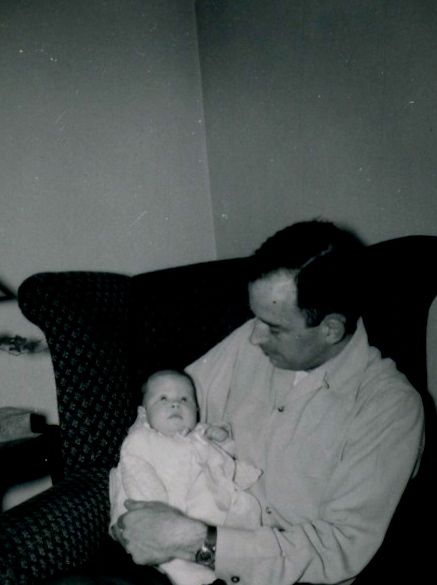
Henry Campbell and Madeline, 1950

Dad with little Midge, 1950

Today is the day after the day after Dad died. And it feels like a week ago. I slept, really slept, in a spare bedroom at my in-laws, a half mile away. I slept without listening for trouble in the night, and without awakening to catalogue the things that grow disproportionately in importance in my unconscious brain.

Everywhere I went today, the people in my life who had come to know my Dad cried when I told them he had died. Our family internist, Dr. Flaningam, called after work hours to extend his condolences and his compliments for the quality of life we helped Dad to achieve in the seven years since he moved to California.

We removed the medical equipment that helped keep Dad comfortable. As helpful as these things were — the commode, the hospital bed, the oxygen compressor, the nasal cannula, the air bed — I hated them. They represent the rudeness of old age and the torture of dying. I banished them to the garage and tossed out the bedding that served my Dad on his last day. I am still shaking my fist at death for taking Dad even though I know he wanted to be released and I wanted that for him.

Knowing that they were leaving tomorrow, my brothers began to sort through Dad’s things — his hats, gloves, socks, shirts, fishing gear, knives.  I know it made sense for them to choose things they would like now while they are together; Dad, if anything, was pragmatic. He had “good gear” and he would want to see it used. Irrationally, I just wasn’t quite ready for the divvying.

During the day, we reviewed a draft press release that I wrote describing Dad’s accomplishments in the Marine Corps. We picked over this detail and that, but in the end came up with an accurate history that we all could agree to. After we approved it, I sent it to a few newspaper editors.

As dinner approached, I was feeling pretty low. For the first time, I faced across the dinner table and Dad wasn’t there. Bruce and Dean were in his customary spot, the “defensible position” on the far side of the table. I started to cry.

Over dinner, we talked about Dad. The news release focused on the accomplishments that news media might find noteworthy, but what did we really think was the story of Dad’s life?

Bruce said that he felt he got to know Dad better after Mom passed away. “He became my hero,” Bruce said, not only for what he did in the war but for the extremely difficult things that happened to him. “I got to know who he was,” he said.

As we talked more, we concurred that Dad became more loving, gentle and non-judgmental as he aged. Scott said, “When I did something stupid, Dad would let you talk and help you lay out your alternatives. He’d let you pick your course of action, but once you did, he’d back you up.”

We all acknowledged that Dad changed after leaving the Marine Corps. As Dean put it, “Dad was incredibly career focused. He was so focused on achieving the next milestone that he didn’t have time to smell the roses… Once Dad set aside his ambitions, he reassessed what was important.”

We all know what was important to Dad in these last decades of his life. Mom was important…and we were important.

We haven’t written his obituary yet, but we are going to try to write about who he is, not what he did. I capitalized and underlined these two phrases:

LOVE

NO UNFINISHED BUSINESS

2 Comments

Filed under Uncategorized

With Love, to the Last Breath

roses

At 6 p.m. tonight, Dad took his last breath as my brother Dean told him that he loved him, and as I read Shakespeare’s Sonnet 130, one of Dad’s favorites. To understand why my Dad loved that particular sonnet so much, you have to appreciate how he “fought for his pants” every day of day of his wonderful marriage to my mother. Not long before he died, his eyebrows lifted up, the way they would when he saw someone who delighted him, and his lips moved as if he were speaking to them.

Dad, this is for you and Mom, thanks to the Bard:

My mistress’ eyes are nothing like the sun;
Coral is far more red than her lips’ red;
If snow be white, why then her breasts are dun;
If hairs be wires, black wires grow on her head.
I have seen roses damask’d, red and white,
But no such roses see I in her cheeks; 
And in some perfumes is there more delight
Than in the breath that from my mistress reeks.
I love to hear her speak, yet well I know
That music hath a far more pleasing sound;
I grant I never saw a goddess go;
My mistress, when she walks, treads on the ground:
   And yet, by heaven, I think my love as rare
   As any she belied with false compare.

Their love was rare, and they are together again. But, dear Dad, I will miss you.

4 Comments

Filed under Uncategorized

Preparing

photo[4]

I am listening to my brother Dean in Dad’s bedroom, “I’m right here with you. I love you.” He’s telling him the story of chukar hunting with our sweet Springer Spaniels, Beall and Katie.

A little while ago I heard Maddie reading a beautiful passage from Kubla Khan, by Coleridge:

“In Xanadu did Kubla Khan/A stately pleasure-dome decree:/Where Alph, the sacred river, ran/Through caverns measureless to man/Down to a sunless sea

So twice five miles of fertile ground/With walls and towers girdled round:/And there were gardens bright with sinuous rills,/Where blossomed many an incense-bearing tree;

And here were forests ancient as the hills,/Enfolding sunny spots of greenery…”

I hope my Dad is imagining himself in a sloop on that sacred river, on his way to his mother, my mother, and his daughter, Midge. Or perhaps out in a field on a frozen morning in Eastern Washington, quietly walking through the stubble of a wheat field.

He is on his way. He took a turn for the worse a couple of days ago, and his heart – that has served him so long and well – just can’t do it any more.

I have set the table in the living room with things that have meaning: the pictures of my mother and my brothers that he has commented on so often in the past week; his college Shakespeare volume that Tommy thought to fish out; a bear from my cousin Louise and her daughter Mary; beeswax candles from my cousin Lynn and her husband, Henry; Remy Martin VSOP brandy; memory books I created for Dad; a collection of his favorite memorized passages; and chocolate, lots of it. Chocolates given by my mother and father-in-law for Christmas; Frango mints that were my grandmother’s favorites; chocolates brought in December by my friend Lisa.

Dad hears us and knows we’re here, though he cannot respond. Other family members arrive tonight and tomorrow. I don’t know what moment Dad will choose to let go; he doesn’t have any experience with quitting.

As Dale Swan, the Sutter Hospice chaplain, said to me, “This isn’t giving up. This is his victory lap after a life well lived.”

What I think I will say to my Dad is what Dad said to Mom as he held her hand, when her heart stopped on May 10, 1999: “I love you. You will be with your mother and Midge. And I will be with you again.”

We will miss you, Dad. I am so incredibly grateful for the legacy of your love in my life.

5 Comments

Filed under Uncategorized

“They Were Siblings, Right?”

They Were Siblings

Tonight at the dinner table, as my Dad looked at a picture of my three brothers, he asked, “Scott, Bruce and Dean, they were siblings, right?”

I answered smoothly, “Yes, and they still are,” but my heart skipped a few beats.

That kind of confusion has been accelerating. Awakening earlier than usual yesterday morning, Dad asked me, “Who put me here? Where am I?” And this afternoon he asked, “Whose house is this?” He’s spent hundreds of nights in this house since we moved in six years ago.

He does not seem to be afraid during these periods of disorientation – he sees and recognizes me – but they shock me.

I’ve talked about the physical challenge of Dad’s decline, but I think his cognitive changes are the scariest. I don’t really understand them, and I don’t know what the future holds.

It’s one more thing that I have to find a way to be at peace with, so that Dad can be at peace.

Leave a comment

Filed under Uncategorized

For a Brave Surgeon: Thank You, Dr. Kari Vitikainen!

Credit: University of Southern California

Today, I am mailing this letter to the surgeon who decided to perform my Dad’s third and final coronary artery bypass graft (CABG) surgery in 1999:

Dear Dr. Vitikainen,

I hope you don’t mind me tracking you down through Bruce Wheeler, M.D., in Tacoma. I’m fairly sure you won’t remember me, but I wanted to track you down to thank you for the nearly 14 years my father, Henry Campbell, has enjoyed since you performed what we all knew was a high risk CABG surgery in April 1999.

I am sure that surgery as a specialty carries a fair amount of gratification. But I hope this letter will give you just one more chance to remember what a difference your skills made.

In my Dad’s case, you saw an 82-year-old man struggling with extreme angina who was in the hospital following a small heart attack. He had his first MI in 1962 and had already had two prior CABG surgeries. We all felt that nothing more could be done. But… his wife, my mother, was home with very late stage lung cancer. He hoped to be able to return home so that he could be with her in her final days.

You were also the surgeon who was able to repair the tear in my mother’s very friable lung in February. That repair made it possible for her to go home with hospice, which she did in late February. I remember fighting with the physician who was in charge of her care initially; he told me it would be “kinder for all parties if she just winked out in the hospital.” We felt differently. She was afraid in the hospital and we knew she would want to die in the comfort and security of her own home.

I remember sitting with Dad in the hospital, hooked up to a drip of nitroglycerin that was as strong of a concentration as possible. You came in and told him you thought it might be possible to consider surgery – that his heart function was quite strong. If he had enough veinous material that would work, and other indications turned out to be favorable, just maybe a CABG was possible. You explained that the surgery would be high risk. “What do you mean by high risk?” my father asked. You said that he had at least a 25% chance of dying due to complications from the surgery.

From my father’s perspective, he had a 100% chance of dying soon without it, and would not get to be there for my mother. He opted for the surgery.

We know that the surgery was difficult. It took five hours to open. When Dad was recovering, you explained to us that this surgery was unlikely to last as long as the others given the amount of blockages and damage to the heart that could not be repaired. You estimated five years.

My Dad is now in hospice, here at my home, almost 14 years later. He has had some great years in between.

Perhaps most importantly, he was holding my mother’s hand at the moment her heart stopped, the day after Mother’s Day, May 10, 1999.

In those initial years after Mom’s death, he lived in the family home in University Place. He continued to hunt with his friend, Bob. Eventually he felt he should no longer drive and he moved to Seattle near my brother, Dean. He had a major stroke in 2003 or 2004 from which the doctors at UW expected he would not recover the ability to walk. He eventually walked unassisted without dragging his left foot, and had a complete recovery. (In later years, he used a walker for balance, but you still could rarely tell he had any effect from that stroke.)

I moved Dad here in 2006 when he was becoming more isolated and it became more difficult for him to walk alone in the Seattle wet. I retired to have more time to spend with him in what we expected would be a short time ahead of him. Until this summer, we walked together at least five days a week. He had another small stroke while living here – this one affected his speech temporarily but the effects disappeared within days.

If you’re keeping score, that’s one major heart attack (1962) and two small ones, three CABG surgeries, one major stroke and two small ones.

We’ve had a lot of great times together. He’s continued to entertain us all with vast amounts of memorized poetry. He’s seen the family grow. Until 2010 we took him on family fishing vacations. He and I have traveled to the Monterey Aquarium for his birthday, and last summer, to Seattle for a family reunion. Although he had an assisted living apartment the past few years, he has spent about three-quarters of his time living at my house. And we’ve had many a pre-dinner glass of wine and convivial gathering.

He is very much “himself” although he is now quite weak and struggling with late stage congestive heart failure, and in hospice here with me. He expresses gratitude constantly for me, and for the team of people who help him. He continues to be a gracious, humble, loving man.

In 1999, when you performed that last CABG, it was outside the norm to consider surgery on an 82 year old man with a long history of heart disease. I just want you to know: that was a great decision.

We’re down to the hard part – the failing and the letting go, and it isn’t easy. But he is safe, and loved, and cared for.

As I review the times we’ve had with Dad, I could not help but think of what made it all possible: your initial decision. I just wanted to say THANK YOU!

2 Comments

Filed under CHF and Other Medical Problems, Uncategorized

The Post That Shall Not Be Named

This blog post has alternatively been titled, “Laid Bare,” “Kicked in the Gut,” “Is This a Guy Thing?” and “WTF?” I thought about leaving the prompt, “Enter Title Here,” but that seemed a little too odd.

This post is about how, in the face of loss, differences in personality and coping approaches are laid bare. It’s about family. It’s about needing emotional support and not always getting it. It’s about how we are all human, including my brothers and me.

When my mother was ill and in hospice in 1999, my brothers’ personalities and mine were on full display. One brother responded characteristically by getting organized and applying his keen mind to the problems of medication and comfort; he was utterly reliable, a rock, and a little on the anal retentive side (said lovingly). Periodically his tough outer shell would crack and you could see the anxiety and pain that he held in check.

Another brother seemed to avoid coming around during Mom’s 3 1/2 month illness. He would come be her caregiver if asked, but there was a reluctance. After she died, he poured out his heart in the form of rituals and writing a speech about his memories of her.

From this and other experiences, I have learned how differently people grieve. I place no judgement on it. It just “is.”

We as a family — or as a team of caregivers — are not unique in the variation of our emotions and response.

My fellow member of the Caregivers Social Club (which has a membership of two) went through a health crisis last weekend when her husband, who has Alzheimer’s, was hospitalized with a life-threatening slow bleed in the brain. When we met for a glass of wine Thursday, according to our standing date, we talked about her husband’s sons’ responses. They talked about the brain bleed, the procedure and the prognosis for the procedure. But noticeably absent was any expressed emotion about seeing their father impaired by Alzheimer’s, acknowledgement of their own feelings, or sympathy for how hard this is on my friend — his wife — emotionally. But I know how hard it has been on her. While one part of your brain is whirring away managing symptoms and preventing problems with carefully executed clinical steps, another part is watching, feeling and hurting. She is constantly managing her husband’s emotions with patient reassurance, but most of the time no one is taking care of hers.

This week, I felt like I was kicked in the gut when two brothers cut their plans for visits shorter. Like my friend, I am busy – very busy – with Dad’s medical and physical needs. But I am also a little overwhelmed emotionally as I see new signs of decline arise every couple of days, if not every day. Dad’s not in crisis, but there is a slow-drip of worsening symptoms.

Maybe the mental thought process goes something like this:  Betsy sends near-daily email updates about how new problems have been identified and managed. Needed more caregiver help? She got it. Needed medications adjusted? She did it. Conclusion: “Betsy’s got it handled.”

Part of what has kept me going for the past four weeks has been looking at the calendar to the next date when one of my brothers would come and take over for 5-7 days. Unfortunately, through no fault of his own, the one who was to come yesterday got sick. But oh, did I feel crestfallen.

I wrote an email asking my brothers to start committing to a longer stretch at least once a month. I talked about the physical and emotional challenges, and about wanting make sure that I also spend some time with my husband, who now has my attention and company for a half hour or so before Dad awakens, and about 15 minutes after I come to bed and he falls asleep.

By happenstance on Wednesday night, one brother sent an email shortening his upcoming stay from four days to three saying that he needed to be home. The next day, my brother who had rescheduled his trip from January 4 to January 16 sent an email saying that he was shortening his visit from the requested six days to three so that he could celebrate a family birthday.

I hate asking for help. I really do. I’m a “handle it” kind of woman and always have been. I figure that my brothers know that. I think my emails all but beg for reinforcements.

My friend, Ellen, who I wrote when I was crying and needed to vent, observed that my brother’s email saying he was shortening his planned six day visit to three days contained no expression of feelings. I also thought it was interesting that he didn’t call. Just sent a two-sentence email. The day before, my Caregiver Social Club buddy described the same lack of emotional expression when she conversed with her husband’s sons.

Is this a guy thing? I don’t know. I think it’s a not-here thing and a scared thing. If you’re not here, you don’t see it and can comfort yourself by knowing Dad is getting great care. And a terminal illness – whether Alzheimer’s or congestive heart failure – is scary. Alzheimer’s perhaps especially so because of the genetic linkage (although the sons supposedly don’t carry the same gene).

When family members respond by sharing and pulling together, they grow closer. Unfortunately, the reverse is also true. I’m frustrated, hurt and trying not to be angry.

My hope is that when the brothers visit who have not seen Dad in a month or more, they will get it. They will understand that we need to be a true caregiver team and take turns. And that we each have something to say to Dad, some special kind of comfort that only we can offer. It’s time. Dad needs them and so do I.

1 Comment

Filed under Uncategorized

I’m Not Alone

morning candles

It’s been almost seven years since I moved my Dad to California, knowing that his cardiac disease was catching up with him. We’ve had quite a few scares since then: a small stroke that temporarily interfered with his ability to speak, a strange seizure, numerous falls and illnesses. During one of those scares, my husband was in Mexico, unreachable, and I was alone at the hospital with Dad, afraid.

I hate being alone when Dad’s life is at risk. I can handle the decisions that need to be made. I can handle the physical challenge of the long hours. I can be strong for Dad so that he is not afraid.

But I want to be able to cry and have someone to hold and comfort me when am afraid. I just don’t want to be alone.

Yesterday my first morning thought was of all the people who are, as one friend puts it, “holding me in the light.”

In recent days, I have heard from a college friend with whom I have been out of touch in recent years. My spiritual and artistic cousin, Lynn, has become the angel who perches on my shoulder with frequent, loving messages, like this one:

Whenever I read your ardent posts as I did just now.. and look at your exquisitely poignant and palpably tender photographs.. I am reminded again and again of the Rumi stanza..  that I am sure you are familiar with but I can’t help writing:“Let the beauty of what you love be what you do.” –Rumi    

 Mostly, I want you to know this New Year’s eve that even though it may seem I am in the background I am a part of that large net beneath the high wire you are walking– where by the way, you are dazzling in your diamond light.  I am not quite breathing with you, but almost…

My dear friend, Lisa, who spent the day on the 18th hanging out with me and cooking for me, is in Italy with her family where she is lighting a candle in every church she encounters. When traveling, Lisa normally devotes her laser-like focus to something food-related, like tasting lentil soup in Turkey, but on this trip, she says she is thinking of Dad and me. She wrote:

It is making me feel slightly better — but marginally so — wish I could be with you to help you through this important time. Your dad is a great man, and you are the best daughter and friend anyone could hope for. Miss you.

Yesterday I wrote my oldest friend, Ellen, about how she had rescued me when we met as lonely adolescents. She wrote back:

I have loved walking this current path with you. I have felt your sadness and pain. I have cried with you. I have wondered, and asked, and railed with you. I have grown with you. I have deepened and broadened who I am with you. I want to be there with you, but also know that you would be caring for me, and worrying about me, while at the same time you are caring and worrying about everyone else in your life. It’s your nature.

This is a hard path. But it’s far harder on Dad as he struggles. The love and support of family and friends makes all the difference. It holds me up so I can hold him up.

5 Comments

Filed under Uncategorized

Planning Care for the “Biologically Tenacious”

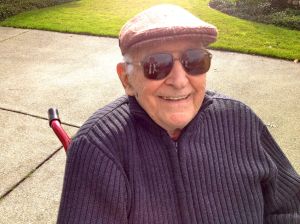
Henry S Campbell

As Dad has weakened the past few weeks, I’ve been preparing myself for his final days. That means coming to terms with what his dying may entail (ugh) and what his loss will mean to me and my family. A tall order.

Enter my husband who reminds me that, “Hey, don’t forget. This is your Dad.” Sure, Hospice thinks weeks to months, and it looks like he may have weeks to months based on all indications. But still. We’re talking about the guy who has survived war, heart attacks, strokes and high risk cardiac surgeries.

This phrase struck me in Sidney Callahan’s post about her mother’s long, long illness with Alzheimer’s in the Over 65 Blog published by The Hastings Center: “biologically tenacious.”

My husband’s grandmother was biologically tenacious. Like Sidney’s Mom, she still enjoyed eating and was comfortable, even though she hadn’t spoken or seemed to recognize people in years. And Gigi always said that she had “a bad heart,” something that amused us as the pages turned on the calendar, long past her 100th birthday.

I also have to be prepared – or at least set up for – Dad’s body persevering even if his mind and heart would prefer to move on. He is still a Marine, and some inner core of him doesn’t know the meaning of “quit.”

In practical terms, I have to have a reliable team of caregivers to help me care for Dad safely here, which means being able to transfer him safely until such time as he is confined to bed. I have a great partner in Visiting Angels, and an independent caregiver who was suggested by a family friend, but I’m not in a reliable groove yet.

This is a practical challenge when someone is facing the end-of-life: scheduling. If my husband wants me to join him with his folks to see Les Miserables, I have to have a caregiver who is capable of transferring Dad alone. On a weekend, if my son wants to run with Todd, leaving me alone in the house with Dad, I will need them to stay close to home in case I need help. The toughest transfers are on and off the john, which really takes two people. And unfortunately, there is no pattern as to when Dad’s urge might strike.

I want to be able to be a daughter and support my Dad every step of the way, but I know I must also make time for my mental and physical health. I don’t feel any resentment at the commitment I’ve made to move him to my house and have him spend his last days here, but I know, if enough time goes by, I might feel that way.

Semper Fidelis, Dad. I will find a way to make this work for both of us.

2 Comments

Filed under Uncategorized

Taking Stock of My Journey with Dad

Henry Campbell Dec. 23 2012

I’m one of those people who likes to take stock and tidy up as the new year approaches. But instead of cleaning my office as I have in years past, my attentions are here on this blog. Looking at the “About” description, I realized how its content has changed as Dad has aged and weakened. It started as a celebration with a few funny bits and occasional bits of advice thrown in. I wrote from the head, thinking, how can I capture useful insights from this experience for me to remember and for others to benefit from?

Last summer, as Dad’s health began to fail, I started writing from the gut. I wrote about my experience, about feeling vigilant, not just about Dad but about everyone in my life. I wrote about not sleeping. I felt a little like a mother hen trying to keep the chicks safe in the nest.

In the process of seeing Dad start to slip, I became more aware of and grateful for family and friends, especially my amazing husband of 30 years. My post on our anniversary, “30 Years of Opposites: Happily Ever After,” became my most-read post of the year, with over 300 views.

In October and November, The Henry Chronicles took on a more somber tone with the loss of my “other mother.” In the last month, my posts have expressed my desperation to turn things around and my anger at God when I could not. Without planning to do so, I find myself writing almost daily in the quiet hour after the night caregiver leaves and my Dad calls out that he is awake and ready to get up. One morning I thought about all of the people who have been supporting Dad or me, and I said thank you to “Team Henry.”

I’m no longer trying to be smart or useful. I’m just trying to get through this time with as much strength for Dad as I can. I keen online because I can’t help it. By releasing the terrible pain and fear that comes with caring for someone in the last months of life, I feel better. Maybe it’s self-therapy, online.

I do draw great comfort from the small company of friends and followers who read my little posts and share their own experiences, or offer a supportive word. I’m kind of amazed that, in this frenetic holiday period, people are willing to read something that isn’t about the fun of the holidays.

I may be hanging on by my fingernails, but I am hanging on.

The “About” page now ends with: These days, this blog is about coming to grips with the impending end of his life, a search for faith and understanding, and a longing for strength so that I might offer him the same unconditional love that he has always given me.

Leave a comment

Filed under Uncategorized