Tag Archives: family

Chaos and Comfort

Friend card

My friend Sharon has been laughing at me all weekend. It started soon after my arrival when I began straightening up, knowing that her family was coming in the next day.  It’s what a good guest does, I said. But she and I both knew the truth. I’ve become a teence obsessive, an aftermath, perhaps, of feeling that things were so out of control as my father lay dying a few months back.

Every time I open one of her cupboards, my palms literally itch to organize them. Most of the cans are on an upper shelf, but why are the canned clams on the shelf below it? Why is the sugar in a baggie on the floor?

I itch, but I don’t fix. I realize that this is her home, and she likes it comfy.

Walking Saturday, our conversation turned to families. She has been “an orphan” for some time, one of four children born within a five year span. I talked about my evolving relationship with my brothers. A recurring question for me in the months since Dad died has been, “Who is my family now? Who are we to each other?”

There is choice involved now, you see. Dad gave us a reason to come together for birthdays or holidays. He was the draw. Though there may still be obligation, it is less compelling.

In families like ours, where there are more than two siblings, there are affinities. A pair might feel more like-minded and naturally confide in one another. Or having the distance of a couple of years and a sibling in between, they might feel less competitive. A common interest — like trout fishing — may foster a bond.

We grow up with a natural place in the family architecture. My Dad’s family referred to the eldest brother as “the handsome one,” the youngest brother as “the sweet one,” and my Dad, the middle child, as “the smart one.”

My friend and her siblings are finding their way. It’s hard to say if their paths will draw them together, or push them apart. They may become more intransigent, or, like my Dad, more tolerant.

You can rearrange cupboards but you can’t rearrange your siblings. Their comfort may be my chaos, but we are the only people in the world who carry the precious and intimate knowledge of our family from childhood forward.

Leave a comment

Filed under Uncategorized

With Dad Gone, A Void (Part Four)

photo[1]

Napping…

To start at the beginning of this little series, click here.)

Now that I am home, really home, after Dad’s death, I am coming to terms with my identity all over again. Carol Mithers wrote a very poignant essay in the New York Times entitled, “Suddenly, They’re All Gone.” Instead of being relieved when five years of caregiving for her mother-in-law, then her father-in-law, then her childless aunt and finally her mother died, she felt worse. She concluded, “While you’re caring for the old, you can’t believe what you’re called on to do and where you find yourself, can’t believe that your time with them will ever end. Then one day, it just does.”

As Dad became more fragile, and I became more vigilant, caregiving did become all consuming. I was neither angel nor martyr; like Carol, I had my days when I lost my temper when Dad locked on to something about which he was dead wrong. But many times, it was a pretty zen experience.

Dad always asked me if I got tired of walking with him or hearing his bits of memorized poetry. I could honestly answer, “Never.”

I miss it.

3 Comments

Filed under Uncategorized

Naked Shredding and Other Awkward Retired Moments (Part Three)

photo[5]

The project plan and portfolio of materials for Friends of Hospice (design by Pat Davis of Pat Davis Design)

(To start at the beginning of this little series, click here.)

What came next was… a whole lot of nothing. I had cleared the decks in anticipation of Dad moving to California, but he was hesitating. Even though he had already made THE BIG MOVE out of the family house three years prior, he was now nearly 89. Moving sounded so daunting: packing, change-of-address, changing doctors, etc.

I no longer had to check my Blackberry constantly for new texts or messages. My phone wasn’t ringing, and I didn’t have to coordinate my calendar through my assistant.

No one was looking for me, needing my input or approval.

I found out, as many retired caregivers do, that you are not quite as essential to the world as you thought you were. The void of your departure quickly fills. You find out who your real friends are.

I enjoyed walking in the cool of the mornings in Davis. I started going to yoga. And I began cleaning out my house with a vengeance.  I started tackling old papers, many of which needed to be shredded.

During those early days, with Maddie and Tommy off somewhere, and Todd at the office, I began to question my old routine of showering, blow-drying hair, dressing and putting on a little makeup. I dropped hair and makeup.  Who was going to see me? Then I started skipping showers on some days. Who would notice? And one day it just seemed stupid to dress. Why dress if no one could see you? It just adds to the laundry.

Which led to the naked shredding incident. There is something that just seems wrong about shredding with nothing on. House cleaning or cooking without clothes seems okay, but to shred just seems unhygienic.

“What are you doing,” I asked myself. I wrote my friend Jim – my mentor even then – about my crisis of productivity. How would I measure the value of my days without project assignments and milestones, without output? He counseled me to just breathe and I would figure out what I was meant to do.

I breathed all summer.

Then in the fall, with Maddie installed at college, a thought bubble appeared above my head. I had the rare opportunity to use my skills to further a cause I cared about, without having to charge for it. And I cared a lot about hospice.

My mother had the bad fortune to be admitted to a hospital on the weekend. Three physicians were involved in her care, no one seemed to have any idea what was planned, and the nursing staff was reluctant to “bother” a doctor when Mom “sundowned” and became deeply paranoid. I asked the nurse manager to arrange a meeting with whatever physician agreed to be in charge.

Mom’s doctor came in, sat at the conference table, and said, “Your mother is terminal. It would be kinder for all parties concerned if she winked out right here in the hospital.” Then he rose.

“We’re not done,” I said. I explained that we were under no illusions about her prognosis. But she was scared. And we wanted her to be able to die at home, with hospice.

Another doctor took over her care, one who was on the same page with us.

I knew then that hospice – still, after two decades – was poorly understood by lay people, and worse, by doctors. Having been responsible for communicating about a hospice program early in my career, I knew that hospice was not “giving up.” It was better care, more caring care. I knew my mother would want to be at home, looking out on her garden as it bloomed in the spring, surrounded by familiar things. Hospice was our best shot at being able to let her die at home, in comfort.

I offered to develop a pilot program under the auspices of the California Hospice Foundation to raise awareness of hospice among consumers. The “Friends of Hospice” public relations campaign was implemented successfully with the cooperation of three hospice programs and CSU Chico’s Tehama Group Communications in Chico, CA.

Sometime that fall, I talked to Fr. Greg Bonfiglio, president of Jesuit High School, about my transition. He asked,”Have you ever thought that perhaps you are being called to this work?”

Even after Dad moved to California in March 2006, I found that I still needed something beyond caregiving to provide meaning in my life. Maybe it’s that his needs weren’t that demanding. But I suspect more of it is what Mom recognized when she made her hospital bed speech and said that I was “competent, with a high level of activity.” It’s who I am.

As when Maddie and Tommy were young, I couldn’t completely let go of my own needs and focus only on theirs. Maybe it’s selfishness.  Some would certainly say that it is. I have a Puritan work ethic without the Calvinist self-loathing (as Dan Pallotta recently described it in his Ted Talk).

I wanted to make a difference in Dad’s world, and keep contributing to the broader world. That stake in the community was a source of strength that sustained me through the very hard times.

Next: What happens now, when the merry go-round of caregiving has stopped?

Leave a comment

Filed under Uncategorized

The Journey of a Caregiver Begins (Part Two)

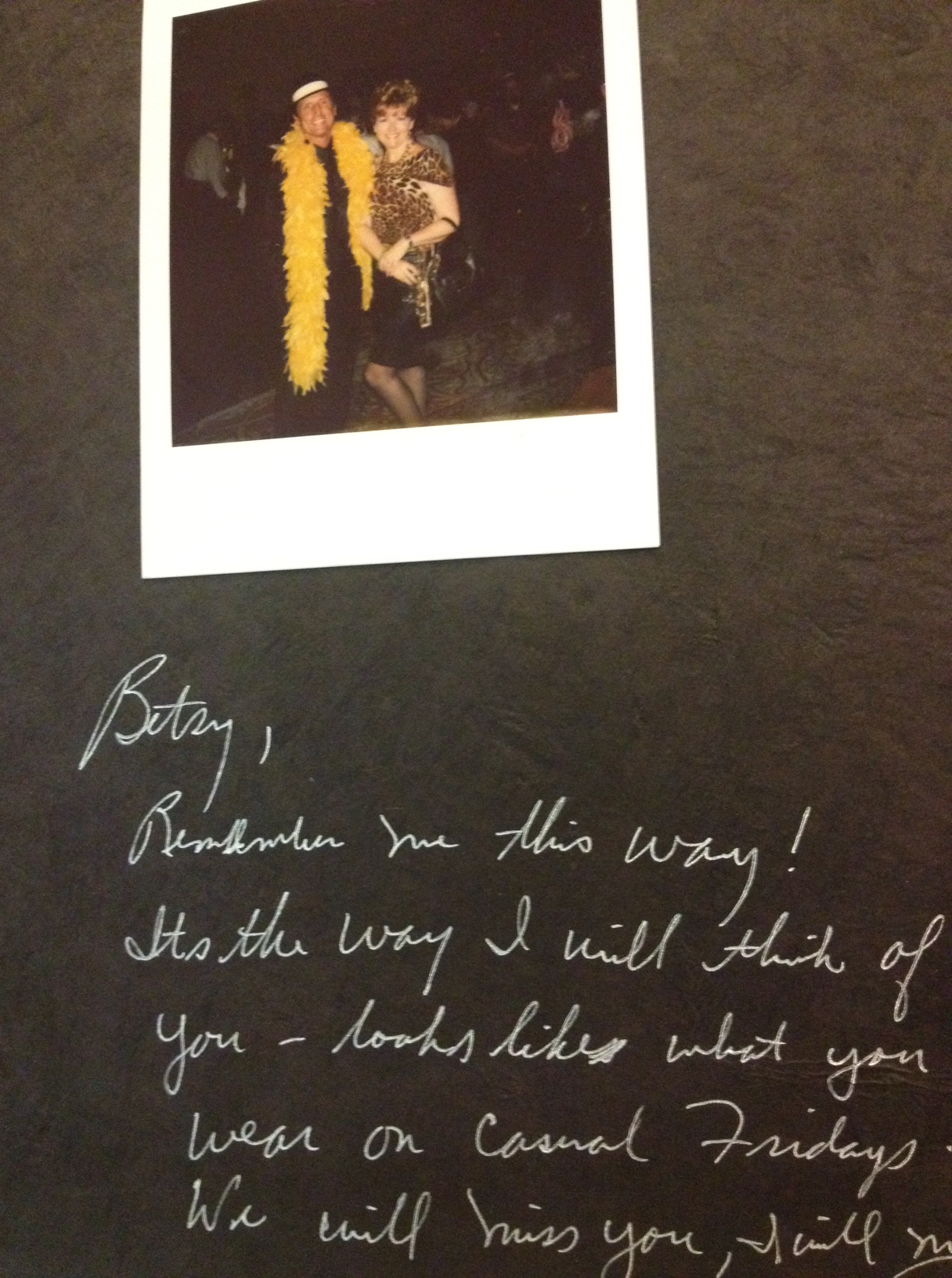
My awesome retirement party (planned by Samantha Smith) included Polaroid party pics signed by colleagues and boss

My awesome retirement party (planned by Samantha Smith) included Polaroid party pics signed by colleagues and my boss

(To start at the beginning of this little series, click here.)

Today, I stumbled across something I wrote for myself in 2005, shortly after my “retirement” (I have no recollection of writing this). It feels a little weird to find a time capsule like this one, written as I took my first steps into my new “retired” life:

Whenever I reach momentous personal decisions, it always seems to follow this pattern.  People tell me they are taken by surprise, that they had no inkling I might be considering such an action.  I surprise myself.  Thoughts may be gestating but I often have no conscious awareness of them.  Occasionally, I’ll experience a fleeting thought in the shower, or driving.  They usually come when I am at ease, when I have not even named a problem, much less become engaged in solving it.  Then, up through the depths, it dawns on me:  maybe it’s time to make a change.  In the first few moments, I roll the idea around, feeling its texture.  I’ll speak of it casually, almost as if stating a whim.  Once spoken out loud, I add to it, refine it.  It takes shape in the moment.

Just this kind of process led to my decision to leave the world of work.  With a problem that wasn’t named, but a solution found, I am doing what I often do:  getting comfortable after I’ve decided to act.

Over the weekend, Todd said to me he had purchased a printer/fax machine to go with our new computer.  I snapped, “That’s my computer, not our computer.”  For the past 15 years, maybe longer, I’ve had a laptop computer that has followed me everywhere.  I’ve anthropomorphized these sidekicks, even naming one, “Lappy.”  There is no piece of equipment upon which I have been more dependent, with which I feel more natural, than my personal computer.  It captures my addresses, remembers my appointments, serves as the slate for both memos and my internal process of reflection.  I’ve stored information about our stocks, written holiday letters, inventoried my father’s house, created itineraries for far-flung trips.  I’ve transcribed prayers, written customer service complaints, captured quirky horoscopes. I used a laptop to capture the words my mother found the strength and heart to say from her hospital bed, while fighting the twin demons of cancer and dementia.  My traveling PC has been a loyal and hard-working appendage.

I am just beginning to understand what I have exited.  First, there are the messages of the farewells.  I was surprised at the heartfelt message from my boss.   Rather than the obligatory “with regret, so and so is leaving the company after X years of service to concentrate on her personal life,” he chose to recognize some of my style proclivities we had occasionally argued about:  “…she will be equally missed for her leadership of people – caring about their development, demanding and rewarding top performance, and demonstrating (our) values in the context of creating a great work environment.”

As the news spread, e-mail greetings poured in like pebbles — some smooth and efficient:  “Your leadership has made many lasting contributions.  You will be missed.” Other messages were strikingly personal: “I am occasionally surprised at how much time it has taken me to work out from under the loss of my Mom last Christmas, even after her long illness.  The only thing that I’m certain of is that no matter how much time you spend, or how many things you do, or how close you come to ‘getting it right’ in dealing with family stuff, I haven’t met anybody who doesn’t wish they had done one more thing, said one more thing or made one more special time happen.”  Another wrote:  “I also find myself prioritizing my life and the things that are important to me.  As you may or may not know, I have just undergone radiation treatment for throat cancer and it has really made me stop and think – and who knows – I may decide to hang it up sooner than later.”  Still another:  “I think of jumping out of the work-for-pay race often.  I’m now painting a lot and I have paintings in a few galleries.  I often wonder what would happen if I could devote more time to painting.  I get great responses… that they are joy-filled.  Lots of color helps.”

In some of the messages, people explained that they had reached a conclusion similar to my own, that – if you have to choose – it is one’s teenagers that require your presence most:  “I started this job when my son was three months old and I am having the time of my life.  I was torn when I received the offer and so talked with all my professional women friends to see how they managed this work/life shift.  So many said, ‘Oh stay home if you can… you’ll miss it otherwise.’  I was surprised.  But I kept digging and another story began to emerge.  One of my colleagues very wisely told me that she found her kids adapted incredibly well to her work schedule when they were little, but she has cut back to part-time now that her daughter is 13 years old.  She believes her kids need her much more now than they ever did before.”

So far I have been credited with wisdom, character, selflessness and inspiration.  Why, then, don’t I feel that way about it?  What I know, that others do not, is that many of my decisions have been based on ambition and fear, supported by a healthy dose of self-justification.  I am not wearing a hair shirt here, nor engaging in self-flagellation.  In a message to my team, I wrote:  “I’m not doing anything heroic.  For nearly 25 years, I have vigorously pursued achievement and learning.  I was promoted during the sixth month of my first pregnancy and met with my boss while in the labor room; six weeks later, I was back on the job.  The desire to keep going was paramount.  Now I am selfishly following another desire.” 

Both subtly and more obviously, I have also been motivated by fear.  After leaving one company and promising to take time out for a while, I found myself accepting my current position after just one month off.  It was a great opportunity that seemed too good to pass up, but I also feared the quiet time in between.  Where would I be without the structure of my work life?  More deeply, there are things I have been afraid to commit to – even to speak of – such as my interest in writing.  What would happen if I just tried to write?  Had to write?

Though the analysis may be right in the long run, I understand my colleague’s desire to justify her decision to work now, when her children are young.  Hearing that children need you most during the rocky teenage years is an answer I was hoping to hear, even as I wondered about the long-term consequences.  We are all engaged in a giant social experiment to try to find the best way to raise healthy children.  Children can be healthy and happy with working parents, or stay-at-home parents.  That’s not the point.  The challenge is in knowing what will turn out to have the very best result for one’s own children.  No one, not even me, knows whether I have made the right decisions.

From four sources came wagers.  Even my brother wrote, “Sure, but the real money is on how long it will last before you get the itch again  J”

And a few carrots were dangled:  interest in consulting, sitting on corporate boards, “let me know when you decide to re-enter.”

Talking with an old friend over the weekend, he noted that he and his wife were considering a similar decision.  She has risen to the top financial position in a large corporation.  If she leaves, they both acknowledge, there will be no going back at the same level, or for the same pay.  In today’s environment, skills rust quickly, resumes mold, and reputations fade.

If one thing doesn’t work, I usually have another option half-lined up in the wings.  This time I have no such fallback plan, and I think it’s important that I keep it that way. 

I have exited, and now I stand at the border of whatever is next.  For now, I am firmly fixed on just noticing.  I am an observer of my own experience.  As Jose Saramango wrote in Journey to Portugal:  “(M)ay I learn in passing from one land to the next to pay the closest attention to the similarities and differences, whilst not forgetting… that a traveler has preferences and sympathies….”

That was me in June 2005.

If I had to do all over again – leave my job and care for Dad – I would do it in a heartbeat.

Next: naked shredding and other awkward moments adjusting to retired life.

At the management team farewell, gifts included this valise packed with well wishes

At the management team farewell, gifts included this valise packed with well wishes. They couldn’t have been more right about the beginning of a journey.

Leave a comment

Filed under Uncategorized

Identity Crisis! (Again!) Part One

My Dad and our friend, Peggy Woods, at our Tacoma "house cooling" party, 2002

My Dad and our friend, Peggy Woods, at our Tacoma “house cooling” party, 2002

My Dad always said that he felt like he had several lives: his formative years up to joining the 5th Reserve Officer’s Commissioning Corps in the lead up to WWII, his career in the Marine Corps, his civilian life, living and working in the Pacific Northwest, and the 14 years of his life after Mom’s death.

Yesterday, my dental hygienist, Mary, observed that women have an easier time adjusting to old age because we go through so many physical changes in our lives: first raging hormone fluctuations and cramps as we enter adolescence; then the inflation of our bellies to near-alien proportions during pregnancy followed quickly by the transformation of our breasts into feeding machines; and finally a return to raging hormonal fluctuations accompanied by night sweats, belly fat that seems to reproduce overnight and the growth of random wiry hairs on our chin or necks. Even they never have children, women usually get two out of three of those changes.

Men, Mary holds, never face the ego challenges of appearance and body changes that women do. Their egos can’t take it when they go from captains of industry to invisible old men.

Mary may have it right as far as some men are concerned (although it certainly didn’t apply to my Dad). But I certainly took a blow to my identity and my ego when I retired to care for my Dad, and I know many caregivers who have gone through a similar transition. And now, with Dad newly gone, I am finding I am having to redefine myself – again.

Let me back up and talk about my initial transformation into retiree and caregiver.

I had lost my Mom to late stage lung cancer in 1999, and the words of her last lucid speech to me – from her hospital bed – echoed in my mind. After more than two weeks of being out of it, she began talking quietly to me about 9:45 p.m. I wrote her words as she slowly said them on a scrap of paper. For almost an hour she told me what I had meant to her, shared her reflections of me as a person, talked about the special importance of daughters, and asked how my Dad was “handling all of this,” taking in her surroundings with a glance. She said, “It is hard to say goodbye to people you love, but it is very important.” When I asked her what I could do for her, she said, “You can continue to be the marvelous woman that you are – competent, with a high level of activity. The world needs you.”

In 2004, I knew that time was marching on for my Dad. Just one year before, he suffered a major stroke, and I was all too aware of his cardiovascular surgeon’s prediction that Dad’s arteries would begin to clog after five years. Which was right about then.

Maddie was beginning her senior year and would soon be off to college. Tommy was in 7th grade, in the midst of a difficult adolescence.

Having already lost one parent, I was all too aware that this time with my Dad would never come again. I would be Maddie and Tommy’s Mom for many years to come, but the window of time to be a daughter, to enjoy my father, would close forever.

Much has been written of late about Sheryl Sandberg’s advice to women to “lean in.” For the first 10+ years of my career I leaned in. I didn’t lean in so hard that I was willing to permanently relocate to other cities (not feasible for my husband’s second-generation company), but I took every promotion I could. I started my MBA when Maddie was one year old, and I worked full time while I completed it. I made vice president in a major company by the time I was 33. I became president of my national professional society. I was recruited by a national company and got to write my job description for a senior level position at another.

After Tommy was born, I would have to say that my career advancement strategy resembled bobbing in and out more than leaning in. For three different companies, I built up enough credibility to cut back to part-time, all in search of the elusive work-life balance. Cutting back to part-time always came with a cost – and I am not referring to compensation. But I had the reputation, the access to leadership and professional skills to get done whatever I needed to get done. I respected the people who worked on my team, and loved supporting their development and careers.

When I resigned, I fully expected Dad would be gone within a few years and that I would return to the workforce after that.

Although I cleared my plate in readiness for Dad to move down, he was dragging his heels a bit. Maybe when it cooled off in Sacramento. Maybe in the spring. He eventually relocated in March of 2006.

Tomorrow: words to myself in June 2005, “The Journey Begins”

Ahead: what it was really like to transition from career to retired caregiver

Farther ahead: what it’s like to suddenly STOP being a caregiver after Dad’s death

3 Comments

Filed under Uncategorized

Scott speaks to Dad’s exemplification of Marine values

scottdad

My eldest brother, Scott, 15 years senior, kicked off the family remarks at my father’s memorial on Saturday. He spoke from notes rather than full text, so I’ve done the best I can to recreate them here:

My Dad was, quite simply, the finest man I’ve ever known. He was always a rock for everyone in the family, and his passing has left a void that will never be filled. The family was very fortunate that he was a major part of our lives for so long.

If I were to describe my Dad’s character, I would say that he exemplified the core values of the USMC:

Honor,which means to display the highest ethical and moral behavior; of abiding by an uncompromising code of integrity; and of respecting others. The quality of maturity, dedication, trust and dependability commit Marines to be responsible and be accountable for their actions; to fulfill their obligations; and to hold others accountable for their actions.

Courage, which entails the mental, moral and physical strength expected of all Marines. It carries them through the challenges of combat and helps them overcome fear. It is the inner strength that enables a Marine to do what is right; to adhere to a higher standard of personal conduct; and to make tough decisions under stress and pressure.

Commitment is the spirit of determination and dedication found in Marines, it leads to the highest order of discipline for individuals and units, and it inspires a driving determination to achieve a standard of excellence in every endeavor.

Dad displayed an abundance of all these qualities throughout his life.

But Dad’s most important achievement was of a more personal nature. Dad did not have a particularly happy relationship with his father, although he did not talk about it much until the latter years of his life. He made a deliberate decision to break that cycle and to be the best father he could be. Several pivotal events in his life may have influenced that decision: marrying our mother, Eileen; combat in WWII, the death of Midge, their first daughter; and his heart attack in 1962, which forced his retirement from the Marine Corps.

He was a romantic in the complete sense of the word, with a deep love for his wife and family. There were almost certainly times during WWII when he wondered if he would come home alive. If he had not, I’d be his only child, and I would not have the same brothers and sister.

After Ken Burns’ series about the Civil War aired Maj. Sullivan Ballou’s letter to his wife, I shared it with Dad. He told me that, had he been writing in the 19th century, he might have written a letter very much like this one:

July 14, 1861

My very dear Sarah:

The indications are very strong that we shall move in a few days — perhaps tomorrow. Lest I should not be able to write you again, I feel impelled to write a few lines that may fall under your eye when I shall be no more.

Our movement may be one of a few days duration and full of pleasure — and it may be one of some conflict and death to me. Not my will, but thine O God, be done.

If it is necessary that I should fall on the battlefield for my country, I am ready. I have no misgivings about, or lack of confidence in, the cause in which I am engaged, and my courage does not halt or falter.

I know how strongly American Civilization now leans upon the triumph of the Government, and how great a debt we owe to those who went before us through the blood and suffering of the Revolution. And I am willing — perfectly willing — to lay down all my joys in this life, to help maintain this Government, and to pay that debt.

But, my dear wife, when I know that with my own joys I lay down nearly all of yours, and replace them in this life with cares and sorrows — when, after having eaten for long years the bitter fruit of orphanage myself, I must offer it as their only sustenance to my dear little children — is it weak or dishonorable, while the banner of my forefathers floats calmly and proudly in the breeze, that my unbounded love for you, my darling wife and children, should struggle in fierce, though useless, contest with my love of country?

I cannot describe to you my feelings on this calm summer night, when two thousand men are sleeping around me, many of them enjoying the last hours, perhaps, before that of death — and I, suspicious that Death is creeping behind me with his fatal dart, am communing with God, my country, and thee.

Sarah, my love for you is deathless, it seems to bind me to you with mighty cables that nothing but Omnipotence could break; and yet my love of Country comes over me like a strong wind and bears me irresistibly on with all these chains to the battlefield.

The memories of the blissful moments I have spent with you come creeping over me, and I feel most gratified to God and to you that I have enjoyed them so long. And hard it is for me to give them up and burn to ashes the hopes of future years, when God willing, we might still have lived and loved together, and seen our sons grow up to honorable manhood around us.

I have, I know, but few and small claims upon Divine Providence, but something whispers to me — perhaps it is the wafted prayer of my little Edgar — that I shall return to my loved ones unharmed. If I do not, my dear Sarah, never forget how much I love you, and when my last breath escapes me on the battlefield, it will whisper your name.

Forgive my many faults, and the many pains I have caused you. How thoughtless and foolish I have oftentimes been!

How gladly would I wash out with my tears every little spot upon your happiness, and struggle with all the misfortune of this world, to shield you and my children from harm. But I cannot. I must watch you from the spirit land and hover near you, while you buffet the storms with your precious little freight, and wait with sad patience till we meet to part no more.

But, O Sarah! If the dead can come back to this earth and flit unseen around those they loved, I shall always be near you; in the garish day and in the darkest night — amidst your happiest scenes and gloomiest hours — always, always; and if there be a soft breeze upon your cheek, it shall be my breath; or the cool air fans your throbbing temple, it shall be my spirit passing by.

Sarah, do not mourn me dead; think I am gone and wait for thee, for we shall meet again.

Sullivan

Major Ballou perished at the first battle of Bull Run.

Leave a comment

Filed under Marines and those who serve, Uncategorized

My brother Bruce remembers, “My Dad was cool!”

brucedad

At my mother’s memorial in 1999, we were all too raw to share personal remarks, but at Dad’s memorial, it seemed right to share our memories and reflections. Together, we painted a more complete picture of Dad for those who joined us in honoring him, and for each other. Bruce is my middle brother, 10 years older than I am. Here are his remarks:

“I wrote this recollection in 2008, shortly after Dad had a pretty significant stroke and I thought we were going to lose him. I wanted to capture some of my favorite times with him (and some were yet to come). Most of my best memories of Dad took place outdoors, frequently involving hunting or fishing. I dimly recall fishing Deep Creek Lake with Dad and Scott before my sister Madeline died, and I also remember fishing through the foot-thick ice on Lake Ontario. My first “best memory” took place during the summer I turned 13. It may actually have occurred the day I turned 13, but I’m not sure of that. It was the summer before everything changed, forever.

I had been involved in the Sportsmen’s’ Club (not sure that’s the name) as an after school activity at Kensington Junior High that year, and I wanted to go fishing with Dad in the worst way. I also wanted to go to summer camp at Monte Vita Ranch, near Berkley Springs, WV. I had been invited back as a CIT, and all of my best friends were going. I knew it was a financial stretch for our family, at least in comparison with those of my friends in Kensington’s Rock Creek Hills. When I actually got to go to Monte Vita, I was surprised and thrilled, and really didn’t expect much else, birthday-wise. I did mention to Dad that I wanted to go with him to fish for smallmouth bass in the upper Potomac River sometime.

On the second weekend at camp, Dad showed up (my birthday or parents day?). I remember showing him around the camp, especially the pond where I fished for bluegills after supper, and also the rifle range where I had just earned my Sharpshooter and Expert Rifle certifications. That night, Dad gathered me and several of my friends up and took us all down to the Potomac River, just upstream from Harpers Ferry. He had a rod for each of us boys, and he set up the rods for my friends. Then, he roped us all together and, ever the optimist, handed each of us a burlap sack to hold our fish. Then we waded out. It was terrifying, but incredibly exciting at the same time. It was dark; my glasses were completely fogged up from the humid summer air. The cool rush of the water tugged powerfully at my legs, and the rocks were slippery beneath my PF Keds. I have no recollection of actually catching anything, but I know absolutely that I was an instant hero with all my buddies. MY Dad was COOL!

I know now that Dad had fished the area many times for smallmouth bass. I know from personal experience later in life that it is possible to know a river well enough to wade safely even at night. I know now that he would never have done it if he felt we were seriously at risk. But I didn’t know it then, only that I trusted him completely. He never failed the trust we placed in him; he never failed the trust anyone put in him.

My second “best memory” with Dad probably took place in 1978 or 1979. It was not long after his first bypass operation, and he had a new lease on life. I came home in November on leave (perhaps for Thanksgiving?), and we took off Friday night together for a weekend of chukar hunting in the Bridgeport, WA area. We stayed at the “Y” Motel, a running joke: Y NOT! The next morning, we parked the truck and began walking uphill along a long intermittent stream channel. We had been walking perhaps 30 minutes when the current dog started getting birdy. As we crested the rise, it opened up into a sunlit shallow bowl. Dad was slightly downhill and to my left with the dog, working along the edge of the rimrock, and I walked slowly into the depression. About ten yards in, the birds began to flush. I hit one, then another, and the birds kept flushing and flushing, in the hundreds. I heard several shots from Dad, and saw more birds fall from the sky. We recovered 4 birds (one of mine was lost), and spent the rest of the day picking up scattered birds from that same initial flock. We probably walked ten miles up and down the mountainside. It was a great hunt, and we returned to the Y tired and content. After that, I never again saw a flock of chukars that large in one spot.

My Dad also loved the romantic poets, and often recited long passages from memory. He often quoted from the poem I am going to share with you. It embodies, I think, how he sought to live his life, and largely succeeded.

A Psalm of Life, by Henry Wadsworth Longfellow

Tell me not in mournful numbers,

Life is but an empty dream!

For the soul is dead that slumbers,

And things are not what they seem.

Life is real! Life is earnest!

And the grave is not its goal;

Dust thou are, to dust thou returnest,

Was not spoken of the soul.

Not enjoyment, and not sorrow,

Is our destined end or way;

But to act, that each tomorrow

Find us farther than today.

Art is long, and Time is fleeting,

And our hearts, though stout and brave,

Still, like muffled drums, are beating

Funeral marches to the grave.

In the world’s broad field of battle,

In the bivouac of Life,

Be not like dumb, driven cattle!

Be a hero in the strife!

Trust no Future, howe’er pleasant!

Let the dead Past bury its dead!

Act, – act in the living Present!

Heart within, and God o’erhead!

Lives of great men all remind us

We can make our lives sublime,

And, departing, leave behind us

Footprints on the sand of time;

Footprints, that perhaps another,

Sailing o’er life’s solemn main,

A forlorn and shipwrecked brother,

Seeing, shall take heart again.

Let us then be up and doing,

With a heart for any fate;

Still achieving, still pursuing,

Learn to labor and to wait.

1 Comment

Filed under Uncategorized

A bittersweet cousin “union”

cousinsfeb162013

Tall row: Isaac Campbell, Vincent Campbell, Thom Stone, Sandy Campbell Kaduce, Marc Campbell, Henry Campbell, Madeline Stone. Front row: Eileen Campbell, Alison Campbell, Oleg Kaduce, Max Kaduce (Max was a little tired but he had a great time!)

What do you call a reunion with people you’ve never met before? Or people you hadn’t seen since they were infants? At my father’s memorial on Saturday, my brothers and I brought all of our children. And they brought all of their children. The result was a first for our family: all of the cousins and cousins-once-removed in the same place at the same time.

As much as they enjoyed each other, taking advantage of the bowling alley next to Pour at Four where the family met to share wine, food and memories following the memorial service, for my children, at least, there was a sadness to it. They know what it is to have close cousins, living within an hour of their four Stone family cousins in California. In seeing cousins they had not seen in many years, and meeting others for the first time, they recognized what they had been missing.

Growing up, my brothers and I never saw much of our cousins. Although we have developed close relationships some, especially with Louise (on Dad’s side) and Lynn (on Mom’s), our family seems to be missing the cousin gene. There are plenty of practical reasons that we didn’t spend time with our cousins: divorces that pushed cousins away from one another, family estrangements, distance and finances. (Despite these forces, we were surprised and delighted that two of Dad’s nephews came from Yakima to honor Dad: West Campbell and Ed Campbell, Jr.)

The memorial was a gift in so many unexpected ways, but one of the loveliest was the chance for our children and children’s children to spend a little time together. Remember this, dear ones, when it is time for you to foster relationships between your children. You belong to one another. Hold on tight.

1 Comment

Filed under Uncategorized

My brother Dean took Dad home

deandad2011

Of my three brothers, Dean is closest in age to me, just three years older. As he explained in his remarks at yesterday’s memorial, he and I knew the kinder, gentler version of Dad. Dad used to say that he and Mom raised Scott and Bruce, but he let us raise ourselves. I’m not sure that’s quite true, but he did perhaps trust the process more than he did when he was first a father. Here are Dean’s remarks:

“I would like to thank you all for coming today to help us remember and celebrate the life of my father, Henry Snively Campbell. I know he would be and, I like to think, is very pleased to see all of your familiar and beloved faces. I imagine his broad smile, and the warm greeting he would extend to all of you. On his behalf, I welcome you.

Today each of my siblings and I are sharing a few fragments of our memories of and love for our father. In some respects, my sister and I experienced a different father figure than did our two older brothers, so different in age were Betsy and I than they were.  Scott and Bruce knew the fiery, hard-charging, career-oriented Marine officer, a decorated WWII veteran who aspired to the Commandant’s mansion in Washington D.C., whereas Betsy and I were raised by a less rigid and more compassionate father. I believe that two events led him to re-balance his life outlook: the loss of his 4 year old daughter Midgie to leukemia in 1953; and his heart attack in 1962 that led to his premature retirement from the Marine Corps. I think these events made him re-consider what was most important to him in life; and it’s clear he decided it was his family.

My first memory of my father dates to the latter part of his Marine Corps service, during his post as Executive Officer at the Marine Barracks in Washington DC. I was about 4 or 5 years old at the time. Each Friday during the summer, an Evening Parade is held on the grounds within the barracks; the Exec is the parade commander, the conductor, if you will. In my memory of those parades, I see a marine platoon in spotless dress uniform, flawlessly conducting their silent drill with M-1 rifles, fixed bayonets gleaming in the twilight. The President’s Own Marine Band plays John Phillip Sousa. My father stands at the center, calling for the precise maneuvers in his full-throated, commanding voice.  You can imagine the impression that made on a 5 year old boy. He seemed about ten feet tall to me back then.

As I grew older, I naturally came to know him differently and more realistically, but the legacy of his Marine career was still much in evidence. He carried himself with an unmistakable grace and military bearing. He dressed smartly, and he spoke with authority, confidence, and courtesy. He modeled, more than he taught, the values and behaviors expected of a Marine, an officer, and a gentleman: respect; integrity; honor; courage; and commitment. I realize now more than I did during my childhood and adolescence that I tried to emulate him.  It was in this way that he taught me how I might become a man, poor student though I was.

Some of my most enduring adult memories of my father are of the times we spent together in his native eastern Washington, hunting chukar partridge in the hills high above the Columbia River near Bridgeport. The images are clear to me, as though they happened yesterday. This is my memory: on crisp fall mornings while it is still dark, we drive under bright stars from the river to the top of plateau, and out across the wheat stubble fields to our destination. We strike out before sunrise into the arid grass- and sage-covered land adjoining the cultivated fields. At the very edge of the Columbia gorge, we walk in the mist of early morning fog as it is driven off by the light breeze coming from the plateau. We move in silence, the only sounds coming from the snuffling dog working in front of us, and the crunching of the frosted grasses beneath our boots. The pungent smell of sage hangs in the cool morning air.  As the sun rises behind us in the eastern sky, we pause to stand at the precipice, looking out over the majestic expanse of the Columbia River gorge that spreads before us.  The hills across the river, many miles away, turn from dark to purple to tan as the sun climbs from the horizon. It’s an awe-inspiring sight that makes one feel humble and quite insignificant. I will always carry the memory of these mornings we spent together; and for me, he will live on within them.

I was truly fortunate to have been with my father in his final hours. The night before his passing, he was too weak to come to the table for dinner, even in his wheel chair – so Betsy and I brought our dinner into his room. We set up a card table in front of his recliner, squeezed in next to him, and had a quiet time together. In retrospect, he was clearly starting to fade, although Betsy and I did not realize at the time how close he was to the end.  He was very sleepy during dinner, and seemed to be in a waking dream state: still connected to the physical world around him, but clearly seeing and responding to other things as well.  As we sat together, he looked at me with half-closed eyes and asked, “Dean, will you drive?”. This caught me a bit off-guard, but I responded that of course I would. I wish now that I had had the wits to ask him where he wanted to go, but I did not. Afterwards, my first thought was that in his mind he thought we were sitting in our camper on one of our hunting trips, and that he wanted me to drive because he was too tired to carry on. What I’ve now come to believe is something else. In the few days preceding his passing, he was often restless and wakeful during the night, trying to get out of bed, even though he had become too weak and short of breath to walk on his own. Our hospice nurse told Betsy and me that such restlessness is fairly common, and offered the belief that perhaps those close to death know they have somewhere they need to go, and are so determined to get there they will get up out of bed and walk right out the front door if you aren’t watching over them. Today when I look back on my father’s words, I think he knew it was time for him to leave, and that he wanted me to drive him there. I think he was asking me to take him home.”

1 Comment

Filed under Uncategorized

Planning My Father’s Memorial

sympathy cards

Every day for weeks, I have written a different set of remarks to share at my Dad’s memorial service on February 16. All in my head.

Do I talk about how he softened as he aged, what a remarkable role model he is for all of us as we approach the prospect of living into our 90s? Or focus on how he broke the mold of his family’s dysfunctional example and grew into a wonderful father? Should I summon dear memories from early childhood, like happy times wedged in the front seat between Mom and Dad, driving around Kensington, MD, looking at the strings of colorful bulbs strung on houses at Christmas, singing, “Here we go looby-loo…?” Could I use a symbol that had resonance for Dad as a rhetorical device — perhaps a river, or a rose? Do I tell how he was still my Daddy, and share how I cried one last time, cradled against his powerful chest, after he died?

I sat down this morning and wrote, just wrote. Didn’t outline, didn’t plan, didn’t try.

Planning Dad’s memorial has been like listening to several radio stations at once. My brothers are broadcasting on their channels, sharing their experiences and their ideas, and I swear I am transmitting on several stations of my own. I’m so busy listening to my thoughts and feelings that I can barely hear theirs.

And it isn’t limited to my brothers. Often, my husband has said something to me in recent days and I’ve had to say, “Start over. I wasn’t listening and I didn’t hear a word.”

Slowly, however, the noise is abating. I am feeling less agitated by the emotional bombardment. I am starting to hear some notes that penetrate the muck, a phrase or two.

It wasn’t like this when we planned my mother’s services in 1999. I wondered to my brothers: is it because we’re doing this more electronically than we did 14 years ago? Or because Mom pretty much scripted her funeral and all we had to do was implement it? Or that Dad was the arbiter in planning Mom’s service and this one is on us?

I am feeling more hopeful that we will come to a place like that described by Alexander Levy in The Orphaned Adult:

Gradually, with unconscious cooperation, survivors weave a commemorative tapestry from these bits and pieces of shared nostalgia…. Story by story, smile by smile, and tear by tear, these memories intertwine, creating a fabric in which an image of the departed is preserved, within which survivors are enveloped, and by which they are forever bound.

Leave a comment

Filed under Uncategorized