Dear Natalia Ginzburg

http://milleracconti.altervista.org/blog/?s=Natalia+ginzburg

Dear Natalia Ginzburg,

I feel like I know you. We’ve never met, of course. I’d never even heard of you back in 1991 when you died. Maybe it’s that “we” you take as your point of view in so many of your essays. It makes me feel like you were talking to me. I’ve never written a letter to anyone dead; not my mother, when she died in 1999, not even my father, who died just twenty months ago. So I hope you won’t mind if I reach out to you across the decades, across the veil that divides us, to tell you how disturbed I am by your description of aging.

In your essays, I found we had much in common, you and me. You, like me, were anxious about the world of adults in which we lived as children; alert to their changes of mood (and in my case, their health), we feared for the very stability of the ground we walked on. Their anger was an earthquake. You, like me, escaped into fantasies. Yours were a lot more interesting than mine, I’ll grant you, your chorus of invisible persecutors (the “we’s”) and imaginary prince. My dreams were about longing for true love – would Johnny McNutt be mine? (he loved me, he loved me not) – and the desire to be special, truly special, which would surely lead to the admiring attention of my parents, my teachers, maybe even the world at large. And adolescence! That terrible self-consciousness, self-interrogation and self-centeredness. And then marriage and motherhood. The day that my daughter was born, I felt as if my skin had been abraded, leaving me stripped of the membrane that protected me from the world. Forever after I was a quaking, bleeding mass of love and fear. You said it better when you wrote, “We never knew our bodies could harbor such fear, such fragility; we never dreamed we could feel so bound to life by a bond of fear, of excruciating love.”

Writing when you were younger than I am now, you refer to yourself as “old now.” Old now? You say that you are more patient but you find this new state of affairs disagreeable and feel only self-contempt for it. You say you see the future as “a cracked, rutted stretch of road where no grass grows.” You say you are tired.

You mention – mention – that maybe your loss of imagination is freeing you to “tell what really happened,” what you learned from the experience of others and your own. I read this while I am waist high in the lush landscape of your essays.

Perhaps I am confused because I met you as the freeway of the Me Generation petered out in a thicket. We “me’s” (not to confused with your “we’s”) see old age as a choice. We may mourn but we are not haunted by the dead. We haven’t suffered many losses, not yet. We’re ready for our Second Act. We’re ready for our close up.

You lived through the terrible war. You met “the right person” and married him when you were twenty-two. He was torn from you before you were thirty, thrown into prison by the Fascists in 1944. There he suffered and died alone.

Your experience, so different than mine, lies across a canyon I don’t know how to cross. You were old before my time. You were old before your time.

I miss you, and I’ve never even met you.

To “meet” Natalia Ginzburg, read “A Place to Live and Other Selected Essays of Natalia Ginzburg,” chosen and translated by Lynne Sharon Schwartz, a writer and faculty member of the Bennington Writing Seminars.

Leave a comment

Filed under Uncategorized

Inheritance

Dad and Midge

Dad and Midge

I’ve finally started writing about my mother. That’s been hard for me and the reasons are a little complicated. It isn’t just that she died fifteen years ago — just about anyone who’s lost a loved one will tell you that time doesn’t seem to follow the rules when it comes to grief; it’s that for much of my life we were locked in a push-me-pull-you mother-daughter battle.

I’m not talking about fighting. (Although yes, we did that, oh boy did we…) I’m talking about what I wanted from my mother that she did not have the capacity to give. 

Before I was born, I had a sister who died of leukemia, three months short of her fourth birthday. Until about the age of two, her pictures were indistinguishable from mine. One of my earliest memories is of my mother standing by the kitchen sink doing dishes. She turned and looked toward me but I had the feeling she wasn’t really seeing me. And she was crying, something I never saw my mother do. I asked her why, and she told me she was thinking about my sister. Then she dried her eyes and finished the dishes.

This is an excerpt from what I wrote this week:

Was Midge’s death why my mother kept me at arms’ length? Did she wall off part of herself ? I wanted nothing more than to be with her, to drink her in, to devour her. I wanted to feel her inside me, to feel full to the point of stuffed, to finally feel satisfied. I wanted more of her than she could give. The more I clung, the more she pulled away. She would pick me up and hold me, I know she did, but only for a few minutes. It was never enough. Finally she would say, “Stop hanging on me.” She sloughed me off.

On Thursday night, I attended a book signing by a local Santa Cruz psychotherapist and book author, Alexandra Kennedy. She introduced an idea I’ve never heard before: generational grief. When grief does not heal, when it is stuffed down and sealed up, the old hurts do not dissolve. Neither does the love. Alexandra suggests that grief, and love, can be passed down through generations. She wrote:

Perhaps before you were born, your mother or grandmother lost a child whom she never fully grieved; perhaps your family in past generations experienced a significant loss or trauma that was never healed. When this generational grief surfaces, it is your work to be the sanctuary to simply embrace the surge of feelings as they emerge, to pay attention to any images that come to mind, and to listen closely to your dreams for guidance.

I realize, now, how the pattern I learned from my mother carried into the next generation, affected my mothering. 

My father, in his last years, revisited many old wounds — the love and acceptance he never felt from his father, the loss of Midge, the loss of Mom. When he died, he had no unfinished business. I can’t say the same for my mother, since dementia stripped away her memory, and lung cancer took care of the rest.

Maybe if falls to me, now, to heal — for her, for me, and for the generations to come.


1 Comment

Filed under Uncategorized

Going The Distance

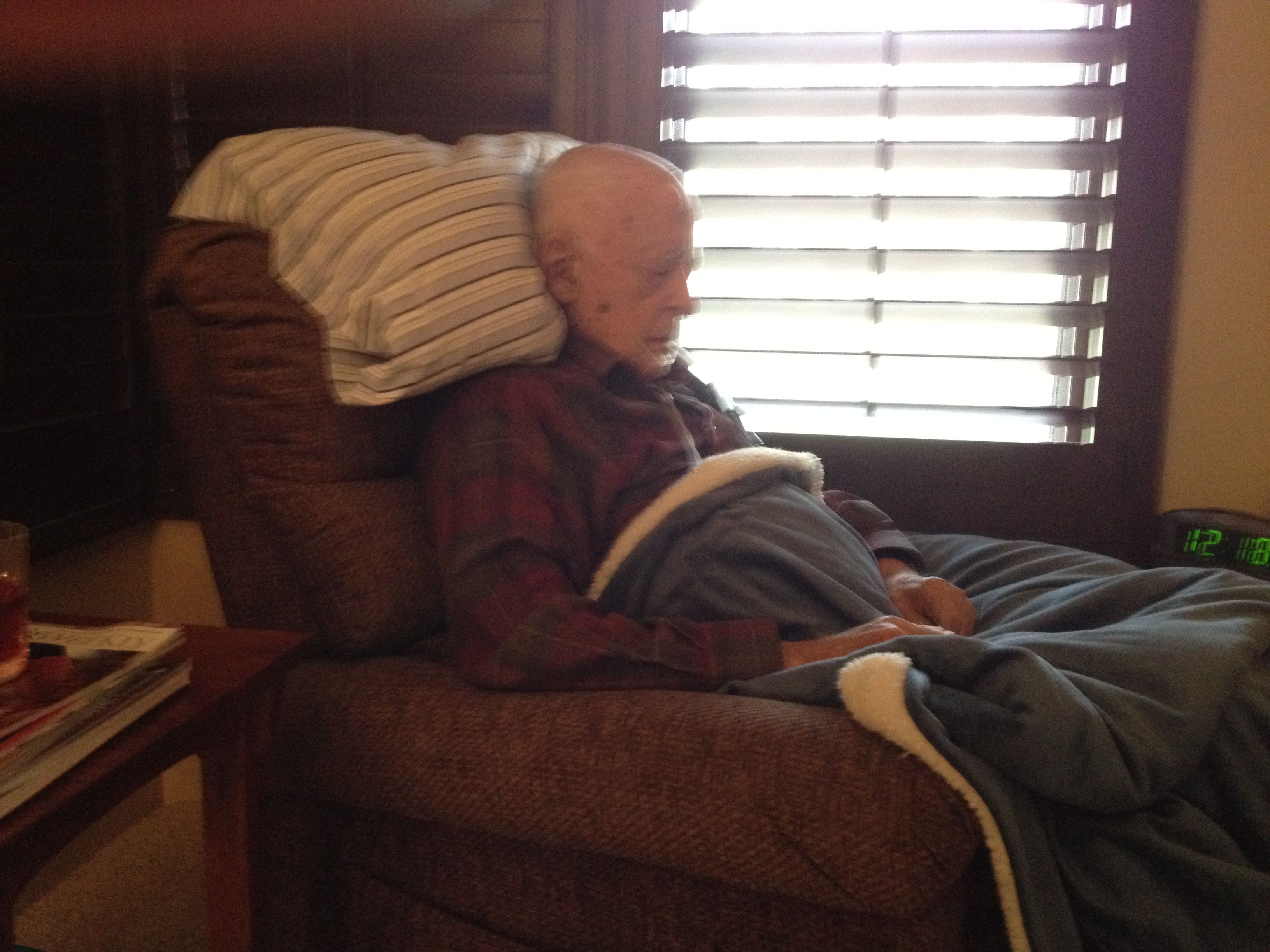
Dad on January 8, 2012

Dad on January 8, 2012

On a good night, when the wine was flowing and we were gathered as a family around the dinner table, my father told jokes. My brother Bruce and I were given to puns of the worst sort, and for a time I specialized in the foul humor I picked up from the ad agency where I worked, but Dad was the family story teller. One of us usually handed him a cue, a short sidelong reference like, “There’s a pony in there.” Off to the races he’d go.

He straightened, there at the head of the table, and made eye contact with his audience as if to ask if we really wanted to hear that old story. His pause, his expectant look, was all he needed to gather us in.

There was one about the boy who found a strange spotted creature he called a “rarey” that began to grow so fast it threatened hearth and home, prompting the boy to load it in a truck and attempt to drop it over the edge of a cliff on a high mountain peak. The punch line? “That’s a long, long way to tip a Rarey.” (Insert groan here.)

But my favorite was the one about the optimist and the pessimist.

He avoided the usual start. No “once upon a time.” My father launched right into the action of the story, setting the stage. In the setup for the optimist and the pessimist, he described a family’s problem with a pair of twins. One looked on the bright side of everything, so much so that he could imagine no problem that could not be surmounted or that wouldn’t dissipate all by itself. The other saw only gloom and doom, and no matter what wonderful opportunities arose, he felt he was sure to fail. The parents decide to engineer a resolution by giving the optimist truly terrible Christmas presents and the pessimist, truly wonderful ones. The story ends with the parents standing by, confounded, while their optimist son gleefully digs in a huge pile of horse manure, exclaiming, “There must be a pony in here somewhere!”

My father loved to tell stories, but in the end, he left me a riddle. My father, who was doled out more than his fair share of dung in life, never gave up, never became bitter, never stopped believing in the possibility that things would get better. While many people become curmudgeonly as they age, he became gentler. Why? What drove him?

If my mother had her druthers, the answer would be faith. Her faith sustained her through the loss of her father while still in her twenties, the war, the loss of her daughter to leukemia, the death of her mother, and the long frightening years of my father’s struggle with heart disease. Resting on the levee of the river during one of our many walks, I asked my father if he believed in God. I wanted to hear him say yes. I wanted that little bit of reassurance that, when the time came, he would be welcomed into heaven to join my mother, even as the little doubter in my own mind wondered if that’s what really happens after we die. “I wish I could believe,” he told me. He just couldn’t make the leap from concrete reality to ephemeral faith. The closest he ever came to saying he believed in an afterlife was to say he looked forward to seeing my mother again.

Perhaps it was love that fueled him. Love, to my father, wasn’t about what you said, it was what you did. His place in the middle of three sons, with an emotionally abusive father and a bully for an older brother, had a lasting effect on his dedication to others. My grandmother lived out her last years in a convalescent home in our community. After he ate with us, my father took her dinner every night. I’ll be honest. I didn’t like my grandmother, and she didn’t like me (she thought I was entirely too outspoken, my father confirmed much later). Why my father would want to spend time with such a sour old woman I couldn’t understand. But in his last years, I saw my grandmother as my father saw her: she was a gentle woman trapped in a loveless marriage with a philandering egotist. I remember how her face softened, how something flickered across her features, when my father spoke to her. His nightly visits were driven by more than filial duty. They were borne out of love.

Or maybe it was hope that kept him going. Within a week of his death, he still believed he could recover his strength, if he just got out there and started walking again. Anthony Scioli, a professor at Keene State College in New Hampshire, has been investigating the link between hope and health. Writing in Spirituality & Health magazine, Louise Danielle Palmer summarized his conclusion, that “…hopeful people tend to be more resilient, more trusting, more open, and more motivated than those less hopeful, so they are likely to receive more from the world, which in turn makes them more hopeful.”

I’ve used a lot of trite quips to explain my father to others. “Like a Timex, he took a licking and kept on ticking.” His health challenges alone would have flattened most men: three heart attacks, three open heart surgeries and three strokes.” While we were growing up and he still had our college educations on the horizon, I know he felt he had to recover. He had to provide. That was duty. But how do you explain his dedication to come back from strokes after my mother died, after his duty was discharged?

He did it a step at a time. With the help of a physical therapist, he learned to concentrate on swinging his weaker left leg and striking with his heel. He had to think about each step to avoid stumbling. When he was in acute rehab at the UW Medical Center, I remember how proud of himself he was when he demonstrated the new skill he had relearned with the occupational therapist: he made me a cup of instant hot cocoa. Even now, when I write about it, I cry. To be so reduced by a stroke that completing the steps – take out a cup, fill it with water, microwave it, pour in the cocoa and stir – was an accomplishment. It could have been humiliating, but it wasn’t. It was a milestone. A good day. The medical professionals predicted he would be wheelchair bound; then they revised it to “he’ll never walk independently without a walker.” But he did. For years, he just used a cane.

Every day on our walk, he set a goal. Sometimes it was to make it no farther than the third driveway down. He felt the load in his chest, was breathing hard, but he rarely stopped short of his goal. When I said that most people would quit when they started to feel the strain, he simply said, “Every day I try to go a little farther.”

My father went the distance.

Leave a comment

Filed under Uncategorized

Break In

Theft

One kick to the door was all it took. My first thought when I saw the splintered door frame was: thank God my son wasn’t home; he would have slept through the noise. The CSI detective showed me how they entered by shining her light down the surface of the front door: the clear print of a boot. Waffle stompers we called them in college. “That’s exactly where you kick,” she said.

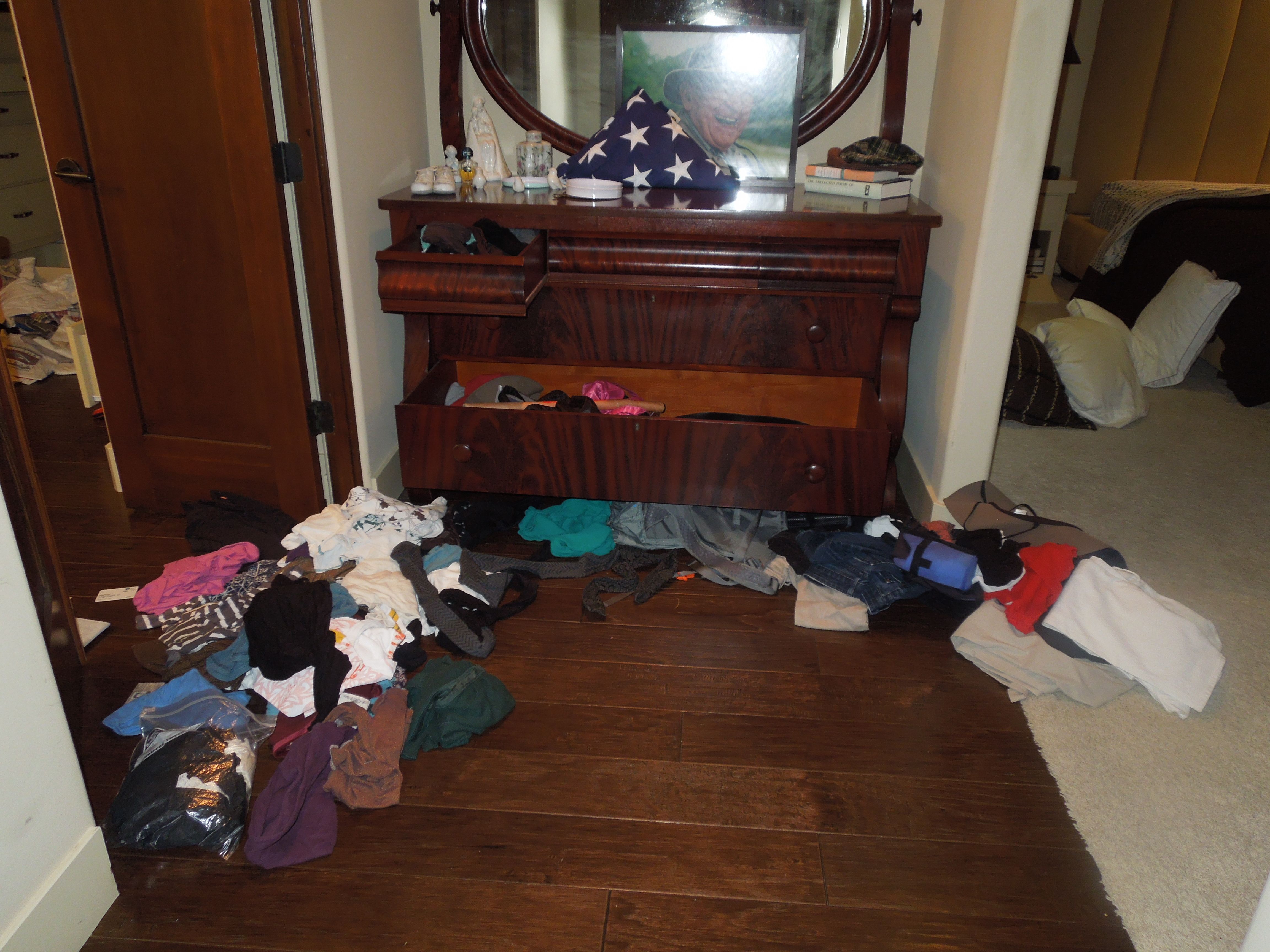
The thieves who came in the night took their time, dumping drawers, opening cabinets and sorting through my jewel boxes. Things were strewn throughout the house. A Mexican five peso bill from my husband’s bathroom drawer was next to the dining room curtain. A stained pillow was lying next to it.

I thought (with some satisfaction) that it couldn’t have been a very gratifying haul for them. I keep the little good jewelry I have in a safety deposit box. The burglars went to the trouble of removing two wall-hung TVs. The TVs were eight years old and worthless. They took a huge silver plate serving tray that I’ve never used; new “princess” trays sell online for about $75.00. No prints, the detective said, they even used a new kind of glove that left no smudges. They were pros.

I thought (with some relief) that they didn’t break anything. The old Chinese tea caddy that I use for a jewel box was on the floor, drawers emptied but undamaged. They could have vandalized things just for the hell of it, dumped condiments from the refrigerator, graffitied the walls.

I thought (with effort) that it was just stuff. While rushing home, my friend called with the news that her husband had just passed away. I had been with her most of the week while he lay “actively dying.” For eight days, he had been unable to take in liquids. For seven days, he had been in a hospital bed, lying in that state that hospice calls “transition.” I remember “transition” from giving birth; with this version there’s no happy ending.

After CSI left, I went to see my friend, then came home and fell asleep. I awakened some time later. I thought I heard a thump through my husband’s open window. Had someone hopped the fence? I listened, willed myself awake. No sound, not even crickets. Had the crickets been startled into silence?

I drifted. The image of my grandmother’s pendant watch floated before me. My mother’s mother – I called her Nana — died when I was five. I entered her bedroom after my afternoon nap, expecting to find her resting, too. I couldn’t awaken her. My mother hurried me out of her room while she called our neighbor the doctor. Nana had always been a gentle presence. I remember her softly curled gray hair. Her soft lap. Everything about her was soft. The edges of her frameless glasses caught the light and sparkled around her eyes. I have two things that were hers. Correction: had. I unconsciously looked toward my dresser for one when I approached my bedroom after the break in: my grandmother’s jar of potpourri. It was untouched — a white porcelain jar painted with a delicate pink chrysanthemum, a red-and-white morning glory and a tuxedoed magpie. I lifted the lid and inhaled. The scent of summer roses wafted across sixty years. I didn’t think about her watch then, the round ball with tiny face. It was enameled with tiny pink flowers against a turquoise background. Throughout my childhood, when I stood by my mother as she chose accessories for an evening out, I took it out of her jewel box and let the links trickle into my hand before I dropped the cool globe into my palm. When my daughter was young, she would hold it and ask me to tell her about my Nana. The watch would have gone to her.

My nights are still like this: I fall asleep reading and rouse with the memory of something I will miss. A sterling spoon engraved “Ella’s baby.” That was my Nana. The gold butterfly necklace my father gave me. My mother’s silver earrings with the dangling bells that tinkled when she moved her head. The things that connected me to those who came before.

1 Comment

Filed under Uncategorized

An Anniversary Tale

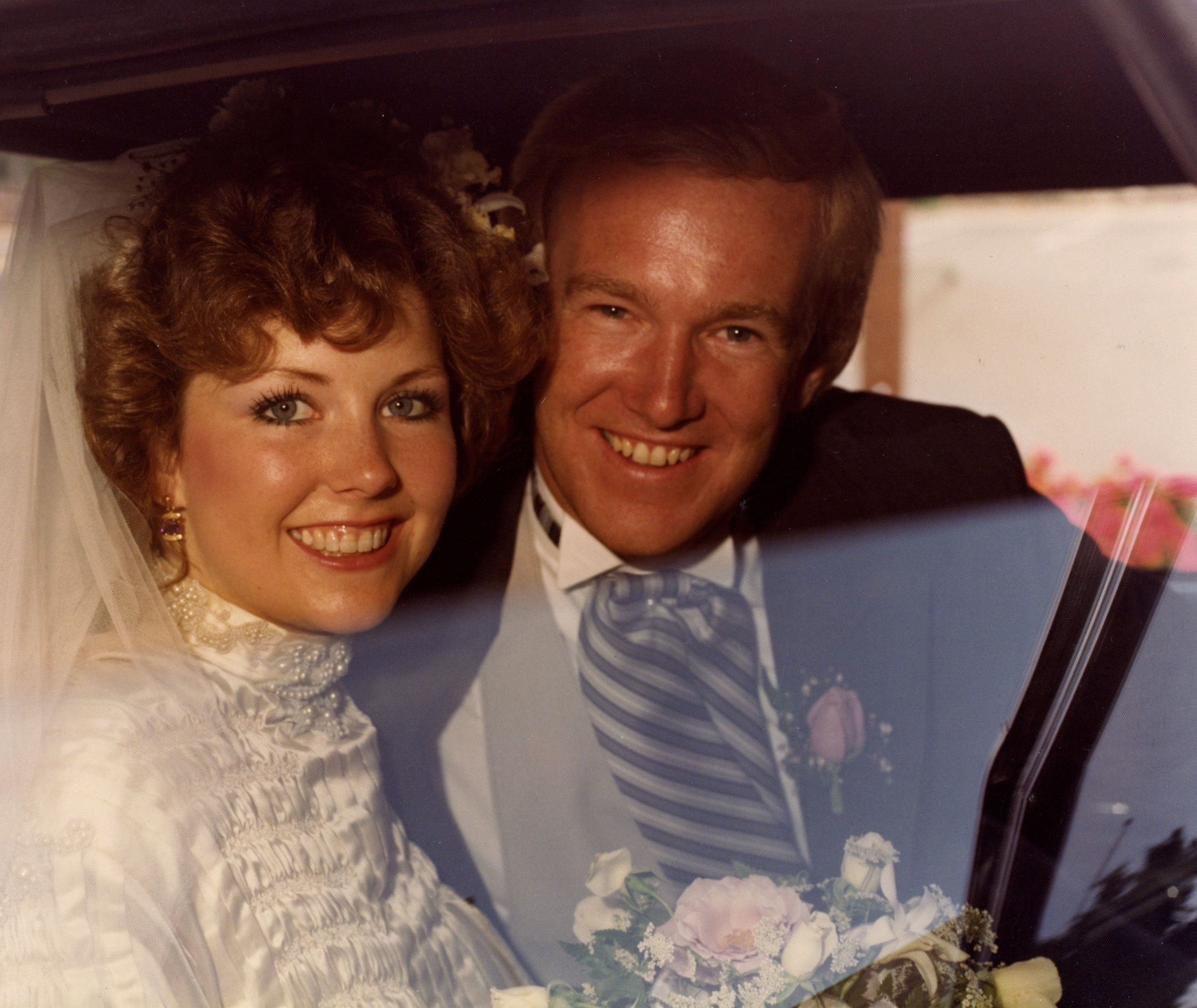
The happy couple - wearing a 1906 wedding dress and tux in 100+ degree heat!

The happy couple – wearing a 1906 wedding dress and wool tux in 100+ degree heat!

A few minutes ago I saw my classmate’s post after she received her first feedback from her advisor since beginning our graduate writing program. Within the space of minutes, she reported that went from feeling curled in a fetal position to feeling Determined.

After my first workshop at graduate school didn’t go so well (the most favorable comment was “weird but interesting”), someone at home asked me if I was going to continue. Well, of course! It’s not so much that I’m a when-the-tough-get-going kind of girl, but that I’m a tell-me-what-I-can’t-do-and-I’ll-try type.

This characteristic has led to some stunningly stupid outcomes. When I was in fourth grade, my brother told me I wasn’t brave enough to jump off the roof where it was two stories high. Well, of course I was! It worked out well for him and for me: he got a chance to practice his Boy Scout first aid skills and I got street cred with my brother.

In the still-early years of my career, I was told I shouldn’t apply for a promotion because I was pregnant. Well, of course I would! Though I didn’t regret it in the long run, I would never advise someone to take a new job when six months along.

Trouble arises when my narrative collides with someone else’s. For example, my husband’s. About nine months after the birth of our first child, we talked seriously of continuing our family. He had waited eight years for his sister, and he believed that having a sibling was a good and a joyful thing. Then I returned home from work one day, fresh from my performance review, and announced to my husband that I’d made a decision. He looked at me expectantly. I’m going to get my M.B.A., I told him enthusiastically. Dead silence. He had his own story arc in mind: happy couple marries, happy couple has some time to enjoy their freedom before settling down, happy couple starts family, happy couple has baby number two within three years (three years seen as ideal spacing), and the family is complete. We were telling different stories to ourselves.

Here is why this is an anniversary story. Today, my husband and I have been married 32 years. Looking for something else over the weekend, I found the notebooks into which we wrote our hopes and fears when we attended an Engaged Encounter retreat four months before our marriage. He wrote of his hopes for five years out, “I want to raise a family with you, badly. To nurture, protect, and to love.” I was a little more tentative. I wrote, “I’d like to be about ready to have our first.”

Marriage and family hadn’t been part of the stories I told myself in my early 20s. It was the Seventies, and I was Going Places. Then I met Todd. I couldn’t imagine life without him, and my narrative changed. I’ve always been the type that opened door number one without much idea of what might lie behind it. When he proposed — complete with a fake plane ticket made out for Mr. and Mrs. Todd Stone to Hawaii — I said yes. Here I come, I said, and there I went.

I wasn’t prepared for marriage. I didn’t know how the story would unfold. I called him “my puppy and my knight in shining armor” when I wrote my betrothal pledge at age twenty-four. (Yes, I really used those words.) Deciding to say “yes” to my love’s proposal was the scariest thing I ever did. And the wisest.

I wrote that I wanted to be “sensitive, supportive, vulnerable, loving, protective, and broad shouldered.” Turned out that my husband was. Every time that I suddenly changed the story line, he wove himself right back in to the narrative.

My story would be incomplete without him.

Dear knight in shining armor: you still are.

6 Comments

Filed under Uncategorized

What Will Happen To Me?

IMG_1242

What will happen to me?

           My father often asked this question. Like answering a child who wonders where babies come from, I gave the simplest answer. I knew that money had been a concern of my father’s for as long as I could remember, so I summarized his financial position and told him he did not need to worry. I even went so far as to write out a statement of his monthly income and expenses for him to carry in his breast pocket. For a while, that was enough.

After a time, his question what will happen to me took on a different tenor. He wanted to know how he would die and how he would be cared for. He was the man who had figured out how to load a battle ship (put in last the things you need first). He thought in scenarios. What was the plan, he wanted to know. But this wasn’t a briefing. He was asking me, his daughter, to acknowledge his death and dying. How to even talk about it? Did he want reassurance – don’t worry, Dad, we’ll take care of you – or did he want a contingency plan? Should I use the word “death” or something sanitized: when the time comes? Did we really have to talk about this? I told him the truth: that I didn’t know what would happen. He could have “the big one” and die suddenly, felled by the heart disease that had plagued him since he was forty-six. He could fall and have to go to the hospital, in which case we would get him home to my house as quickly as possible. Or he could slowly lose ground, in which case he would be at my house with hospice. Whatever happens, Dad, we will work to get you home and you will not be alone. And for a while, that was enough.

He was thinking about his death. But he did not seem frightened. As hard as it was for him to lose my mother, first to dementia and then to lung cancer, he did not rail against the heavens. I asked if he believed in God. He said he wished he could. But he was angry, angry that my mother had feared her own death – a woman who had been devoutly religious, a mother who had been sustained by her faith when her little girl was taken from her by leukemia. He placed the blame on God. If there was a God, how could he let her be afraid, he asked. The Just God was unjust. Then he said, “I hope it doesn’t shock you but I look forward to being with your mother again.” So you believe in the afterlife, I asked him. He replied, “What’s the alternative?”

Six months before he died, he had stopped asking what would happen to him and started predicting his own death. On a visit in July, my brother Bruce called, choked up; hearing our father talk about dying unhinged him, he said. Initially Dad’s phrasing was playful: “I don’t have long before the big jump.” He made it sound like an adventure. He was plummeting to earth.

It was summer then, when the trees drooped from the heat that pressed down from relentlessly blue skies. In better days we would have walked in a lazy serpentine from one circle of shade to the next. Dad would have summoned his breath to recite a passage from The Ancient Mariner, intoning in his best imitation of Richard Burton, “Alone, alone, all, all alone,/ Alone on a wide wide sea!/ And never a saint took pity on/ My soul in agony.”

Instead I watched him pant in his chair, his lungs crunching inward at the end of each exhalation. He interrupted his sentences to breathe. For a while he said I don’t think I can pull through this. Finally he began to say I’m not long for this world.

I didn’t want to believe him. I even found a word for people like him, people who survive long past every prediction, people who teeter on the precipice time and time again, but always pull back from the edge. People like my father are called “biologically tenacious.” On the day that hospice came to evaluate my father, my son told me that he didn’t think Papa could die, would die within six months, as the nurse had to conclude for my father to be admitted in the program. My son was angry at the hospice nurse for her matter-of-fact statement about Dad’s prognosis.

My friend Jim wrote me: “Remember, the descent is like going down stairs.  Sometimes one by one, and sometimes several at a time.  Nothing you can do about this but be present and loving.  His spirit is trying to discard his human body so it can move forward.”

I wrote this prayer:

Help me, God, to be fully present

Help me to feel calm so that I can calm my father

Help me to radiate so much love that it warms him

Help me to support the others who love him on this awful journey

Help me to understand

Help me to love

Help me

I knew I had to say goodbye, to say the words that might help release him. I told him my brothers and I would be okay, that he had raised us well. That we would do the best that we could to help him be comfortable. I told him I wished I could make it easier. He told me he was proud of me.

On New Year’s Eve, when we watched the festivities on television, we did not know he had only twelve days left. He turned to me and said, “In my next life I’m going to come back for you.”


Leave a comment

Filed under Uncategorized

Aging Gracefully… or Disgracefully?

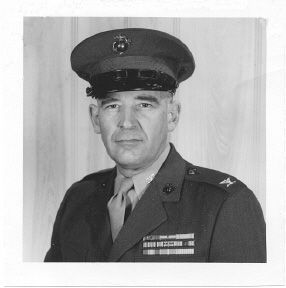
Official Portrait, Promotion to Colonel, 1959

Official Portrait, Promotion to Colonel, 1959

Somewhere along the line, word got out that I knew something about aging parents. During the seven years that I cared for my father, and the eighteen months since, I’ve received many a call or email from adult children – correction, daughters – who were deeply concerned about their parent’s welfare and at sea when it came to figuring out solutions. One was a friend who was actually collecting information on behalf of her husband, although the husband didn’t know she was looking for advice and she was uncertain how much she could suggest to him. If the wise men had been women, so the old joke goes, they would have arrived on time, helped deliver the baby, cleaned the stable, made a casserole, brought practical gifts and there would be peace on earth – all because they asked directions.

After a while, my marketer’s brain started to look at their stories as data that fell into two groups: those whose parents who were grateful for a little help, and those who seemed to become nasty and difficult. Call it aging gracefully versus disgracefully. I don’t mean to be flippant or suggest that a bunch of elders are out there besmirching the family reputation. Aside from a few outliers who were sociopaths in their youthful years and whose tendencies ripened with time, the latter group is made up of people who were once decent human beings before age stripped them of their filter and embittered them. Their younger selves would be disappointed in their older selves.

My father fell into the changed-for-the-better group. When I was growing up, his authority was absolute. He did not yell or hurl scornful statements or fling barbs. He said little. He didn’t have to. I knew – my brothers and I all knew – when we were on thin ice. It was in my father’s eyes. He froze and simply looked at us – a level stare, unflinching. We were put on notice without a word. He transformed into The Colonel. There were no coiled muscles waiting to explode – the telltale sign of a violent father. Nothing in our experience suggested that he would strike. He was too controlled. But something in his eyes hinted at a potential. He later described his own father as “severe” and his older brother as a bully; harassed to the point of retaliation, he described futilely trying to wound his brother only to be held out of reach as his brother laughed at him. Maybe my sense of threat came from a glimpse of something long buried, the soldier self that enabled him to survive WWII. He said nothing, he did nothing, but I feared my father; loved him, longed for his approval, competed for his attention, but feared him.

The danger dissipated with age; whatever reservoir of anger he had stored up leaked away. He did not rail at the indignities of aging, though he did not like them. This business of the bladder for example. Whose idea was it to make peeing both difficult – a long time coming and an anemic stream once started – and hard to control, so much so that my father avoided going anywhere without a bathroom in sight and more than once ended up urinating in my neighbor’s yard when he couldn’t make it back to my house during a walk? And no one expects an old person to be funny. My father would jest and I would have to explain to his audience, in the silence that followed, “That was a joke.” Most people did not address my father; they would first address me, speaking of my father to me, treating him like an imbecile. His aging made me angry but it did not seem to affect him that way.

I can’t let go of my questions. During those seven years and in the time since he’s died, I continue to wonder: how is it that one elder becomes kinder, and another mean? Is there a way to influence or control how one feels about the many cruelties of aging? What will happen to me?

I read and hypothesize. An op-ed by Arthur C. Brooks in the New York Times boils things down to an equation. One describes oneself as a happy person when one’s happiness (y) is greater than one’s unhappiness (x): when y > x. He wasn’t writing about aging, in fact his point was that the most unhappy people are self-aggrandizing, materialistic fame-seekers or promiscuous hedonists, people who are generally in their prime. The answer to happiness, he concluded, is to love people, not things: “It requires the courage to repudiate pride and the strength to love others – family, friends, colleagues, acquaintances, God and even strangers and enemies.”

Aging is nothing if not a punch to the solar plexus of pride. But assaults on one’s pride don’t seem to explain who will transform into kinder and gentler versions of their younger selves.

One friend of mine theorizes that women are better prepared for old age because of the many adjustments they have to make in their self-image. With the arrival of one’s “monthly visitor” or “period” or “curse,” suddenly you’re transformed into a woman, someone capable of bearing another human being. Being pregnant is a different kind of shock. Love or hate the experience, hardly anyone is neutral. Besides feeling like an alien in one’s own body, or worse, feeling like one is gestating an alien, the cultural rules bend sideways and suddenly someone you’re meeting for the first time puts his hand on your belly by way of introduction and says, “Hi, I’m Pete and I see you’re expecting a baby.” And let’s not even talk about menopause. (Beware, says the menopausal woman.) Unfortunately, I’ve heard just as many stories about difficult mothers as difficult fathers. Maybe more, because mothers more often push the hidden buttons that fathers don’t even know exist.

Then there is the school of suffering. As David Brooks wrote in the New York Times, “Recovering from suffering is not like recovering from a disease. Many people don’t come out healed; they come out different.” I know this was true in my father’s case. He was a different father after the death of my sister Midge, who died just short of her fourth birthday. He often referred to the different way he and my mother parented my two older brothers compared to how they raised us two “youngers.” The difference can’t be explained by the seven year gap between the pairs of children or my parents’ increased age – 40 and 41 when I was born. David Brooks continues: “Instead of recoiling from the sorts of loving commitments that almost always involve suffering, they throw themselves more deeply into them. Even while experiencing the worst and most lacerating consequences, some people double down on vulnerability. They hurl themselves deeper and gratefully into their art, loved ones and commitments.”

In Brooks’ statement, “vulnerability” sounds right, but it’s the “gratefully” that resounds. My father became more grateful as he aged, grateful for the wife and daughter he loved, even when they were beyond his reach in death, grateful to be welcomed into a family, even though he lost his independence, grateful for the years of life that had somehow, miraculously, been granted to him, even during the days of pain and confusion. Did gratitude make him more tender, or did tenderness make him more grateful?

This is a problem I am unable to solve. My father’s kindness overflowed; I know because I experienced it everyday. Gordon Morino, professor of philosophy at St. Olaf College, wrote, “…in moments of tenderness it is as though the ego and all its machinations momentarily melt away so that our feelings are heightened and we are perhaps moved by the impulse to reach out with a comforting hand.” My father did not mourn what he lost – his virility, his independence, his place in the world. On Christmas Day, eighteen days before he died, I asked if he had enjoyed his holiday morning. He answered, “It’s enough being here.”

2 Comments

Filed under Uncategorized

Poco Loco

photo

I heard the coffee first, a gurgling fountain of sound emanating from the kitchen. With sleep still swaddling me, only my bare feet were awake enough to follow its call down the hall and around the corner. Like an old Pepé Le Pew cartoon, the scent of the coffee floated across the room in a thin undulating cloud, stretching until it tickled my nostrils. Good morning, coffee.

My awareness, trailing behind me or still curled in the bed sheets perhaps, caught up and slipped into place. If the coffee was brewing, my husband must have risen first. I glanced past the coffee pot and saw him slouched there in the comfortable club chair, his hips scooched almost to the end of the seat, one leg crossed on top of the other. Wifely thoughts: he’s going to get a backache sitting like that. Readers perched on his nose, eyes on his iPad, he hasn’t noticed my entrance. I know he’s reading the news, catching up on emails. He takes his time these days, Sleep is often illusive to him, not going to sleep but staying asleep. He usually drops off well before I do, right before he leans over to my side for a kiss. Within minutes his breath has fallen into a regular, slow rhythm. I often awaken once in the middle of the night but I don’t know why. I pay attention to the sounds inside the house: the quiet tells me our son is out or asleep. He said he’d be in by midnight but he almost never makes it by then; he’s twenty-two and recently graduated, hasn’t lived at home in several years and not used to broadcasting his whereabouts to his mother. I wonder if I should get up and see if his door is closed. He always sleeps with it closed, a sure sign that he’s in for the night. Then I argue with myself: that’s ridiculous, he’s fine, and if he’s not home he’s probably better off staying where he is. Then I worry: what if he went off the road somewhere, what if he’s missing?

The house is quiet. I’m almost sure our son is home, asleep. Then I realize that my husband’s breathing is quiet. I don’t hear the whistle that his nose sometimes makes when he inhales deeply. He’s probably awake. I don’t say anything in case he’s on the verge of sleep. And if we start talking, I won’t be able to go back to sleep.

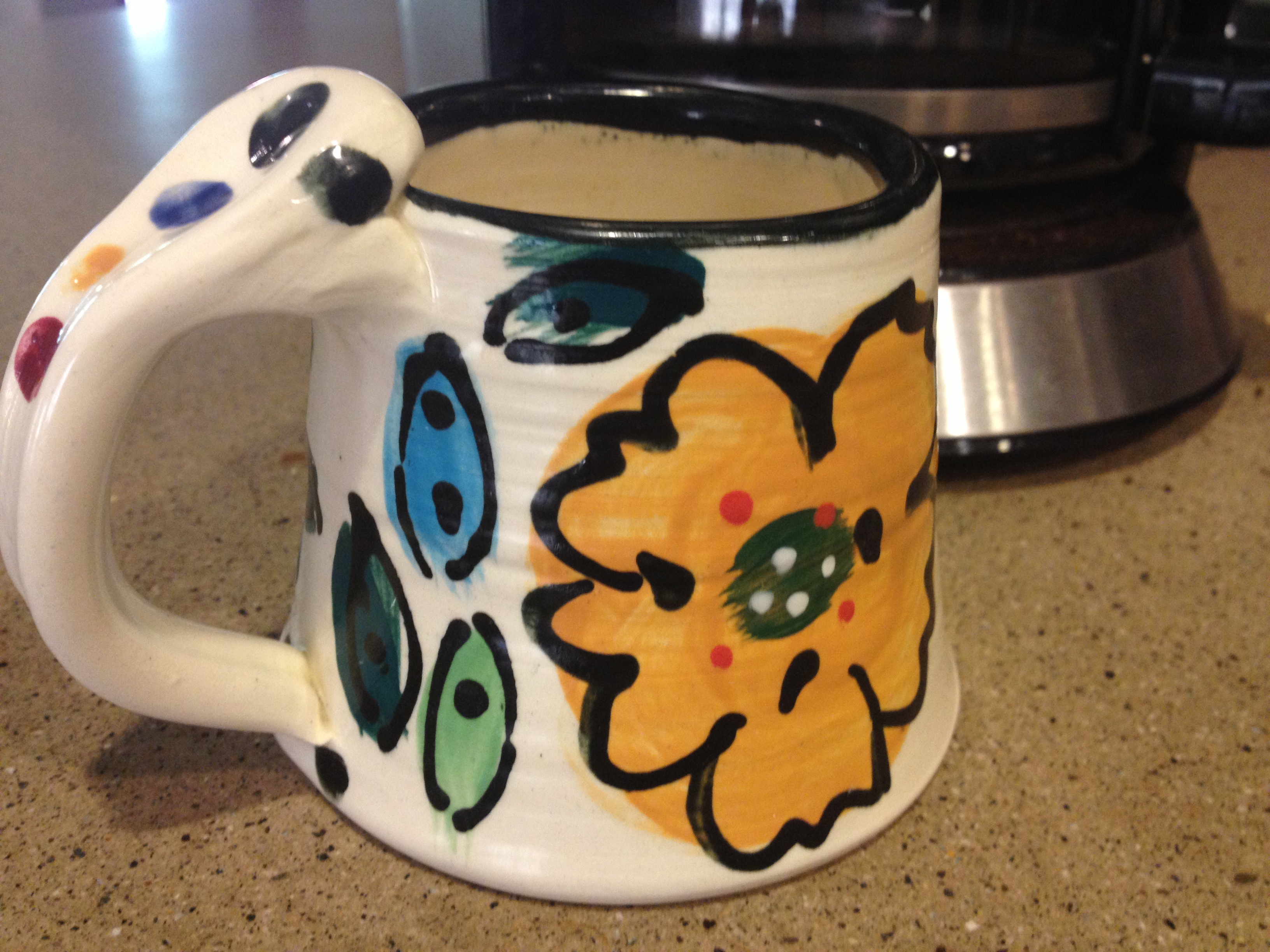
When I’m up first, which is most days, my husband offers to refill my coffee. I should return the favor. Without thinking, I pull a flowered ceramic cup from the cabinet, one of a set we purchased in Bisbee, Arizona from a local potter, Sonja something. The town, described as an artist’s colony, was romantic, although not in the way I’d expected. I imagined Southwestern sunsets in a quaint restored town, the Old West but with better coffee. We decided to follow the snowbirds south during a particularly rainy January in Northern California. Bisbee, that January, was freezing. It actually snowed. The wind whistled – it actually whistled — down the narrow lane that shot precariously up the hill, rising so nearly vertical that it reminded me of those paintings of San Francisco where the streets appear to bend at a ninety degree angle and head straight for a vanishing point in the sky. How could the cars stay on it? That’s the joke, of course. The artist – Thiebaud I think – has managed to capture what the eye sees, but exaggerated it so much that the image turns comic. Now I remember. The ceramic mugs we purchased that day were a pattern called Poco Loco.

The coffee maker finishes brewing in a final whoosh of steam as if to say “ta da!” Still blinking in the bright kitchen light, I notice that the dark liquid only comes up to the eight cup mark. I usually make ten cups since we have a third coffee drinker in the house these days. I carry the mug to the refrigerator, noticing how the smooth indentation at the top of the handle cradles the pad of my thumb. Without thinking, I pour a half inch of milk into Todd’s cup and start toward the microwave. And stop.

This was what I did for my father every morning. He liked the milk warmed for twenty seconds before the coffee was added. If you didn’t warm the milk first, you’d have to reheat it, he said. Whenever I forgot, he would rise from the table, cane in his right hand, coffee cup in his left, starting toward the microwave. Sometimes he would have made it from the kitchen table to the center before I rushed in to take over. Dad, here, let me! He would assure me that he was perfectly happy to do it himself – perfectly capable – but his unsteady walk said differently. He walked slowly, his right bicep flexing as he shifted his weight onto the cane; that side was sturdy enough. It was the left side that couldn’t be trusted. On that side, he still had to concentrate to achieve a natural stride. Swing it all the way forward and strike with the heel, the P.T. had coached him. When he didn’t consciously swing it, the sole of his sturdy walkers made contact with the floor too soon, turning the forward movement into a shuffle. His shoulder dipped as his left thigh muscle bore his weight and gave a little. From the back, he looked like he was limping.

Milk in a flowered ceramic mug, microwaved for twenty seconds, then two packets of Equal, and then coffee. That was the recipe. This morning, half asleep, I started to prepare it the same way for my husband. When I carried it to him in his chair, I realized he already had a cup. Two cups of coffee is better than one, I said. He slept well, didn’t wake up once. A rare morning.


Leave a comment

Filed under Uncategorized

A Belated Independence Day Tribute

This morning, I arose thinking about the triangular folded flag that I keep on my dresser, the flag from my father’s honor burial at Arlington National Cemetery last August. As I started to write something about it, I wondered if there was a term for it. So I did what all smart writers do and Googled “triangular folded flag.” I stumbled across this excerpt from a flag folding ceremony, something that may be read on special days like Memorial Day and Flag Day:

“The first fold of our flag is a symbol of life.

The second fold is a symbol of our belief in the eternal life.

The third fold is made in honor and remembrance of the veteran departing our ranks who gave a portion of life for the defense of our country to attain a peace throughout the world.

The fourth fold represents our weaker nature, for as American citizens trusting in God, it is to Him we turn in times of peace as well as in times of war for His divine guidance.

The fifth fold is a tribute to our country, for in the words of Stephen Decatur, ‘Our country, in dealing with other countries, may she always be right; but it is still our country, right or wrong.’

The sixth fold is for where our hearts lie. It is with our heart that we pledge allegiance to the flag of the United States of America, and to the republic for which it stands, one nation, under God, indivisible, with liberty and justice for all.

The seventh fold is a tribute to our Armed Forces, for it is through the Armed Forces that we protect our country and our flag against all her enemies, whether they be found within or without the boundaries of our republic.

The eighth fold is a tribute to the one who entered in to the valley of the shadow of death, that we might see the light of day, and to honor mother, for whom it flies on mother’s day.

The ninth fold is a tribute to womanhood; for it has been through their faith, love, loyalty and devotion that the character of the men and women who have made this country great have been molded.

The tenth fold is a tribute to father, for he, too, has given his sons and daughters for the defense of our country since they were first born.

The eleventh fold, in the eyes of a Hebrew citizen, represents the lower portion of the seal of King David and King Solomon, and glorifies, in their eyes, the God of Abraham, Isaac, and Jacob.

The twelfth fold, in the eyes of a Christian citizen, represents an emblem of eternity and glorifies, in their eyes, God the Father, the Son, and Holy Ghost.

When the flag is completely folded, the stars are uppermost, reminding us of our national motto, ‘In God we Trust.'”

Leave a comment

Filed under Marines and those who serve

A Handkerchief Man


Circa 1972 - Hank - Weyerhaeuser

A few days ago, a brown Kleenex box triggered a flood of images – all of my father in his last year of life. He had shrunk by then so that we stood eye to eye, his broad shoulders rounded as if chipped away by a sculptor. All of his sharp edges were gone. Even his feet had lost their original conformation and spread like puddles (the same flat feet that nearly prevented his entry into the Reserve Officer’s Commissioning Corps but for an obstinate doctor who said he sure as hell was going to accept him).

As I wrote about the tissue box, I was thrown back forty years to a time when my father would never have carried tissues. He was a white handkerchief man.

Although my father was no longer on active duty, he still wore a uniform: neat pants, lightly starched white shirt, tie, belt and shoes (polished). Under protest, he capitulated to my mother’s demand, grew his hair longer and altered his grooming regimen in conformance to the “dry look.” Though a civilian, he remained prepared for inspection. Every Sunday, he assembled his gear to maintain his shoes: the brown terry cloth towel that would protect his trousers, the Kiwi shoe polish (brown and black), the mesh leg from a pair of pantyhose (successor to silk hosiery, back in the day), the long brush with natural bristles, and a bottle of Aqua Velva. Next to him, a row of sturdy Oxfords awaited at attention. In a process that seemed to take hours, he inspected a shoe, wiped off any dirt with a damp cloth, and applied a thin coat of shoe polish. Resting the shoe on his thigh, he buffed it to a sheen, rhythmically dashing the brush back and forth across the toe, along the side and around the heel. One-two, one-two, the same number of strokes each time. Then he paused to regard the result. Although any normal person would have stopped there, he was not done (he would say finished — he often corrected waiters who asked if he was “done” when they wanted to clear his plate). The process was not complete until the shoe had been dabbed with after-shave tonic to set the polish, and then buffed with nylon, see-sawing back and forth until the shoe was so shiny it reflected. Periodically my father would notice the sorry state of my shoes and suggest I polish them. What a waste of time, I thought.

My father looked out of place in the 70s. When he grew his hair longer to match the style, it flared out from his head in waves below his bald pate. I look like Guy Kibbee, he said, referring to the old actor known to play jovial buffoons. Shearing his hair in the style he preferred would expose him as the former Marine he was, an identity my mother was sure would limit his advancement, when protests against the Vietnam were at a crescendo.

My mother and I each had a part in maintaining my father’s standards of appearance. (The “boys,” my brothers, performed masculine chores like mowing the lawn.) My mother laundered Dad’s prodigious supply of white V-necked undershirts, white boxers and wool socks, ironed his shirts (permanent press though they were) and dropped and retrieved his light-weight wool trousers from the dry cleaner’s. But ironing my father’s handkerchiefs was my responsibility. One of few. I was hardly overburdened with chores like my best friend who seemed to be grounded every other week for failing to load or unload the dishwasher when it was her turn.

I am standing by the ironing board in the laundry room, setting the hot appliance on its heel while I lay a damp hankie across its surface. In this small utility room off the kitchen, crowded with the extra refrigerator at one end and the washing machine on the side opposite the wooden ironing board, I can barely turn around without collapsing the flimsy drying rack behind me. On the washing machine is the roll of handkerchiefs that I sprinkled with water the night before and then rolled in towel. It was the third time I’d prepared them for ironing — and then didn’t do it. My mother hollered at me, angry that my father was out of stock and exasperated that the hankies had been abandoned once again (they will get moldy, dammit).

I look out the laundry room window, half noticing the white spring sun as it lights on the hummingbird feeder sparkling with cherry-colored liquid. I’d rather bike over to my friend Ellen’s. Or go downstairs, where I get left alone. I’d rather be doing anything but ironing or be anywhere but home. In my reverie, I almost scorch the hankie.

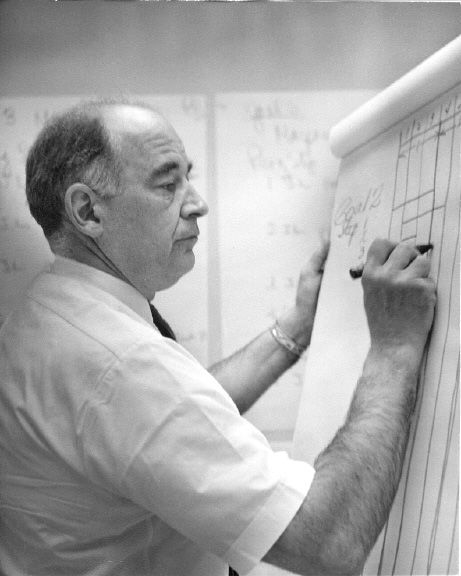
Those were tough financial times for my family. So tough that my father convened a series of family meetings run according to Management By Objectives (complete with flip chart), a technique he used in his work as a human resources director. We play our roles according to type: Dad the planner, laying out the problem and situation; Mom the annoyed, noting that she had more house to manage than ever before, with less help; Bruce the eager, brimming with ideas about how he could help; and Dean the loyal, committing to find part-time work at a gas station (and doing so, within a week). Me the self-absorbed teenager. I did not see how I could possibly help, given how busy I was with homework and activities. I also contributed to the meeting evaluation by complaining that a family should not be run like a business. Duly noted by my mother in the typewritten minutes.

I finish my chore. I have ironed each square flat, folded it in half, then in halves and halves again. My father will fold it one more time when he places it in his pocket. I probably gave it to him. I never know what to get him, the man whose only interests are hunting and fishing. He knows exactly what he wants – another rod, another shotgun – or needs – another pair of Filson tin cloth pants, wool socks. Nothing in my budget, anyway, and nothing I’m interested in. So he gets handkerchiefs. I know he will open the gift ceremoniously, slicing the ribbon with his pocketknife (ever at the ready) and displaying the contents of the box with a flourish. (Handkerchiefs! Great, just what I needed, Betz!) I think, he is the most predictable human being ever.

I never predicted that he would become old, so old that we would stand eye to eye, so old that he would rely on Kleenex, wouldn’t even remember that he was once a handkerchief man. I feel ashamed by my teenage annoyance, my flickering embarrassment about my father, my glowering thoughts that I hid behind thickly mascaraed eyelashes. I remember the days when I still looked up at him, and he was a handkerchief man.

3 Comments

Filed under Uncategorized