The Intimacy of Leadership


Henry S Campbell, 1945, 23rd Marine base camp Maui

What makes young men and women willing to risk their lives on the front line? What is leadership in a military organization? How is it taught and instilled? These are some of the questions I’m pondering in preparation for some research I’m undertaking as background for a memoir.

My father, a retired Marine Corps Colonel who fought in World War II, rarely talked about his wartime experiences. Sometimes his emotions overwhelmed him, but more often, he didn’t think they were worthy of elaboration; like many of his era, he didn’t consider himself a hero. The heroes were the other guys. The ones who died.

My brother Dean recently stumbled across a video recording of his conversation with my father in 2003, ten years before his death. Talking about his officer training in Quantico in 1941, he recalled that his mother and aunt visited the base just as he came off the bayonet course. He remembered that he “ran it for blood.” Then he explained why he took the training so seriously — not because he needed to save his own skin when facing an enemy, but because, as a second lieutenant, he would likely be responsible for his platoon:

“You’re going to teach kids this stuff. You’re their mommy, you’re their daddy. They depend on you for literally everything at the platoon level, which is the message I drilled my young candidates on. It’s your monkey. It ain’t going anywhere. You better fly it.

“If you’re good at this, you’ll know their names, and if they’re married, you’ll know their wive’s names and the names of their kids, be interested in them as individuals. Because when you get into battle time, there’s no time to get an introduction. All that should be behind you. You’re familiar with the guy; you’ll know what he’ll do and what he won’t do. You’ve got to know this and that takes intimate contact. That’s a serious matter, which is why the Marine Corps is good at what they do. There’s nothing impersonal about any of it, no matter what you see in the movies.”

1 Comment

Filed under Uncategorized

The Night I (Finally) Understood Christmas

Animal onesie hugsMy favorite Christmas moment was the last one before I fell hard asleep.

I’d been in commandant mode all day, maybe all month, but finally — finally — the presents were opened, the meal was produced, and the family was unpleasantly full after gorging on turkey and all the fixin’s plus some extra fixin’s for good measure. “Ben!” I’d barked at my nephew, “move it!” as I motioned for him to step away from the counter where I planned to set the brimming dishes. Then I added, “I want you to know I speak to you like my own children.”

As if he would understand that I only bark at those I love.

In the moment this picture was taken, this delicious moment after I emerged from bed to take it, my adult daughter and son had returned from checking on two pooches that my son was babysitting over the holidays. He seemed too tired to drive so my daughter, his older sister, agreed to go with him. When they returned, they had concocted the idea to take a picture in front of the tree in his-and-hers animal onesies.

They could hardly stand, they were so tired. I could hardly stand. But I’m so glad that I got out of bed to say goodnight just as my daughter was telling her brother that no one was around to take the picture. Then they saw me: problem solved.

Pictures were taken: arms flung wide, arms wrapped around each other. They’ve been this close since the beginning, a true gift to one another.

Why is it that I just figure Christmas out — remind myself what the season means — about the time it’s over? Until then, it seems, there’s just so much work to do to make it perfect for everyone. Or (let’s be honest, Betsy) to make it perfect enough for my own standards.

Christmas had begun to seep in on Sunday when I finally made it to church. As the advent candle was lit for the fourth Sunday, this blessing was said:

“Love surpasses the secure locations we would choose, the holy nests in precarious places and roots in the fragile.”

I’d been feeling overwhelmed. Broken. With my son applying to teach English in Japan, it had been like college app season all over again, characterized by my own frantic feeling that I needed to make sure he didn’t miss a step. He wanted this, after all, so I was all in. I know what they tell parents — it’s supposed to be their problem, not ours (there’s yet another “should” from whoever “they” are) — but I’m terrible at disconnecting.

So I was sitting in church feeling like a failure, like a rotten mother who, in her effort to ensure that things got done and done right, was turning the holiday season into boot camp. Instead of offering love, I was draining it. Ninety percent of the time I’d been in bitchy mode; the other 10 percent I tried to make up for it.

As the week continued, I couldn’t stop thinking about the blessing of the Advent candle. About precarious and fragile places. About brokenness.

Was this a reminder that love conquers all? That I could make all things right with enough love?

No, I had it on its head. It was a reminder that I was loved — am loved — even in my fragility and weakness. Even when I confuse motherhood with sovereignty.

Then I read Pope Francis’ homily on Christmas Eve. The meaning of the birth of Jesus, he said, “is the humility of God taken to the extreme; it is the love with which, that night, he assumed our frailty, our suffering, our anxieties, our desires and our limitations. The message that everyone was expecting, that everyone was searching for in the depths of their souls, was none other than the tenderness of God: God who looks upon us with eyes full of love, who accepts our poverty, God who is in love with our smallness.”

God’s love could surpass my smallness? The way I sometimes fail in mothering, the most important role entrusted to me?

Here were my children, standing by the Christmas tree, engulfing one another in a hug, goofy in zebra stripes and leopard spots. Here it is, I thought, what Christmas is really all about. Love, just love. If only I let it in.


1 Comment

Filed under Uncategorized

Egg Beater Drawers


egg beater drawers

There it was this morning, my mother’s voice. In my head, of course, since it’s been 15 years and counting since she passed away. But I heard it, clear as her prized Waterford crystal: “Dammit, Betsy, my drawer looks like you’ve gone through it with an egg beater!”

She was right. Her underwear drawer did look a mess after I got through with it. My mother wasn’t particularly neat — she considered piles a perfectly appropriate organizational system in the kitchen — but her drawers were another matter. That woman knew how to fold. And the neatest drawer of all was her underwear drawer. I know because I raided it every time I needed a half slip.

Her underwear was practical but silky with bits of lace on the bras and panties, camisoles and slips. All of it was folded into neat squares — the slips set toward the back, the underwear and bras toward the front. Bras were folded in half and stacked on top of one another, a miniature mountain in a landscape of lingerie.

Some people hear their mother’s voice critically — there she is again, bitching at me from the grave — but (thankfully) that’s not what I heard. She sounded exasperated, to be sure, but loving. As if wondering how she was going to survive my teenage hood while in her mid 50s. And just that phrase — her distinctive “dammit!” — was like having her back again, if only for a minute.

I never did master underwear folding, and my underwear drawer does look like it’s been mixed with an egg beater. But at least I stowed my stuff, Mom, so it doesn’t look like it’s been spread from “hell to breakfast.” And, by the way, Merry Christmas… and I miss you. Thanks for stopping by.


1 Comment

Filed under Uncategorized

Mom, On Thanksgiving

Mom's prayer guide

As I’ve been thinking and writing about my mother this month, I’ve unearthed various letters and tidbits that bring her wit and wisdom roaring back… I published this as part of a post last week but it seemed somehow appropriate to bring this piece back in honor of our national holiday for gratitude…

A few days after my mother died, I found a book in her bedside table that contained 24 spiritual exercises “for healing life’s hurts.” I don’t remember taking it, but I must have, because I stumbled across it again this week, in a cupboard, forgotten. There was her first name in her careful right-leaning cursive, the top and bottom of the “E” of Eileen curling back upon itself, the “n” swooping east in a long, straight stroke. Other than the cover, only one page of the book bears her handwriting, the third lesson, entitled “The Healing Power of Gratitude.” She underlined this passage: “(S)ometimes just letting ourselves be loved can solve so many problems. When we let go and just soak up love from the Lord and others who care for us, we have a whole new power to go on again.” Next to this, in a slightly shaky hand, she wrote, “God doesn’t walk out on me — I walk out on him.”

Gratitude was a common theme in the letters we exchanged over the years. When we spoke by phone, living 800 miles apart, we often struck sparks off one another, but on paper we were forced to listen. (I say “we,” but more likely it was me who had the interrupting habit.) She almost always began with news of her church “doings,” good Episcopalian churchwoman that she was. A letter I received when I was single and working in Los Angeles — now bundled with others in a box — was written in her classic vein. She began by noting that she was “piddling around” getting some things done, including publicity about the United Thank Offering, which she lamented was rarely used as it was intended. One was supposed to put coins in the Blue Box as a personal spiritual discipline for acknowledging the good little things that happen every day. She wrote, “I admit that I frequently forget to use it but I do remember a lot of the time to say thank you, God, when I get a lovely letter such as yours which came yesterday, or Dad shows his appreciation for something — or maybe because I didn’t have a flat tire when I was in a hurry and late — this past week I have been grateful when there may have been a whole 24 hours this puppy of your brother’s didn’t dig something up in the yard — or managed to hit the papers during the night.” She ended that long train of thought paragraph by saying she just wished the timing of babysitting my brother’s dog was different so that she could get on with gardening.

Even that last bit is true to form. On the page, she just shrugs her shoulders and moves on. The dog digs. The garden will suffer. We shall overcome. I can think of dozens of examples when she took far bigger things in stride. Her anger worked the same way. She yelled, said her peace, gave as good as she got. But when the argument was over, she didn’t resurrect it. Her lexicon seemed nearly devoid of those negative emotions that require time to fester: blame, guilt, spite. She wasn’t one to let things marinate.

This Thanksgiving, I’m grateful for so much, but, Mom, you are at the top of the list.

Leave a comment

Filed under Uncategorized

The Air of Aloha

Maui

The air, when you walk off the plane in Hawaii, doesn’t so much hit you as hold you. Hit you is what the air does in summertime Sacramento when you break the seal between the air conditioned inside and the flame-broiled outside.

First the tropical breath teases its way into the pressurized cabin; then it dances around your feet and surrounds you.

It is a trust circle that says lean back and I will catch you.

All the elements of aloha are present in that moment:

“alo” — sharing, in the present

“ha” — life, energy, breath

The air says carry this spirit with you.

And then breathe.

2 Comments

Filed under Uncategorized

With Gratitude: Seeing Red

FullSizeRender

All summer and fall, I’ve been trying to write about my mother, who died in 1999. I thought I was at peace with her when she died. I had been one of her hospice caregivers during the months she struggled for breath, and I was with her at the moment of her passing. At one point, she even made a speech in which she said everything I ever hoped she would say to me. My mother and I had no unfinished business, or so I thought.

But every time I went to write about her, I remembered a particular instance in which she threw underhanded, called me a name, apologized later. It became my personal whack-a-mole. No matter what I was writing about — my childhood, my father, my husband, my own children up the incident popped. Yes, her comment was mean. But why skewer her? If she were alive, we could have a good fight about it, a fair fight. That one scene did not a relationship make. There were hundreds of other scenes — thousands — I could have brought to mind, but I was stuck. The words would not come.  Until I opened the box with the Chinese brocade.

I don’t know what possessed me to go spelunking in my attic last week, but I felt compelled to pull out some of the stuff I have squirreled away in nooks and crannies. I’ve inherited some stuff, and collected other bits when my father moved out of his house in 2003. On this particular day I went looking for the bins I stored among dusty luggage, abandoned briefcases and boxes of seldom-used holiday decorations. The last time I opened one, I think, was when one of my children mined it for show-and-tell. Both of my children are out of college now, so that had to be long ago, at least a dozen years back.

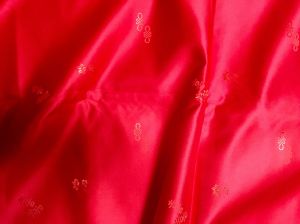
Through the translucent side of the top bin, the contents looked like layers, vanilla except for a ribbon of red. What could possibly be so unabashedly red? I removed the packing tape, so old it it cracked rather than peeled, to discover what was on top. Oh, it’s you, I thought, as I extracted the remnant of silk. Left over from the cheongsam my mother had made when we lived in Hawaii, I greeted it like a long lost friend. It’s red without the pop of orange, red without a calming hint of blue: red for blood, red for lust, red for love. It’s red as in red-white-and-blue for the nation’s birthday, which my mother conscripted into a celebration of her own every July 3rd.

When I touched the fabric, still as vibrant as it was 50 years ago, I could see my mother laughing, regaling the family with the story of how she had pointed to where the slit should end, mid-thigh, and how the seamstress kept gesturing to a spot a foot lower and shaking her head: “not Chinese lady.” I remembered my mother showing off the finished product, her curves straining against the thick brocade, her thigh peeking forth a full three inches above the knee. My mother had movie star legs and feet so lovely they landed her a college job modeling shoes at I. Magnin, the nicest store in Seattle. Did the shoe models parade down a runway curtained like a puppet stage, I used to wonder, so that only the calves and ankles showed? My grandfather, who knew more than he should have about a nicely turned leg, reportedly told my father upon meeting her, “Son, a pretty face will fade away but a good pair of legs is a joy forever.” She was never traditionally pretty — exotic, yes, with the olive skin of the Black Irish, cheekbones like Mt. Rushmore, pillowy lips and dark brown eyes that snapped beneath lids that almost lacked folds. An interesting face, a strong face, but not one that could precisely be called pretty.  Her hair, in the last ten years before her death, was more gray than brown but what she lamented was the increase in shoe size that followed the birth of five children. The beautiful shoes she’d received in exchange for modeling — the pumps and the sling backs and the snappy navy Spectators — all had to be given away.

I wrote, “Oh, it’s you,” because my mother felt more fully present than she had in years. Seeing the silk made me want to laugh and yell red, red, red, red, red! God, my mother loved red, and red loved her back. My father had a bouquet of Shakespearian sonnets he would offer up to her — or use to extol her after her death — but my favorite was Sonnet 130 with its dripping irony: “…I have seen roses damasked, red and white,/But no such roses see I in her cheeks.” I can see him at the dining room table, looking at my mother, smiling a half smile as his baritone voice marked off the meter, ending with, “…I think my love as rare,/As any she belied with false compare.”

Once I had touched the silk, she seemed to be woven into everything. Below the red silk was a pink bed jacket that had been my grandmother’s but it was my mother who told me about it. Now that I think about it, that brief exchange was just so my mother. I know she missed her mother, who lived with us for many years — she was a big help with the children — but I don’t think she kept the old lingerie for its utility. So far as I know, she never used it. I think she kept it for its sentimental value, for the same reason that I cannot purge it. I thought of her again when, at the bottom of the bin, I saw a little christening robe with an embroidered wooly kitten. I’m almost certain it was made for my sister.

My sister, Madeline Elizabeth, was born in 1950 and died on October 22, 1953, two days before my father’s birthday. They called her Midge. She was my parents’ third child, planned to be their last. At thirty-two, my mother had her daughter.

Sometime around Midge’s first birthday, my parents noticed that she was tired and listless, not the energetic little girl she’d been. My father’s brother, a doctor who specialized in blood cancers, came down from Boston to examine her. He took a sample of bone marrow from her hip and diagnosed leukemia. For almost three years, my uncle treated her with an experimental drug. During Midge’s last remission, the family vacationed on the Northeastern shore. In one picture, she held my father’s hand, looking shy. Even though she was not yet four, she wore size 6 clothing due to the weight gain that was a side effect of medication. It embarrassed her, my mother told me.

Then the remission ended. The leukemia advanced rapidly, and after she was taken to the hospital, my brothers never saw her again. They weren’t allowed to say goodbye, or attend her memorial service, or visit her grave; in 1953, that’s what experts recommended. Midge’s death must have brought my parents to their knees, but my mother muscled through it. She would have done well in ancient Sparta. She had two other children to care for, then six and ten, and she had recently learned that she was expecting. Again, the experts weighed in, advising an abortion since the stress might be too much for her or the baby. This time, my parents ignored the counsel. My brother Dean was born in April 1954. I followed three years later.

I remember seeing my mother cry only once. She was standing at the kitchen sink doing dishes and looking at me, looking at me but not really seeing me. I asked her why she was sad and she told me she was thinking about my sister.

After my mother died, I found a book in my mother’s bedside table that contained 24 spiritual exercises “for healing life’s hurts.” I stumbled across it again yesterday, in a cupboard, forgotten. The first thing that struck me, besides its red cover (now that she is on my mind, I see red everywhere) was her name written in pen. There is her name in her careful right-leaning cursive, the top and bottom of the “E” of Eileen curling back upon itself, the “n” swooping east in a long, straight stroke. The book’s pages are a little water logged, as if she read it in the bathroom and accidentally dropped it in water. Other than the cover, only one page of the book bears her handwriting, the third lesson, entitled “The Healing Power of Gratitude.” Here is my clue, perhaps, as to how my mother handled the losses in her life. She underlined this passage: “(S)ometimes just letting ourselves be loved can solve so many problems. When we let go and just soak up love from the Lord and others who care for us, we have a whole new power to go on again.” Next to this, in a slightly shaky hand, she wrote, “God doesn’t walk out on me — I walk out on him.”

Is this how she muscled through? By putting her faith in God? By practicing gratitude? Gratitude was a common theme in the letters we exchanged over the years. When we spoke by phone, living 800 miles apart, we often struck sparks off one another, but on paper we were forced to listen. (I say “we,” but more likely it was me who had the interrupting habit.) She almost always began with news of her church “doings,” good Episcopalian churchwoman that she was. A letter I received when I was single and working in Los Angeles was written in her classic vein. She began by noting that she was “piddling around” getting some things done, including publicity about the United Thank Offering, which she lamented was rarely used as it was intended. One was supposed to put coins in the Blue Box as a personal spiritual discipline for acknowledging the good little things that happen every day. “I admit that I frequently forget to use it but I do remember a lot of the time to say thank you, God, when I get a lovely letter such as yours which came yesterday, or Dad shows his appreciation for something — or maybe because I didn’t have a flat tire when I was in a hurry and late — this past week I have been grateful when there may have been a whole 24 hours this puppy of your brother’s didn’t dig something up in the yard — or managed to hit the papers during the night.” She ended that long train of thought paragraph by saying she just wished the timing of babysitting my brother’s dog was different so that she could get on with gardening.

Even that last bit is true to form. On the page, she just shrugs her shoulders and moves on. The dog digs. The garden will suffer. We shall overcome. I can think of dozens of examples when she seemed to take far bigger challenges in stride. When my middle brother came home from his sophomore year of college to announce that his girlfriend was pregnant, there were no recriminations. My mother just rolled with it. In my brother moved with his new wife and baby. Her anger worked the same way. She yelled, said her peace, gave as good as she got. But when the argument was over, she didn’t resurrect it. Her emotional lexicon seemed nearly devoid of those negative emotions that take their time to grow and then fester: blame, guilt, spite. She wasn’t one to let things marinate.

I inherited my mother’s ability to compartmentalize, although I’m a journeyman in comparison. I could use more of her joy, her appreciativeness, her unbridled passion. (I’m passionate, mind you, but more given to a more bridled variety.) I could do with more of her ability to forgive — obviously, if I had a hard time letting go of the one time that she threw a slur in my direction.

After she died, I typed out a list of words to describe her: proud, opinionated, funny, bold, independent, nurturing, dedicated, faithful, feminine but never frail, organized, a leader, passionate, fiery, loving.

There was nothing pastel about her.

2 Comments

Filed under Uncategorized

Finding Your Own Voice: O’Keeffe On Writing

IMG_5377

Here at Ghost Ranch, there’s a library that’s open 24/7, chock full of books on geology, Native American culture and traditions, poetry… and of course, all things O’Keeffe. I’m reading C.S. Merrill’s “O’Keeffe: Days in a Life,” a collection of poems written, with O’Keeffe’s permission, based on her experience of working for the artist as librarian, secretary, cook, nurse or companion, from 1973 to 1979, the last years of O’Keeffe’s life.

Here in number 77, Merrill describes an exchange about writing for a community.

Sunday morning O’Keeffe and I

discussed how to find your own voice,

your own vision.

I argued a painter can get off

alone and work in color 

but a writer must use words

which requires a community

of minds, you write to a community

of minds, I said.

She spoke harshly, very loudly,

“Do you think that

community of minds cares a moment

for what you have to say?

Of course they don’t!”

She answered herself.

She said I was writing

like others told me

said it was a very difficult

thing to listen to yourself

and write from that

said the key is free time.

Give yourself an hour or two a day.

all to yourself

everyone has free time

but they don’t use it

I said I have time when I am walking

to school — she said that wasn’t free

yes I was walking, but I was walking to

that wasn’t free time.

March, 1978

1 Comment

Filed under Uncategorized

Lessons in Loosening Up

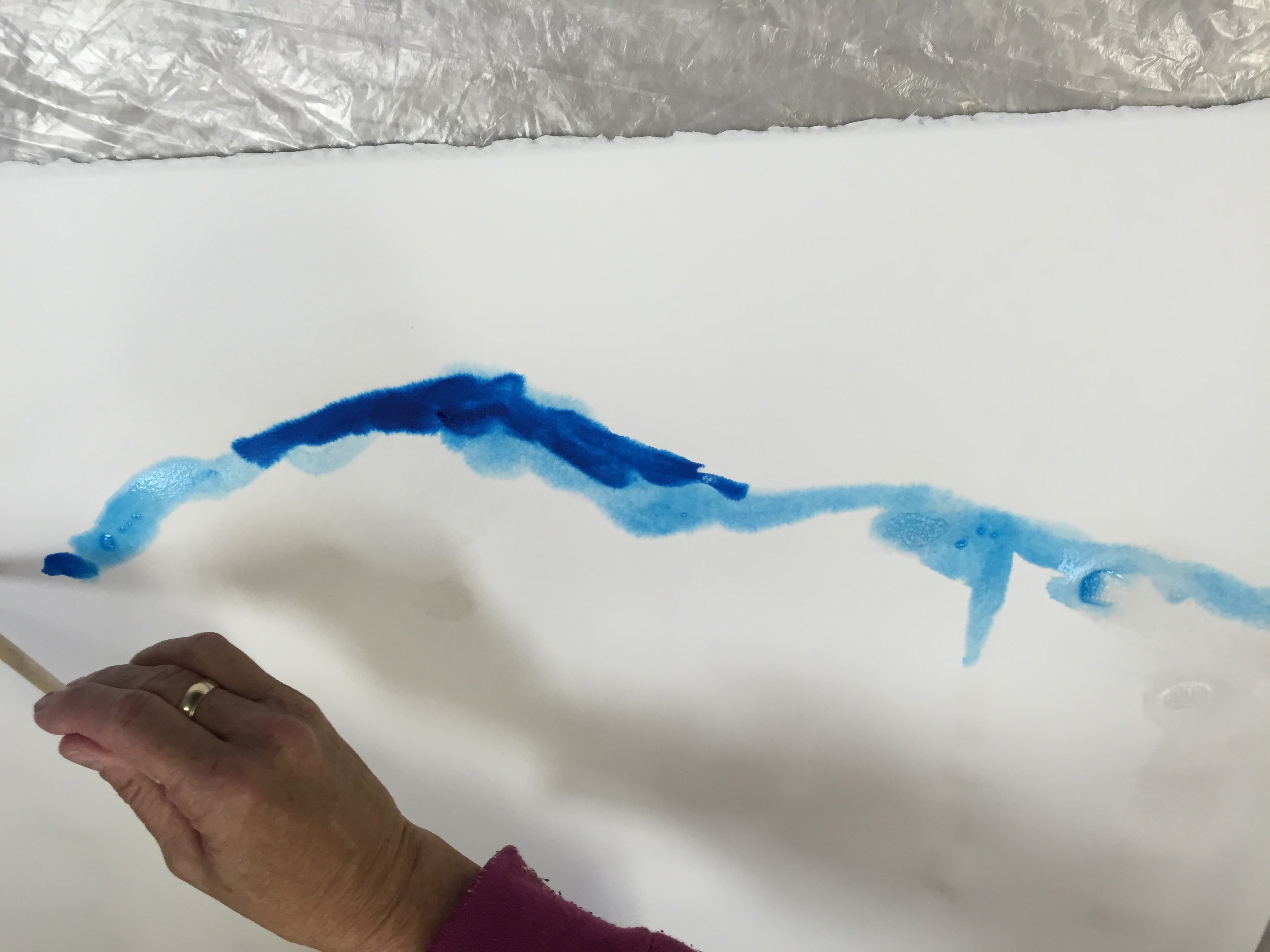
Tesia beginning a Golden Flow Release demo

Tesia beginning a Golden Flow Release demo

I’m in Georgia O’Keefe country — at Ghost Ranch, no less — attending a five-day painting retreat taught by Tesia Blackburn, the Acrylic Diva, whose tagline is “explorations for creating art that nourish the soul.” I didn’t think I had time for this, but my friend Lisa was so persuasive (and frankly bossy) that I couldn’t say no. And here I am in the painted desert painting.

What I didn’t expect was how much I could learn about writing from a painting workshop. Here are my top 8 lessons so far:

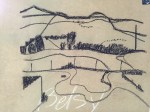
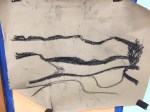
1.  Tell your inner editor to shut up. With so much color and form surrounding us, Tesia’s first exercise was based on the Japanese principle of Notan, which uses contrasting dark and light to create harmony. She invited each of us to sketch the forms of the mesa just outside the studio using charcoal. No shading, just dark lines or masses and white space. At the end of the exercise, we realized that my friend had folded up her image and was trying to look unobtrusive. When we made her show it (well, I did), hers was one of the most striking of the images produced by the students, but she had decided it didn’t look like it should. Her inner editor almost succeeded in shouting her down. As Tesia said, “The art doesn’t care how you feel about it.”

2.  A good composition takes a contrast of values. In art terms, the most intense color is a 10. The palest, lightest color is a 1. Most beginning artists tend to end up with colorful pieces that have almost identical mid-range values. They lack the intensity of a saturated dark color and thirst for some areas of lighter value. Writing, too, requires variation in emotional tone.

3.  Know when to stop. I think I’ll stop right there.

4.  Listen to the paint; see what’s on the paper. Almost everyone at the workshop starts with an idea in mind, but sometimes the paint (or here in New Mexico, the atmospheric humidity) has a mind of its own. The result is sometimes a happy accident. The product doesn’t turn out as expected; it takes off in a direction of its own. I have been astounded at how many times a piece of writing has taken a dog-leg turn… and ended up somewhere more interesting.

5.  Try to get away from the “thingness” – the representation of something – and get to the spirit of it. In writing terms, I think of this as self-consciousness. When I write with a tone in mind, but not necessarily an outline, the writing seems to take a more interesting shape.

6.  Loosen up. One way to do this, Tesia suggests, is to repeat an idea as a theme or a series but with different approaches. It’s like baseball, she says; you just have to keep going to bat and swinging for the fences.

7.  Simplify. My Notan exercise was a perfect example. Initially I captured lots of detail from the surrounding mesa. It ended up looking like a line drawing of a golf course. The more I simplified, the better it got.

8. Fix the problem. Many first attempts just aren’t quite right. Acrylic, like writing, lends itself to editing. Paint over… or backspace/delete and cut/paste. But to find the solution, you have to have an inkling about what’s wrong with the composition.

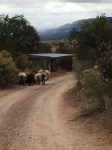
Even if I wasn’t benefiting from the painting workshop (Tesia is AMAZING), I’d still come away fed by this magical place. Check out the pictures (click to see full size)…


4 Comments

Filed under Uncategorized

Finding Poetry

Screen Shot 2014-10-02 at 9.34.45 AM

Dear lovers and writers of poetryThere’s nothing for you here today, nothing at all, except the first mewling cries of someone who is trying to understand why and how poetry is speaking to me even though I hardly understand a word. Read on at your own risk.

For everyone else: This is a short story that is a love letter to a friend I have lost and found.

I thought I wanted to raid poetry for its words. Poetry contains a well of words (see? there’s a metaphor already, though not a very good one since it isn’t novel; the best metaphors link unlike things) that I thought might inspire me as I attempt to write memoir.

I picked up Louise Glück’s Faithful and Virtuous Night, a dreamy collection of poems that the book cover says are meant to tell a single story, although it’s not like any story I’ve ever read. That said, I couldn’t put it down and I can’t stop thinking about it.

I read this scene from the title poem about sharing a room with a brother in a candlelit room at night:

[Note: WordPress is deleting the spaces between stanzas, so I put a “/” where a space should follow]

I was alone with my brother;

we lay in the dark, breathing together,

the deepest intimacy./

It had occurred to me that all human beings are divided

into those who wish to move forward

and those who wish to go back.

Or, you could say, those who wish to keep moving

and those who want to be stopped in their tracks

as by the blazing sword.”

So much unspoken mystery as Glück floats through her dream-night. I confess to feeling pretty lost but I keep thinking about the symbols she strews along her way. There is something here, I thought, more than words. Something that is affecting me.

I looked for answers in Edward Hirsch’s “How To Read A Poem and Fall In Love With Poetry.” And I read this: “Reading poetry is for me an act of the most immense intimacy, of what the poem finds in me. It activates my secret world, commands my inner life. I cannot get access to that inner life any other way than through the power of the words themselves. The words pressure me into a response, and the rhythm of the poem carries me to another plane of time, outside of time.”

Glück took me somewhere with her when she wrote of “the blazing sword,” the kind of metaphor that Hirsch calls “a concealed invitation,” which invites the reader to figure it out. Throughout her poem there are such references to the sword in the stone, and I’ll admit I find them a puzzle. Is the narrator the heir? The heir to memory? I’ll have to get one of my poet friends to explain it to me.

But besides the riddle, I was struck by Hirsch’s description of poetry’s ability to give him access to an inner life. I understood what he meant. I don’t always “get” poetry, but something in my shifts when I read some of it. The words and their rhythms go to a place within me that is beyond words, beyond logic. To a place of longing, of pure feeling, of community, of prayer.

And now I will give you a short story.

Yesterday I spent time with a dear friend who used to be my boss. In the professional world, she was my first true teacher and mentor. The place she holds in my heart cannot be filled by another. Just a couple of years older than me, she has been set upon by a series of strokes that the doctors don’t seem to understand. The smartest woman I’ve ever met is now much different. I won’t go into the details. Her brain is like a bog, with bits of organic material occasionally floating to the top. Thinking is hard. Putting names on things is impossible.

But feeling, feeling is still there. So much love it can light up her face.

So I decided to read her poetry. She cannot name images, but I wondered if words could form images in her mind, pictures that would bring her joy. I read from Mary Oliver’s “Why I Wake Early,” a book that I have taken to bedsides and even deathbeds.

The fourth poem that I read to her, I think, was “Peonies.” My friend closed her eyes when she listened and I remembered that was her pose of reflection. When she wanted to listen deeply with her head and heart she would press her eyes shut so that the only thing that existed was what poured into her ears. She always heard what one said, but she listened for the meaning underlying the words, tipped off by the telltale tone of voice, the choice of words. This is what she did yesterday: she tilted her chin down and her lashes floated onto her cheeks.

Poetry is a soul-making activity, Hirsch says. I wrote this poem, as terrible as a poet would find it, because I can’t seem to capture in prose my confusing stew of feelings: the deep grief I feel for the loss of my old friend, and the momentary joy we found together reading of peonies. Thank you, Mary Oliver, wherever you are, for the gift of that moment.

My old friend is someone new

I can’t say a stranger because she is familiar

diminished to some but polished to my eye,

silky of spirit./

Strokes like ordnance have reordered her brain.

Like a prize fighter, her husband says:

Too many hits to the head./

So we read of wild iris and humble sunflowers

But it was the peonies that swayed her

Lacy pools, white and pink./

She closed her eyes, lashes dancing

As we read of green fists opening, black ants tunneling

The words watered the parched patches in her soul./

When the poem ended we read it again

Delighted, her face sparkled

And then we were silent, two wet souls./

Shall I read more, I asked?

Sometimes you should let it sit, she said.

So we sat in the sunshine

Old and new friends.

3 Comments

Filed under Uncategorized

Dream Weaving

The Walloomsac Inn, Bennington, VT

For the last four nights, I’ve had vivid dreams… and remembered them, which I rarely do. Maybe it’s because I wrote a piece based on a recurrent dream — well, nightmare — I had as a child. The whole Freudian listen-to-your-dreams thing has always struck me as a little goofy, but let’s have a little fun. Play along with me, won’t you?

  • Night # 1 – The tale of the tumbledown house: I am doing a walk through of a house in terrible condition with a realtor and my husband (always the value real estate shopper). The location alone makes it a potential good investment (in Minnesota?) , but the place was built strangely and has lots of negatives: probable mold, harlequin red and green stained glass windows that make the interior strangely dark, and flooring in such poor condition that my stiletto heel (me in stilettos?) pokes through the subflooring spearing a chunk of pink insulation. I am in an increasing state of disbelief and finally say it’s too much of a mess. We walk away.
  • Night #2 – Three dreams in which I arrive late, two in classrooms where poetry is being taught: In the first, a nonprofit board meeting, I am late and frustrated because I can’t get through the line to get in and then I don’t have a seat; in the second, I am late (again) and can’t understand the pattern of the list that the female teacher, a poet, is writing on the board; and in the third, I come in as class is wrapping up and seek out the teacher, a poet, after class to talk to him about the semester assignment to write 320 pages. I tell him I’m a Bennington writing student and he says, “You guys are the worst.” When I asked why, he said that we can write but we can never figure out how to pull the packet together. I tell him I’ve lived a little, that I want to explore The Word. He smiles and says I’ll do fine. I am relieved.
  • Night #3 – Rainy season: The house on stilts where I am living with two children is safely above water level as the rainy season begins, but as I watch the waters rise slowly, I worry the road will flood and become pestilential. I am ticked at the base housing manager who is supposed to address the road drainage problem.
  • Night #4 – A busy night of dreams: In the first, I recover in the hospital from a cracked spine injury and get out of bed to go to the cafeteria after the nurse tells me they ran out of food on the unit; then, after a vacation at a resort, I end up driving the bus with my fellow tourists down a narrow levee and then successfully (and confidently) back it down a switchback; finally, I go for a run alone along a drainage ditch in Davis.

Hmmm. Houses. Classrooms. Teachers. Late. Flooding. Driving. Running. There’s a story, isn’t there? At least one.

Turning to the wisdom of the Internet, here is one possible interpretation:

I am leaving behind my old attitudes (run down house) and expanding my knowledge (classroom), better late than never (late) and ready to learn (teacher). The good news is that my worries will soon be swept away (gentle flooding), I am healing (hospital) from some weakness (broken bone), have accepted the challenge before me (driving), have faith in myself (water), and am determined and motivated in the face of my goals (running alone).

Here is another:

I need to update my thinking (run down house) and I am learning an important life lesson (classroom). I am ambivalent about a new opportunity (late) and I have childhood anxieties that have never been resolved (school) and am looking for approval (teacher). I need to release some sexual desires (flooding) but am afraid of losing control (hospital) and there is a weakness in my plans (broken bone) plus I am facing setbacks (driving backwards). And finally I need to make a decision (running) and stop wallowing in my negative emotions (muddy drainage ditch).

You decide. And leave my sex life out of it. 😉

1 Comment

Filed under Uncategorized