The Impressions We Leave

Runner on the bike trail

I had just forced myself back into running after a hiatus of several weeks (and, truth be told, I’m not really a runner anyway).

A runner passed me. As he did, he flared his left fingers into a brief wave. He looked vaguely like someone I know, but I thought, “No. He’d have said something.”

Then I saw him make his small wave at a runner going the opposite direction. And the bicyclist approaching him.

The cyclist’s head turned. You could almost see the question on his face, “Did I know that guy?”

Down the trail the runner went, making his small, friendly gestures along the way. Behind him, I could see the effect. People looked. They smiled. Their spirits were lifted.

I’ve been reflecting on several funerals that I’ve recently attended. How can a memorial service stick with you if you didn’t know the person?

I remember how my neighbor’s mother took someone in to her home when they were alone and ill with cancer, how she cared for a child day in and day out while the child’s mother was fighting to recover. Yesterday I listened as my friend’s father was remembered for his ability to find a personal connection with those around him, a man who never checked his intellectual curiosity at the door of the university where he taught, but also never played the game of intellectual one-upsmanship or intimidation.

My father told my niece, “In time, the world will forget all but a very few of us. But in the hearts of those we love, lies our chance to be remembered.”

The guy on the bike trail. The stories told at funeral. What these disparate experiences tell me is that we have the potential to have an impact beyond those we love.

A gesture, even a small one, received at just the right time, may be remembered. Stories are retold. Something is carried forward and becomes part of a new narrative.

3 Comments

Filed under Uncategorized

Moved by Someone Else’s Father

Henry S. Campbell, 2011

My Dad, Henry, in 2011

I went to a funeral for a friend’s father yesterday. Now that more of my contemporaries’ parents are hitting their 80s, I seem to be attending more services for a mother or father who I never met.

This one really struck me and I’m trying to figure out why. It didn’t have the biggest attendance, held in a tiny old fashioned white frame Methodist church in the country. Nor did this father produce an unusually big family, just three daughters, eight grandchildren and a few great grandchildren.

Yet I’ve never heard so many people speak at a memorial service.

The pastor reminded people that the family’s wish was to remember and to celebrate, not to get over the loss. In the years since losing Mom and the months since losing Dad, I am still startled by the many times I hear people talk about “closure” or moving on.

The oldest sister chose as her theme how her father lived up to the Boy Scout law: trustworthy, helpful, loyal, friendly, courteous, kind, obedient, cheerful, thrifty, brave, clean, and reverent. She expounded on each. That, and her Dad liked desserts, especially ice cream, a lot. As she shared anecdotes, she giggled the way my friend does: head tilted back a bit, eyes sparkling, mouth slightly open and the brightest set of white teeth you’ve ever seen on full display. Joy bubbled up and out to all of us. The second sister talked about her father’s kindness and wisdom. When she was torn by a work situation and isolated from her family, she asked for his advice. He told her simply that things would work out, as they usually did, for the best. He offered his support, unconditionally, and trusted her to figure it out. And he loved ice cream.

My friend, the youngest daughter, shared little stories. Her father, brilliant as he was, never failed to see the humor in situations, even at awkward moments, like church. Her sense of humor and her father’s hummed between them like an electrical current, the kind of connection that doesn’t take much to set one of them off in a fit of giggles. Though she shared information about her Dad, what came through most was feeling. You could feel the way she felt about her Dad, and see the joy that he left with her. And he loved ice cream.

Many of the grandchildren shared. Their grandfather, they said, had a way of connecting personally with each of them. For the granddaughter with athletic talent, he was the athlete, having been a three-sport letterman back in the day when you could be good at more than one sport. The grandson with musical talent knew him as the pianist who gave him a coronet that had been handed down from the prior generation. If a grandchild liked to match wits, their grandfather was always ready to take an opposing point of view, teaching them the love of debate for the sheer enjoyment of divining a more comprehensive understanding. They played cribbage. He was handy around the house. He loved nature and the outdoors. He was a devoted and loyal husband. He adored his grandchildren. And he loved ice cream and dessert.

As the pastor promised, the family and friends — former university colleagues, neighbors, childhood classmates — stitched a more complete portrait of the man they all loved. It was a remarkably consistent portrait.

For me, listening, it was a little like watching a movie. Though chronologically disconnected, as the story unfolded, it captured me.

It also reminded me how each member of my family has similar stories of my father inside them. Although my father was greatly diminished by the time he passed away at 96, memories are tucked away, waiting to be dislodged by something one sees or does.

Maybe something as simple, in my father’s case, as eating a bowl of ice cream or chocolate cake. My Dad loved dessert, too.

Remembering isn’t like picking a scab. I get a fuzzily happy feeling when little memories of Mom and Dad flash through my mind. They do not sting; rather they leave me tingling with the knowledge that the people I loved have not truly left me. They are part of my life as long as I remember them.

2 Comments

Filed under Uncategorized

The Friends Who (Always) Stand By

Ellen

Yesterday I awakened to an early morning message from my best-oldest best friend, who I have often described as “the one into whose arms I fell” when I was in 7th grade, the one who saved me as a newbie in junior high. She wrote, “I am feeling full of love and appreciation for the important people in my life. Just wanted you to know.”

And last week, a friend that I haven’t spent much time with since she moved in 1992 or 1993 drove all the way from Chapel Hill to stand beside our family at Mom and Dad’s burial. She’s the one who wouldn’t let me go to D.C. alone in May, when I made the trip to the Capitol to try to secure a burial date from Arlington National Cemetery.

Sharon

Tonight, one of my closest friends is driving up from the Bay Area to join the weekly Caregivers’ Social Club.

Lisa

There are more.* I don’t know how I rate these friends in my life. But I’m not complaining.

Long ago, I picked up a cheesy book full of aphorisms by a Canadian talk show host named Merle Shain (When Lovers Are Friends). This quote always stuck with me:

“(Friends) are like the pillars on your porch. Sometimes they hold you up, and sometimes they lean on you, and sometimes it’s just enough to know they’re standing by.”

So much is written about the value of friends, particularly the value of female friends to one another. I love writing – anyone who stops by here can figure that out – but when I try to express in words what these friendships mean to me, I feel like a fish. My jaw moves up and down, but no words come out.

So here I am this morning, speechless, wordless, overflowing with love for the blessings in my life. I don’t know how I would have gotten through the past years without them. I hope I can be half the support to them that they are to me.

*Wendi, Tracy, Sandy, Judee, Tamalon, Collette, Nancy, Cheryl, Deb…

1 Comment

Filed under Uncategorized

After: the Pull of Family, Redefined

Circa 1960 - Dean, Scott, Betsy, BruceJust before flying to Washington DC for the burial, I laughed when my son and I passed through the New Age vortex that is City of Mt. Shasta on our drive with his belongings back to college. “Amorandre’a” promised “evolutionary transformation sessions and workshops transforming the Body Mind to the level of the Atom.”

I’m remembering the “stick and ball” model of a testosterone molecule that my son had to create in 7th grade. The atoms (balls) of the model had to be connected with bonds (toothpicks) that shaped them into the angles dictated by nature: straight lines, angles and tetrahedrals. The shapes aren’t created by logic; the atoms are propelled and repelled into relationship with one another.

In the absence of Mom and Dad, we are forming new bonds across family units, relationships that seem to have an agency of their own.

After Dad died, one of the big questions that seemed to float in space before me was, “Who is my family now?” The phrase, “Friends are the family you choose,” implied to me a corollary: that family was something I could choose to define. I now think that was too simplistic.

My brothers and I are very different. We look different, we have different temperaments and we grew up in different eras. Mom and Dad’s life experience changed the way that they parented by the time my youngest brother and I entered the picture, so effectively we grew up with different parents.

In the months that have followed Dad’s death, I have increasingly felt that my brothers and I belong together, that they belong in my life and I in theirs. In the Marine Corps, you receive your “standard issue,” the equipment that you are expected to maintain. Take care of your equipment and it will take care of you. My brothers are my “issue.” I am theirs. We don’t get to exchange. We have to discover and value each other as we are.

Perhaps the most surprising thing about our weekend in D.C. – with 20 of us present – was the way that new relationships took shape.

Some of us were just plain new to each other. My nephew remarried and the weekend was the first opportunity his spouse and step-children to meet our clan. My brother’s fairly recently adopted teenage son is finding his way into the family, something that’s new to him after spending most of his life with foster families.

Family members’ messages popped up on Facebook:

The only thing I regret about my life is not having all the people I love in one place. Goodbyes are hard, so …let’s just say see you later.

one thing i hate: one day your having fun with family the next day you have to enter reality again grrrrr 

finally home whoooooo!!!!!!!! happy but sad to leave family 

At Washington National Cathedral Sunday, the jumping-off point for the sermon was a discussion of family. The Dean of the Cathedral, Dean Hall, said he was skeptical about the nuclear family; the Hebrew Bible, after all, unfolds like a dysfunctional family Thanksgiving dinner (remember Cain and Abel?). Though the family is the structure we’ve developed for mutual support and nurture, it “contains all of the contradictions of what it means to be human.” He went on to say that family alone cannot sustain us, that Jesus alone offers us a community, “a table where all are welcome and equal.”

Mom and Dad left us all a legacy, a multi-faceted legacy of the things they so obviously believed in, through their actions. One of the most important things they stood for was family.

They felt present to me throughout the long weekend that followed the burial on Thursday. I felt their smile as they watched us stumble our way toward one another.

This message, from my niece, said it best:

A wise man once gave me advice that changed the way I thought about life. He told me that family is the meaning of life. He said to me that try as we might, most of us will never do the sort of things about which great books are written. In time, the world will forget all but a very few of us. But in the hearts of those we love, lies our chance to be remembered. 

The wise man was my grandfather. I thought of his words today as I watched the faces of my family gathered to remember. I can’t help thinking that my grandparents’ story isn’t over. They may be laid to rest among heroes, but theirs was not a war story. It was a love story, and it’s one that is still being written.

The pen is in our hands now. Let us remember well, and may we never stop writing. 

1 Comment

Filed under Uncategorized

Perseverance

Photo cityoflennoxsd

I’m in a time warp. Everything at home is just as I left it, last Sunday’s paper mostly unread, the Sunday NYTimes Magazine still open to an article about the mid-career time out, cat toys on the coffee table. But the shriveled tomatoes and brown mangoes on the counter remind me that I’ve been gone for a week, as does the cat who won’t let me out of his sight.

When I see the souvenirs on my desk from a July trip to Japan, I expect to see dust. How could that have been just three weeks ago?

It feels as if I’ve been gone longer. I feel… different.

I didn’t expect to experience a greater sense of finality by burying Mom and Dad at Arlington last Thursday. “There’s a sense of closure,” a family member suggested before I left Washington, D.C.

No, that’s not it. Not it at all. Nothing felt unclosed.

This feels more like coming to the end of an enthralling book series that, in its coda, left me with certainty that my favorite characters could not return. There will be more books, but the plot will move on. New characters will be introduced. But the new protagonists will never quite equal that first story and I will not forget.

This feels final.

My role was final. At Washington National Cathedral yesterday, the second reading had this phrase: “…let us run with perseverance the race that is set before us…” (from Hebrews 11:29-12:2)

God knows Dad ran his race with perseverance, caring about all of us, and for us, to the end.

We persevered, too.

I finished what I promised Mom when she thought she was dying in the hospital: I took care of Dad.

I finished gathering the family for this final event.

My brothers and I finished the final task set for us: Mom and Dad’s wish to be buried next to Midge at Arlington.

We did it.

1 Comment

Filed under Uncategorized

A Wish and a Dream Fulfilled

Fiftieth anniversary, 1991

In 1953, when my then-three-year-old sister died of leukemia, my mother and father buried her at Arlington National Cemetery, promising to join her after the two of them had seen their lives through.

Sixty years later, my family and I have now fulfilled that wish.

I don’t know quite how to explain the power of the past two days. It’s 1:15 in the morning, here in the nation’s capital, but I can’t sleep. Not yet. Not without telling a little bit of this story.

On Thursday, we gathered in the family greeting area in the Administration building at Arlington and were met by two representatives of the Marines, part of my parents’ honor burial. “Your father was a national treasure,” Colonel Steve Neary told us. He went on to recognize not only my father’s service, but my mother’s sacrifice as well.

The beautiful companion urn crafted by my brother Scott gleamed in the sunlight that cascaded through the windows, the grain dancing when you looked at it from different angles. The plaque read, “In our hearts and minds always, Scott, Bruce, Midge, Dean, Betsy.”

companion urn for Eileen and Henry

Arlington’s representative, Mr. Dixon, led us to the transfer point where a company of Marines, a contingent from the USMC Band, and a caisson awaited, drawn by six horses.

Two Marines moved toward the cemetery vehicle in such slow motion that time felt suspended. Fluid step by fluid step, they approached the drawer in the flag-draped coffin, and gently placed the urn inside. Because we created a companion urn for them, Mom joined Dad on the stately march to to grave site.

Drums led the way, followed by a company of Marines in lock step. Then the caisson, and then those family members who chose to follow the caisson on foot. We sat within view of Midge’s grave stone while the urn was placed on the pedestal. To our left, Col. Cabaniss, Commanding Officer of Marine Barracks, commanded the Marines.

The Chaplain’s remarks reflected his understanding of my parents’ story. He spoke of Dad’s valor in Saipan, Tinian, and Iwo Jima. He acknowledged Mom’s sacrifices, and the value of their service to their country. In his prayers, he spoke of them being joined with Midge for eternity.

Seven rifles fired three shots each, a 21 gun salute. Taps played. I lost it.

Agonizingly slowly in the glaring mid-day sun, the Marines folded the flag, and presented it to my brother, who passed it to me. I held the perfectly folded triangle against my stomach, like a child.

One by one, the officers dropped a knee and extended their condolences to we four siblings, we adult children who carried through the wishes of our parents.

That night, the family gathered at Siroc Restaurant on McPherson Square. Food, family and wine: all the ingredients we needed to honor my parents’ legacy.

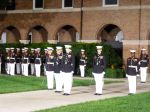
If yesterday was the fulfillment of a wish, then tonight was the fulfillment of a dream – a chance to viscerally demonstrate my parent’s legacy of love and service by attending the Marine Baracks’ evening parade as guests of its executive officer, LtC. Tom Garnett.

“It’s not a Disney parade,” I told the grandchildren and great grandchildren in attendance. “It’s like nothing you’ve ever seen.”

Two hours of riveting ritual, unfolding at a stately pace, performed perfectly under the watch of Major Sarah Armstrong, Parade Commander, and directed by Sgt. Major Angie Maness. Dad and Mom, I’m sure, were smiling, to see two such accomplished women in these roles.

The graciousness of the Barracks, in inviting us – all of us – to attend the parade as their guests, moves me  beyond words.

And if that weren’t enough, we happened to attend the annual parade hosted by the Commandant and honoring the chiefs of all of the armed forces, and were introduced by Col. Cabaniss to the Commandant, Gen. James Amos.

Though I would do anything to change the reality of losing Mom and Dad, I know that celebrating their lives has brought us together. Some branches of the family had never met before this week. We experienced something rare, together. A dream fulfilled.

8 Comments

Filed under Marines and those who serve, Uncategorized

A Bouquet of Adjectives for my Mom

Eileen Driscoll Campbell in 1993

It’s been a long time since I have looked at my mother’s obituary, but in reviewing it, I’m really glad that we took the approach we did, painting a colorful portrait of her colorful life.

Eileen Driscoll Campbell was known by many people in several communities for her forthright and outspoken style, tenacity, strength, intelligence, energy, wit, selflessness, strong leadership abilities and – most of all – her deep love for and commitment to her family.

Born on July 3, 1917 in Boise, ID, she was utterly devoted to the important relationships in her life – to her husband, children, parents, church and community. She passed away on May 10, 1999, at her home in University Place, WA, holding the hand of her husband, Henry Snively Campbell, to whom she was married for 57 years.

Eileen met Henry at the University of Washington during the spring of their senior year in 1939; Eileen had transferred from Mills College after her freshman year. Both were enrolled in an elective course on Browning’s “The Ring and the Book” narrative poem, taught by the UW’s “Dean” of English literature, Dr. Padelford. Henry recalled seeing “this vision enter the room, dressed to the nines.” For the first two weeks, Eileen left the class on the arm of their mutual friend, Brook Fink. After that, Eileen left on Henry’s arm. Eileen was active in Gamma Phi Beta sorority during college and as an alumna.

Anticipating the US entry into World War II, Henry was commissioned a second lieutenant in the Marine Corps Reserve in May, 1941. After receiving a letter from Henry in early December, Eileen boarded the train with her mother from Boise to join Henry in Quantico, VA. The two were married a short time later on December 26, 1941.

Eileen loved babies and children. The couple became parents for the first time in November, 1942, with the arrival of Scott Driscoll Campbell. She devoted her life to building and caring for her family, which over 15 years grew to include Bruce Harrison Campbell, Madeline (“Midge”) Elizabeth Campbell, Dean Driscoll Campbell and Elizabeth (“Betsy”) Harrison Campbell.

Just prior to Eileen’s diagnosis of lung cancer, the family gathered for a family portrait following Christmas. Eileen sits smiling in the center holding her newborn great grandson, surrounded by her husband, children, two daughters-in-law, son-in-law and six grandchildren. Scott and his wife, Pat Ford Campbell, live in Seattle. Scott’s son, Marc Christopher Campbell, lives in Mesa, AZ, with his wife, Jennifer, and their newborn, Henry Scott Campbell. Bruce and his son, Vincent Manzari Campbell, live in San Diego, CA. Bruce’s daughter, Cassandra Eileen Campbell, lives in Seattle. Also residing in Seattle are Dean, his wife, Gwendolyn Snyder Campbell, and their daughter, Alison Rose Campbell. Betsy lives in Davis, CA, with her husband, Todd Stone, and their two children, Madeline Follis Stone and Thomas Milton Stone. Eileen and Henry’s third child, Madeline, died in October 1953 of leukemia and is buried at Arlington National Cemetery.

Eileen is also survived by: her cousin, Donald Clark, of Nampa, ID; her niece, Louise Campbell Ulbricht, and grandniece, Mary Ulbricht of Tacoma; her nephew, William F. Campbell, Jr.; his wife, Margaret, of Yakima, WA; and her godchild, Lynn Fawcett Whiting of Bliss, ID.

She was a devoted officer’s wife who supported Henry’s successful career in the US Marine Corps. The couple lived in the Washington, D.C., area for several tours of duty including Henry’s service as Executive Officer of Marine Barracks between 1957 and 1959, during which he was promoted to Colonel. Henry also served as the US Marine Corps member of the Directing Staff of the Canadian Army Staff College, Kingston, Ontario, between 1955 and 1957. The couple moved to Washington state following Henry’s retirement from the Marine Corps following his heart attack in Honolulu, HI, in 1963. Henry continued his career with Weyerhaeuser Co.

Eileen approached their civilian life with equal gusto, becoming a leader of many church, community service, and arts groups in Seattle, Everett, and Tacoma, WA.

Eileen’s Christian faith was central to her life. To Eileen, being a part of a community was synonymous with active participation in church. She fondly remembered Washington National Cathedral in Washington, D.C. She was an active member of St. Mark’s Episcopal Cathedral in Seattle, St. Patrick’s Episcopal Mission (later Parish) in Everett, and St. Andrew’s Episcopal Church in Tacoma. She chaired the Vestry of St. Andrew’s several times and was instrumental in the church’s incorporation efforts. She served as president of the Episcopal Church Women and St. Mary’s Guild, and contributed her time to many church support guilds, including the Altar Guild and Wedding Guild.

Eileen was a strong proponent of the P.E.O. Sisterhood, a philanthropic educational organization. She served three terms as president of Chapter CA, twice in the 1970s and the third time in 1981-82.

She participated actively in children’s school activities, leading an Indian Guides group in Kensington, MD, serving as den mother in Seattle, WA and marshaling an effort to build Curtis High School’s first entry in the Daffodil Festival Parade in 1975.

Having studied and sung opera as a soprano during her music studies at the University of Washington, Eileen’s interest in opera was passionate. She was an active member of the opera guilds of Seattle and Tacoma and served as president of the group in Everett. Eileen also was an active participant in pediatric orthopedic guilds in Seattle and Tacoma.

Eileen attributed the importance she placed on relationships to her parents, Madeline Spieles Driscoll and Dean Driscoll, a Harvard-trained attorney who practiced in Boise. Eileen also was devoted to her grandmother, Hannah, whom she credited for her tenacity and positive attitude. She was proud of the family’s Irish heritage and its role in settling the West.

Services are scheduled for Saturday, May 15, beginning at 2 p.m. at St. Andrew’s Episcopal Church located at 12th and Jackson Streets in Tacoma. An informal reception will follow in the church parish hall. In lieu of flowers, unrestricted gifts are welcome to St. Andrew’s Episcopal Church. Those who celebrate her life are encouraged to wear red or bright colors, reflecting Eileen’s vibrant approach to living.

Eileen leaves a gaping hold in the lives of all who loved her. In another sense, she filled many holes with her fierce brand of love and devotion. She was much loved by her family and the many others whose lives she touched. Her memory will be cherished profoundly.

Leave a comment

Filed under Uncategorized

Before I Die, I Want to ______________

That’s what TedX Sacramento asked participants to write on a big blackboard on Friday.

My best oldest friend recently reminded people what I used to say when we were teenagers. I told her I wanted to be wise. Maybe I thought that would be an admirable answer. But now that I am where I am in my life, I think it’s still a pretty good answer.

I spent a lot of time in the past 7 years with someone I considered very wise, and wisdom turned out to be something different than I imagined.

My father, who died in January at the age of 96, didn’t offer his opinions, although his were well informed by experience. He didn’t try to demonstrate how much he knew, although he was well educated and read broadly. He was patient, and humble to the point of self-effacing.

And to much of the world, he was invisible.

This, to me, is one of the great tragedies of our time: that we live in communities with more and more old people, and we mostly ignore them because they are seen as no longer beautiful, not useful as a source of social connections, don’t get the inside jokes, and – horror of horrors – they are not fast. They take too long pulling out of parking spaces and writing checks at the grocery store. Their stories can’t be condensed in 140 characters.

Until his last few months of life, my Dad was capable of listening with great empathy, as if he had nothing more important to do than to listen to my problems or those of others. And maybe that’s the point, he really didn’t have anything more important to do. He was able to devote 100% of his attention to anyone who was sincere and making an effort.

His wisdom was dispensed in stories, not just the ones with successful endings, but the things that caused him pain. Through these stories, he conveyed what really mattered: family, accountability, bravery, loyalty, integrity.

We have time and money to address childhood poverty, as we should. But there seems to be no moral outrage that one out of five of seniors in California is living in poverty, according to the supplemental Census bureau measure that factors in the cost of medicine, which is not an elective expensive for seniors. One in ten seniors doesn’t have enough food to meet their needs.

Seniors may not hold the future, but they may help us to live our future better. With their wisdom, maybe they will help us to avoid a few mistakes, or to correct a few that we’ve made. If only we can unplug from our social networks and pause from the demands of our lives long enough to notice the precious resources who lie hidden among us.

[I’ve never cross fertilized my blogs before, but this one seemed relevant to readers of both The Henry Chronicles, and local nonprofit followers who read Philanthrophile.wordpress.com. This post was originally published there on Sunday.]

Leave a comment

Filed under Uncategorized

Home in Tacoma: Family Life After the Marines Part 2

(Seventh in a family legacy series… almost done, I promise!)

In December 1969, I had never lived anywhere longer than three years. That all changed when the family moved to 8601 43rd Street West in University Place, the kind of community where kids generally went to school together from kindergarten on. The only problem was that hadn’t lived there from my early elementary years. I was on the outside looking in while students whispered and slipped each other notes in core class. But frankly, maybe everyone feels that self-conscious in 7th grade. They weren’t unfriendly, just segregated into class structures like 7th graders everywhere. No one had to tell you who the roosters were, or the partyers, or the nerds.

Thank heaven for Ellen Palmer, the other new kid. We discovered each other standing next to our lockers and soon found we had a lot in common, including being from ex-military families. With Ellen, I could face anything.

1970betsy

We were down to two children living at home, Dean, in 10th grade, and me. Scott was still stationed in Germany and busy raising Marc with Jody, and Bruce and Camille had moved out on their own with Sandy in South Seattle.

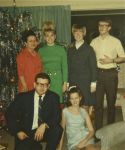
Decorating our home for Christmas was one of the first priorities. We unpacked Mom’s angel collection, which she displayed on a bed of “angel hair” (spun fiberglass), lit from underneath by a string of lights. We acquired a Douglas fir tree, festooned it with colored lights and metallic icicles, and hung our old favorite ornaments: glass globes that survived the various moves, Japanese court ladies’ silk balls (temari), wooden jumping jacks, and yarn angels. Out came the felt stockings we had made in while still living in Washington, D.C.  Jody, Scott and Marc arrived for the holidays on leave and Mom invited old friends from Seattle and Everett to come warm the house: Kay and Bruce Straughan, Patsy and Rick Lukens, and Jim and Sheila Campbell. And Santa brought Dad just what he wanted.


We all found things to like about the new house. Although it was about a mile from Puget Sound, it was situated near the top of a hill and commanded a spectacular view of the Sound and the Olympics – when it was clear, that is. The rhododendrons, already mature in 1969, grew to at least a dozen feet high and surrounded the house with color in the spring. Dogwoods, lilacs and camellias also made their appearances according to their seasonal schedule. But the showpiece was a Mt. Fuji cherry tree that exploded with double pinkish-white blossoms along its horizontal branches each spring, just outside the dining room window.

Mom always made an effort with the garden and landscaping wherever we lived, but she really put her heart into the yard in Tacoma. She planted the rockery in the back yard with roses and seasonal flowers, set off by trailing greenery. In shady areas, she planted colorful impatiens. To the front yard she added a rose garden with some of her favorite specimens, especially yellow-throated Peace roses tinged with pink and apricot.

Three outdoor areas facing the West provided plenty of opportunity to enjoy the yard and view: a wooden deck that ran the entire length of the upstairs level, which Mom embellished with hanging baskets of fuchsias, a large deck downstairs off the recreation room for entertaining, and a patio just off the kitchen which turned out to be perfect for barbecuing and making ice cream in a hand-cranked freezer.

The L-shaped living and dining room became the focal point of the house for family dinners, cocktail parties, bridge parties and PEO meetings, with the bay windows and a sliding glass door providing seasonally-changing vistas. The fireplace hearth made a natural place to display Mom’s favorite brass tray and Japanese or Chinese statuettes, while the wood box was converted into an indoor garden featuring orchids, ferns and plants with colorfully variegated leaves. Scott built a cabinet for the stereo and furnished it with a state-of-the-art turntable, receiver and speakers, which Mom quickly filled with a collection of operas, classical music and Broadway musicals (“South Pacific,” “Kiss Me Kate,” My Fair Lady,” etc.). And there was always room for humor, which used to be delivered by LP: Andy Griffith’s “What it Was, Was Football,” and an album with a sketch about an astronaut who refused to go into space without his crayons. (Every family has those one-liners that no one else understands, but results in the recall of the entire story for those in the know. One of our family’s was, “I want my crayons….” from that comedy album.)

Though the setting was elegant, our family dinner tradition usually included the singing of children’s songs from a long-lost album: “The Sturdy Elephant,” “The Hippopotamus,” “The Policeman and the Little Bum.” Also in the mix: a few nonsensical rhymes passed on by Dad’s father. One began,”I went down on hilter halter, and came upon filter falter…”

Nearly-naughty limericks were also favored, such as: “There once was a young woman named Kroll/Who had a sense of humor exceedingly droll/At a masquerade ball/Dressed in nothing at all/She backed in as a Parker House roll.”

And of course there was the recitation of Great Poetry. Dad would inhale deeply and with a booming voice begin, “Speak!” The initial startled response over, he continued with Longfellow’s first few verses: “speak thou fearful guest/Who, with thy hollow breast/Still in rude armor drest,/Comest to daunt me!/Wrapt not in Eastern balms/But with thy fleshless palms/Stretched as if asking alms,/Why dost thou haunt me?”

The well-trafficked kitchen had room for a table where four could sit, and a built in desk under which first Boot, and then Katie and Beall, and finally Meg curled up with the hubbub of the family nearby. The upstairs also included a full-sized office, which doubled as a bedroom when Sandy or other family visited.

Downstairs, the full basement easily accommodated our friends and activities. Dad and Mom appreciated the large storeroom with an old furnace reminiscent of the many-armed beast in the movie, “A Christmas Story.” It didn’t belch smoke, nor did Dad have to do battle with it, but it turned on and off loudly throughout the chilly nights. Across from the store room was Dad’s workroom, a man cave with built in drawers for every type of tool, nut and nail, as well as space for Dad’s gun safe. His shotgun shell reloading equipment served as an alarm clock of sorts on weekends; first the waterfall sound of the shot being dropped followed by the ka-chunk sound of the lever being depressed to crimp the reloaded shell. Over and over and over again.

Dean and I had bedrooms on the corner of the house at ground level. To me there were few more mesmerizing sounds than that of rainfall on the sidewalk outside my window. The large “rec room” included a pool table, an acquisition intended to help Dean build social connections after he broke his shoulder playing football not long after our arrival. The downstairs fireplace was often stoked and putting out heat, great for napping in the Lazy Boy recliner during the college football and basketball games that were often on TV.

Mom led the usual routine in establishing our social connections. She became active in St. Andrew’s Episcopal Church and PEO, and soon collected a group of couples with military ties, especially Bob and Jean Hankins and Peggy and Joe Woods, with whom they celebrated the Marine Corps’ birthday every November 10.

Dad continued his habit of walking, devising three- to four-mile routes that he rapidly covered in an hour. He shot skeet in tournaments and later helped to plant and raise pheasant on Ft. Lewis. Returning to his roots in Eastern Washington, he hunted for duck and upland game in their seasons, beginning with dove and moving on to pheasant, quail, hungarian partridge and chukar. Mom could make them all taste good.

1970sNormNelson

These hunting and shooting adventures were favorites for everyone. As adolescents, both Sandy and Marc were invited to learn to shoot skeet at Ft. Lewis. In addition to hunting at The Family Hunt Club in Othello, hunting chukar in the Bridgeport area up above the Columbia river was a favorite of both Bruce and Dean. Although I didn’t shoot, I loved it when I accompanied Dad. Bruce remembers staying at the Y Motel (running joke: Why? Y not…). In the pre-dawn hours, we’d arise and dress in heavy woolen Filson pants, sweaters, jackets and hats and gloves, prepared for below-freezing temperatures. Dad drove the “beast,” the four wheel drive green truck, to the field, and we’d begin walking uphill along a stream channel. The ice-encrusted shorn wheat fields would crunch under our boots as we entered the farmland, the cold air striking our faces. Then the sun broke over the horizon and the scene was bathed in white winter light – a tapestry of cream and tan colors sparkling as ice crystals caught the sun. Katie and Beall, the two springers who succeeded Boot, bounded away, but always responded to Dad’s whistle. Later, Meg, a Brittany, loyally retrieved birds.

Bruce remembers one trip a few years later when Katie started getting “birdy.” “As we crested the rise,” Bruce wrote Dad, “it opened up into a sunlit shallow bowl. You were slightly downhill and to the left with the dog, and I slowly walked into the depression. About ten yards in, the birds began to flush. I hit one, then another, and the birds kept flushing and flushing, in the hundreds. I heard several shots from you, and saw more birds fall from the sky. We spent the rest of the day picking up scattered birds from that same initial flock. Since then, neither of us has ever seen a group of chukars that large in one spot.”

Not long after we moved to Tacoma, Grandmother Campbell moved from her apartment in Yakima to a convalescent home nearby, after breaking her hip. After our dinner each night, Dad religiously packed up a plate for her and took it to her at Abilene House, returning around 9 p.m.

1970grandmother

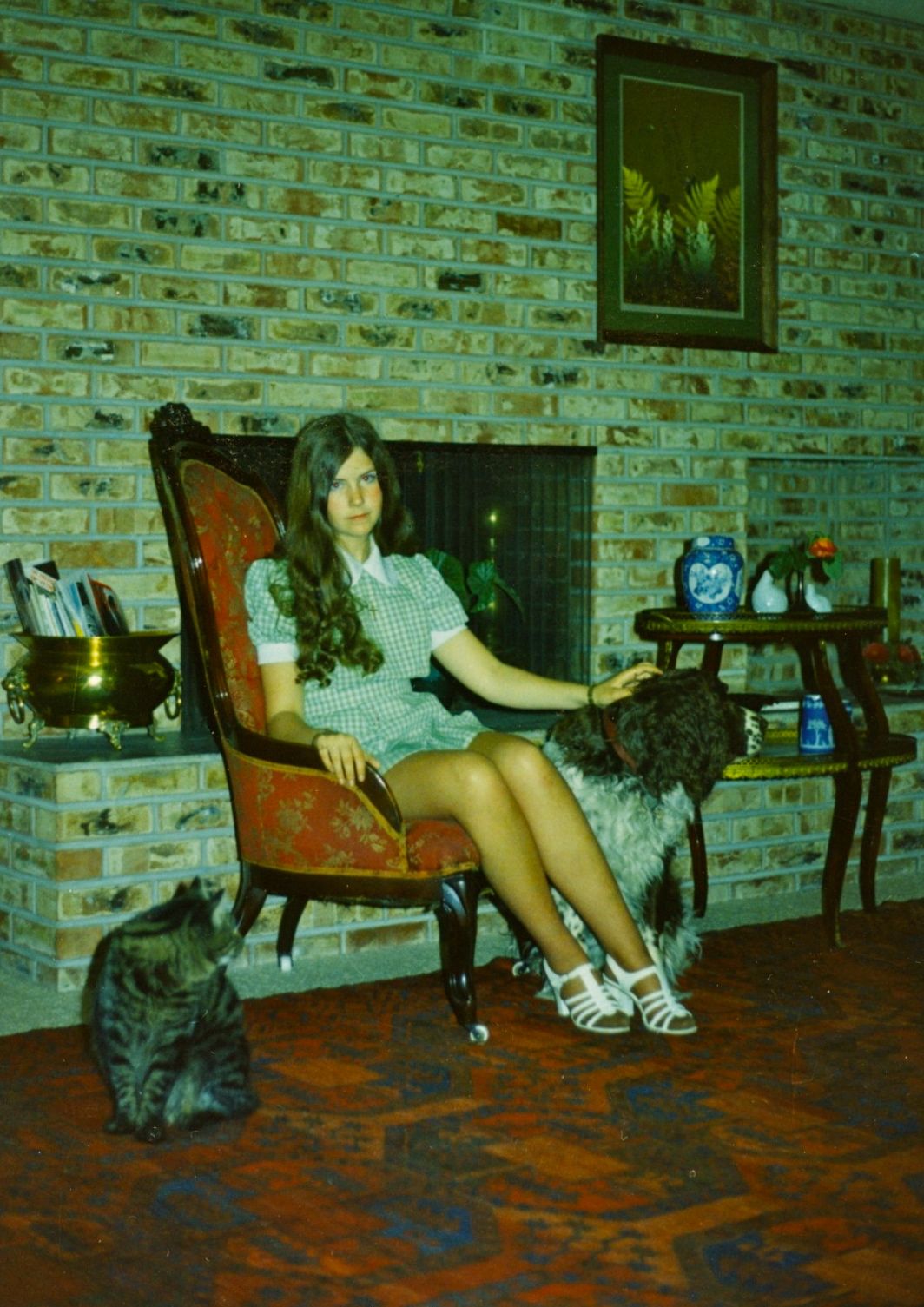
It was around this point that I discovered God, boys and mascara, not necessarily in that order. After attending the Camp of the Holy Spirit on Mt. St. Helens, I came home with the fervor of the born-again and mooning over my first boyfriend, who nicknamed me “Butterfly.”

When I turned 53, I realized that I was exactly the age my mother was when I turned 13 and overnight began to assert my independence. Menopausal women and adolescent daughters make for a volatile brew.

There was yelling, there was foot stomping, and there was door slamming. And a lot of statements like, “You don’t understand me!” The photo below was taken later, but it tells the story:

1973grumpybetsy

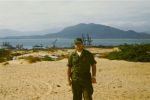
In 1971, the family anxiously awaited letters while Scott served in Vietnam. Though he said he was not in danger and far from the front lines, Vietnam was Vietnam. The evening news continued to display the mounting death toll. Fortunately, Scott returned unscathed a year later, and upon his return was awarded a Bronze Star medal for meritorious service. He was recognized for the accuracy of his projections on a monthly and fiscal year basis as to how much fuel the Army would use, and setting up the regulations for an allocation system in Vietnam.

1971 was also about the time that Bruce and Camille divorced. Sandy lived with her mother on Bainbridge but continued to spend most holidays and summers in Tacoma. Bruce moved home while he worked on his undergraduate degree at University of Washington.

In 1972, both Dean and I were in high school, and immersed in activities. Dean played football and volunteered during summers at a camp for mentally disabled youth operated by the Boy Scouts. He continued to be involved in Scouting, and completed the rank of Eagle. I had become very involved in the Episcopal Church’s House of Young Churchmen as well as choir and theater. And dating.

With Dean getting ready to graduate in 1972, Dad was concerned about the difference between the family’s income and “out-go.” Kicking off a series of family conferences, he noted that the family was expected to spend about $2,500 more than its income. Something needed to be done.

Dad approached the family about the need for a plan. He facilitated the meetings using a Management By Objectives technique, with a formal agenda and notes recorded on a flip chart pad. Beginning with a discussion of “where are we now,” a number of significant facts were put on the table including this one: “Dad’s physical condition – family plans depend on his ability to continue to earn. He is a valuable person to all of us, and earning power aside, we need him as Father, husband, counselor and guide.” Mom stated that the house needed more effective supervision and she needed to “spend more time on deck”; that said, she also said that she needed more help to maintain a home that she could be proud of and “one which provides the climate in which we can all be our best and do our best.”

My contribution? As stated in the minutes that were distributed by Mom after the meeting, “I am too tired and busy to help as much as I’d like to because of too many concerts lately and the demands of my homework.” I also complained that, “I don’t like this process because it seems too impersonal… a family should not be organized like a business.”

Wow, I really jumped right in there. Meanwhile, Dean (quiet to this point) offered to find a part-time job and Bruce committed to find a job to reduce the impact of his schooling. (Dean did indeed find a job at a service station and Bruce found a position in a lab. I assume I continued to be involved in school and applying copious amounts of makeup.)

Dean applied for and was awarded an NROTC scholarship, which meant that he would be headed to Marquette and its cold winters. After a year, however, he dropped his commission, feeling that since he did not intend to pursue a career in the Navy, it would be unethical to continue to finance his education on their dime; he transferred to University of Washington.

Bruce rebounded into a brief marriage, and began the process of rebuilding his life by joining the Navy.

1973bruce

The family financial situation must have eased a bit in 1973. Dad bought Mom a diamond “engagement” ring to celebrate their 32nd anniversary, and Mom and I were able to visit Scott, Jody and Marc in Germany. Turned out that Scott does a passable Schuhplatteln, the Bavarian folk dance. A few months after this picture was taken, Scott and the family returned to Washington state after the Army decided it had too many non-commissioned Captains.

1973germany

Despite being in her 32nd year as a parent, Mom proved herself game when asked if she would host a foreign exchange student. Lisa Larsson of Stockholm joined the family for my senior year. And when I was selected as my high school’s Daffodil Festival Princess, Mom and the ladies of St. Andrew’s stepped up to build Curtis High School’s first Daffodil parade float.

Lisa Larsson and Betsy Campbell Stone

That spring I was accepted into Occidental College and prepared for the wind-down of my high school career. The rug felt pulled out from under all of us when Dad’s job was eliminated, putting our finances – and college – in jeopardy. Fortunately, Mom’s connections with PEO led to an offer of a Trustee Scholarship from University of Puget Sound. If I kept my grades above a 3.5 GPA, my tuition would be covered. Though initially disappointing, it turned out to be one of the best things that could have happened.

Dad did secure another position within Weyerhaeuser, but the stress took its toll. In the spring of 1976, he visited Dr. Starr’s cardiology clinic in Portland at my uncle Ed’s urging, and was immediately admitted for open heart surgery. His first of three. And around the same time, his mother had a stroke and passed away.

Life went on. I got my first job (working at the Tux Shop in the Tacoma Mall), and my first car, a used Rabbit. Dean graduated from UW and went on for his master’s degree.

Tons of important, REALLY important, milestones happened after this. Bruce married Kathy Manzari and they brought Vincent into the world in 1981. Betsy married Todd in 1982 and gave birth to Madeline (“Maddie”) in 1987 and Thomas (at present, “Thom”) in 1992. Dean married Gwendolyn Snyder and they began their family with Alison in 1995 and added adopted Eileen, then one, in November 1999. Scott married Pat Ford in 1991. And Bruce married Bronwen in 2001, and adopted Isaac George in 2010.

But this is a legacy series about Henry and Eileen, and my brothers’ stories and mine are still being written. We’ll leave those for the next generation to describe.

1 Comment

Filed under Family history, Uncategorized

A Brave New Life After the USMC, Part One

(Sixth in a family legacy series)

I ended the fourth post of this family legacy series by describing our family as “walking wounded” when we sailed to the West Coast months after the massive heart attack that forced Dad’s early retirement from the US Marine Corps in 1963.

This is where the family story is also part-memoir. From the period of Dad’s career in the Marines, I have only flashes of brief memories. My memories really begin in Seattle.

As we moved into our Seattle home at 2701 11th Avenue East, a brick Tudor house reached by ascending 42 steps, I felt unsettled. I think we all did. Even the welcome addition of a dog – a black mutt Dean named Laddie – didn’t change that.

Not only our family had changed. The world as we knew it was changing. In the summer of 1963, the Beatles had launched the “British Invasion,” the American Heart Association began its campaign to eradicate smoking, the Equal Pay Act was signed to outlaw wage discrimination based on gender, the race to put a man on the moon was in full swing with both American and Soviet teams successfully orbiting the Earth, Kennedy made his famous Ich bin ein Berliner speech to a crowd of 450,000 in West Berlin not far from the recently-erected Berlin Wall, the nation increasingly moved to a war footing for Vietnam, 23 people were arrested at a civil rights sit-in at Seattle’s City Hall, and hundreds of thousands marched on Washington in support of racial equality and jobs, stirred as Martin Luther King told the assembly, “I have a dream.”

What a time. The house was a little scary to me. The blue curtains with the kokechi doll print that kept my room cool in Honolulu made it dark in Seattle’s rainy climate. I was convinced that the sealed opaque glass window on the stairwell led to a hidden attic where – surely – something lurked. The downstairs basement was cold (and it didn’t add to my feeling of safety the next year when my mother chased us out of the house during aftershocks from the 9.2 magnitude Great Alaskan earthquake).

It was time for me to start growing up. I learned to ride my bike right there by Devil’s Dip, the nickname of the precipitously steep slope in the next block of 11th Avenue East. And Mom insisted on making sure I learned how to swim, which somehow didn’t happen while in Hawaii. I hated undressing in the damp, chlorine-smelling women’s dressing room at the UW; Mom said I was “nasty nice” for being too modest. I tended to get worked up when I was upset and could wail like a fire engine, which I soon learned would result in a dose of discipline with Dad’s belt. (Though Dad gave up using the belt soon thereafter, we all knew and dreaded the swish-snap sound as Dad whipped his belt out of his trousers.)

I felt out of place, happiest spying on passers-by in nearby Roanoke Park from my hidden eyrie in a tree. I bird-dogged my brother Dean wherever he went, including his visits to Robbie Racz, the neighbor boy across the street. Until I was chased by the boys downstairs, I’d loiter in the hallway while Robbie played Dean the new Beatles album on his record player. I had begun to hone my little sister strategy while we lived in Seattle; I couldn’t compete on size, ability or knowledge, but I had annoyance down pat. Dean ignored me at his peril; I could sing the nonsensical Japanese nursery song lyrics ad nausem: “Moshi, moshi anone, anone, anone… Moshi, moshi anone, ah so desu-ka.” When we moved to Seattle, I imagined myself an expert at surreptitious surveillance. Unbeknown to me, Dean and his friends were on to me. They first ditched me while spying on the overgrown mansion at the top of Devil’s Dip, which we imagined was inhabited by ghosts rather than the two old sisters who actually lived there (still, reminiscent of “Arsenic and Old Lace”). Another time, I tracked them all the way down to the overpass that led to the floating bridge; several years later, Police found the remains of 4 year-old Heidi Peterson near the embankment there, ending forever the period of innocence when parents could tell their children to just go outside and play until dinner.

Dean, Robbie and me (of course)

Dean, Robbie and me (of course)

It was a rough introduction to our civilian life.

Dad told me in recent years that he was disabled for two years as he recovered from his heart attack. He re-entered UW’s law school, the program he interrupted in 1941 when he joined the Marines. But he concluded what he suspected before; he simply didn’t like law.

Like many vets he counseled in later years, he had to figure out how to translate his experience in the Corps to fit the requirements of civilian posts. He eventually went to work for Weyerhaeuser, hoping to apply his experience managing officer assignments to manpower planning and human resources in the corporate environment. Though he never complained, he came to have little respect for the politics of a major corporation. The Marine Corps was a meritocracy; advancement depended on successful performance in a range of settings, from staff to operations. Dad was to learn how staff was regarded in an operationally-driven lumber company like Weyco. Pretty expendable. After years of sporting a regulation Marine Corps buzz cut, Mom had to nudge Dad to loosen up his look a bit and wear his hair longer, at least on the sides.

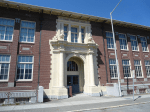
They had four children to put through college, and there was never any question as to Mom and Dad’s priority when it came to education. Scott headed back to college at the University of Washington, Bruce enrolled at Lincoln High School, and Dean and I walked through Roanoke Park across the freeway to ancient Seward Elementary School, built between 1893 and 1917.
Screen Shot 2013-06-24 at 8.18.41 PM

It was there, sitting in my first grade classroom on November 22, 1963, that my Principal came on the speaker to announce that the President of the United States had been killed.

As disappointing as it was to be shoved out of his Marine career, Dad seemed to embrace being back in the Pacific Northwest. Ski clothing and equipment was acquired for all of us – bulky boots and skis that reached to the wrist when your arm was fully extended. I remember walking up and down the concrete aisles in the REI warehouse, which looked the part of a 60s sportsman’s co-op, with fascinating curiosities like freeze-dried food and mountaineer’s gear.

Dean remembers getting in to the family’s little yellow rubber raft and fishing among the lily pads of Portage Bay for bass. He taught Dean how to use a bait casting rod to toss bass plugs and pork frogs right up against the old pilings at the south end of the bay. About that time, Dad also resumed hunting, heading east of the mountains to Uncle Bill and Aunt Louise’s house in Wenatchee. “The first time out or two I was just a retriever,” Dean wrote to Dad, “but the next year I got to shoot a little bit.”

Skiing at Mt. Pilchuck

Skiing at Mt. Pilchuck

Dad did his best to help all of us find our footing. He led Dean’s Scout troop, assisting the boys with pursuit of merit badges and introducing them to fishing. One casting lesson ended with a hook firmly embedded in Dean’s scalp. I desperately wanted to be a Boy Scout. Not a Girl Scout, not a Camp Fire Girl, but a Boy Scout. I settled for participation in Camp Fire Girls and tried to content myself with our crafts-oriented curriculum, embossing copper, tooling leather, weaving hotpads and blanket-stitching red felt “wallets” to hold a selection of sewing needles. Not only was I prohibited from joining the Boy Scouts, but I had to endure being around obnoxious 4th grade boys when they came to our house for weenie roasts (one tossed up his masticated food on my shoe in an act I took to be hostile). When my first grade teacher reported that I was a fast reader but had poor retention, Dad led the charge to get me to read and summarize passages of the Frank L. Baum Oz books.

Mom, too, reconnected with old friends from the University of Washington. I remember accompanying her to visit Dr. Wagner, her former signing coach. At 46, she was soon back to practicing arias she hadn’t sung in over 20 years. She acquired season tickets to Seattle Opera and reveled in its repertoire, favoring classics by Verdi, Mozart and Puccini, while Dad leaned toward Wagner. When Aida came around, I accompanied her to what was my first opera, dressed in my Sunday finest, awed by the magic of the sets and the music, and thrilled by the pomp of the attendees as they walked up the grand staircase.

At St. Mark’s Cathedral, the giant though still unfinished Episcopal Cathedral atop Capitol Hill, Mom sang in the choir while Dean and I attended Sunday School.

On the homefront, Mom adjusted the family’s diet to accommodate Dad’s low-salt, low-fat, low-cholesterol diet, although when I look back at my favorite dinners from that period, I can’t imagine how these were healthy choices: chicken tetrazzini (made with 9 tbs. of butter), Chinese hamburger hash (seasoned with soy sauce), and shrimp creole (featuring a tomato sauce base). To compensate, perhaps, there were also plenty of roasted chickens, Cornish game hens and cubed steak – all purchased from the Sand Point Naval Air Station PX, which made a huge difference in stretching our family budget. To keep our bones strong, we were encouraged to drink milk at every seating. Facing the challenge of keeping a family of six in milk, Mom economized by training us to drink reconstituted powdered skim milk.

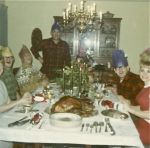
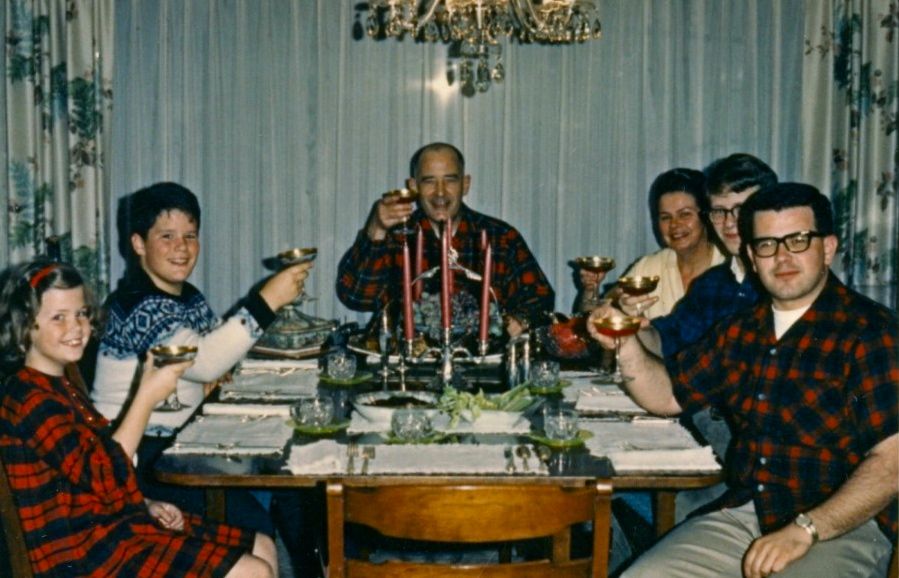
Dinner was always a sit-down affair, usually all together under the glittering prisms of the dusty crystal chandelier. (Yet another strange thing about the house: the previous owners had tiled over the dining room window with 12×12 black veined mirror tiles, perhaps for privacy from the neighbors. Mom, who intensely disliked dark rooms, quickly removed them.) With times as volatile as they were, there was plenty to discuss at the table. I remember one conversation that revolved around the mystery of that day’s missing newspaper – and the discovery later of a front page picture in which Scott was front and center in a protest against US involvement in Vietnam war. Children weren’t expected to be seen and not heard, as had been the case in Dad’s childhood home. If we didn’t understand a word and asked for its definition, we were promptly told to fetch the dictionary.

1966thanksgivingseattle

We all developed friends, and friendships with other families. Soon I was invited to join other neighbor kids as they watched “Saturday Afternoon at the Movies” on TV (with fare like “Creature from the Black Lagoon”). In Washington DC, Mom and Dad had become acquainted with the Lukens family. Fred, his wife, Patsy, and their large and lively branch of the family moved West a few years before we arrived in Seattle. It was natural for the families to reconnect. Though we occasionally visited Mom’s cousin Harriet’s family in Los Banos, and our Uncle Ed and Aunt Letty Ann’s and their sons in Yakima, we didn’t have family nearby. Having the Lukens family was like having loaner cousins.

For every one of us four, there was an “opposite number” of similar age, with a few spares. Paddy was Scott’s peer, Molly was friends with Bruce (out of which Mom expected a romance to blossom), Dean could choose from Peggy or Rick, and I generally played with Ricky (my age) or Tommy. (Kimberly was a later addition, just as I had been to my family.) At their rambling house on Capitol Hill, the younger set played tag, hide-and-seek, and, if I had my way, “Kingie,” a made-up game that inevitably involved a royal Queen or King being waited upon by his or her subjects.

Being back in the Pacific Northwest gave us the opportunity to return to a special place in Mom’s memory, Payette Lake, in McCall, Idaho. Each summer, we piled into the car and drove the 500 miles (sans air conditioning) to the Ponderosa Pine-forested summer retreat owned by Mom’s uncle on Wagon Wheel Bay. When we started to feel we’d worn out our welcome – Uncle Lynn could be pretty intimidating – we started staying at Lena Lukens’ cabin across the bay.

After three years, Dad announced that we would be moving to nearby Everett where he would become Personnel Director of Weyco’s large lumber operation. Though the chaotic family gatherings with the Lukens wouldn’t end, they became less frequent when we were 30 miles away. Although we were used to moving about every three years, I had come to like my school – especially my beloved third grade teacher, Mrs. Dingley. Seward was an inner city school and my friends and acquaintances reflected the diversity of Capitol Hill: African-American Cecilia Lee, second generation Japanese American Julie Aoki, and my Scandinavian-American best friend, Lisa Frolund, who had the added attraction of owning a Barbie Dream House and actually living in a house that kind of looked like it on Boyer Avenue overlooking Portage Bay.
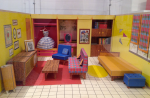
Oh how I loved Lisa Frolund's Barbie Dream House

Oh how I loved Lisa Frolund’s Barbie Dream House

We moved to 2507 Helena Lane in Eastmont in 1967, a suburban community south of Everett and north of Seattle. We acquired a new dog, a moose of a Springer Spaniel named “Boot” with whom Dad planned to hunt upland game in Eastern Washington. (Sadly, Laddie disappeared with a bunch of other neighborhood dogs, victim of a dognapping ring.)

A lot of kids our age lived on the new block, including Shari Schoonover. Shari – who I called “Shoutz” – was as uncool as I was; we were perfect for each other. By this time, my mother had let me stop wearing my hair pulled straight back from my face secured by a giant bow that looked like a propeller, but I still looked fully the part of dork next to sophisticated young gamines with popular names like Keely or Kelly or Kerry (so much cooler to have a “K” name). My crooked overbite didn’t help, although that was soon to be attacked by a Seattle based orthodontist, Dr. Leslie Erickson, who was always delighted to listen to my constant attempts at poetry. At least, he convinced me he was. I turned out to be a six year customer of poor Dr. Erickson’s and I rarely showed up for my monthly appointment without something for him to appreciate.

The family adventures in hunting quickly resumed. Dean remembers pheasant hunting in the Ephrata area with the old “White Trail Grange” association. Quentin and Mike Schoonover (Shari’s father and brother) joined Dad and Dean for an pheasant shoot that turned out to be more like visiting a chicken ranch than hunting in rural farm country. On opening day, at least 15-20 pheasants were just milling around the willows in the middle of an alfalfa field. They stopped the car, lined up, and at noon pushed them across the road and up to an elevated ditch bank, where they started flushing in flocks. Dean emptied his old 16 gauge Browning A-5, reloaded and shot again, without raising a feather. None of the party hit birds; the birds unexpectedly all flushed almost straight up.

Eastmont was surrounded by a lot of undeveloped property, and people on nearby farms often had horses, which fed an obsession. By the time we moved to Everett, I had moved on from reading the Mrs. Piggle-Wiggle and Pippi Longstocking series. I inhaled every Marguerite Henry book and imagined myself atop Phantom (Misty of Chincoteague) or Sham (King of the Wind). I really wanted a horse. And a cat. I got the cat (the diabolical Tuffy), and a few riding lessons at a nearby stable. With matters left to me, I talked my classmate’s parents into letting me clean stables on their “Funny Farm” (its real name) in exchange for free rides on their mean-tempered Shetland ponies. They got the better end of that deal.

Looking back, Eastmont was probably chosen for its modest home prices and decent schools. Things were tight financially and soon grew tighter. It was the only time I knew my parents to argue – really argue – and once I heard Mom fling the word I feared most into the conversation: divorce. Women’s liberation, besides opening career possibilities for women, brought with it a rise in divorce. I had heard of kids whose parents divorced. And then there was that friend of Mom and Dad’s who wore caftans and announced that she had freed herself and graffitied obscenities on her bathroom walls. Would my Mom be liberated? Would she start using the F-word? Could my parents split?

Scott had finished college and was drafted into the Army in January 1967. Fortunately, his first tour was in Germany. I was pretty shocked when he called with the news that he would soon marry Jody, daughter of an Army general, in Karlsruhe, Germany. Their honeymoon getaway car? An Army tanker.

Mom did what she always did, setting up familiar activities in a new town and establishing new social connections. She joined St. Patrick’s Episcopal Church and soon our home was filled with the smell of ironing as she brought home a weekly load of altar linens. She sang in the choir, and I (ever clingy) insisted on sitting next to her, singing along. Shari and I completed confirmation classes, donned our virginal white dresses and pinned circular lace doilies to our head for the big moment. I still remember Bishop Ivol Curtis greeting me with a handshake so firm that his Bishop’s ring nearly crushed my finger joints.

Mom arranged bridge foursomes and small cocktail parties featuring pu-pu’s she learned to make in Hawaii: teriyaki mock drumsticks, rumakis, sliced pork tenderloin with hot chinese mustard and sesame seeds. When fondue became popular, a bubbly pot of melted cheese was added to the buffet table.
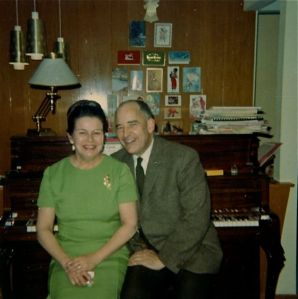
1969

For the first time, Dean and I weren’t attending the same school; I was at Jefferson Elementary while he moved on to junior high. He continued to move up the ranks of Boy Scouts, while Dad stepped up to Scout Master.

With me more at a more independent age, Mom began to have a little more time for herself. She resumed golfing after a hiatus stretching back to college, always walking the course in her Bermuda shorts and sleeveless blouse, and poured, sanded and glazed ceramics with me at a small studio. After the house was quiet each night, evenings would find her quietly smoking in the kitchen until around midnight, when she went to bed.

Then Bruce, a sophomore at Western Washington State College, came home with a bombshell. He was going to be a father.

Mom did what she always did: she rolled with it. I’m sure they discussed the options, but very soon I learned I was about to be a sister-in-law, and an aunt, before I turned 10. And, as it turned out, a Godmother.
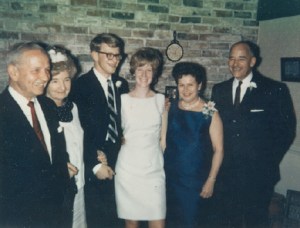
1968 - (from right to left) - Hank, Eileen, Camille (Bruce's

I moved out of my comfortable upstairs room within ear shot of the living room and my parents’ room to a windowless bedroom in the basement down the hall from my brother Dean. Smelly boy territory, as far as I was concerned. But it was worth it, as Cassandra Eileen Campbell, Bruce and Camille moved in with us after Sandy’s birth on February 26, 1968.

And a year later, on March 23, I became an aunt again, with the birth of Marc Christopher Campbell to Scott and Jody.
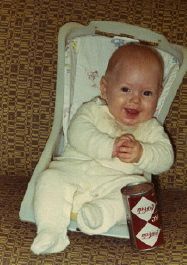
1969 - Marc, about 6 mos

I had hit that gangly stage that follows childhood and precedes young woman hood.

Betsy - 5th & 6th grades

That summer, we headed to Eastern Washington to visit Mom’s childhood friend, Barb Kidder Ringrose, and her family in Colville, WA. On July 20, it was blisteringly hot. I felt a little awkward in my cotton two piece bathing suit; whatever fit my top at that age didn’t fit my bottom. But the curving water slide that landed in the Ringrose’ pool, with periodic diving exhibitions by their older kids, helped to pass the time while we waited, and waited, and waited. About 1 p.m. we learned that Apollo 11 had landed on the moon. Almost five hours later, Neil Armstrong was heard through the static to say: “one small step for [a] man, one giant leap for mankind.”

That fall, I made the move to 7th grade, joining the 8th and 9th graders on a campus that seemed huge after my small elementary school. But before I adjusted, we learned that Dad was being promoted and transferred to a position at Weyerhaueser’s corporate headquarters in Tacoma, WA.

Tacoma was best known in the Seattle-Everett area for its aroma, due to the pulp mill in Commencement Bay and Tacoma Smelter around the corner. The house hunt extended from Dash Point to the north, to as far south as Lakewood. Finally, the family settled on 8601 43rd Street West in suburban University Place, spending the most it had ever spent on a house, $42,500.

In December 1969, just in time for Christmas, the family moved.

Next: Home in Tacoma

2 Comments

Filed under Family history, Uncategorized