A Fright Fest of Memories

In first through third grade, I lived at the foot of 11th Avenue East in Seattle, a street that curved like a scimitar. So dramatic was the block long drop that it had been given a name by the kids who lived there before me: “Devil’s Dip.” (Insert minor chord here, “Dit dit dit DAH!”)

Safely piloting your bike from the very top of the hill all the way to the bottom took a major act of heroism, requiring more daring than watching the Saturday televised horror movie without covering your eyes, more bravery than sticking your hand in a bucket of brains at the Boy Scout Haunted House and more guts than playing hide-and-go-seek in our unfinished basement laundry room with all the lights off (especially since someone – whose name is DEAN — always seemed to jump out of the laundry chute).

It took me a long time to work up the courage. I’d go halfway up the hill and struggle to mount my bike, which wasn’t easy on an incline. Each time, I’d start a little higher until finally I convinced myself that I was ready for the plunge.

The street seemed to pull itself up a little taller, opposing me. It didn’t help that at the top of the hill was a house that was haunted. Everyone knew it. It loomed, cocooned in an overgrown yard surrounded by dark black boulders, a fortress occupying almost a full block of its own. If I squinted, I could imagine it as it might have been. Outside, dark half-timbers bisected ballet-pink stucco; picture windows gleamed, ornamented by transoms made up of prismatic diamond-shaped panes; roses, dogwoods and rhododendrons bloomed in the yard. Inside, golden light cascaded from chandeliers burning gas flames, spilling on to two young girls who sat up straight in high-backed chairs as they practiced their lessons or embroidered a sampler. My imaginary scene was hard to reconcile with the aging ruin before me, its stucco now a faded flesh tone stained by mold, vines obscuring some of the windows. At night, it lay in gloom. Maybe the house was vacant, but maybe the girls were still there, in ghostly form, or maybe the two old sisters lived alone, glowering from their bedroom at the kids who periodically spied on them from the shrubbery.

Finally, I did it. I pointed my bike downhill and my stomach went airborne as I gained speed. My heart pounded impossibly fast. Then I was back to terra firma, safely parked in the street between our house and the Racz’s.

I remember it like it was yesterday.

I remember what scared me most as a kid. I remember everything about my first real kiss: where I was (Camp of the Holy Spirit on Mt. St. Helens), where I stood (right next to a big boulder), even what I was wearing (butterfly shirt). I remember exactly how my husband asked me to marry him (I missed the proposal initially, but that’s a story for another time).

Some moments are so powerful and so universal that they become cultural touchstones: first pet, first bike ride, first kiss… engagement, marriage, birth. Countless times when someone has talked to me about losing a parent, they say, “I remember it like it was yesterday.”

I remember, too. I remember it all.

Leave a comment

Filed under Uncategorized

My Parents’ Gifts of Love

With the latest salvos in the Mommy Wars, I’ve been thinking a lot about my parents’ push-me pull-you influence on my professional development.

When my father told me in high school that I had to take typing in case I ever had to support myself, I rolled my eyes. I thought it was stupid. I had no intention of making my living from typing.

By the time I graduated from college, I was ready to pursue the career that was my right. Women could succeed at anything they chose, if they were willing to work hard enough. Marriage or family could wait until my mid 30s — if they came at all. I had too much to do.

My mother was by no means pleased about the prospect of me pursuing a career. Work, yes. Career, no.

Tension between my mother and me surfaced as soon as I launched out on my own, following our usual pattern of escalation: explosion, “disagreeable disagreement” (as my mother put it), letters and rapprochement or at least truce.

On a telephone call home to Tacoma from Davis, California, I told Mom that I wasn’t ready to get married anytime soon although I was dating a great guy (now my husband of 31 years). Mom asserted that I was “throwing away a personal life.” The call did not end well.

I think I wrote first. She wrote a five page letter back. She explained, “There is a big difference in being work-oriented and career-oriented…. Career women were admired by my peers and sometimes even envied – but it was also expected that women would be women first and career women secondly…. But I don’t want you to think for a moment that I believe I did not have a career – I know I did have, and I am grateful to have lived at a time when being a full-time wife and mother, with all that entails, was possible….. Most parents want for their children what they feel they missed or wanted and didn’t get – I am just the opposite – I want my children to have what I have had. I really do believe, Betz, that a better state of affairs would exist in the world if mothers were home with their children…. I really have not meant to sound in any of our conversations as though I did not understand what you wanted – I really do – and I do understand what is happening with your generation. I know it is not possible – or perhaps even desirable – to live the kind of life I have lived. Though I do admit to wishing it were, but only because my own life has been one of satisfaction and fulfillment, and because I am wise enough to know that I have been singularly fortunate in having been on the receiving end of so much love…. I respect your desire for independence – that is certainly one sign of maturity – and in spite of how I may have come across to you, I surely want you to to find a job-career that will be challenging to you and which will utilize the many talents you possess…. What I hope you will find ultimately is a combination of personal and professional life. I really don’t believe you yourself will feel complete or whole unless you can function in life as a professional, but also as a woman…. It won’t be easy, when the time comes, to balance professional obligations with personal relationships – and since I can read, it obviously isn’t easy for any one, but if anyone can do it, I think you can.”

I did marry (at which Mom probably breathed a sigh of relief) and my career in marketing continued to advance.

Several years later, I phoned home on President’s Day weekend to share the good news that I’d been promoted. I stood on one side of the counter that divided our kitchen from the family room while my husband puttered away next to the sink. I could picture my parents hovering over the white speaker phone on the long formica counter in their kitchen, with the Springers, Katie and Beall, curled up underneath. Outside the window, the rhodies would be huddled close to the house as protection from the cool, wet weather. Mom would be wearing one of her thick woolen cardigans – maybe the fisherman’s knit with the Nordic buttons – and Dad would be clad in his usual winter uniform: heavy Pendleton shirt, Filson tin cloth trousers and suspenders (which Mom said made him look like a hick).

Even after four years of marriage and seven years away from Tacoma, I still missed home.

“I have some good news,” I began. Then I explained how my title had been changed from “manager” to “director” reflecting my broadened responsibilities.

My husband watched my face, smiling. Neither of my parents spoke right away. The expectant look slipped off my face as I waited. Finally, Mom blurted out, “That’s all fine, but what I want to know is when are you going to become a real woman?” By which she meant, a mother. My husband left the room when he saw my face tighten just before I started hollering. In Tacoma, I’m fairly certain that Dad did the same.

She wrote the next day: “Now to the nitty-gritty of children. Yours that is. Because I like babies – I hope you will have some, Betz. But that isn’t really any reason you should have one – or some. The only real over-riding reason for having a baby is because a particular moment is so special that there has to be an ultimate result. A moment of love so caring — so intense — that the only possible response of trying to produce a lasting memory of that time is to throw caution to the wind and trust in God and His purpose – and hope that a child of that moment of union and unity of spirit will produce a child of real love.”

Not long after, Mom must have conscripted Dad into a sit-down with me. She told me in no uncertain terms that she feared I would lose Todd if I kept on as I was — which was to say, pursuing a career. I don’t remember Dad saying anything during that conversation. There was simply no way to reconcile the world my mother grew up in with mine. She consequently watched the early years of my marriage with an impending sense of doom.

Eventually, Mom got her wish. Less than six months after the “when-are-you-going-to-become-a-real-woman” confrontation, I was pregnant. It turns out that fertility was an inherited trait.

I can’t say that I knew what I was getting myself into. Not the motherhood part, but the work-home balance part.

While I was pregnant, I was interviewed for local newspaper feature called “Women Trailblazers.” Noting my rather impressive belly (I had pregnancy-induced hypertension and had swelled to the size of an exercise ball), the reporter asked how I thought my career would change after I had the baby. I remember saying I didn’t expect anything to change. I would continue working and be a mother. Easy.

What I didn’t understand then was that attempting to have a career while being a good mother would push and pull me for the next 20 years. And that my career strategy would be to oscillate (or maybe vacillate): drive hard, succeed, cut back (with its commensurate loss of authority and/or influence), accept new challenge. Repeat three times.

Not until the end of my father’s life did I understand how he hoped to protect me from one of the worst things that he felt could befall a woman: being trapped in a marriage without an escape route. As his mother was. My father’s hopes for for me were shaped by his position as the middle child, a vantage point from which he witnessed his father’s verbal harangues and his mother’s suffering as his father departed each night for his mistress Erma’s home.

My grandfather apparently thought that he was marrying into money, knowing that my grandmother’s father was “the grand old man” of Yakima. When he learned that the family fortune had been decimated by investments in my great uncle’s failed ventures, he no longer had a reason to be pleasant. The relationship that my grandmother had been warned about continued after the marriage. At best, it was a loveless marriage. At worst, abusive.

My mother wanted to ensure that I did not lose out on love – either the love of a husband or the love of children, while my father quietly strived to make certain that I could never be trapped in a loveless marriage. What gifts.

2 Comments

Filed under Uncategorized

Fall Colors

Ruston Way Tacoma October 25 2013

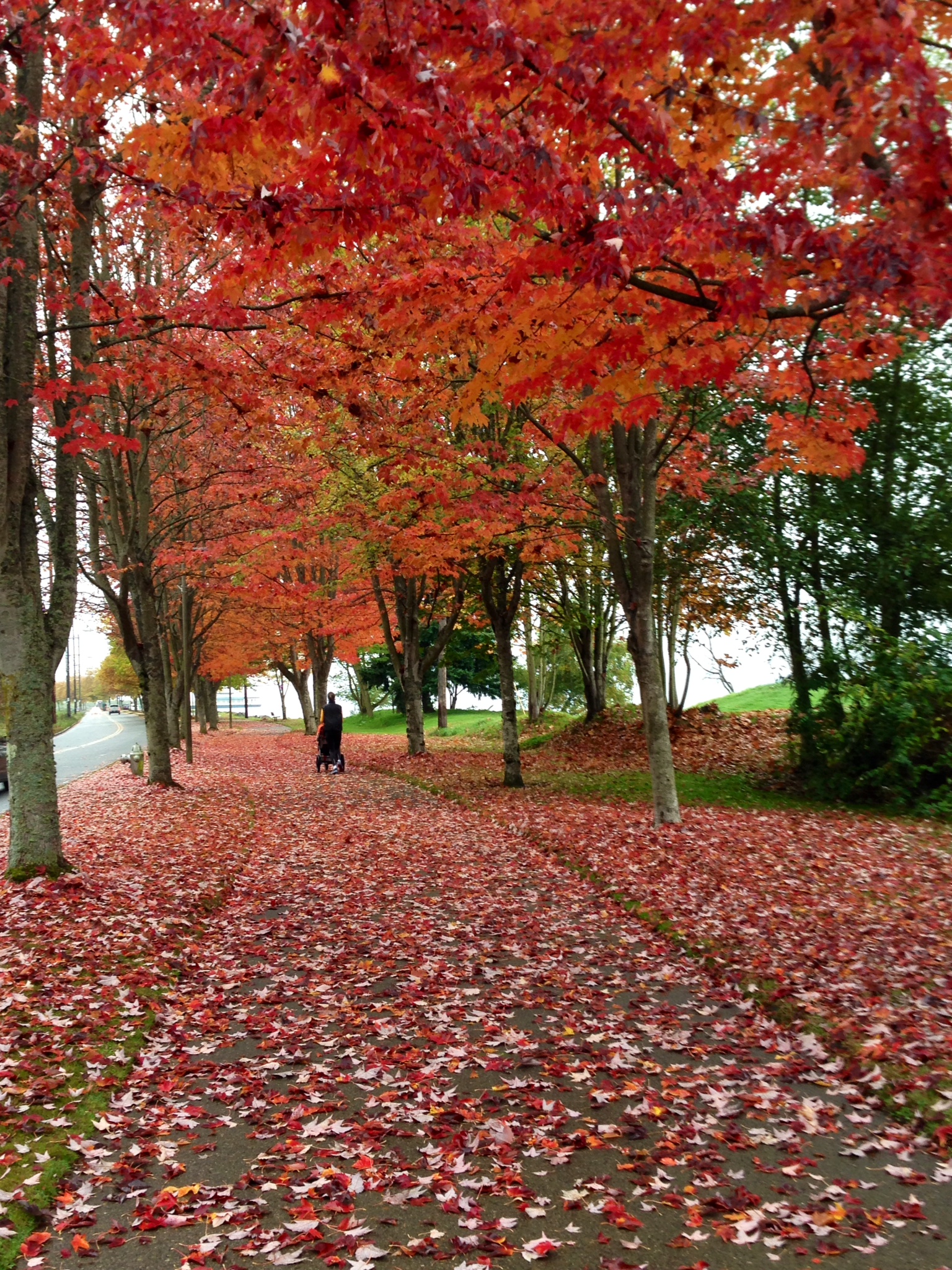
When I walked the cement pathway along Ruston Way here one year ago, my eyes traveled to the carpet of sodden leaves at my feet. The heavy rain of the past few days had stopped and between the clusters of flattened leaves the sidewalk had dried to tan.

Occasionally, I glanced at the sky: blue, finally, with misty suggestions of clouds scudding by in the upper atmosphere.

I moved at a slower pace, as if I was a worm, with a worm’s stature and a worm’s eye view, pulled toward the earth. The black tips of my boots plodded forward, cautiously advancing. In my pocket, my phone felt heavy. I was conscious of its weight, knowing that it could at any moment summon me for the latest crisis. I was sick of my phone.

As I neared the hotel, a patch of crimson and orange leaves had begun to dry, enough for a breeze to shift a few a matter of inches. Everywhere else, the leaves left shadows when they moved: solid charcoal shapes. But here, in this one patch, the leaves transferred their pigment and the architecture of their veins onto the pavement below.

Crouching, I began to turn leaves over, investigating which left wet shadows and which left inky stains. I felt like grief and fear and anger had been pressed on to me leaving ridges and bruises so that anyone walking by could see them.

What a difference a year makes. Though fog blocked the sun and the leaves were moist, I didn’t see any that had bled on to the sidewalk. They were just leaves, wet leaves on a Tacoma pathway, ubiquitous. It was the canopy of colors that drew my attention today, burning red as the chlorophyll waned and warm colors, secreted within, emerged.

Leave a comment

Filed under Uncategorized

Birthdays Remembered

Just now, my fingers hovered over the keyboard, not quite ready to land. If I don’t write about it, if I pretend that tomorrow is just another day, maybe it won’t be real: one year since my Dad’s last birthday.

I have a parade of Dad’s birthdays marching through my head. There was his 87th birthday when he had a speech all prepared beginning with, “Four score and seven years ago….” That was the last time I tried to faithfully match the number of candles to his age.

Five years earlier, Dad’s surgeon had emerged after an eight hour cardiac bypass operation with the good news that the procedure was a success, and the bad news that he expected this one, Dad’s third, would last only five years. When we gathered the family for his 87th, the five year timer had gone off. We faced the possibility, even the likelihood, that Dad would die within the year.

We drank a lot that night, liquid accompaniment to the many toasts, stories and recitations of Dad’s favorite poems. In the midst of it, Dad cocked his head, raised his glass and looked directly into my eyes. I think of the smile in this picture as my smile. He would purse his lips gently, the way I do when I’m about to cry, and the corners of his lips would lift. He held that pose, for one beat, two, three. That gaze remained on his face for as long as I wanted to look back. To me, it said it all.

Scan 2

Two years later, Dad moved permanently to California. The word went round before every birthday: you should come, it might be his last.

When someone’s death is predicted for nine years running, it starts to become comedic. We began spreading out family visits to provide Dad with something to look forward to. Two years in a row, I turned Dad’s birthday into a road trip, taking him to Monterey to enjoy an ocean front room and a visit to the Monterey Bay Aquarium.

As Dad gazed up at the aquarium’s 28 foot high tank, the pale blue light of the tank washed over him. He seemed to drink in the majesty of the display before him: swaying fronds of kelp, swirling sardines, cruising fish. Its beauty moved him.

Dad and me at the Monterey Aquarium 2010

By his birthday last year, his 96th, much of that joy had slipped away. His rich, brown eyes had faded, and it was harder to rise to the occasion of a party in his honor, even a small one. He was quiet, though he enjoyed his lamb, and of course there was chocolate cake. He always had room for chocolate cake.

IMG_0965

I could not envision celebrating his next birthday with him. And I was right.

This year, there’s no Pendleton shirt wrapped and ready, no bacon-and-eggs breakfast planned, no chocolate cake in the refrigerator. For most of the world, it will be just another day. But for me, it’s the first birthday that wasn’t.

Leave a comment

Filed under Uncategorized

Darkened Windows

The windows of the corner room in my house were dark when I pulled in last night, which should have been no surprise. With a few exceptions, they have been dark since January.

I stopped the car in the driveway and thought about what was missing.

The glow of the television through the shutters was usually the thing that caught my attention. Even from the driveway, I could see images from the The Military History Channel strobing from light to dark in the shadowed room. In the foreground, Dad’s face was revealed when brighter images flashed on the screen. I could see him tilted back in his recliner.

He was waiting for me to come home.

As a teenager and young adult, I often returned home late. I’d turn the key in the lock as quietly as I could and take off my shoes so they wouldn’t make a racket on the green slate entry hall floor. At the sliding door that separated the hallway from the kitchen, one of our Springers would be snuffling along the half inch gap below the door. Slowly, I’d slide the pocket door open an inch or two, just enough to pat the soft brown head before closing the door and heading downstairs to my basement bedroom.

A few minutes later, it would start: Dad “buttoning up” the house. The springs of my father’s twin bed would complain and the wood floor creak slightly as he rose for his nightly rounds. Three steps to the end of the bed, another five or six to the doorway. It was quiet for a count of ten as he padded down the carpeted hallway past the bathroom, turning left into the front hall. Then a series of clicks: push-push, push-push. My parents’ 50s era house had buttons instead of switches to operate the lights, and none of us ever managed to remember exactly which switch operated what. So turning off the lights meant pushing the buttons to check whether everything was shut down. Then in reverse: movement down the hall, bathroom stop, bedroom door firmly closed, steps to bed, bed springs sounding their dissonant chord several times before Dad settled down. The house was secure.

This time last year, Dad would have been listening for the sounds of my return. He liked to retire by 10 p.m., but he’d often delay his bedtime if I wasn’t back. The bombs of Iwo Jima had decimated his hearing so much that he didn’t even turn on the television sound, relying instead on the closed captions. But something about the squeal of the garage door springs and the heavy whump of the door where we entered from the garage were within the range of his hearing.

When I peeked in, he’d be watching the door rather than the tv. “There you are, Bets. Did you have a good time?” He’d say he thought he’d retire, and I’d kiss him on the cheek. See you in the morning. “Shut the door, please,” he’d ask, so that the cat wouldn’t visit him during the night.

These days, his corner room is dark. And yet I feel he is still present.

2 Comments

Filed under Uncategorized

Seeing Baba Boja

Photo credit Nada Stojadinovic

Hours after posting my lament about the invisibility of the elderly here on The Henry Chronicles, I was moved by this Facebook post, shared by my friend Nada Stojadinovic:

photo credit Nada StojadinovicA few weeks ago, I had the blessing of participating in one of my most proud moments as a granddaughter. Many of you know that my sweet Baba Boja is in a nursing home. Every Friday, residents have the opportunity to showcase something about themselves, so their friends can have a glimpse of the life they once led. To help my Baba do this – my mom worked day and night for weeks to create the most beautiful display honoring her life, and showcasing her incredible skills and achievements. My sis Dana and I were there to see her proudly sitting next to her display to show everyone, “this is who I was.” My nephew, Ilija, was there too – who is named after my grandfather, Djedo Ilija. Baba Boja was over the moon. 

My Baba’s quiet, sweet exterior doesn’t even come close to illustrating her tough-as-nails interior. She is a lady who wouldn’t hurt a fly, but on the flip side, was part of the world’s Greatest Generation, where she faced evil in WWII. She came to the U.S. and was determined to have a beautiful life, and the display my mom created proved that she achieved the American dream. She has taught me lessons about perseverance, kindness and work ethic that I will never forget. While I know she feels so blessed to have seen so many great-grandchildren born, it has actually been our blessing that she is our grandmother. For without her, all of our family memories would not be possible. I love you Baba Boja – thank you for all that you’ve done for all of your family over a lifetime, and continue to do, even at 89.   

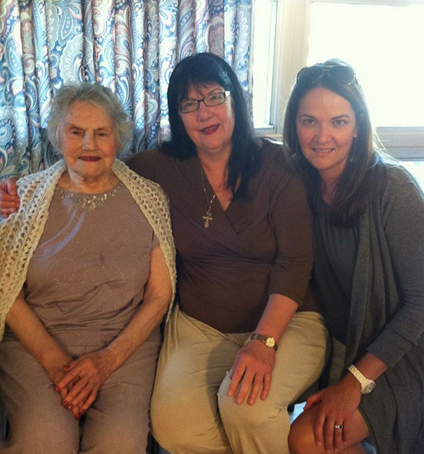
Beautiful ladies all: Baba Boja (l), Nada Stojadinovic (r) and Nada's mom (center)

Beautiful ladies all: Baba Boja (l), Nada Stojadinovic (r) and Nada’s mom (center)

Leave a comment

Filed under Uncategorized

Seeing The Old Through a Glass, Darkly

Henry Snively Campbell 2012

I almost titled this blog post, “I See Old People.”

One of the most beautiful and painful aspects of spending a lot of time with someone as they near the end of life is to glimpse life through their lens. To watch my Dad’s face as he drank in the view off my back deck — a vista of one redwood tree that commanded his attention — was to experience a bit of heaven on earth. His face softened, the corners of his mouth tilted upward, and the expressive wrinkles around his eyes contracted every so slightly. Minutes passed as he gazed across the yard. He communed with the natural beauty before him. Poetry sprang to his lips.

When we were out in the community, however, I became aware of how others viewed him. Or rather, didn’t view him.

At restaurants, in the grocery store, out on the bike trail, I could see people’s eyes take me in, dart over to the attractive young people in the vicinity, and skate over Dad. One of the smartest men I know was assumed to be either an imbecile or ugly. When he made a witty remark, as he often did, they didn’t get it. They weren’t listening. I thought he was hilarious. When they looked at him, they saw the walker, the wrinkles and the funny lump on his forehead. I thought he was handsome.

In articulating his vision of the church, I am heartened to see that Pope Francis calls out three groups as particularly important to the people of God: the poor, the unemployed young, and the old (source: republicca.it).

“The most serious of the evils that afflict the world these days are youth unemployment and the loneliness of the old. The old need care and companionship; the young need work and hope but have neither one nor the other, and the problem is they don’t even look for them any more. They have been crushed by the present. You tell me: can you live crushed under the weight of the present? Without a memory of the past and without the desire to look ahead to the future by building something, a future, a family? Can you go on like this? This, to me, is the most urgent problem that the Church is facing.”

I’m not Catholic, but I am with the Pope when it comes to being pained by the loneliness of the old.

Not everyone is in a position to offer care and companionship to an old person. But everyone is in a position to see them, and in coming face to face, to recognize the bit of God that is in all of us, especially the very old, who have seen so much of life.

Leave a comment

Filed under Uncategorized

After Time Goes By

It’s now been almost nine months since Dad died. Nine months, enough time for an egg to become a fetus and a fetus to become an infant. Because I am still writing about the experience, some people approach me with concern and ask, “How are you doing? Are you all right?”

I am really, really all right. Maybe better than ever. The experience of caring for my Dad, losing my Dad and grieving my Dad — hard as it was — enriched my life in ways I find difficult to express.

Then came a little blue flyer in the mail from the nice folks at Sutter Hospice, who made such a difference in Dad’s life and mine between December 21 and January 12. I’m sharing it here in the hopes that it may speak to others, as it did to me:

Reflections About Time and Change by Dennis Klass, Ph.D., Webster University, St. Louis, MD

I often wonder what people are thinking when they say, “You’ll get over it.” Sometimes it sounds to me as if they are talking about a case of mumps or my despair at income tax time. But what can they mean when they say it about grief? Maybe they mean that grief is just an interruption in life. Their theory seems to be that life is basically happy — buying stuff, working, watching TV — but that a time of death and grief is an unnatural sad time in that happy life. I can’t agree with that view.

Time can lessen the hurt; the empty place we have can seem smaller as other things and experiences fill our life; we can forget for periods and feel as if our loved one didn’t die; we can find sense in the death and understand that perhaps this death does fit into a bigger design in the world; we can learn to remember the good and hold to that.

But we cannot “get over it,” because to get over it would mean we were not changed by the experience. It would mean we did not grow by the experience. It would mean that the child’s death made no difference in our life.

There is an interesting discussion in the Talmud, an ancient Jewish writing. Jews had the custom of rending their garments – literally tearing their clothes – to symbolize the ripping apart that death brings. But the question was asked, after a period of mourning, could you sew the garment up and use it again? The teachers answered yes, but when you mended it, you should not tuck the edges under so it would look as if it had never been torn. This symbolized the fact that life after grief is not the same as before. The rent will show. The next question was, can you sell that garment? The teachers answered no. The rending and mending of our life is ours and others cannot wear it.

No, we don’t get over it. We change and grow. Our life has a difference which is ours alone. Perhaps we can help each other make that difference — the kind of difference that increases the world’s supply of compassion, love and healing.


1 Comment

Filed under Uncategorized

Fishing for Family

Bruce, Me, DeanSince January, I’ve thought and written a lot about the inevitable shift in my family relationships. In the days immediately following Dad’s death, I told my brothers that I wanted them to include me in their fishing trips.

One of my brothers immediately noted, “But you don’t like to fish.”

I told them it wasn’t really about the fishing. I knew that they had always connected through hunting and fishing. We are three brothers and one sister… three fishermen and one non-fisher person. I figured that if there were going to be future gatherings of family, they were most likely to happen around the activity that brings them together. My request was noted.

This summer, my brother Dean called to invite me to join a trip on the Deschutes River in Central Oregon. With a lump in my throat (that’s what happens when the dog catches the bus), I joined Dean and brother Bruce on September 2, when we put in at Warm Springs, OR, for a 4 night floating-camping-fishing expedition.

Dean’s led this trip dozens of times, most often using his own 13′ raft, and Bruce has often participated. I was jumping aboard a trip with a lot of history, joining men with well-established habits.

What happened wasn’t really what I expected.

I imagined it kind of like a movie: after attending to the necessities of the day (breaking camp each morning, making camp each afternoon) and a long day of fishing and floating through dramatic volcanic canyons beneath blue skies, we’d contentedly kick back in our chairs and fall to talking about Dad, or Mom, or the burial, or our families. It would be a reverie of memories, longing and love.

I was right about the talking, but wrong about the quantity and the topic. The sporadic conversation centered on fish, insects, stars, geology and fish. Did I mention fish?

For example, did you know that Gary LaFontaine extensively studied caddis fly behavior underwater and designed the Sparkle Pupa fly to imitate rising nymphs (read more)? Or that they work so well because the sparkly antron fibers successfully imitate the gasses that build up under a real pupa’s shuck?

That makes me sound unappreciative. On the contrary. It was just one more life experience where you go looking for one thing and find something completely different, something all the more beautiful because it was unexpected.

I learned a lot. I had to confide that I’d never set up a camp, and I needed to be shown a lot. It turns out that Dean has quite specific ideas (inner smile) about how one does things. When you’ve made this trip as often as he has, you have long since figured out the optimal menu, way to organize a camp, method of packing a boat, and even how to do dishes (wash them with environmentally-friendly soap in one container, rinse in a second basin of hot water, and dip a third time in a basin with a few drops of Clorox for good measure). I also learned a lot about fishing, although the one that I hooked was by complete accident when the fish saw me pulling the line up to recast it (I’m told I got him on the rise).

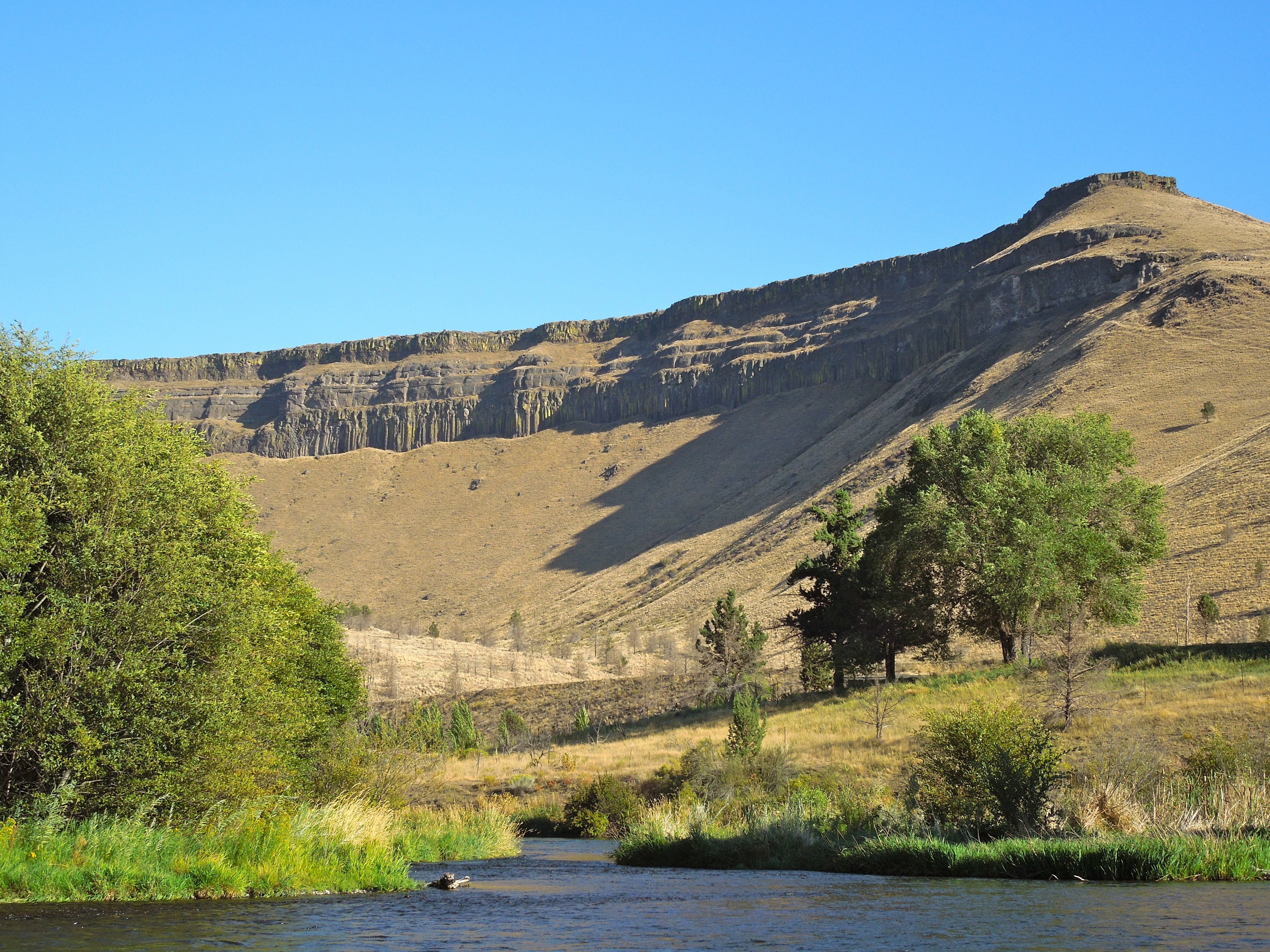
I also was awed by the majesty of the canyons, river and sky of the Deschutes. How had I missed this? Within the first hour, the walls of the canyon rise up along side the river. The first few buttes stood back at a shy distance, their rising brown hillsides topped with rocky red crowns. In front of them, green water streamed serenely by. As we floated past rock gardens — shallow bars with water only inches deep — every rock gleamed in the crystal clear water. The canyon walls crept closer, and erosion revealed their geologic story of volcanic pressure, uplift, ash explosions, hot flows and cooling into a myriad of shapes, colors and textures.
The Deschutes near Warm Springs OR

Some lent themselves to flights of fancy, the way cloud formations beckon us to see images in their ever-changing shapes. Bruce thought the lone rock below looked like the head of an Argonath. I found myself remembering Dad being wheeled down the hospital hallway for an MRI reciting from Shelley: “My name is Ozymandius, king of kings:/Look on my works, ye Mighty, and despair!”

Ozymandius?

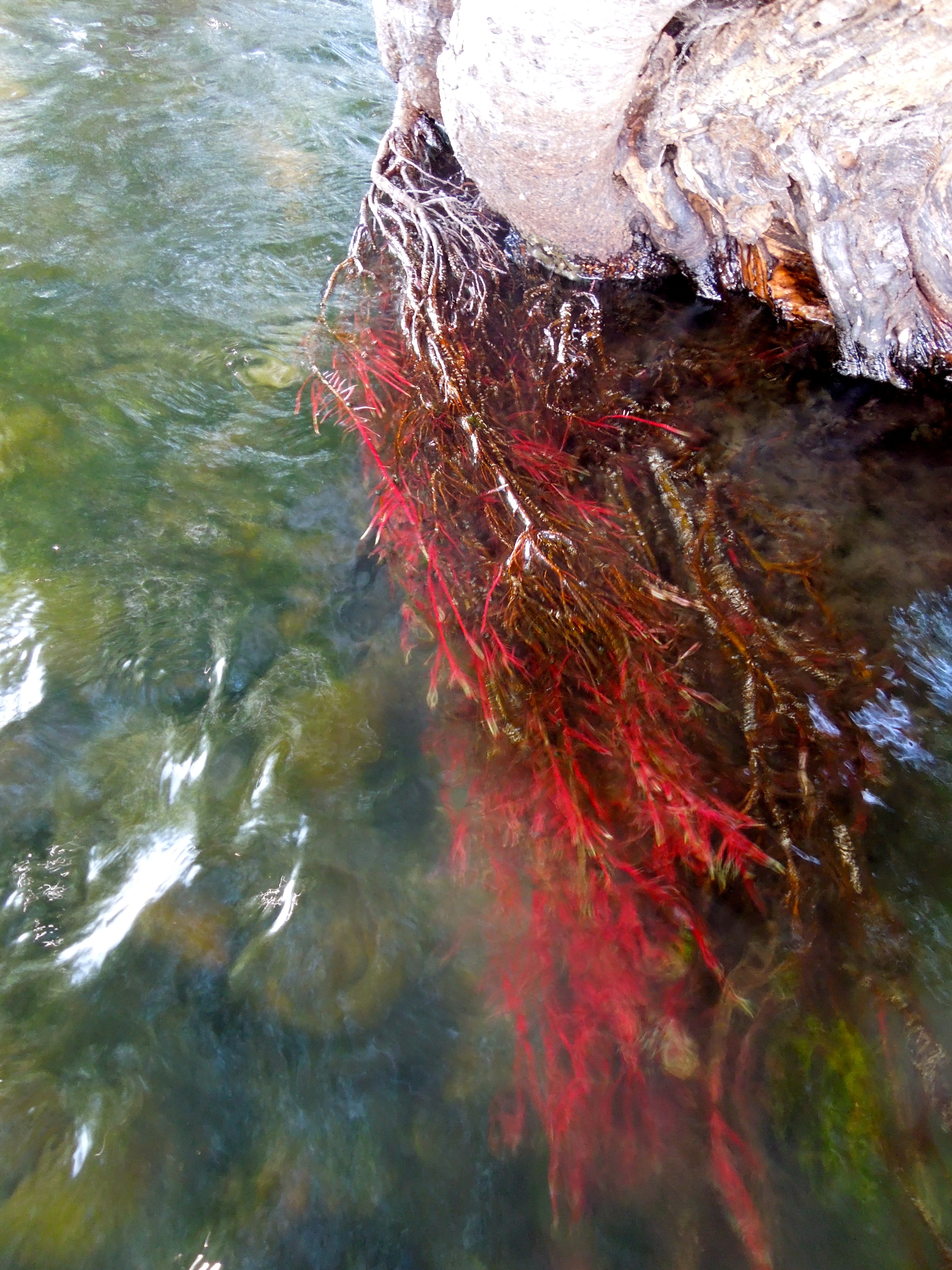
Small islands straddle the center of the river between the off-limits property of the Warm Springs Indian Reservation on one side and the many public campgrounds on the opposite shore. As we pass them, Bruce and Dean remembered their fishing luck on past trips; one island was so favorable they referred to it as “our island.” We tied up at one that could be circumnavigated on foot, revealing tree roots that waved in the water like red hair.

Tree roots in the Deschutes River

We did not go unnoticed as we floated down the river. Wild horses on the reservation stopped their slow stroll as they came down to the water to drink, the stallion keeping us under observation to make sure we posed no threat. Great blue herons heard our approach, crouched and flared out their five foot wide wings to beat slowly upstream ahead of us. Mergansers dove, kingfishers cried their piercing call and ospreys whistled and chirped, circling high above the river. We counted 43 osprey during the course of our trip. At one point, a young buck cautiously approached the river’s edge while Dean cast just 30 feet away.

After the sky flamed from orange to fuschia to grey, the nights were even more magical. With only the background noise of the breeze, the Milky Way made such a perfect, broad arc over us that I could imagine a circle of spray paint continuing past the horizon both north and south, cinching the earth beneath us like a belt. Thousands of stars blinked into view revealing constellations, many of which I’d heard of, but never identified. Each night, I watched shooting stars through the netting of my tent and listened to the chorus of crickets and the thumping of bugs trying to penetrate the thin layer of nylon between them and me. I started to bargain with God: “I’ll go to sleep if you show me just one more shooting star.” And each morning, I awakened to an orchestra of birds calling as the sun poured down the brown hillsides behind us, often punctuated by the cry of a frustrated osprey as it flew reconnaissance over the river.

As entranced as I was by the natural beauty of the area, I really noticed things about my brothers.

I watched Dean walk upstream to fish. I love to watch my brother walk, as weird as that sounds. He conveys preparedness in every fiber. It’s visible in the set of his face, the tension in his arms, and the way he plants his legs as he moves purposefully forward. He has such a sense of purpose, a guy who know’s where he’s going and what he’s going to do there. When he sits, which isn’t for long, he’s usually (as my Dad would say) “working the problem.” When we were en route to Maupin to pick up a rented boat from Deschutes River Adventures, his face reflected concern about making it on the river in time to set up our first camp before dark. Even more serious was his expression when approaching White Horse Rapids. His intensity of expression reflected the responsibility he felt as organizer and river guide. Once he met the challenges of the day, he was finally at ease. Dean is such a rock, and I love that about him.

Dean

Bruce’s demeanor is and always has been more relaxed, even graceful. There is a gentleness to him, in his stance and in his voice. His walk is loose and his movements, fluid. He stood up and demonstrated casting back and forth, side to side, until he popped the fly right in front of a big trout. It was almost like watching a dance as his weight shifted from side to side. Of course, I teased him and said, “Can you do that again?” (He obliged.) Bruce loves to share his passion for things, and his passion for fish may be unsurpassed. Although he had plenty of time to fish on his own, he seemed to really want to guide my progress as I attempted to lob or roll cast. As bad as I was, he never seemed frustrated or irritated, using the same, calm voice to direct me.

That voice brought me right back to being five or six years old, when he patiently illustrated a poem about an elf sitting under a mushroom cap umbrella. I still have the drawing.

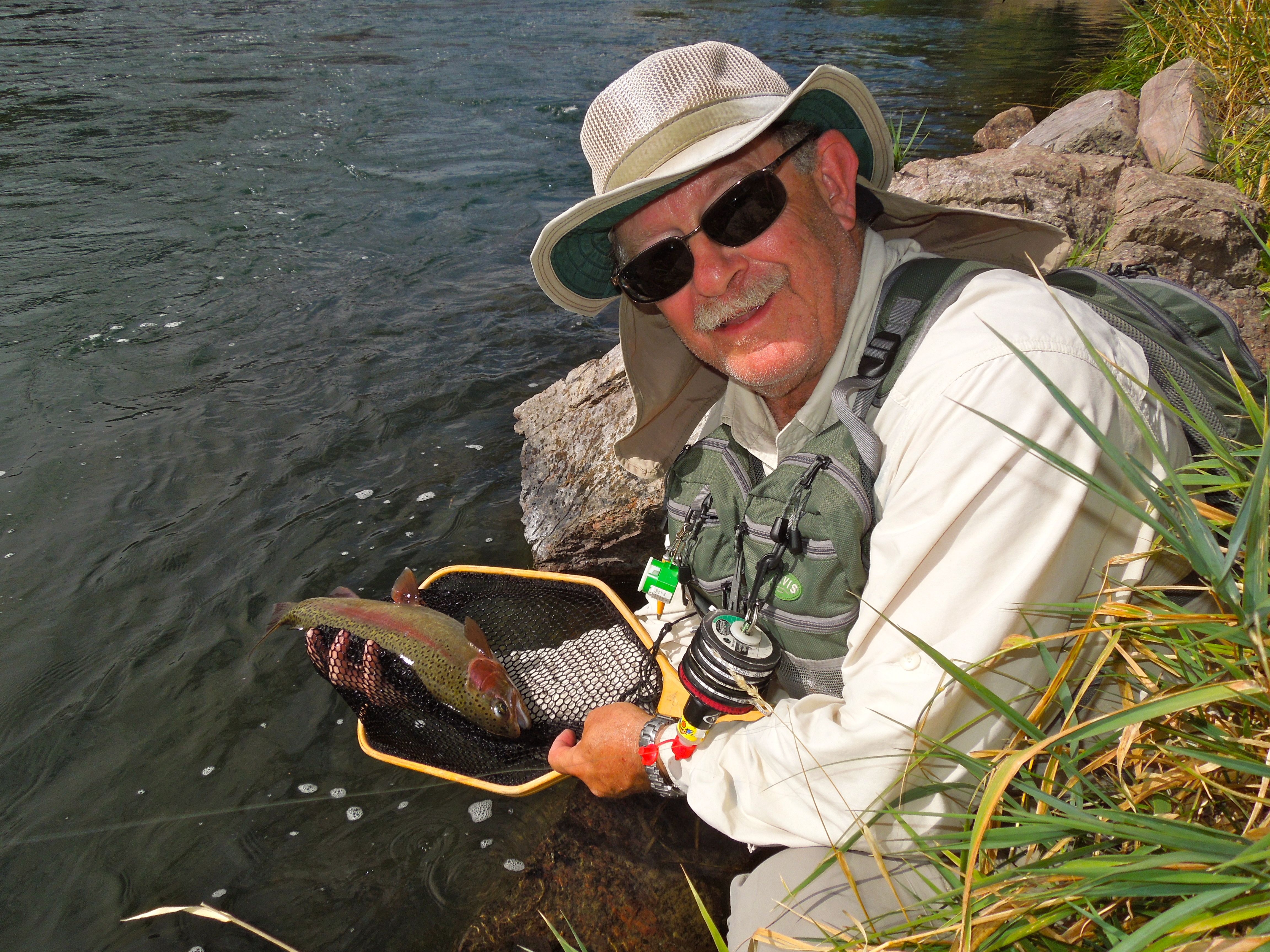
I watched as he caught the biggest fish of the trip. “Are you getting this?” he asked, knowing that I had my camera in hand. After the fish was released, he showed me how his hand literally shook in excitement. Bruce is such a geek, and I love that about him.

Big trout on the Deschutes

On our last night in camp, after being chased off the river by a dramatic thunderstorm (complete with hail, 40+ knot winds and horizontal rain), I summarized my experience for my brothers, telling them that the trip was different than I had expected. Dean asked, “What did you expect?” I shared my little fantasy about deep talks under the stars.

“Oh no, we don’t talk about relationships,” Dean said, “This is a guy’s trip. We do stuff.”

One brother was missing, and that made me sad. His absence made me wonder aloud on the first night, “How are we going to stay connected as a family?”

The next night, Bruce replied, “I’ve thought about what you said. We’ve learned some things. We’re better off together than we are separately.”

We as a family are moving forward, perhaps in fits and starts, but making progress.

Hole in the Wall campground

Leave a comment

Filed under Uncategorized

10,000+ Views: Thanks for Stopping By

A blogger's home computer

Blogging is kind of magical to me. Not the writing part (though the way I write sometimes feels that spontaneous). The community part.

The Henry Chronicles was my little cry in the wilderness. It felt natural to share joyful little stories of my journey with Dad, because finding the joy kept me going. Writing about the tough days gave me a way to move through the pain.

What has surprised me about The Henry Chronicles has been the people who find it.

I wrote my first post on June 28 two years ago, an answer to my Dad’s doctor’s question about whether he was there on D-Day, meaning Normandy. I felt the urge to record what D-Day meant to my father. He had lots of D-Days, but they were in the Pacific.

That was 138 posts ago. I’m still writing, because I’m still remembering, and still coming to understand my mother and father’s legacies.

The blog didn’t go as planned. I thought I would write helpful tips about caring for an aging parent based on my experience just as I write a blog tips and practical information for small, local nonprofits. (I write a travel and hiking blog, too – call me crazy.)

The Henry Chronicles became something far more personal. I poured out my heart here. And the more honest I got, it seems the more people found it and resonated with my little glimpses of life with Dad. The less I tried to advise people and just shared, the more helpful the posts became – at least based on comments and views.

I’ve felt supported and honored by many of the comments people have shared.

Sean wrote, “I understand well what your words mean. But, from a non-experience perspective. I was never emotionally close with my mother and never ever with my father who was emotionally and physically ‘not there’. But, I know they felt a good deal of what you say, but, they just were not themselves brought up to explain and talk about ‘feelings’ and emotions.”

Jane said: “I wish I could have been as patient and giving when my paremts died (fortuunately a much quicker process) and I hope that one or more of my children will be patient and giving when my own time comes…”

Richard jumped on after reading about my visit to Marine Barracks:  “My father never spoke of the trials he endured on Tarawa, Saipan and Tinian – I only learned from others. I know my visit to the Barracks will be an emotional and moving experience for me. My father was proud of being a Marine but spoke of war as the horrific tragedy which it is and the friends of he lost. In a way, our visit is like a ‘coming home’.”

Karen, and other family members watching the last stages of Congestive Heart Failure, appreciated hearing about my Dad’s last weeks, as hard as it was to write about them: “Thank you for sharing your father with everyone who reads this. My mother is 75 & has chf. By following each step you have taken.I now have more insight & answers.before I was so lost with questions that couldn’t be found. Your dad will live on forever in the hearts of families that struggles with this disease. Thank you henery for giving your daughter the strengh to share & a heart as big as yours!”

When Dad died, Kristi and others came on the blog to send love and condolences: “In the tears that have welled in my eyes are full measures of gratitude for your father – his role as husband and parent, his contributions in service to his family, country, faith, vocation and avocations – and for your love, devotion, care and eloquence in sharing so much with so many. Your service has been a benediction, Betsy. In sympathy and with joy for his life and legacy – your good fortune in having such a wonderful Dad. Love.

Thank you, those who have stumbled across Henry Chronicles, for your support. It made a difference to me.

If you’re curious (I was), here are the top five posts:

1.  The Consequences of Dad Losing His Filter (July 10, 2011)

2.  A Wish and a Dream Fulfilled (August 16, 2013)

3.  A Long Day’s Journey into Night with Congestive Heart Failure (January 29, 2013)

4. 30 Years of Opposites, Happily Ever After (August 7, 2012)

5.  With Love, to the Last Breath (January 12, 2013)

Leave a comment

Filed under Uncategorized