
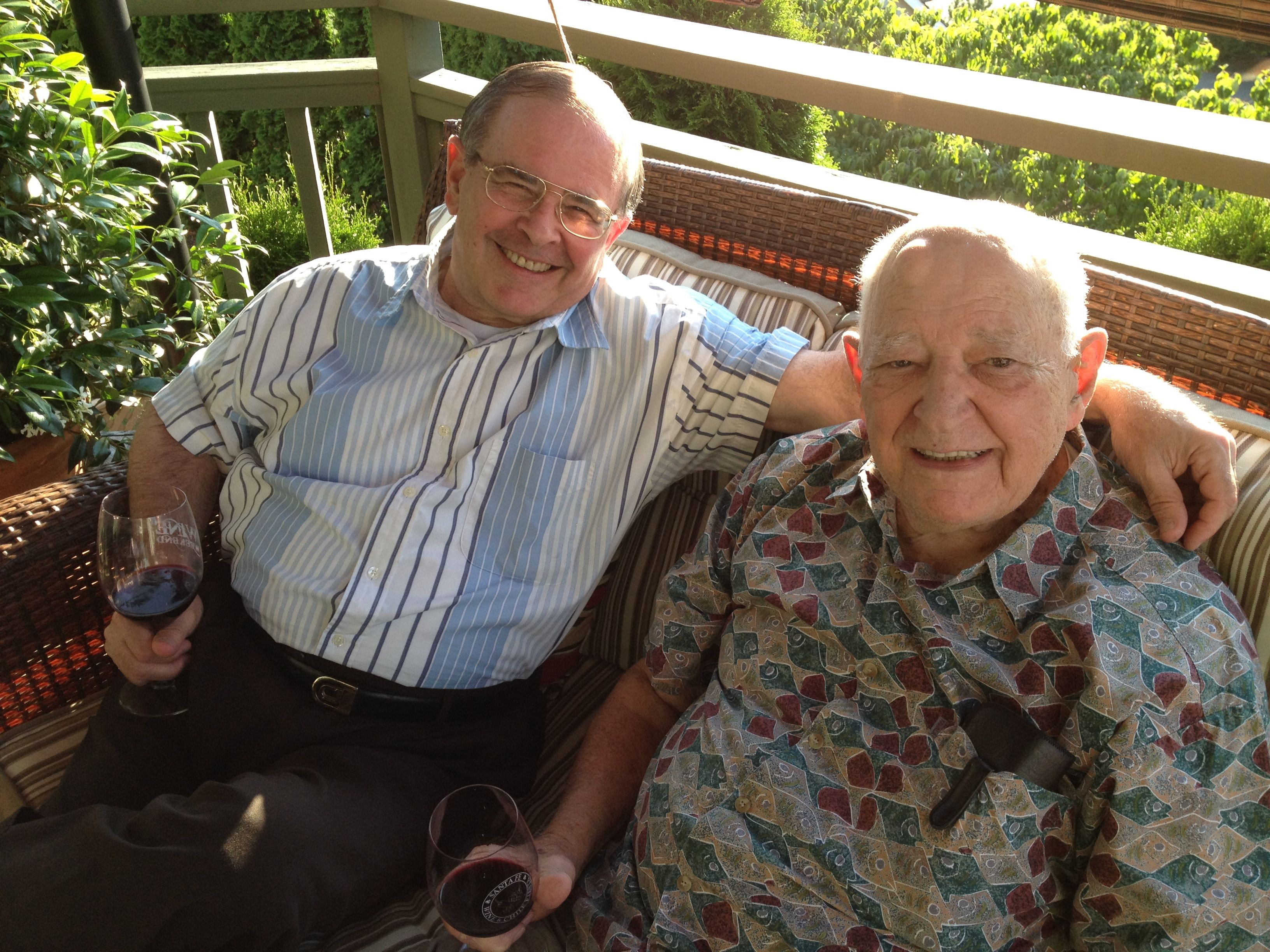
My eldest brother, Scott, 15 years senior, kicked off the family remarks at my father’s memorial on Saturday. He spoke from notes rather than full text, so I’ve done the best I can to recreate them here:
My Dad was, quite simply, the finest man I’ve ever known. He was always a rock for everyone in the family, and his passing has left a void that will never be filled. The family was very fortunate that he was a major part of our lives for so long.
If I were to describe my Dad’s character, I would say that he exemplified the core values of the USMC:
Honor,which means to display the highest ethical and moral behavior; of abiding by an uncompromising code of integrity; and of respecting others. The quality of maturity, dedication, trust and dependability commit Marines to be responsible and be accountable for their actions; to fulfill their obligations; and to hold others accountable for their actions.
Courage, which entails the mental, moral and physical strength expected of all Marines. It carries them through the challenges of combat and helps them overcome fear. It is the inner strength that enables a Marine to do what is right; to adhere to a higher standard of personal conduct; and to make tough decisions under stress and pressure.
Commitment is the spirit of determination and dedication found in Marines, it leads to the highest order of discipline for individuals and units, and it inspires a driving determination to achieve a standard of excellence in every endeavor.
Dad displayed an abundance of all these qualities throughout his life.
But Dad’s most important achievement was of a more personal nature. Dad did not have a particularly happy relationship with his father, although he did not talk about it much until the latter years of his life. He made a deliberate decision to break that cycle and to be the best father he could be. Several pivotal events in his life may have influenced that decision: marrying our mother, Eileen; combat in WWII, the death of Midge, their first daughter; and his heart attack in 1962, which forced his retirement from the Marine Corps.
He was a romantic in the complete sense of the word, with a deep love for his wife and family. There were almost certainly times during WWII when he wondered if he would come home alive. If he had not, I’d be his only child, and I would not have the same brothers and sister.
After Ken Burns’ series about the Civil War aired Maj. Sullivan Ballou’s letter to his wife, I shared it with Dad. He told me that, had he been writing in the 19th century, he might have written a letter very much like this one:
July 14, 1861
My very dear Sarah:
The indications are very strong that we shall move in a few days — perhaps tomorrow. Lest I should not be able to write you again, I feel impelled to write a few lines that may fall under your eye when I shall be no more.
Our movement may be one of a few days duration and full of pleasure — and it may be one of some conflict and death to me. Not my will, but thine O God, be done.
If it is necessary that I should fall on the battlefield for my country, I am ready. I have no misgivings about, or lack of confidence in, the cause in which I am engaged, and my courage does not halt or falter.
I know how strongly American Civilization now leans upon the triumph of the Government, and how great a debt we owe to those who went before us through the blood and suffering of the Revolution. And I am willing — perfectly willing — to lay down all my joys in this life, to help maintain this Government, and to pay that debt.
But, my dear wife, when I know that with my own joys I lay down nearly all of yours, and replace them in this life with cares and sorrows — when, after having eaten for long years the bitter fruit of orphanage myself, I must offer it as their only sustenance to my dear little children — is it weak or dishonorable, while the banner of my forefathers floats calmly and proudly in the breeze, that my unbounded love for you, my darling wife and children, should struggle in fierce, though useless, contest with my love of country?
I cannot describe to you my feelings on this calm summer night, when two thousand men are sleeping around me, many of them enjoying the last hours, perhaps, before that of death — and I, suspicious that Death is creeping behind me with his fatal dart, am communing with God, my country, and thee.
Sarah, my love for you is deathless, it seems to bind me to you with mighty cables that nothing but Omnipotence could break; and yet my love of Country comes over me like a strong wind and bears me irresistibly on with all these chains to the battlefield.
The memories of the blissful moments I have spent with you come creeping over me, and I feel most gratified to God and to you that I have enjoyed them so long. And hard it is for me to give them up and burn to ashes the hopes of future years, when God willing, we might still have lived and loved together, and seen our sons grow up to honorable manhood around us.
I have, I know, but few and small claims upon Divine Providence, but something whispers to me — perhaps it is the wafted prayer of my little Edgar — that I shall return to my loved ones unharmed. If I do not, my dear Sarah, never forget how much I love you, and when my last breath escapes me on the battlefield, it will whisper your name.
Forgive my many faults, and the many pains I have caused you. How thoughtless and foolish I have oftentimes been!
How gladly would I wash out with my tears every little spot upon your happiness, and struggle with all the misfortune of this world, to shield you and my children from harm. But I cannot. I must watch you from the spirit land and hover near you, while you buffet the storms with your precious little freight, and wait with sad patience till we meet to part no more.
But, O Sarah! If the dead can come back to this earth and flit unseen around those they loved, I shall always be near you; in the garish day and in the darkest night — amidst your happiest scenes and gloomiest hours — always, always; and if there be a soft breeze upon your cheek, it shall be my breath; or the cool air fans your throbbing temple, it shall be my spirit passing by.
Sarah, do not mourn me dead; think I am gone and wait for thee, for we shall meet again.
Sullivan
Major Ballou perished at the first battle of Bull Run.

 The Henry Chronicles