Dear lovers and writers of poetry: There’s nothing for you here today, nothing at all, except the first mewling cries of someone who is trying to understand why and how poetry is speaking to me even though I hardly understand a word. Read on at your own risk.
For everyone else: This is a short story that is a love letter to a friend I have lost and found.
I thought I wanted to raid poetry for its words. Poetry contains a well of words (see? there’s a metaphor already, though not a very good one since it isn’t novel; the best metaphors link unlike things) that I thought might inspire me as I attempt to write memoir.
I picked up Louise Glück’s Faithful and Virtuous Night, a dreamy collection of poems that the book cover says are meant to tell a single story, although it’s not like any story I’ve ever read. That said, I couldn’t put it down and I can’t stop thinking about it.
I read this scene from the title poem about sharing a room with a brother in a candlelit room at night:
[Note: WordPress is deleting the spaces between stanzas, so I put a “/” where a space should follow]
I was alone with my brother;
we lay in the dark, breathing together,
the deepest intimacy./
It had occurred to me that all human beings are divided
into those who wish to move forward
and those who wish to go back.
Or, you could say, those who wish to keep moving
and those who want to be stopped in their tracks
as by the blazing sword.”
So much unspoken mystery as Glück floats through her dream-night. I confess to feeling pretty lost but I keep thinking about the symbols she strews along her way. There is something here, I thought, more than words. Something that is affecting me.
I looked for answers in Edward Hirsch’s “How To Read A Poem and Fall In Love With Poetry.” And I read this: “Reading poetry is for me an act of the most immense intimacy, of what the poem finds in me. It activates my secret world, commands my inner life. I cannot get access to that inner life any other way than through the power of the words themselves. The words pressure me into a response, and the rhythm of the poem carries me to another plane of time, outside of time.”
Glück took me somewhere with her when she wrote of “the blazing sword,” the kind of metaphor that Hirsch calls “a concealed invitation,” which invites the reader to figure it out. Throughout her poem there are such references to the sword in the stone, and I’ll admit I find them a puzzle. Is the narrator the heir? The heir to memory? I’ll have to get one of my poet friends to explain it to me.
But besides the riddle, I was struck by Hirsch’s description of poetry’s ability to give him access to an inner life. I understood what he meant. I don’t always “get” poetry, but something in my shifts when I read some of it. The words and their rhythms go to a place within me that is beyond words, beyond logic. To a place of longing, of pure feeling, of community, of prayer.
And now I will give you a short story.
Yesterday I spent time with a dear friend who used to be my boss. In the professional world, she was my first true teacher and mentor. The place she holds in my heart cannot be filled by another. Just a couple of years older than me, she has been set upon by a series of strokes that the doctors don’t seem to understand. The smartest woman I’ve ever met is now much different. I won’t go into the details. Her brain is like a bog, with bits of organic material occasionally floating to the top. Thinking is hard. Putting names on things is impossible.
But feeling, feeling is still there. So much love it can light up her face.
So I decided to read her poetry. She cannot name images, but I wondered if words could form images in her mind, pictures that would bring her joy. I read from Mary Oliver’s “Why I Wake Early,” a book that I have taken to bedsides and even deathbeds.
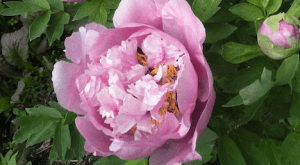
The fourth poem that I read to her, I think, was “Peonies.” My friend closed her eyes when she listened and I remembered that was her pose of reflection. When she wanted to listen deeply with her head and heart she would press her eyes shut so that the only thing that existed was what poured into her ears. She always heard what one said, but she listened for the meaning underlying the words, tipped off by the telltale tone of voice, the choice of words. This is what she did yesterday: she tilted her chin down and her lashes floated onto her cheeks.
Poetry is a soul-making activity, Hirsch says. I wrote this poem, as terrible as a poet would find it, because I can’t seem to capture in prose my confusing stew of feelings: the deep grief I feel for the loss of my old friend, and the momentary joy we found together reading of peonies. Thank you, Mary Oliver, wherever you are, for the gift of that moment.
My old friend is someone new
I can’t say a stranger because she is familiar
diminished to some but polished to my eye,
silky of spirit./
Strokes like ordnance have reordered her brain.
Like a prize fighter, her husband says:
Too many hits to the head./
So we read of wild iris and humble sunflowers
But it was the peonies that swayed her
Lacy pools, white and pink./
She closed her eyes, lashes dancing
As we read of green fists opening, black ants tunneling
The words watered the parched patches in her soul./
When the poem ended we read it again
Delighted, her face sparkled
And then we were silent, two wet souls./
Shall I read more, I asked?
Sometimes you should let it sit, she said.
So we sat in the sunshine
Old and new friends.
















 The Henry Chronicles