Monthly Archives: February 2014

A Quiet Kind of Influence

Betsy Campbell eyes 1975

When I was an adolescent, I made some very unfortunate makeup choices. One of my first signature looks was an alarmingly bright turquoise cream eyeshadow that I slathered on both eyelids. I thought it set off my blue eyes. With that metallic green-blue glowing from my lash line to my brow bone, I now understand that no one could have noticed my grey-blue irises. By high school, I had exchanged the eyeshadow for mascara.

My eyelashes, bent like hockey sticks by my eyelash curler, waved upward like hairy tarantula legs. In my mind, they said “ingenue.” To the rest of the world, they said, “mascara fetishist.”

When I sat at our dinner table facing the bay window, the bright chandelier turned the darkened view into a mirror. I was a great admirer of my reflection.

A little smile would come across my father’s face and he would say, “How is Ysteb tonight?”

Most memoirs and many novels have at their root an author who is coming to terms with her dysfunctional upbringing. Underlying their narrative is a turbulent upbringing that haunted them into adulthood with substance abuse issues and shattered relationships.

When I write about my father, I feel as if I am beachcombing. I walk slowly along the sandy beach, crossing miles of uniform sand granules, until I stumble across a fragment. If I walked more quickly, I’d miss it – something shimmering there in its beauty. But having seen it, I pick it up, hold it in my palm, turn it over.

I think now of all of the things my father could have said to me when I was trying on my young womanhood. He could have said, “What the hell are you thinking? Go wash your face!” Or, “No daughter of mine is going out like that.” Or, “I suppose you think that looks good?”

But he didn’t. Deadpan, he would wryly invoke my name spelled backwards, “How is Ysteb tonight?” Hearing that didn’t feel like a rebuke or even a criticism. I took it as, “Come back to the table, please. You’re not the only one in the room.” It felt like an act of love, even if there was a tease thrown in for good measure. I got the message.

I remember few rules from my youth. I wasn’t harangued to make my bed, come home at a certain time, do my homework, achieve better grades or get off the phone. I wasn’t told when I could start shaving my legs, or wearing makeup or start dating.

I did want approval, my father’s approval in particular, and I knew what he admired without him ever saying a word. I was more interested in the brass ring of admiration than avoiding the sting of criticism or the pain of punishment.

Recently, I learned that one of my acquaintances on Facebook is tired of my posting about my father. She thinks it’s time to get over the grief and move on. She has missed the point entirely.

I’m not grieving, I’m appreciating. My experience of my father was subtle.

He was just there, a quiet, predictable and strong presence even when he just referred to my twin in the mirror.

Sitting at my parents’ table, I didn’t appreciate what I had. It’s taken me four decades to get to the point I can see the beauty in his love and influence. And it remains with me.

Last weekend I attended a retreat where the facilitator shared this poem. The utter reliability of my Dad led me to take him for granted. Remembering the subtle ways he expressed his love for me, my mother and my brothers is a gift that keeps on giving.

Those Winter Sundays

Sundays too my father got up early

and put his clothes on in the blueblack cold,

then with cracked hands that ached

from labor in the weekday weather made

banked fires blaze. No one ever thanked him.

I’d wake and hear the cold splintering, breaking.

When the rooms were warm, he’d call,

and slowly I would rise and dress,

fearing the chronic angers of that house,

Speaking indifferently to him,

who had driven out the cold

and polished my good shoes as well.

What did I know, what did I know

of love’s austere and lonely offices?

– Robert Haydon
2 Comments

Filed under Uncategorized

The Valentine’s Day Card Dilemma

Todd and Betsy Stone

My husband makes me happy. He gets me, even though I am a complex person. I get him, even though he is about as straightforward as a human being can be. The relationship between us is a reaction. We are better and more interesting together than either of us is alone. Even after thirty-one years of marriage and thirty-three years of couple-hood.

But I hate shopping for Valentine’s Day cards.

“You are my soul mate,” one read, in loopy script.

I have never felt that my husband is my soul mate. I’ve never told him, “You complete me,” movie-style, because it isn’t true.

I look at the racks of cards and mostly want to vomit. These are the sentiments that are supposed to express our hearts. There are the “big-strong-man” hubby cards that ooze with compliments about how virile and protective and kind he is. There are the “you’ve still got it, baby” cards that wink at continuing sexual attraction. There are the “old reliable” cards that speak of gratitude for years of steadfastness.

Valentine’s Day cards always make me wonder: is the problem me?

An article published by Aeon provided an explanation that made sense to me:

“…(I)dentities are not fused — they are shared. Profound romantic satisfaction is not about possession but about flourishing; the other person is not an extension of you, but a partner for a dynamic and fulfilling way of life….(T)he partners’ personal characteristics do not have to be the best in town — they just need to be in harmony.”

That rings true.

In the end, I chose a card with an up-close picture of a cow with a baying bull reflected in its eyeglasses, a jokey card. My husband got it, though: a reference to a funny, horny dream I had a long time ago that included a man sidling up to me and suggesting his secret fantasy. “I like to moo,” he whispered to me.

One of the most romantic things I ever saw written said very little. It was a photo of a plane, underneath which my mother wrote, “The plane that brought him home.”

Maybe the perfect card for my husband would say, simply, “It’s you I want.”

Leave a comment

Filed under Uncategorized

Holding Hands

Holding on to love

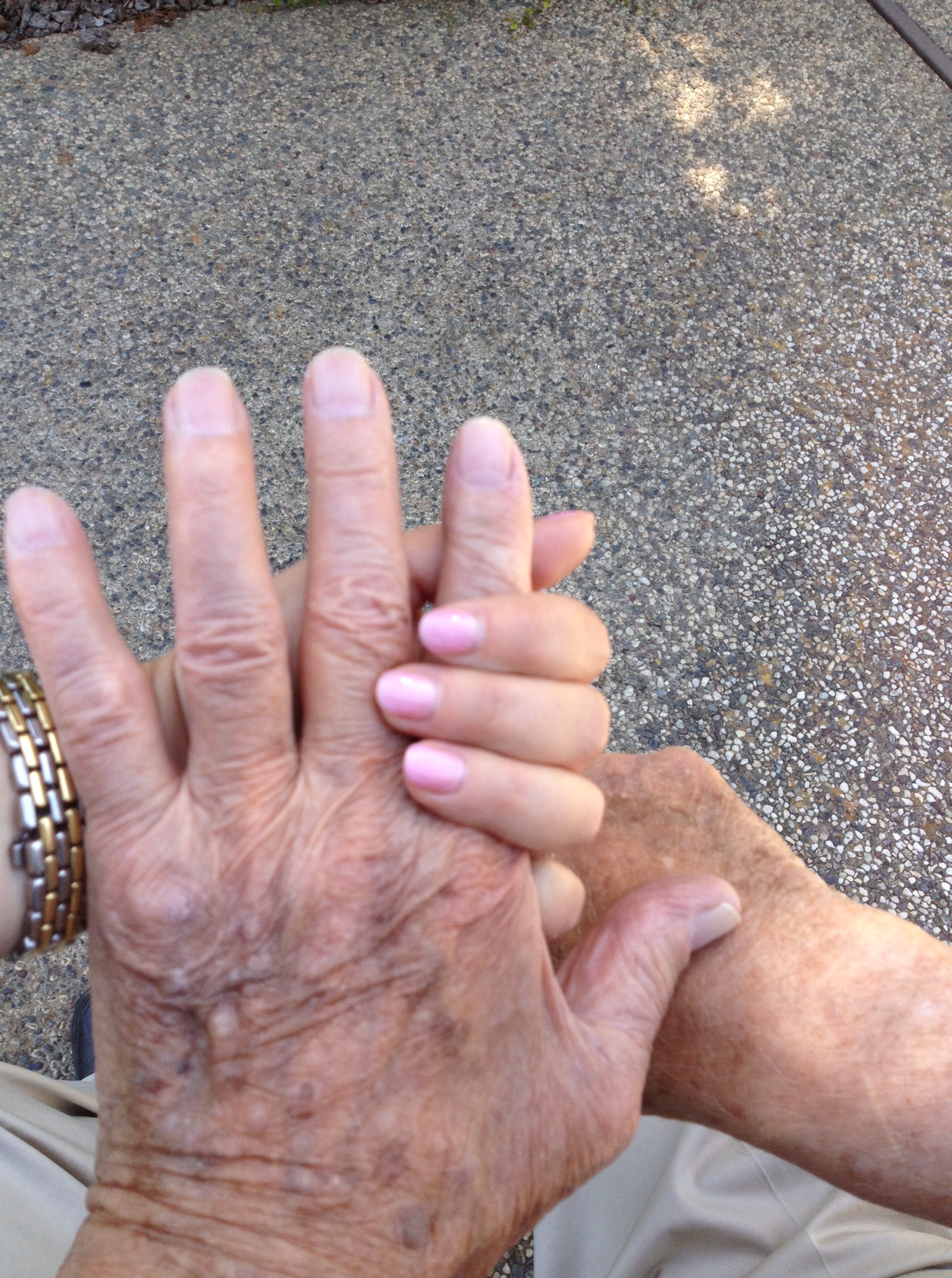
The first thing my estranged cousin did when I met her was ask to see my hands.

Elizabeth took my hand in hers and looked at my finger tips. “They’re like mine,” she said.

I had never met Elizabeth. I didn’t even know she existed until she or her brother — I don’t remember which — wrote Dad a note after my mother’s obituary was published in the Yakima paper. You may not know us, the note said, but we are the children of your brother, Ed.

The year after Mom died, I took Dad to Yakima – a last chance, I thought, for him to see the old family home, connect with a few childhood friends before they were gone, and meet his niece and nephew.

Inspecting her fingers next to mine I saw no resemblance. Her fingers were delicate and tapered, capped by long nails that extended in white tips. Mine were of a sturdier sort, not ugly, but not something I would ever show with pride. I smiled and said nothing.

Elizabeth was looking for a connection, physical reassurance that she was a Campbell, like us.

My father had no doubts about her parentage. He accepted that Elizabeth and her brother were his niece and nephew. Family resemblance shone in their features. Though he loved his brother, who had so tenderly overseen the medical care of my sister Midge as she struggled with childhood leukemia, he could not understand how Ed could deny paternity. That rejection — the events leading up to it and following it — were part of the heritage of dysfunction that stemmed from their father.

I imagine that I am holding my father’s hand. Though he complained that they showed his age, I found them handsome. While Elizabeth’s fingers were thin and tapered, his were straight and square. His nails were near-perfect rectangles, the white base of his nail beds almost a straight line. The tips were filed to conform to the shape of his finger tips: neatly squared.

Mom and Dad often held hands. Especially when traveling in the car, he would reach over and clasp her hand. Her hand would linger in his.

As a teenager or young adult in the car with Dad, he would occasionally do the same with me. My hand would lay encased in the warmth of his. And it made me acutely uncomfortable. I had gotten to that age when physical affection, for more than brief moments, was awkward. If I snatched it away quickly, would it signal that I didn’t reciprocate his affection? What was the soonest I could gently withdraw my hand without seeming ungrateful?

By the time Dad moved here, Mom was gone. His primary physical connection was severed. Once Mom died, almost no one held him, rested their arm around his shoulder, reached over for the familiar three pats on the knee. Dad always said that we are a three pat family. Not one, or two, but three.

I had a special privilege as a daughter. Though my brothers hugged my Dad, and might rest their hand on his shoulder, they faced the added limitation of male-to-male contact. Or so I guess.

As I drove between my Dad’s assisted living community and my home, I often reached over and clasped his hand in mine. We would drive that way for a few miles, separating when I might need both hands to navigate an intersection. I no longer squirmed. I would feel the warmth of our hands together and think of the love that flowed between us.

Leave a comment

Filed under Uncategorized

Emotional Spanx

Brushing my teeth this morning, Idina Menzel’s “Let It Go” was playing in my head.

As I dressed, I reflected on an email I received yesterday from a friend who is undergoing what he says is a new way of living as he comes to terms with being in remission from a serious type of cancer. Reading Jean Shinoda Bolen’s Close to the Bone, he was struck by her argument that having a life threatening disease is a spiritual journey, and its components are  “…finding meaning, creativity, and joy in life.…”  He is especially thinking about creativity.

Then I recalled my reunion yesterday with a former colleague who I hadn’t seen in ten years. After many years in a corporate environment, she left without a specific plan. Her skill as a “connector” led her to one person after another, one opportunity after another, and now she has formed dynamic arrangement with a team of like-minded consultants. “I’ve found my people,” she told me.

Welcome to five minutes in my head.

Why these three vignettes in rapid succession? My mind is “background processing” themes of risk, creativity and trust as I prepare to embark on a Master’s in Fine Arts in creative nonfiction. I’ve written that I’m scared, and I am. But this five minutes of synapses felt like taking a step.

As a person immersed in the return-on-investment world of marketing and strategic planning, most of it plied in the corporate world, I have been accustomed to control. I’ve controlled budgets, tactics and people but perhaps most of all, I’ve controlled me. Impulse control isn’t a bad thing, of course. It’s necessary. We learn from an early age that we can’t throw tantrums to get our way. We learn how to stay out of trouble. We learn to conform to the expected.

I became something of an expert in emotional Spanx.

Deciding to write after years of rationalizing why I couldn’t or shouldn’t is frightening. But it’s also freeing. I’m letting it go.

Leave a comment

Filed under Uncategorized

The Puzzle of the Angel

Every year when I decorate for the holidays, I stop to ponder a ceramic angel that I made in fourth grade. This year was no exception. Lots of my ornaments have memories associated with them: the yarn angel that my mother bought to represent my sister, Midge, who died before I was born; the Japanese silk thread ball that reminded me of our brief sojourn in Hawaii; the little German ornaments that my mother collected. The meaning of each is unambiguous. Only the little blonde ceramic angel has confounded me.

When I was nine or ten, my mother decided to take up a new hobby. We had recently moved to a suburb of Everett, Washington. Compared to our neighborhood in Seattle, a few miles from the University of Washington and an easy drive to the Opera House and downtown, suburban Eastmont didn’t have a lot to offer. For me, there was the attraction of “the gully” (an undeveloped gulch), a hilltop school ground that was perfect for kite flying, and quiet roads where I could safely ride my Stingray bike.

My Mom decided to try making ceramics, and she let me go with her. On a rural road, a small cottage with faded paint had been converted into a studio. Inside, in what might have been the living room, were shelves of casting molds. On the right side of the room was a counter where patrons poured tan or white clay slip into molds, forming a thin layer before being poured, leaving behind damp greenware. In the center were tables where crafters prepared their creations for firing, and once their pieces were hardened by the kiln, painted on details or covered them with an viscous blue liquid that would magically transform into a glistening clear polish. Animals and gnomes were frequent subjects, as were useful household items such as ashtrays. One of my first projects was a large ashtray with raised astrological symbols finished with a mottled brown and black glaze, which my mother proudly displayed.

If we were really lucky, Mom and I would arrive at the ceramics studio on a day when a new mold had just been placed on the shelves. New molds were sparkling white, but more importantly, unworn from constant use. The greenware from these molds, when ejected without mishap, had sharp, clean edges and smooth, unmarred curves.

Starting a new piece always made me hold my breath. At each step, I anticipated the problems that had spoiled my efforts so many times before. Would I drain the excess slip too soon, leaving the piece too fragile to maintain its shape? Would I fumble as I freed the greenware and dent it? Would I nick it when I scraped away the nearly-invisible seam where the two halves of the mold joined, or paint a line too thick, or glaze it unevenly?

In late summer, people had started in on Christmas decorations. I had my eye on a kneeling angel mold. Her feathered wings extended above her head, her long dress puddled gracefully around her legs, and her thick, wavy hair flowed down her back. Her hands were clasped in prayer below her smooth, serene face. I cast two, planning to make one a brunette, like me, and the other, a delicate blonde. The brunette was a disappointment. The dark brown underglaze contrasted too sharply with her porcelain skin. Rather than the brown mane I imagined, her hair looked like what it was: brown paint.

But the blonde was the angel of my dreams. I painted her dress blue, put a touch of color on her lips and carefully added fine blonde eyebrows to match her hair. When she emerged from the kiln, the yellow glaze had hints of darker hue, perhaps a residual from the brown paint I had used on her sister. She was pale, delicate and beautiful.

I placed the two angels on the bookcase on my room. Every time I looked at the blonde angel, I felt proud. Then school started up, and I forgot about her.

About that time, I had become friends with a girl across the street. Occasionally, we played at my house, but most of the time, we played dolls in her bedroom. Each day, however, we would have to interrupt while Dawn completed her chores. My primary chores were making my bed, cleaning my cat’s litter box and setting the table. Dawn was responsible for dusting, cleaning the glass coffee table with a foaming spray, and vacuuming. I never saw much of Dawn’s mother. When she was around, she didn’t greet me warmly as my mother welcomed my friends. I had the feeling I was underfoot.

One day, I noticed that the blonde angel was gone. I hadn’t thought about her in a while and I didn’t know how long she’d been missing. I looked all over my room, then around the living room and even the recreation room downstairs. The brown-haired angel was in her place but not her twin.

About two weeks later, Dawn and I were playing in her room. On her little dressing table was the blonde angel. I blurted out, “That’s my angel!” Dawn said that it wasn’t, that she had purchased it for her mother for Christmas. Our discussion turned into an argument, with me insisting that it had to be my angel. See how the paint on her eyebrows has a touch of brown? I painted that! Dawn held her ground. Finally, I played my trump card.

“My initials are carved in the bottom! I always carve my initials on the bottom of my pieces!”

Dawn turned the angel over. “It’s not yours,” she said. “See? It has felt on the bottom!”

An uneven green felt square was indeed on the bottom. Around it, frosted white nail polish glistened. It seemed obvious to me that Dawn had covered up my initials by using her mother’s nail polish to afix it to the base.

I knew it was mine, but she looked me squarely in the eyes and lied about it.

I wrote her a note. I told her that if it was so important to her to give the angel to her mother, she could have it. I was giving it to her. I didn’t want to lose her friendship over it.

After a few days, Dawn rang the doorbell. In her hand was the angel. She told me that she loved it so much she wanted to have it. So she had stolen and lied.

I’ve thought about Dawn every time I’ve put the angel on display. It’s always seemed like an important story to me but one without an ending. What did it mean?

Yesterday morning, my church pastor, Rev. Mary Hudak, told a story about her first grade classmate, Tina, who had stolen her pencil. When Mary told the teacher on Tina, Mary’s favorite teacher, Miss Haney, told Mary she knew. But Mary, she said, had two pencils, and Tina didn’t have any. Tina didn’t have lots of things that other children had. Miss Haney knew that Mary would not make fun of Tina for not having what the other kids had.

“I learned something about myself that day,” Rev. Mary said. She learned that her teacher knew Mary’s heart was big enough to sacrifice for her classmate. She learned something about herself.

My story had a different moral, but an important one.

It was about mothers. I couldn’t understand how Dawn wanted her mother’s love and approval so much that she would steal something her friend had made and loved.

My mother loved me enough to display what must have been the world’s ugliest ashtray. I didn’t have to do anything to prove my love for her. I was secure in her love, and she in mine.

I went to church expecting to hear a parable from Bible times. I came away understanding my own.

Leave a comment

Filed under Uncategorized