Monthly Archives: January 2012

Why it’s a good thing that my Dad talks to himself

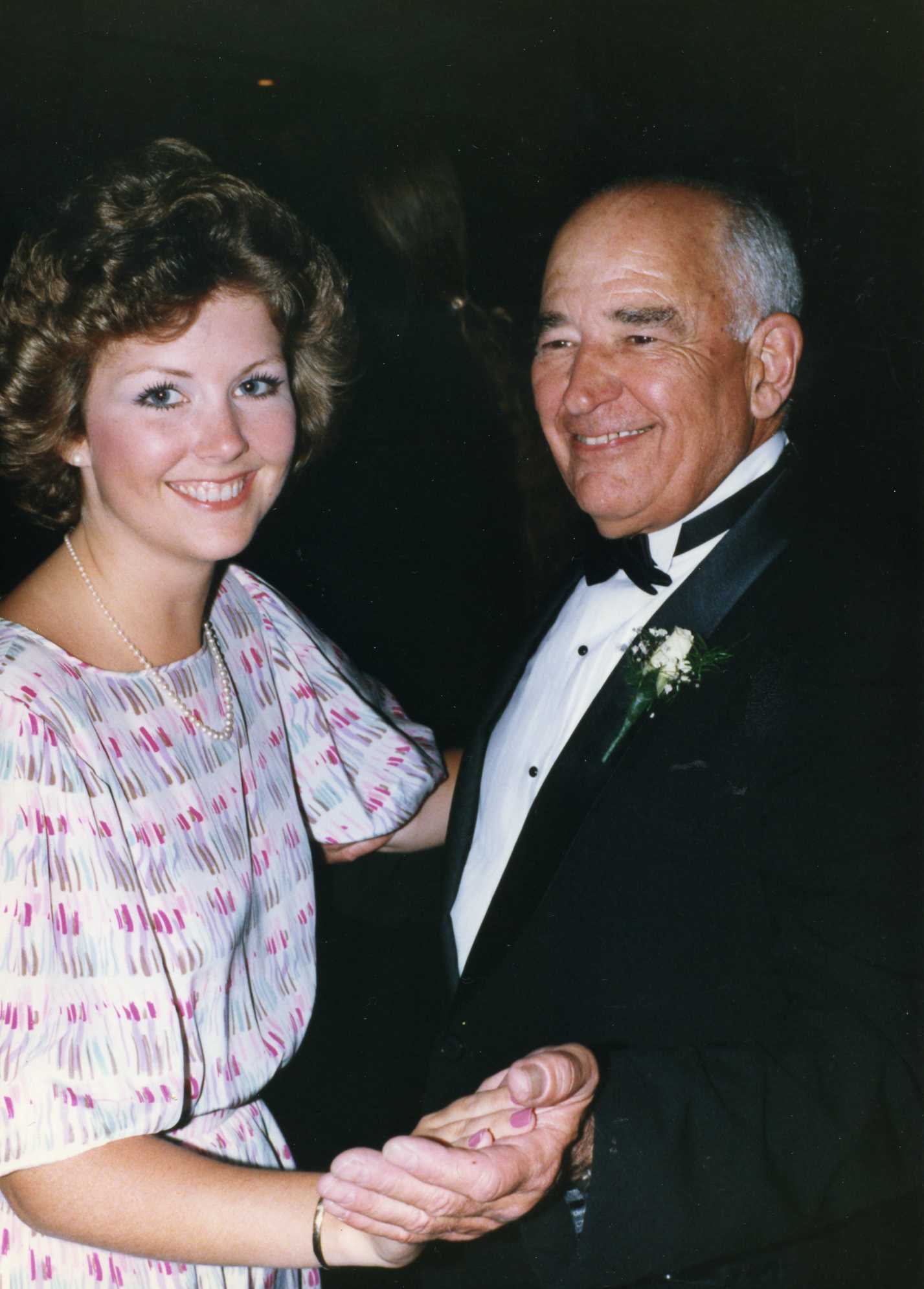
Back in the day, Dad could dance!

I thumbed through the February issue of SELF magazine earlier today and read this: “Find out if your crew is confidence-boosting and how to connect with pals who buoy you, even on ‘I feel fat’ days.”

An hour later, I took my 95-year-old Dad out for his daily constitutional, a two-block walk that now takes about 40 minutes to complete since he frequently stops to let his moderate chest pain subside.

Every time we start on our walk, he has to confront the steps. He approaches them very cautiously, especially since having a stroke eight years ago.

Out loud he says, “I think I’m gettin’ to be an old man.” Or, “Woo, I feel tottery today.”

After we cross the street and he takes his first rest stop, he says, “C’mon, Henry. You can do better than that.”

But sure enough, his joints eventually loosen up and he gets into a slow but comfortable walking rhythm. Momentum is on his side.

Then he says, “Atta boy, that’s the Henry we know and love.”

Although my Dad usually expresses his dismay at how difficult it is when he begins his walk, he never fails to cheer himself on when he starts to walk more confidently.

SELF suggests readers use alternative scripts to use in response to friends when those friends say things like, “I’d kill to have Gwyneth’s abs.” SELF tells women to stop beating themselves up.

While Dad often begins by commenting on his frailties, he also verbally encourages himself to keep trying, and then compliments himself when he sees improvement.

I doubt that SELF will ask my Dad to submit his workout tips, as they have with Jillian Michaels and other hard bodies. But we could all learn a few things from him!

3 Comments

Filed under Uncategorized

Understanding my Dad through poetry

A cartoon created as part of a book given by Dad's colleagues at Canadian Armed Forces Staff College in 1957

Communication has become very difficult for my Dad: bad hearing, slowed comprehension, harder articulation. But my Dad has something most people do not: a bottled up store of memorized passages that seem to uncork of their own accord.

As my Dad lay on a gurney in an Emergency Department exam room last Sunday, he suddenly exclaimed:

I am Ozymandius, King of Kings. Look on my Works ye Mighty, and despair!”

I don’t think the ER staff was impressed. In fact, if I hadn’t been there, they might have though he’d jumped the track. But I knew exactly what was going on. My Dad’s unconscious mind summoned up a passage that he felt was germane to the situation.

Though I wasn’t familiar with it, I quickly googled the phrase on my iPhone and found it in a poem written by Shelley in the 19th century.

The poem describes an old statue with a powerful visage that survives despite being shattered and sunk in desert sands. Dad’s exclamation was the inscription on its pedestal.

The more I thought about it, the more I felt it was the perfect passage for a unplanned visit to the hospital. It was Dad’s way of saying, “I may be diminished by age and illness, but I am still here.”

Then, later in the week, another fragmentary bit of poetry served as Dad’s way of saluting his nurse, Dawn. He offered, “And the dawn came up like thunder, outer China ‘crost the Bay.” Kipling’s poem “Mandalay” celebrates his love of the Orient. While Dad’s memory was jogged by his nurse’s name, I’m not at all surprised that he came up with a poem that celebrates a “neater, sweeter maiden in a cleaner, greener land.”

And then today, after Dad was complimented for his meticulous oral hygiene during his six-month check up at the dentist, out came this one: “My strength is as the strength of ten, because my heart is pure.”

I’m sure my Dad meant it a little self-mockingly. But while he may not be everyone’s idea of Sir Galahad as described by Tennyson, I think the phrase somehow fits him. He’s always been a straight-up-no-bullshit kind of guy; in fact, that trait almost got him court martialed during the war when he disregarded an order that he knew would have been a mistake.

He may not be everybody’s idea of Sir Galahad, but he is my Sir Galahad.

4 Comments

Filed under Uncategorized

Expectations and aging: finding pleasure in what we CAN do

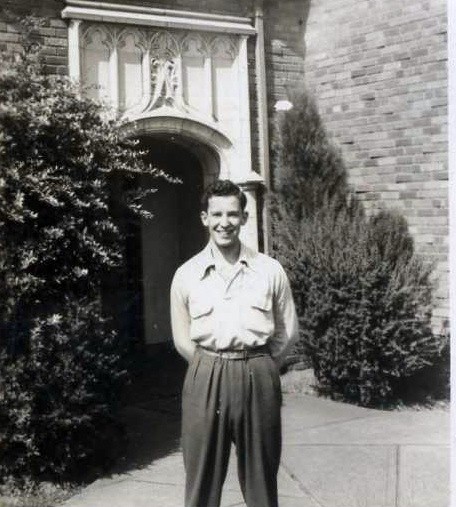
Dad with the world before him, in 1939

If you’ve seen one person over 80, you’ve seen one person.

I have a large number of older people in my life, including my 95-year-old Dad, to whom this blog is dedicated. A rare few, like Win, a 95-year-old compatriot of my Dad’s, seem to have found a magic elixir. Win recently wrote that he is still driving, keeping up a 4 bedroom house and pool, and only has physical difficulties rising from a chair.  Sheesh! He sounds like me!

Another important person in my life is getting older, and he’s kicking and screaming his way into his “golden years.” He is pissed that women treat him like – well – an old guy. In his mind, he is still virile and desirable. Physically, he’s doing pretty well. He’s a good conversationalist, still enjoys athletic pursuits, and remains involved in business. Emotionally, however, he’s not very happy about this aging thing.

As I’ve written, my Dad’s world is rapidly shrinking. His poor hearing cuts him off from most conversations, and now he has chest pain every time we go for a walk. He’s had to give up beloved pursuits like hunting and fishing. And yet, most of the time, he’s in a good mood. I’d go so far as to call him an optimist. Even though he often comments, “Lo, how the mighty have fallen,” when he carefully tackles the four stairs descending from my house, he takes heart from the fact he can complete a walk at all. “Now that’s the Henry I know,” he’ll say when a walk has gone well.

What’s the difference? Why do some people, even in the face of medical or physical challenges, remain fairly happy?

I was really struck by an article in today’s New York Times about the impact of one’s expectations on one’s well-being. Research reported in Your Brain at Work by David Rock suggests that dopamine is released, causing a feeling of pleasure when something positive happens — that is, if it beats our expectations on the upside. Unfortunately, when an experience is worse than we expect, our negative feelings are stronger than the positive ones we get from the favorable better-than-expected experience. (For you engineers and math lovers, Mr. Rock puts it algebraically: “If we expect to get x and we get x, there’s a slight rise in dopamine. If we expect to get x and we get 2x, there’s a greater rise. But if we expect to get x and get 0.9x, then we get a much bigger drop.”

The article concludes:

It seems as if it is best to have low expectations of things out of our control, realistic expectations of things we can control to some degree and high expectations of ourselves.

My Dad has had a lot of experience in his life with things that are outside of his control. He had an influence on the progress of battles for the Pacific in WWII, but he didn’t have control. He couldn’t control the leukemia that eventually claimed my sister in the 1950s. And he could not control his way out of heart disease, although he has been able to successfully manage it since 1963.

He also epitomizes what the article describes in terms of having high expectations for himself. He has emotionally muscled his way through many difficult circumstances.

Who’s happier? The fighting-every-step-of-the-way senior, or my Dad, with far more disabilities at 95. I think I have to conclude that my Dad is. He’s an optimist, but apparently is able to roll with it when things don’t turn out as hoped.

I know we Baby Boomers are going to have a VERY difficult time coming to terms with age. We have changed our world through our sheer numbers, but we will not be able to get God – and medicine – to serve up challenge-free “golden years.” It’s up to us to manage our expectations… and choose happiness.

Leave a comment

Filed under Uncategorized

How an optimist deals with her Dad’s aging

He still is "up" for Christmas: Christmas morning 2011

When I moved my Dad to California in March 2006, I had great visions of the fun we would have. I imagined that we might hunt for the best Zinfandel — a favorite grape of my Dad’s — at the many wineries in the El Dorado, Amador and Lodi appellations. Not long after he moved down, however, he fell with a twisting motion and was almost unable to walk while nursing an IT-band injury. It became uncomfortable for him to spend more than an hour or so in the car. Then I thought we’d enjoy the majesty of the Sierras. When I took him to Tahoe several months later, I warned him to be careful about drinking more than one glass of wine while at high altitude. Predictably (in retrospect), after one glass of wine, a second one sounded even better. I ended up spending the night in the twin bed next to Dad while he experienced a racing heart beat. And I decided that it simply wasn’t safe to take him to high altitude. So, no wine tasting and no trips to the glorious mountains.

Dad’s health challenges may have deflated my plans, but I learned to focus on his capabilities – what he could do – rather than his limitations. He was (and is) still himself: a lover of poetry, a loving father and grandfather, and an informed citizen who keeps up with world news through the TV and New York Times.

Like my Dad, I’m an optimist. But I confess this optimist has struggled for the past six months. And that’s why I haven’t blogged. I’ve been increasingly irritated with people who don’t make the effort to connect with my Dad, which includes (on occasions) family members.

I won’t kid you. It’s work to get Dad to understand you. If I s-l-o-w way down and try to maximize the use of consonants, I can usually get things across to Dad despite his 90%+ hearing loss. But now it takes two to three attempts to get even the simplest of ideas across in an environment with absolutely no background noise.

I’m sad. I don’t like to think about my Dad’s diminishment, but we are increasingly in the “no fun” zone of aging. I feel for his dignity when I have to pull the car over and hand him a urinal because he can’t make it to the nearest gas station. Or when I assist him with toweling after he showers, as I do now. (Dad still seems to be following Marine Corps protocol for showering, which involves soaping up and rinsing off in exactly four short bursts of water, followed by vigorous see-sawing with a towel to ensure that there is absolutely no moisture and chance of jungle rot. Unfortunately, the see-saw move was causing him to lose his balance and fall.)

I know that Dad has just about as good of a quality of life and dignity as a 95-year-old can have, but it’s still painful to watch his decline. When we take our near-daily walks, chest pain (or “load” as he calls it) is increasingly our companion. No surprise, since his last cardiac bypass graft was expected to give out back in 2004. But still. It sucks.

Through this blog, I have sought to document my experience and the many inspirational moments I have with my Dad. But I realize increasingly that we are on the final stretch. It’s harder to write things that are uplifting.

So, to rob the line from the beer commercial, “This blog’s for me.” Today’s post is really about the grief of knowing it’s just not going to be pretty from this point on. I’d do anything to spare my Dad, but this final journey is outside of my control (and for a control freak, that is a very hard realization).

If you’re given to prayer, pray for his release, for his homecoming to God and his reunion with my mother. Pray for him to go in a “burst of glory” and not in painful decline. Pray for him not to be afraid of what will befall him in this last phase. Dad’s not sure there is an after-life, but, then, he’s not sure there isn’t, either. So we believers will have to do his praying for him.

Thanks for listening.

8 Comments

Filed under Uncategorized